News
Author: Young Lin | Role: Export & Project Planning Lead, Oneluck Carpet Factory | Updated: October 2026
Verified by our carpet production team, Zhaoqing | Woven broadloom & carpet tile | Fire Class B1 / Bfl-s1
Fire performance decides whether carpet can legally be installed at all, so we confirm the required class before the design is signed off. Our woven broadloom carries B1 and Bfl-s1 under EN 13501, and our Carpet Tile range carries Bfl-s1, while our wool rich Axminster meets both classes without any topical flame retardant treatment because wool resists ignition naturally. In our experience the certificate, not the appearance, is what gets challenged at handover. Nylon reaches Bfl-s1 through its own melting behavior, while polypropylene results have to be confirmed per project. Where a local code calls for a test method outside EN 13501, we discuss additional testing at specification stage so nothing is discovered during installation.
Fire performance decides whether carpet can legally be installed in a commercial building at all, yet many buyers order samples before checking which class the project requires. When the certificate does not match the specification, material can be rejected at installation even though design and quality are correct, and by then the flooring programme is already behind the handover date. We see this most often on hospitality and public interior projects where the fire strategy is written by a consultant who never sees the carpet specification.
This guide covers the fire classes we produce, why wool behaves differently from synthetic fiber, and what to confirm before you place an order. It concentrates on EN 13501, the classification system behind our own declarations, and explains where a local code may require a different method. It also sets out how the class interacts with the backing and installation method, because those choices can change the documentation your contractor needs on site. It does not cover structural fire protection or wall and ceiling finishes, which sit outside carpet specification and are handled by other trades.
Figure 1: Fire class held and ignition behavior by fiber type. Source: Oneluck Carpet product classification records, 2026.
Every fire declaration we issue is traced back to a product classification rather than to a general statement about carpet. The matrix below sets out what each fiber family holds and what that means for a project specification:
| Factor | Wool Rich Broadloom | Nylon Carpet | Polypropylene Carpet |
| Fire class held | B1 / Bfl-s1 under EN 13501 | Bfl-s1 under EN 13501 | Confirm per project |
| Behavior at heat | Ignites around 560 to 600 degrees Celsius | Melts around 220 degrees Celsius without supporting sustained combustion | Melts at approximately 160 to 170 degrees Celsius |
| Additive treatment | Not required | Not required | Confirm per specification |
| Typical application | Hotel, banquet hall, casino, lobby | Office, corridor, data center | School, restaurant, healthcare |
| Documentation held | EN 13501 classification | EN 13501 classification | Available on request |
| Static control | Not applicable | Surface resistance 10^6 to 10^8 ohms on anti static tile | Not applicable |
Send us the required class and the building type. Oneluck Carpet will confirm which carpet construction holds that classification and flag where a local test method differs from EN 13501.
Request a Free Carpet Fire Class Check
On our Axminster lines we weave the broadloom ranges that carry the paired classification B1 and Bfl-s1 under EN 13501, covering the Luxury Banquet Hall, Luxury Casino Wool, Modern Hotel Axminster, Luxury 5 Star Hotel Axminster, Luxury Banquet Hall Wall to Wall and Premium Hotel Lobby constructions. Those six ranges are the ones we normally quote where a consultant has written a specific class into the tender, because the paired classification covers both the flooring test and the building material requirement in one declaration.
Our Carpet Tile range and the Modern Office Wilton Area Rug carry Bfl-s1. For the anti static data center tile we also hold surface resistance between 10^6 and 10^8 ohms under IEC 61340-5-1, which is a static control property rather than a fire class, and projects frequently need both at once. That combination is common in server rooms and control rooms, where a consultant writes the static requirement into the electrical specification and the fire class into the flooring specification, and both have to come from the same product.
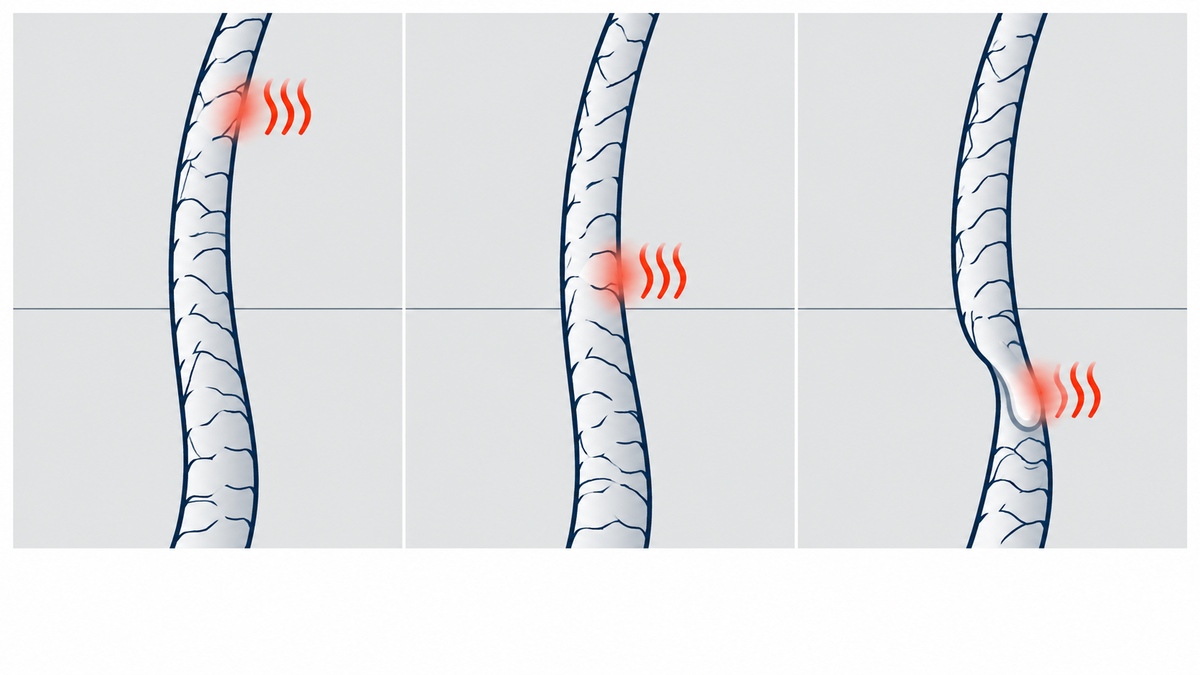
Wool contains approximately 16% nitrogen and ignites at around 560 to 600 degrees Celsius, so it resists ignition as a property of the fiber itself rather than as a coating applied afterwards. Carpets produced with 80% wool 20% nylon meet B1 and Bfl-s1 classifications under EN 13501 without requiring topical flame retardant treatments. That matters commercially as well as technically, because a topical treatment can be affected by repeated wet cleaning over the life of the installation, and a specifier has to assume the floor will be cleaned aggressively in a public building.
Synthetic fibers behave differently. Our nylon 6 yarn melts at approximately 220 degrees Celsius without supporting sustained combustion, which achieves Bfl-s1 classification for technical facility requirements including data center and server room installations. Polypropylene melts lower again, at approximately 160 to 170 degrees Celsius, and we ask buyers to confirm the required class per project rather than assume the wool result carries across. That is not a quality judgement about polypropylene; it is simply a different thermal profile, and a project that specifies a class we cannot evidence for that fiber should be told so before the order is placed rather than afterwards.
Building codes differ between countries, and some projects specify a test method that EN 13501 does not cover. For projects with specific local code requirements we discuss additional testing or treatment options at the specification stage, and we would rather raise that question during tender than discover it at handover. What we will not do is attach a class to a product that has not been tested for it.
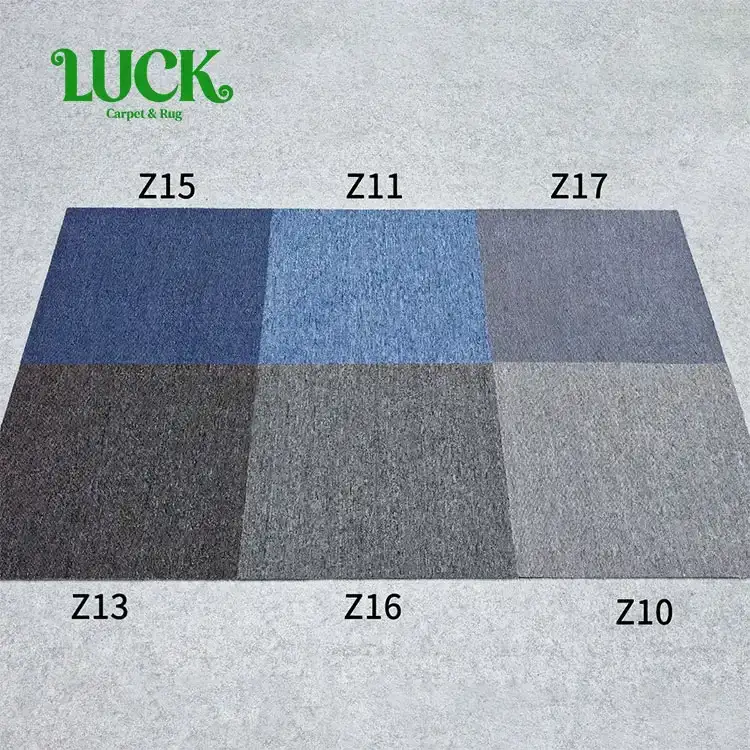
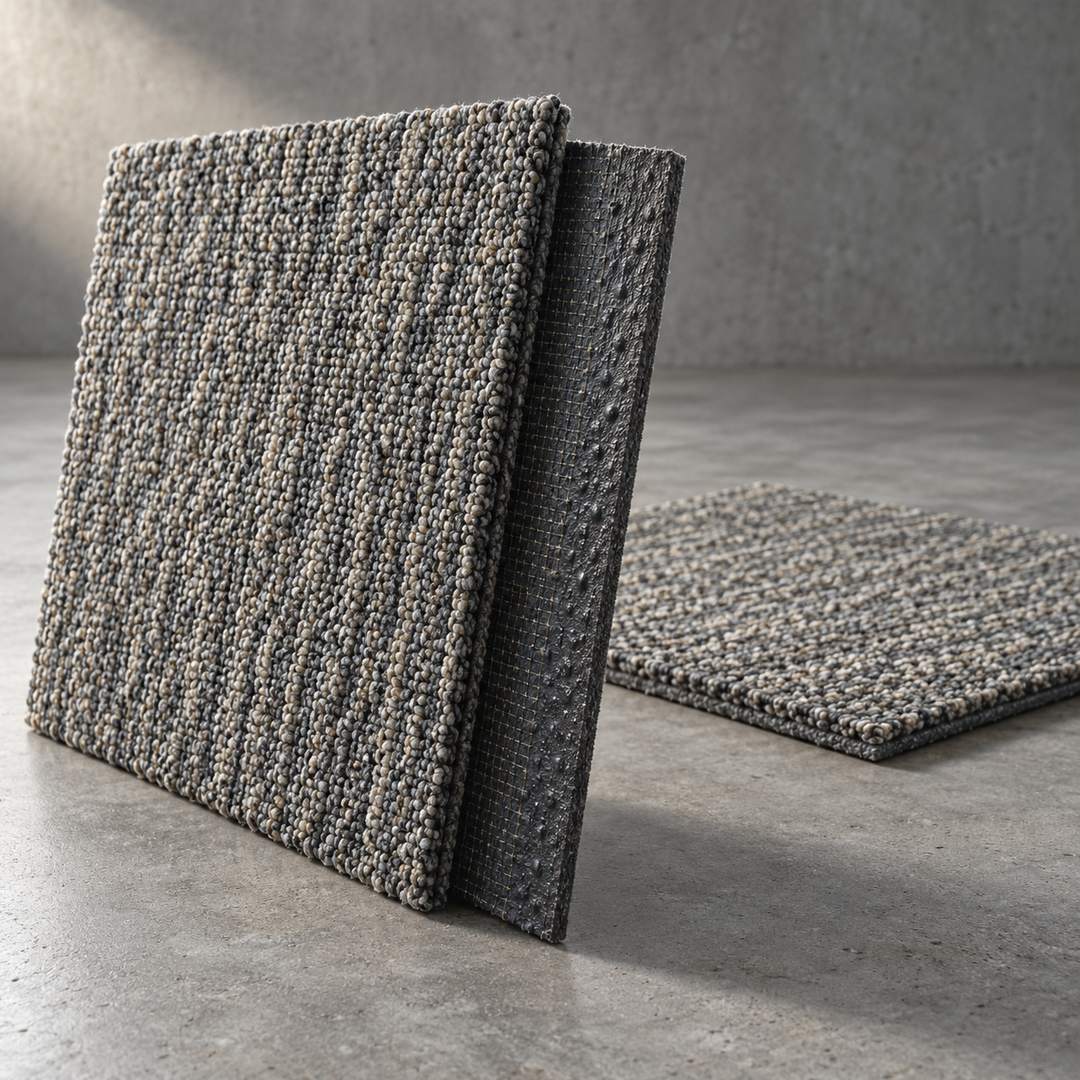
The class belongs to the finished construction, so backing and underlay decisions can move a project outside the declaration it was specified against. Our Carpet Tile carries Bfl-s1 with bitumen or PVC compound backing, and the fiberglass reinforcement inside either compound is part of the tested build rather than an add-on. If a contractor substitutes a different underlay or a cushion layer that was not part of the tested assembly, the declaration we issued no longer describes the floor that was installed, and that is a documentation problem the client inherits at handover. We therefore name the backing system on the specification and ask the contractor to confirm it before laying begins.
Installation method matters for the same reason. Adhesive-free loose lay and tackifier fixings are both compatible with our tile constructions, and neither introduces a wet adhesive layer into the assembly. On a phased refurbishment in an occupied building, that is often the deciding factor, because it keeps the work area free of solvent emissions while the fire strategy stays exactly as specified.
1. Write the class into the specification: State B1 and Bfl-s1 under EN 13501, or the class your consultant requires, as a measurable requirement with the standard number, so every supplier quotes against the same target instead of a descriptive phrase.
2. Confirm the fiber and construction: Ask which range holds the class. Wool rich Axminster holds B1 and Bfl-s1 without topical treatment, while nylon reaches Bfl-s1 through its melting behavior and polypropylene results need confirming per project.
3. Check the local test method: Where a national code calls for a method outside EN 13501, confirm the additional testing route and its lead time before the tender closes rather than after the order is placed, because retesting can move an installation date.
4. Request the certificate for the specified product: Ask for the classification document that names the exact product and construction, not a general statement about the manufacturer's range, and file it with the project handover documents so the contractor has it on site.
Is carpet fire rated as standard?
Our woven broadloom ranges and our Carpet Tile range carry EN 13501 classifications, while some broadloom qualities offer fire performance on project request. If your tender names a class, tell us at enquiry stage and we will confirm which construction holds it before you commit to a design, because swapping construction after sampling usually means re-approving the sample as well.
What does Bfl-s1 mean on a carpet specification?
It is a reaction to fire classification under EN 13501 for floor coverings, indicating a limited contribution to fire spread. The B indicates the flooring test route, and the s1 suffix refers to smoke production during that test.
Do wool carpets need flame retardant treatment?
No. Wool's natural nitrogen content and its high ignition temperature allow our wool rich broadloom to reach B1 and Bfl-s1 without a topical treatment. That keeps fire performance independent of the cleaning regime, which matters on floors that are shampooed regularly.
Can you supply the fire certificate for a tender?
We provide the classification information for the specified product, and we discuss additional testing options where a local code requires a specific test method. Tell us the country and the required method, and we will confirm exactly what we can issue and how long it takes. Where a project needs a test we have not run, we will say so at tender stage rather than after the order, because that is the point at which the programme can still absorb it.
Which carpet is safest for a hotel corridor?
Wool rich Axminster broadloom and dense nylon constructions are both widely specified, and the correct choice depends on the required class, the traffic level and the cleaning routine. We confirm the class first, then select the construction that sits behind it, so the corridor meets the fire strategy without overspecifying the pile. On upper floors we also check the acoustic requirement at the same time, since backing choice affects both properties.
EN 13501-1: reaction to fire classification for floor coverings.
ISO 9239-1: critical radiant flux test method behind the Bfl-s1 class.
IEC 61340-5-1: static control requirement for the anti static data center tile.
Wool ignition behavior and fiber composition from our own product documentation.
What Should a Carpet Specification Sheet Include? : how to write fire class, pile weight and tolerance as measurable requirements rather than brand names.
Which Carpet Tile Backing Does Your Project Need? : backing systems and the installation method that follows from each one.
What Carpet Works in Hospitals and Healthcare Facilities? : stain resistance, moisture regain and cleaning cycles for clinical floors.
Carpet Tile Collection : Bfl-s1 rated tiles in 500×500 mm and 250×1000 mm formats with non-woven or PVC backing.
Oneluck Carpet weaves Axminster broadloom that holds B1 and Bfl-s1 under EN 13501, and supplies Bfl-s1 rated Carpet Tile. Send your required class and we will confirm the construction.
Send Your Fire Requirement for a Class Check
Copyright © 2026 Zhaoqing Yunle International Trade Co., Ltd. All Rights Reserved.