News
Author: Young Lin | Role: Export & Project Planning Lead, Oneluck Carpet Factory | Updated: October 2026
Verified by our carpet testing team, Zhaoqing | Tufted broadloom, Axminster & carpet tile | Martindale Data on Record
Pile weight alone does not predict how long a carpet lasts, because two carpets with the same face weight can perform very differently once pile height, tuft density and fiber type are taken into account. Pile weight tells you how much yarn sits across a given area, pile height tells you how far that yarn bends before it compresses, and tuft density tells you how closely it is packed. Read together, those three values describe the construction. Read alone, pile weight is the easiest number to quote and the least reliable one to buy on. In our experience the carpet that flattens along a corridor center line is usually the one with the tallest pile, not the lightest.
Buyers commonly compare carpet specifications by looking at pile weight alone, on the assumption that a heavier carpet will always last longer. That single figure can be misleading, because two carpets with the same pile weight can perform very differently once pile height, tuft density and fiber type are taken into account. The comparison gets harder still when one quotation arrives in grams per square meter and the other in ounces per square yard, because the two numbers look nothing alike even when the constructions are similar.
This guide explains how we read a carpet specification, which values actually predict wear, and how to compare two quotations that use different units. It sets out what each parameter measures, how pile height changes the way yarn behaves under load, and where fiber selection decides the outcome. It does not offer a service life figure in years, because life depends on traffic, cleaning and installation as much as on the carpet itself.
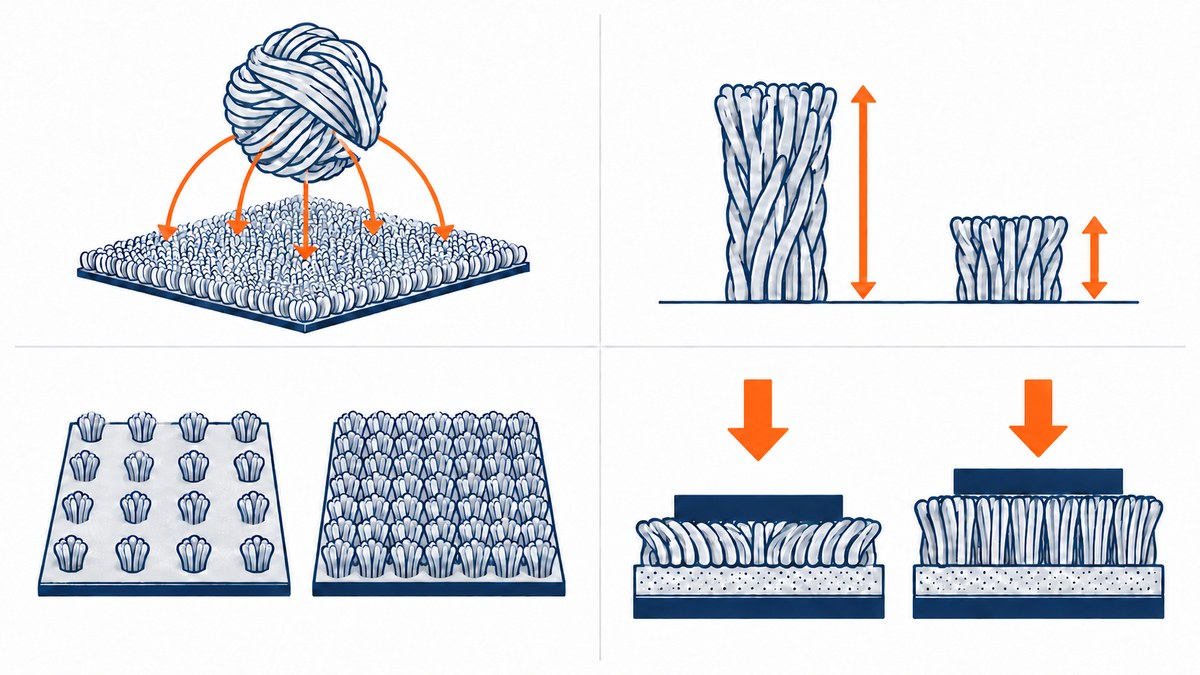
Figure 1: Pile weight, pile height and tuft density mapped against wear behavior. Source: Oneluck Carpet specification comparison records, 2026.
Every wear comparison we run starts from the same parameter set rather than from a single headline figure. The matrix below shows the range we produce and what movement in each direction means for the finished floor:
| Parameter | Lower Value | Higher Value | Effect on Wear |
| Pile weight | 400 g/m² in Carpet Tile | 2000 g/m² in Axminster | More yarn available at the surface |
| Pile height | 3.5 mm in Carpet Tile | 10 mm in broadloom | Lower pile resists flattening |
| Tuft density | 85,000 tufts per m² in woven broadloom | 200,000 tufts per m² in Carpet Tile | Denser pile holds appearance |
| Fiber | Polypropylene | Solution-Dyed Nylon | Nylon recovers better |
| Backing | Standard backing | PVC compound with fiberglass scrim | Keeps tiles flat and aligned |
| Test result | No abrasion data stated | 40,000 to 60,000 Martindale cycles | Objective comparison point |
Send us both specifications and the traffic zones they will serve. Oneluck Carpet will convert them into the same units and the same parameter set, and show you where the two constructions actually differ.
Request a Free Carpet Parameter Comparison
Pile weight measures the mass of yarn in the pile across a given area, expressed in grams per square meter or ounces per square yard. Our Axminster woven broadloom ranges from 1000 to 2000 g/m², our tufted broadloom from 26 to 50 ounces per square yard, and our Carpet Tile from 400 to 800 g/m². Those ranges overlap with a great many commercial products, which is exactly why the figure on its own does not distinguish a floor that will hold its appearance from one that will not.
Pile height changes how the yarn behaves under load, because a taller pile bends further before it compresses and can flatten in the areas that receive the most traffic. Our tufted broadloom ranges from 4 to 10 mm, our Axminster woven broadloom from 5 to 10 mm, and our Carpet Tile from 3.5 to 7 mm. A lower pile with high density holds its appearance better along corridor center lines, while a taller pile suits comfort-led areas such as hotel bedrooms and lounges where the floor is walked on in soft footwear. Where a project has both conditions, we specify two constructions within one scheme rather than one compromise across the whole building, because the compromise almost always favours whichever zone was considered first.
There is a maintenance dimension to the same decision. A tall pile holds dust and cleaning residue lower in the construction, so it takes longer to dry after wet cleaning. A short, dense pile releases soil at the surface and dries quickly, which is why housekeeping teams on large floors generally prefer it even when the specification did not require it.
Density and fiber decide how quickly the pile recovers, and our woven constructions use a mechanically locked structure rather than a punched one. Our Axminster broadloom is woven at 7 rows per inch with approximately 85,000 to 100,000 individual tufts per square meter, while our Carpet Tile ranges from 140,000 to 200,000 tufts per square meter. Density read this way is a more useful number than pile weight, because it tells you how much yarn is holding up each square centimeter of surface rather than how much was consumed across a square meter.
For fiber, nylon 6 and nylon 6,6 offer the highest abrasion resistance among commercial carpet fibers, achieving 40,000 to 60,000 Martindale cycles before visible surface wear at 12 kPa pressure. Polypropylene sits lower on abrasion but holds color well and resists acids, alkalis and solvents, which is why it remains common in healthcare and food service floors where cleaning is aggressive. The practical consequence is that a floor can be replaced for reasons that have nothing to do with abrasion, and a specifier who reads only pile weight will not see the difference. One caveat worth stating: not every construction in our range carries a published abrasion result, so where a tender requires one, ask for the specific test figure rather than a general durability claim.
Backing sits underneath all of this and is often left out of the comparison entirely. A tile on PVC compound with fiberglass scrim keeps its joints closed under rolling loads, while the same face on a less stable backing opens at the seams long before the pile shows wear. On a floor with trolleys or beds, the backing failure arrives first and is usually attributed to the carpet rather than to the layer underneath it.
1. Convert both quotations to the same units: Ask for pile weight in grams per square meter and pile height in millimeters, so a quotation in ounces per square yard can be compared against one in metric without a conversion error changing the decision.
2. Ask for tuft density as well as pile weight: A tuft count per square meter shows how tightly the pile is packed, which is what holds appearance along a corridor center line under concentrated traffic.
3. Match the construction to the zone: Specify lower pile and higher density for corridors and lift lobbies, and allow taller pile in comfort-led areas, rather than applying one specification across an entire building.
4. Ask for the abrasion test figure where the tender requires one: Request the Martindale cycles at the stated pressure for the exact product, and treat any general durability statement without a test figure as unverified.
Is a heavier carpet always more durable?
No. Pile weight matters, but pile height, tuft density and fiber type decide whether the pile recovers after compression. A heavy carpet with a tall, loosely packed pile can flatten faster in a corridor than a lighter one with a short, dense construction, and the difference usually appears within the first two years of service.
What is the difference between pile weight and face weight?
They describe the same measurement of yarn mass in the pile, and suppliers use either term depending on the market convention. Ask which unit is being quoted, because a face weight in ounces per square yard is not directly comparable to a metric figure without converting it, and a conversion error of that kind can reverse a selection decision.
Does pile height affect how long carpet lasts?
Yes. A lower pile with higher density generally holds its appearance better in corridors, while a taller pile suits lower-traffic areas where comfort matters more than compression recovery. Pile height also affects how easily the floor can be cleaned after a spill, since a tall pile holds residue lower in the construction.
How can I compare carpet quoted in ounces and grams?
Ask both suppliers for the same parameter in the same unit, and compare pile weight, pile height, density and backing together. A like for like table takes a few minutes to build and usually removes more cost from a tender than a round of price negotiation, because it exposes where one quotation is lighter than it appears.
Which fiber lasts longest in heavy traffic?
Nylon, particularly nylon 6 and nylon 6,6, offers the highest abrasion resistance among the fibers we use for commercial carpet. We still specify polypropylene where chemical resistance and color stability under aggressive cleaning matter more than abrasion resistance, which is the case on many healthcare and food service floors.
Pile weight, pile height and tuft density ranges from our own carpet documentation.
Martindale abrasion result quoted at 12 kPa pressure for nylon 6 and nylon 6,6.
Backing reference: PVC compound with fiberglass scrim for carpet tile stability.
Fiber behavior figures for wool, nylon and polypropylene from our product records.
What Should a Carpet Specification Sheet Include? : how to write pile weight, pile height and tolerance into a tender as measurable values.
Which Carpet Tile Backing Does Your Project Need? : how backing choice controls stability under rolling loads and on humid floors.
What Carpet Works in Hospitals and Healthcare Facilities? : stain resistance, moisture regain and cleaning cycles for clinical environments.
Carpet Tile Collection : 400 to 800 g/m² tiles with 140,000 to 200,000 tufts per square meter in several backings.
Oneluck Carpet produces tufted broadloom from 26 to 50 ounces per square yard and Axminster woven carpet from 1000 to 2000 g/m², with tuft density recorded per construction. Send both quotations and we will compare them.
Send Two Specifications for a Like for Like Comparison
Copyright © 2026 Zhaoqing Yunle International Trade Co., Ltd. All Rights Reserved.