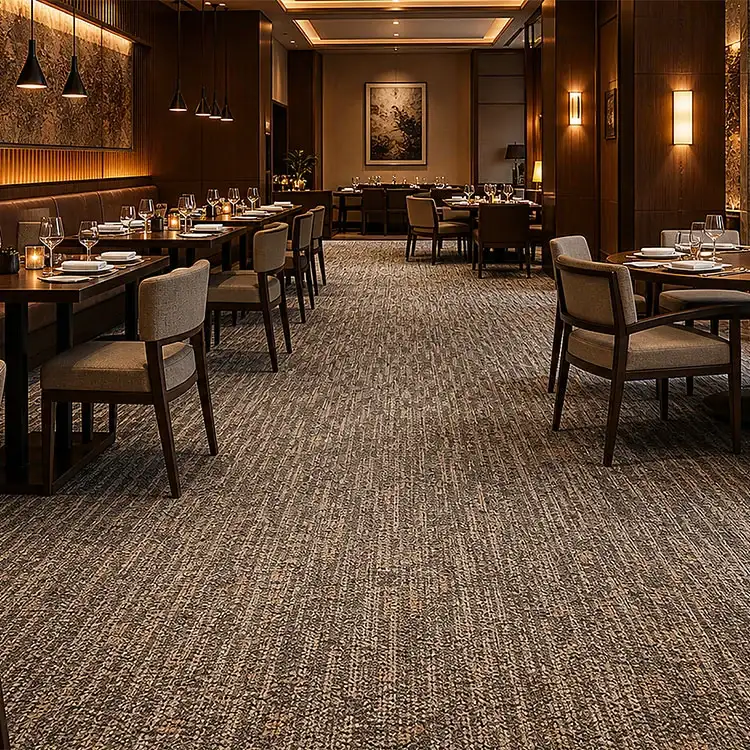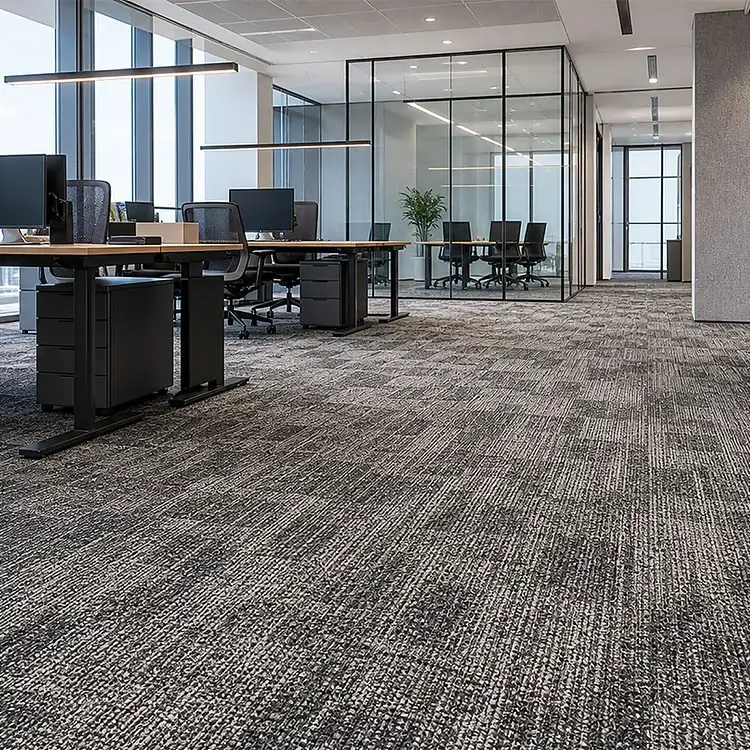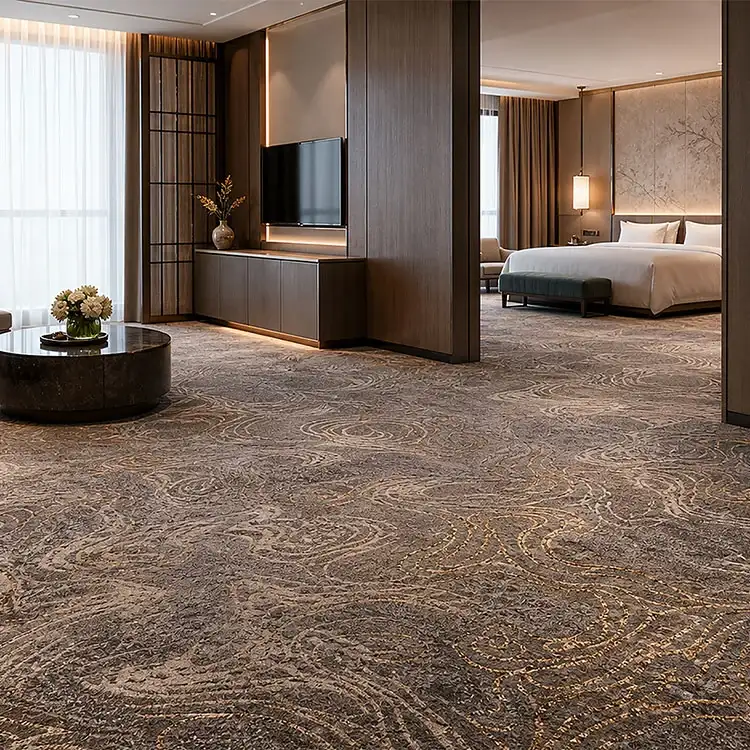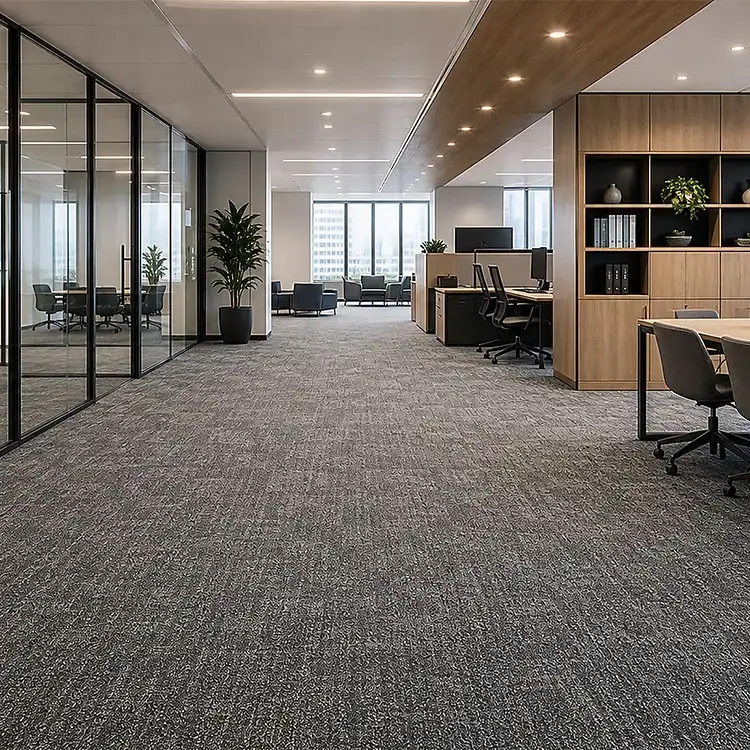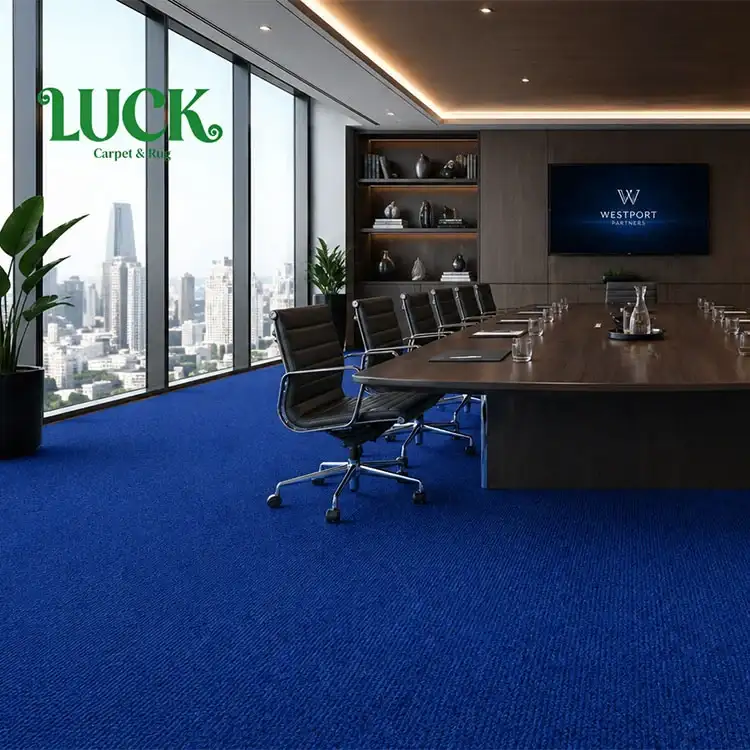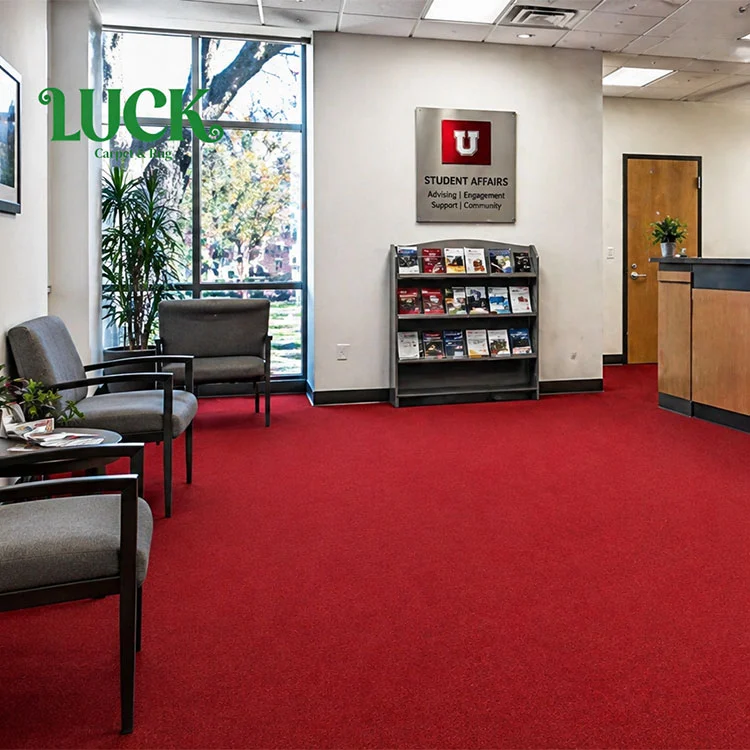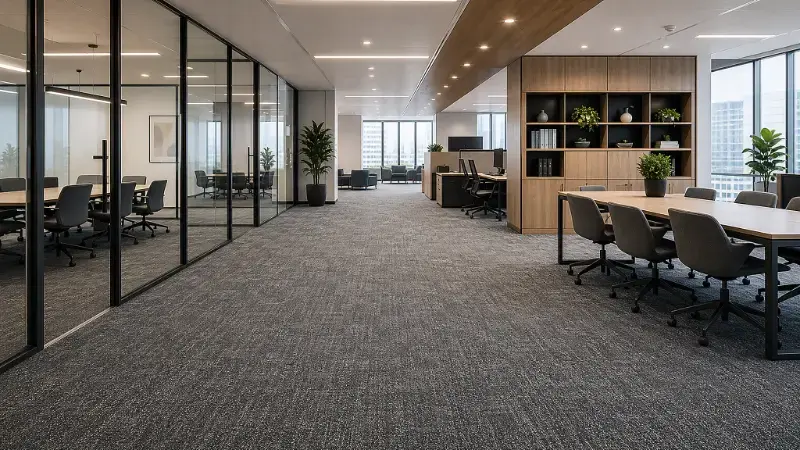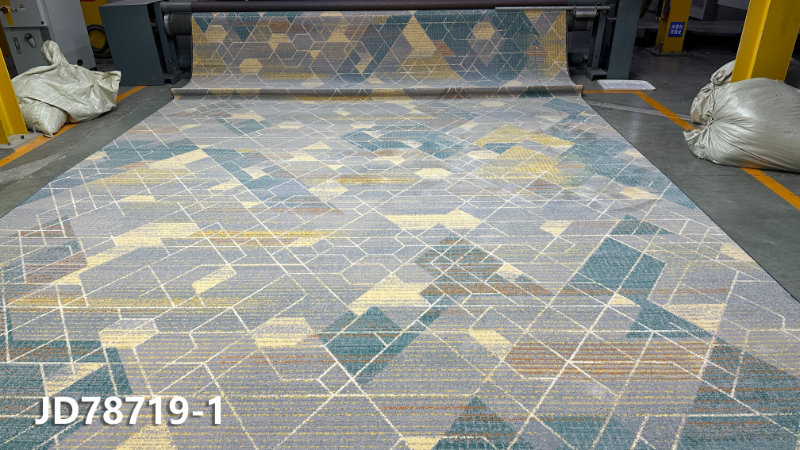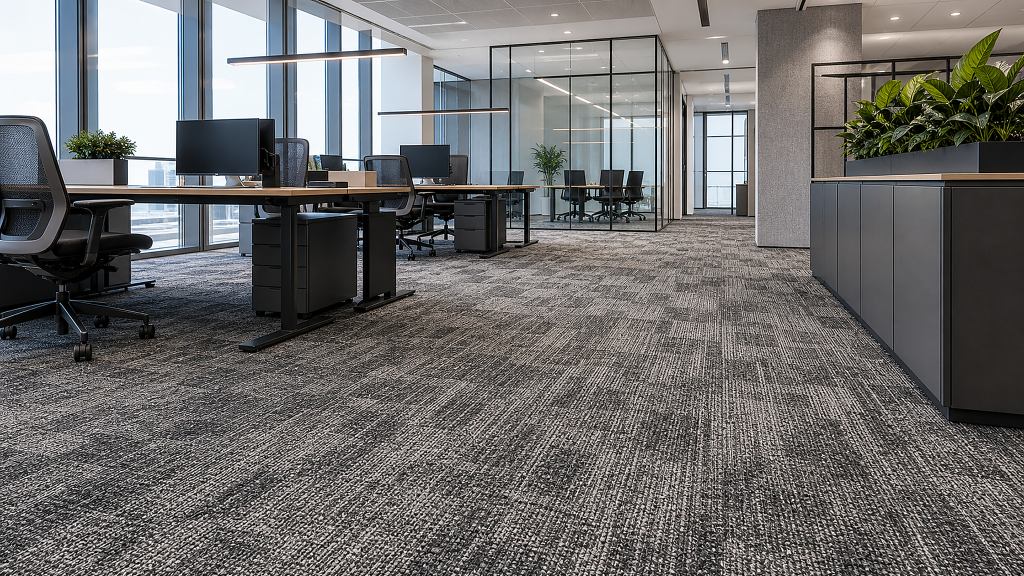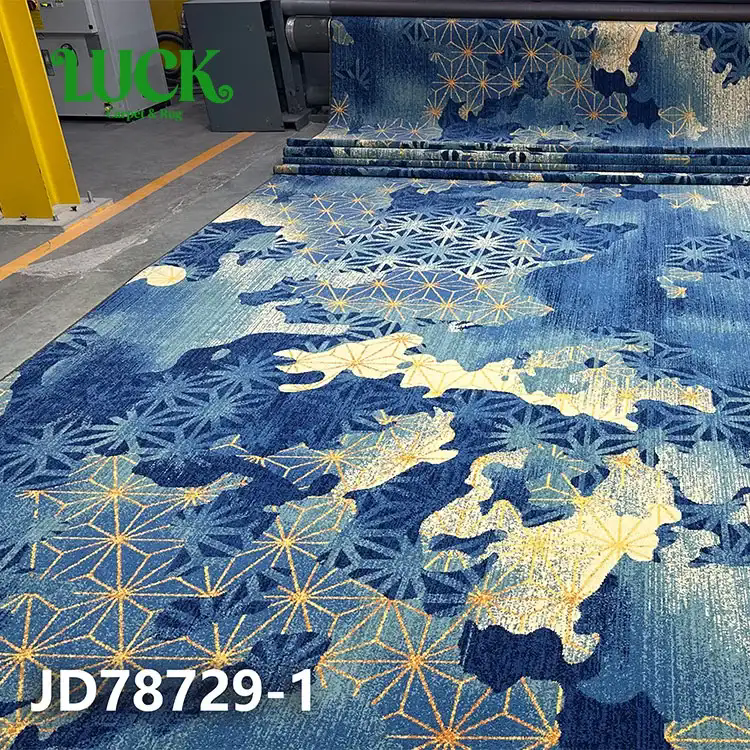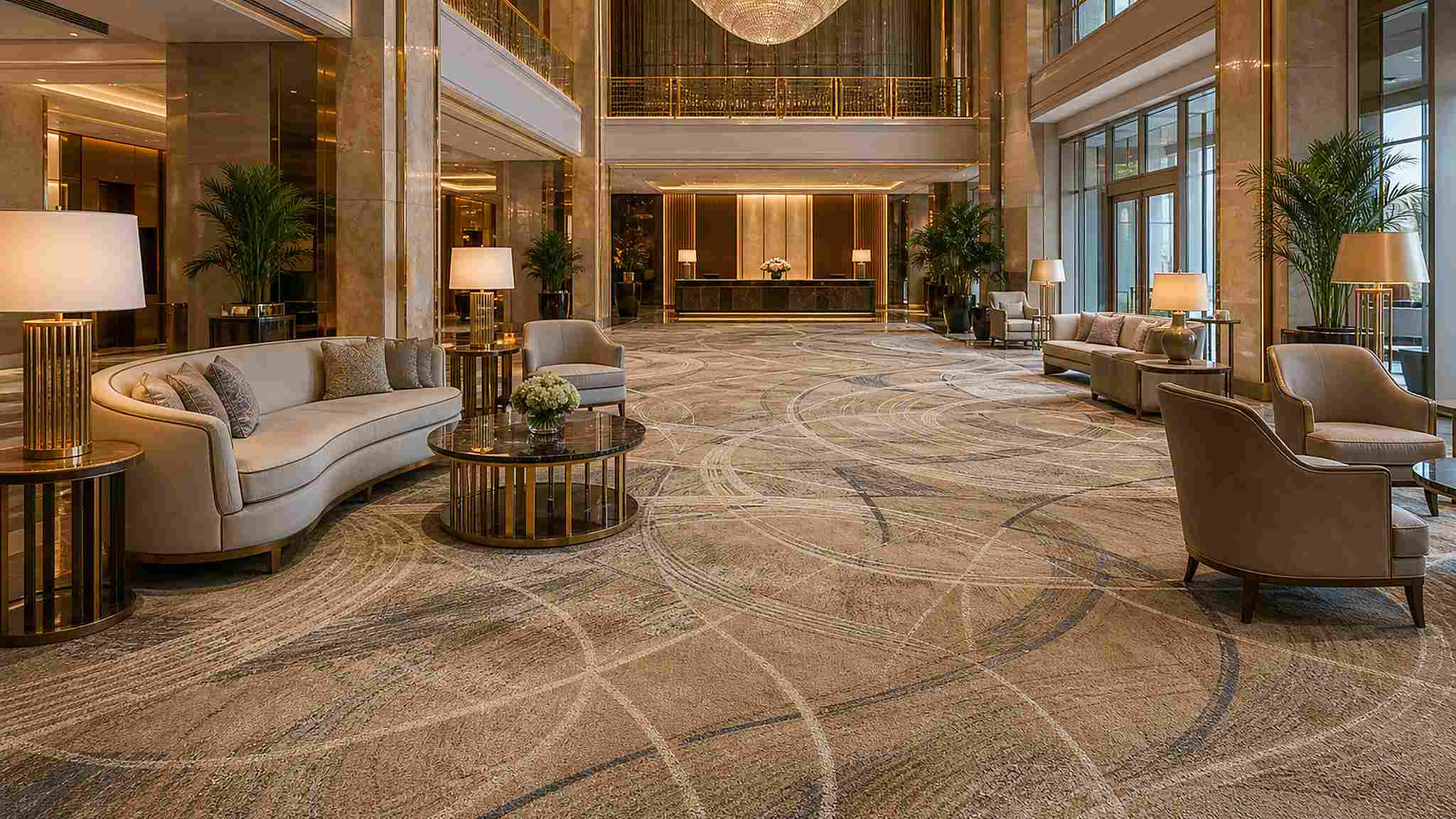
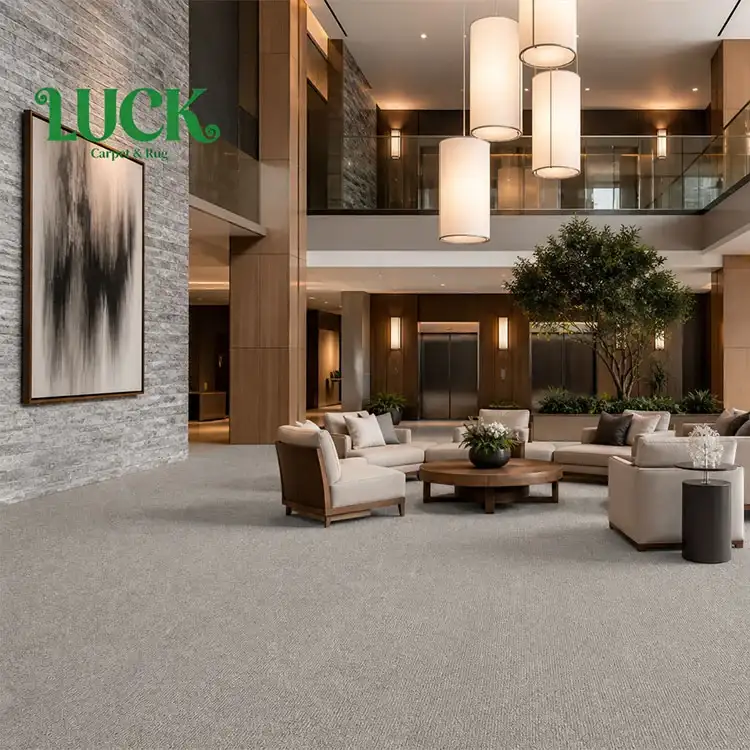
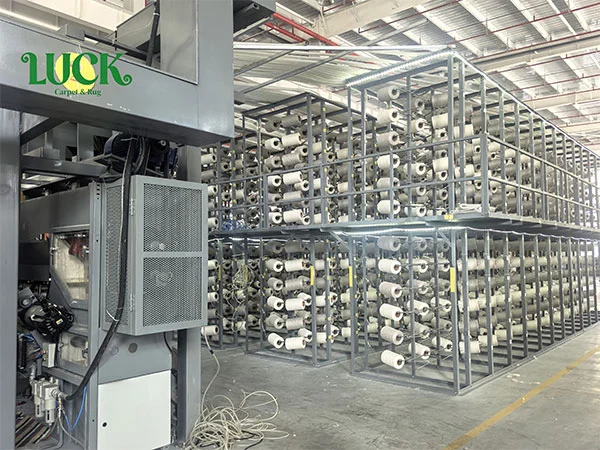
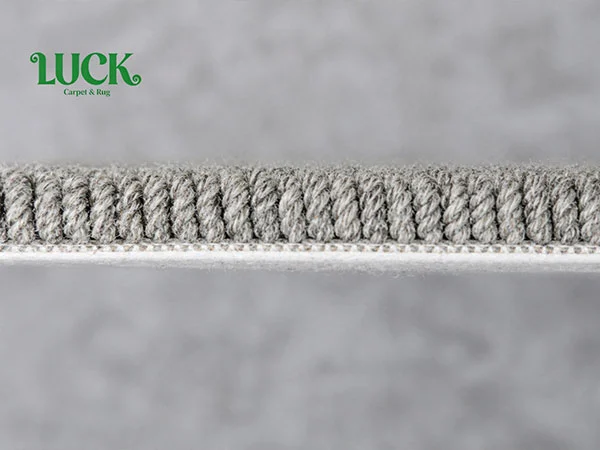
LUCK Carpet produces this nylon tufted wall to wall carpet in Foshan, Guangdong, on cut pile tufting lines we own and run. The face is 100 % nylon, 6 mm at 800 g/m2, on an anti-slip textile backing in a 4 m usable width. It is specified for hotel lobbies and arrival halls, where hard paving meets a soft floor and every guest drags a wheeled case across the join. Compression recovery at that junction is what this page is about.
Pile height sells carpet and pile density keeps it. A deep loose pile looks generous in a showroom and flattens into a permanent track wherever wheels and feet follow the same line, which in a lobby is a strip about 1.2 m wide running from the door to the desk. Nylon has the resilience to spring back, but resilience only works when the yarn is packed tightly enough to support itself.
Compression behaviour is measurable. Under ISO 3416 static loading this construction shows a recovery deficit of 8 to 14 %, and that figure predicts whether the trolley track will still be visible after two winters. A polyester face of the same height usually sits higher on that scale. We build 6 mm specifically for lobbies: tall enough to hold a shadow, short enough that a 200 kg trolley spreads its load across many tufts.
Point load is the enemy in a lobby, and it arrives on four small castors. A loaded trolley puts its whole weight through a contact patch the size of a coin, then rolls on. Two things resist that: how firmly each tuft is anchored, and how well the backing laminate holds the primary and secondary layers together. Tuft bind on this construction measures 36 to 44 N to ISO 4919.
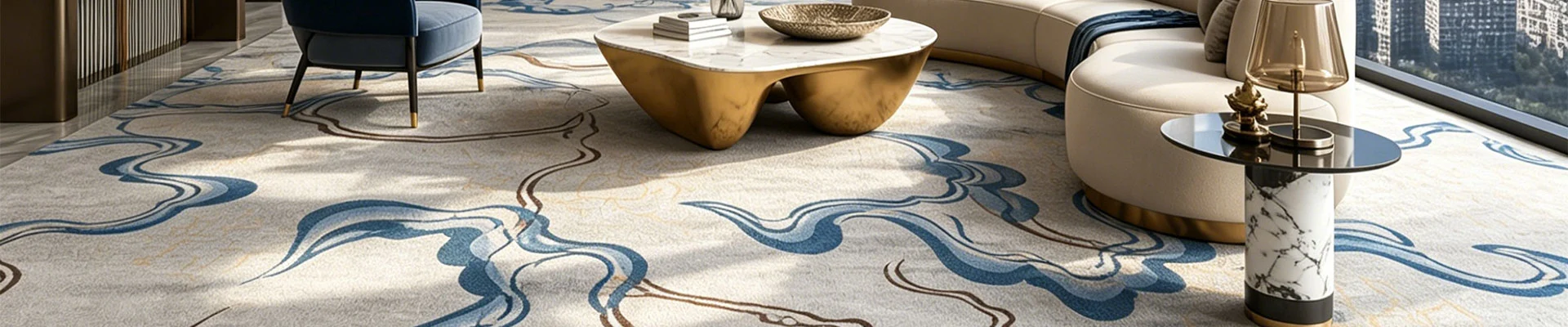
Backing laminate peel strength sits at 30 to 38 N/50 mm. Below 30, a lobby carpet starts to bubble where cleaning equipment and trolley wheels work it loose from the secondary backing. Abrasion to ISO 12947-2 at 5 kPa runs 34,000 to 46,000 rubs across our production, a commercial result rather than a domestic one. In a glazed atrium with all-day sun, specify a fine pattern rather than a flat shade.
Values in the table below describe the roll we ship, measured on finished production in Foshan rather than on a showroom sample. Pile weight and pile height are quoted separately because a lobby buyer needs both: weight is how much nylon holds the load, height is how much stands above the backing.
| Style | Nylon Tufted Wall to Wall Carpet for Lobby |
| Yarn type | 100 % Nylon |
| Pile Height | 6 mm |
| Pile Weight | 800 g/m2 |
| Backing | Anti-slip textile backing |
| Fire Resistance | Bfl-s1 (EN 13501-1) |
| Application | Hotel |
| Width / Size | 4 m (13.1 ft) usable width |
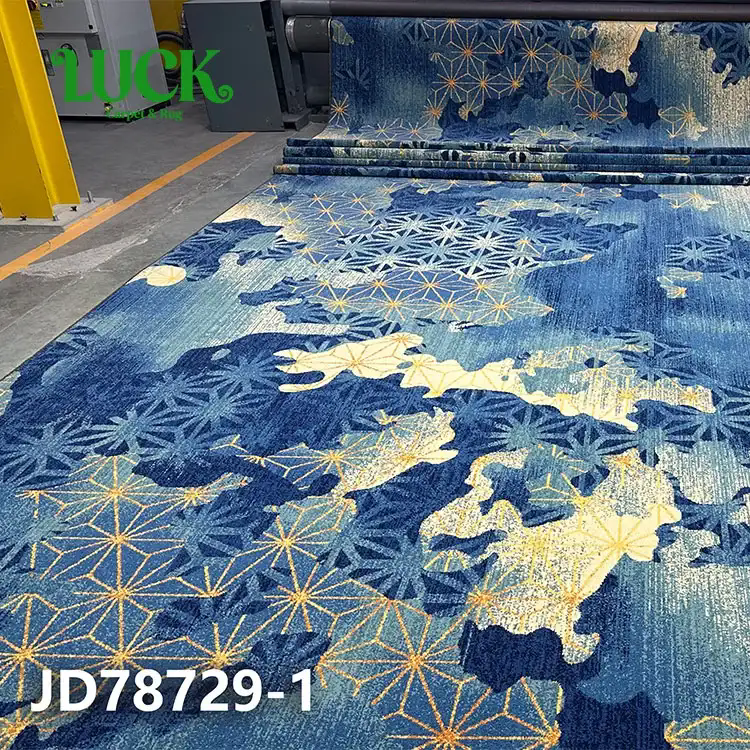
| Pattern | Custom design available (artwork supplied by buyer, strike-off approved before production) |
| Surface / Technique | Cut pile |
Nothing in a hotel works harder than the arrival sequence. A guest crosses a threshold, a wind lobby, a mat, an aisle and a reception queue in under two minutes, and the floor has to look untouched through all of it. Lobby carpet is judged at eye level while it is destroyed at wheel level.
Tuft bind is the force needed to pull one tuft out of the primary backing, expressed in Newtons to ISO 4919. A domestic carpet can pass at 20 N. This construction sits at 36 to 44 N, and the gap is the difference between a tuft that stays put under a castor and one that works loose around a beater bar. When a tuft releases, the hole widens with every vacuum pass.
Ask for the tuft bind figure on the roll you are buying, not on the style. At The Canton Fair in Guangzhou we asked 48 hotel engineers who specify lobby flooring what fails first beside a revolving door. Thirty-two gave the same answer: a flattened wheel track that no amount of cleaning lifts. Rubbing fastness to ISO 105-X12 measures Grade 4 to 5, and an 8-year warranty covers the face pile.
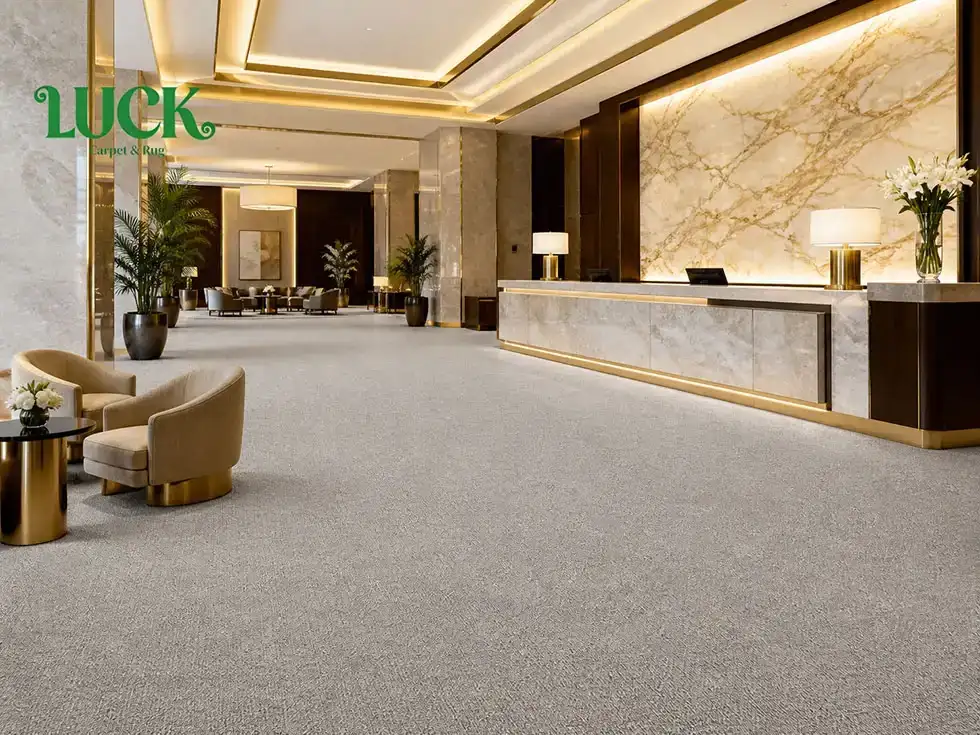
Every lobby is at least four floors in one. The entrance mat well takes grit and water, and scraper matting belongs there, not carpet. The 2 m to 3 m aisle from mat to desk takes the rolling load. The queue zone in front of the desk takes standing pivot load, which is harder on pile than walking. The lounge behind it takes seating and cases left on the floor for hours.
We laid exactly that plan for a 220-key city hotel in Istanbul, Turkey: 1,240 m2 of lobby, arrival aisle and lift lobby from 13 rolls at 4 m width. The brief was a plain grey that had to survive a revolving door with a constant winter draught. Thickness loss after 18 months is reported in the case study below.
Most lobby failures start at the mat transition, not in the middle of the floor. Grit carried past the matting acts like sandpaper on the first metre of carpet, and a badly fixed transition strip lets the edge curl, catching castors and trolley feet. Two rules: extend matting at least five paces inside the door, and set the carpet edge into a metal transition rather than butting it against the mat.
Friction is the other half of the problem. Too little grip under the roll lets a trolley skid instead of rolling, which shears the pile and marks the surface. Our anti-slip textile backing with a full-spread adhesive holds the carpet under that lateral load, and slip performance is reported to EN 13893 as a dynamic coefficient of friction and to DIN 51130 for the R group. On a ramped entrance, carpet is the wrong choice.
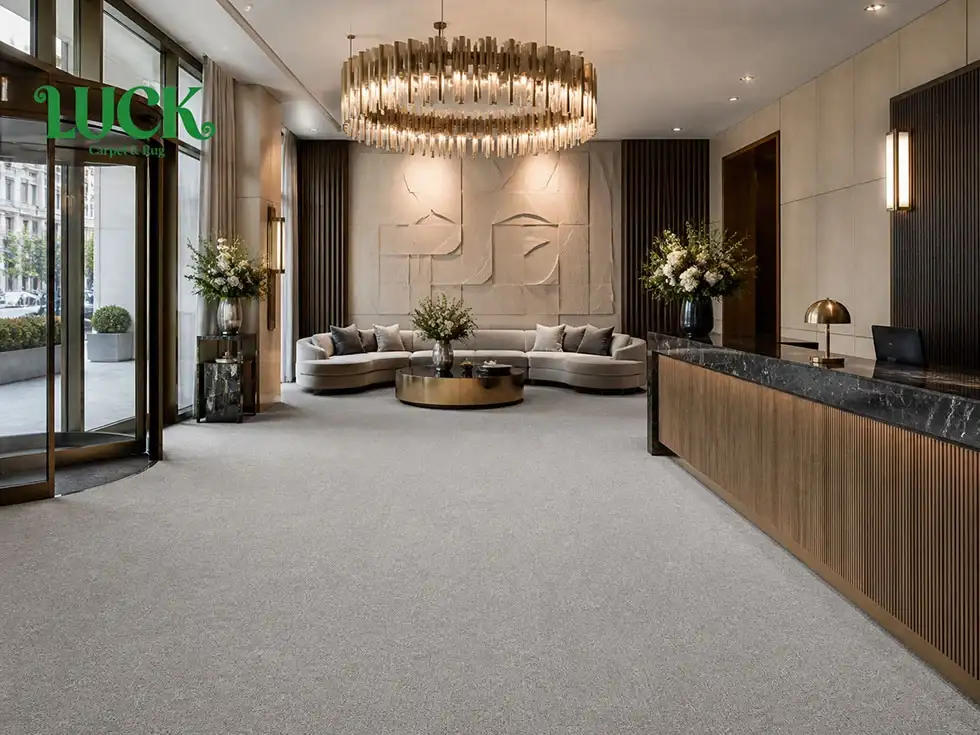
Two streets from a major rail terminus, this hotel takes most of its arrivals on wheeled cases through winter weather. The package covered 1,240 m2 of lobby, aisle and lift lobby plus two meeting foyers, cut from 13 rolls at 4 m usable width. Installation ran in three overnight phases with the front desk operating each morning.
The brief asked for a plain grey that would look unbroken across an 18 m sightline from the entrance to the desk. We specified the 6 mm cut pile over a 6 mm crumb underlay in the aisle and laid it direct elsewhere, pile direction running toward the desk. After 18 months the engineering log records thickness loss of 7 % against the ISO 3416 baseline and no tuft pull-out at the door.
Abrasion to ISO 12947-2 at 5 kPa averaged 39,800 rubs to defined change across our last six lobby orders. Light fastness measures Grade 6 to ISO 105-B02, and rub fastness to ISO 105-X12 holds Grade 4 to 5 wet and dry. Tuft bind to ISO 4919 averages 40 N on retained samples, and backing laminate peel sits at 33 N/50 mm. Reaction to fire is Bfl-s1 to EN 13501-1, backed by EN ISO 9239-1 and EN ISO 11925-2, and indoor air quality is Class A to GB 18587-2001. Ask for tuft bind and peel in writing. Those two numbers decide whether the floor survives year three.
Density, not height, decides durability. At 800 g/m2 the tufts share point load, and a short face resists crushing better than a deep loose one. For a deeper look, add a heavier underlay rather than more pile, because height without weight flattens faster under a trolley.
Cut the carpet straight, fix a metal transition strip into the substrate, and tuck the carpet edge under the strip lip rather than butting it. Extend matting at least five paces inside the door so grit is removed before the carpet begins. We supply edge-setting drawings with every lobby order.
Yes, with restrictions. The screed must be fully cured and surface temperature at the carpet should stay below 27 degrees Celsius. Use a full-spread adhesive rated for that temperature, and avoid a thick underlay in heated zones, because trapped heat shortens the life of backing and adhesive.
Hard castors concentrate load and will mark any cut pile over time. Specify soft-tread or twin-wheel castors for desk chairs and keep luggage carts on the aisle where the underlay is heaviest. Where rolling load dominates, move up to our 1,000 g/m2 construction rather than buying a deeper pile.
A 6 mm cut pile with an even upright face reads matte, holds a plain shade without pooling, and takes vacuum marks cleanly, which matters where housekeeping works in long straight passes. Rolls arrive 4 m (13.1 ft) usable width and about 25 linear metres long, on cardboard cores under PE film, palletised with the ends protected.
Lay with a full-spread adhesive over a dry, sound substrate, pile direction running from the door toward the desk so tracking reads as a direction rather than a patch. Custom design is available: your artwork, our strike-off, no production until you approve it. LUCK Carpet has manufactured tufted carpet in Foshan for 14 years with 180 staff on a 26,000 m2 site.
Address
Shidaigongguan Building No.5 Office 1212, Haicheng east road, Duanzhou District, Zhaoqing City, Guangdong Province, China
Tel
Copyright © 2026 Zhaoqing Yunle International Trade Co., Ltd. All Rights Reserved.