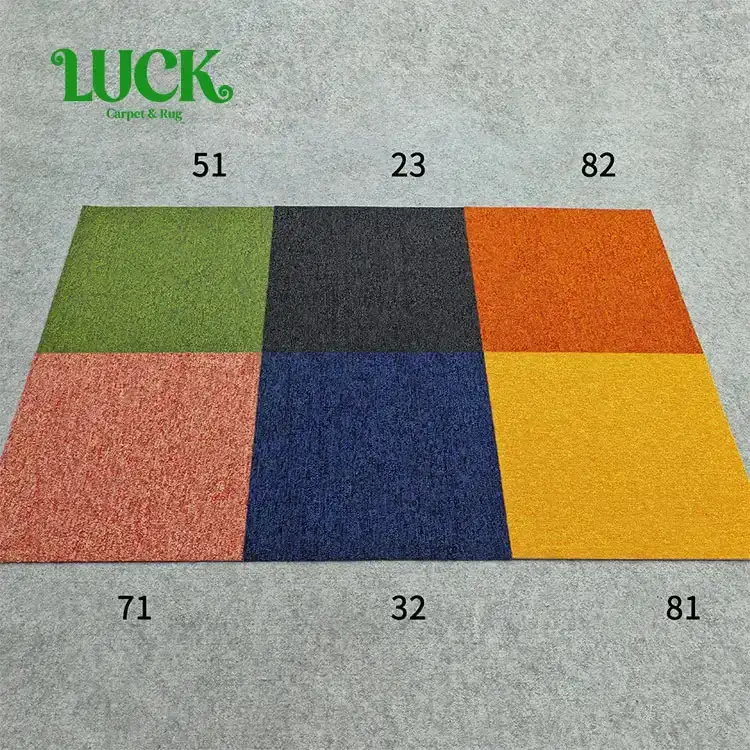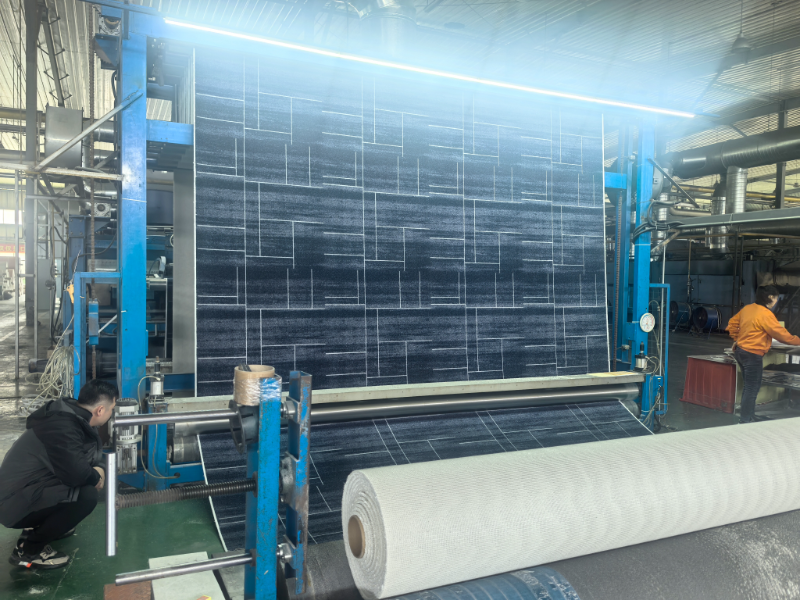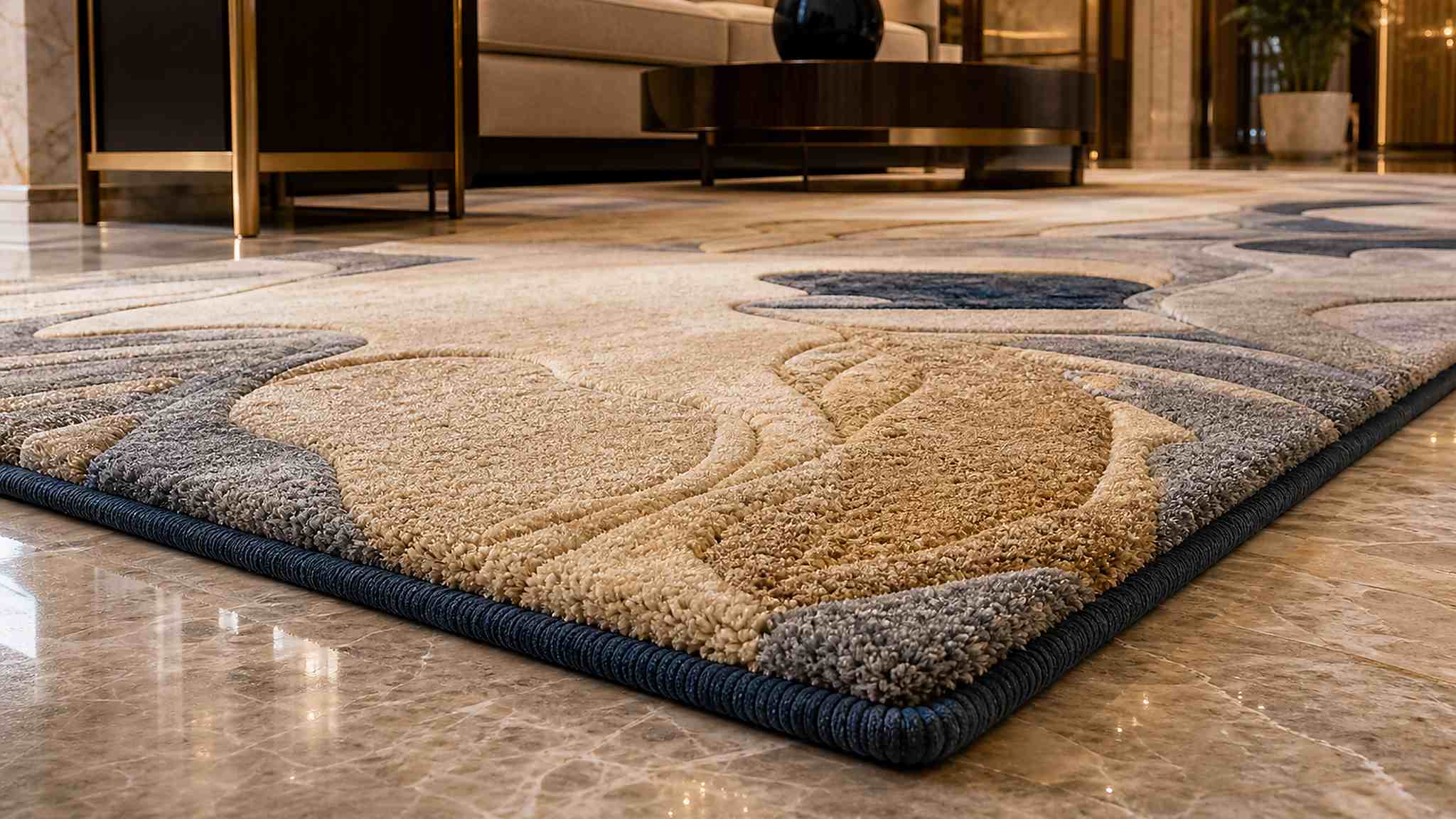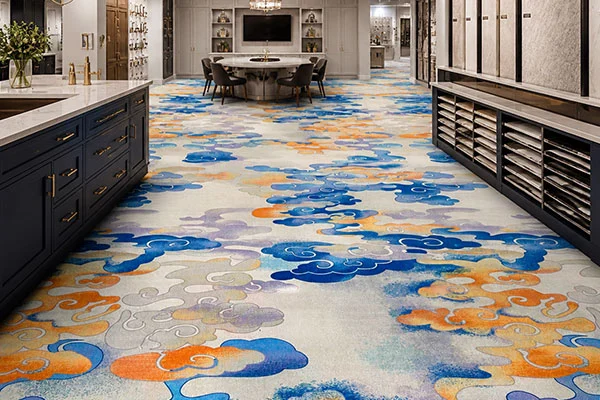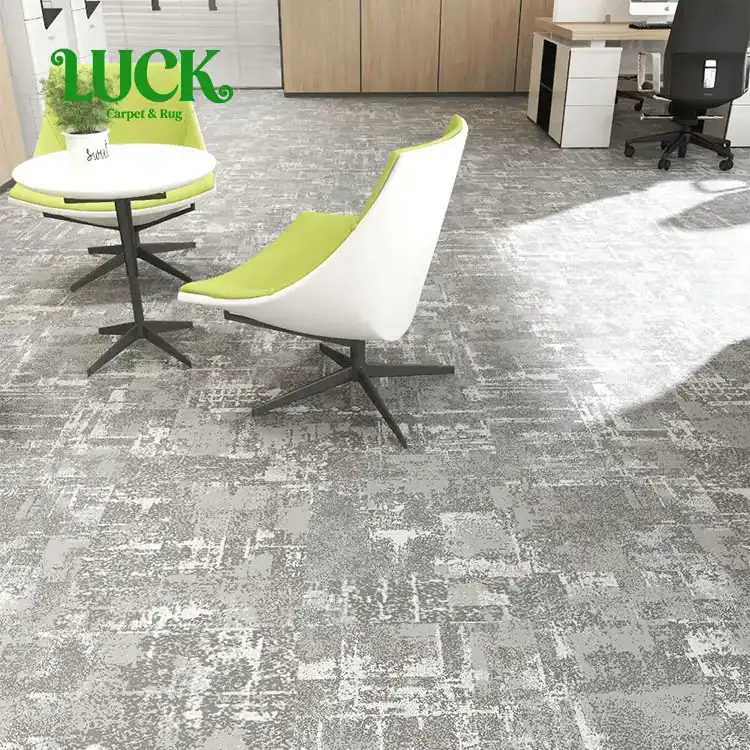
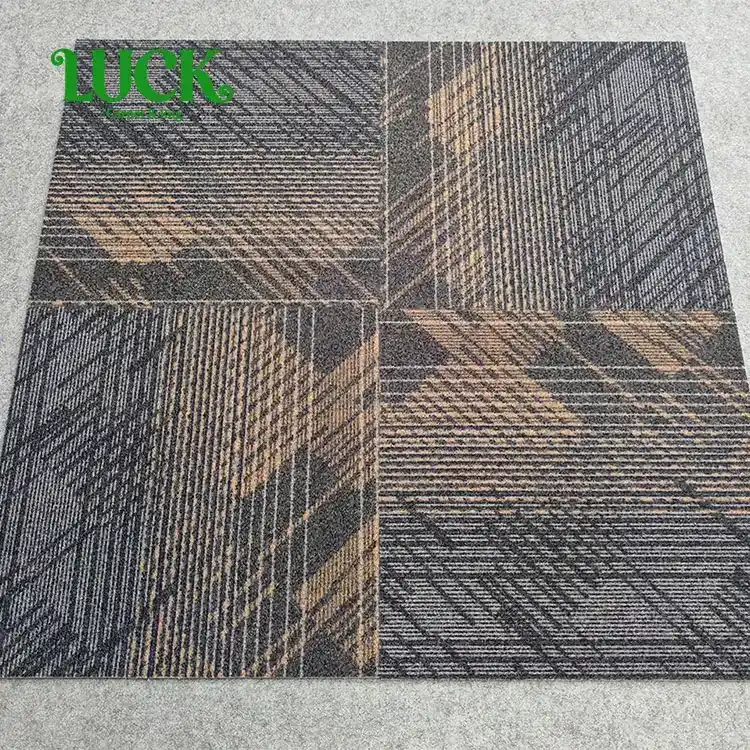
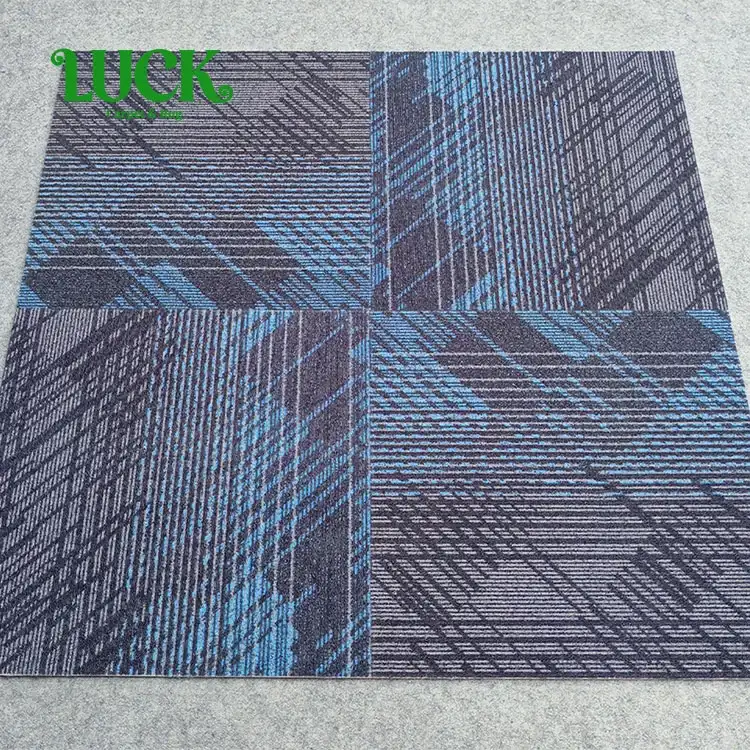
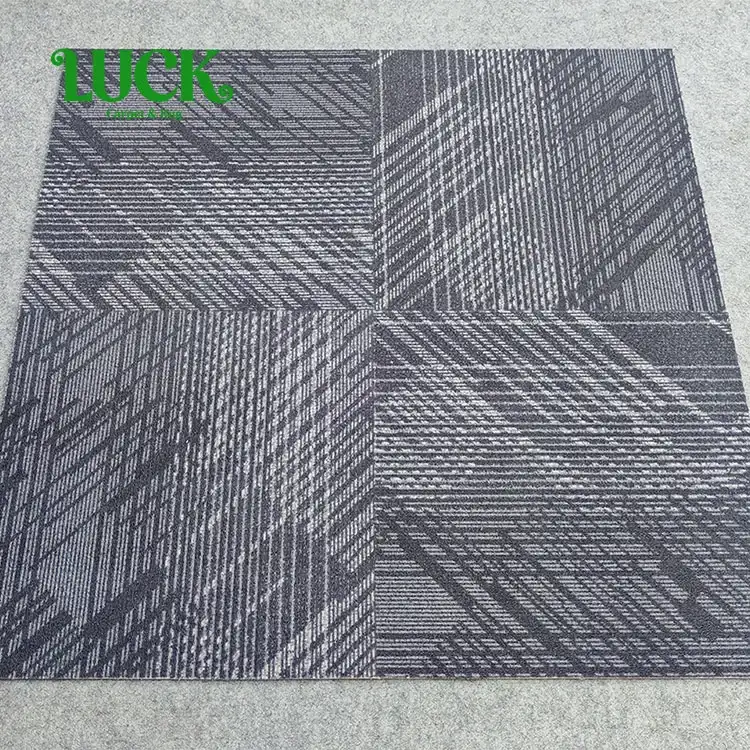
LUCK Carpet prints this loop pile carpet tile on our digital line in Foshan, Guangdong, where 180 staff have spent 14 years producing printed and tufted flooring for export. The face is solution-dyed nylon or polyester at 600 g/m2, tufted into a 5 mm loop, printed before lamination and bonded to a PVC, PE or eco-friendly backing. We supply 50 cm squares or 25 cm x 100 cm planks. This page covers the loop as a soiling-control strategy.
A loop pile presents small arches rather than open fibre tips. Soil sits on those arches and lifts at the first vacuum pass, while a cut pile opens like a brush and lets grit work down between the tufts. That difference decides how a printed floor looks after two winters of wet shoes. The denser the loop, the less gap for grit, which is why we tuft this construction at 600 g/m2.
The print sits inside the fibre, because the design is applied to solution-dyed yarn and fixed before lamination. Abrasion records 34,000 to 46,000 rubs to a defined change under ISO 12947-2 at 5 kPa, and tuft bind holds at 36 to 44 N to ISO 4919, so a printed arrow in a school corridor still reads as an arrow.
A printed tile has one failure mode a plain tile does not: the design itself can drift. Artwork is converted to a repeat before a strike-off is produced, colour is matched to that strike-off on a spectrophotometer, and the printed greige is checked for registration after fixation. Registration is held to within 1.5 mm across a tile, which stops a large motif stepping where four tiles meet.
Fixation drives dye into the loop rather than leaving pigment on the surface, so colour fastness reaches Grade 6-7 to ISO 105-B02 for light and Grade 4-5 to ISO 105-X12 for rubbing. Peel strength on the project-selected backing runs 30 to 38 N/50 mm and dimensional stability stays under 0.25 % length change to ISO 2551. The tile reaches Bfl-s1 under EN 13501-1, with EN ISO 11925-2 covering the small flame response.
Every value below was measured on finished tile in our Foshan QC lab after conditioning at 23 degrees C and 50 % relative humidity. One reading note on the backing row: PVC, PE and eco-friendly laminates behave differently under foot and on a ramp, so fix the backing before the price, and ask for peel and stability figures for that exact laminate.
Style Printed Loop Pile Carpet Tile
Yarn type Nylon / Polyester
Pile Height 5 mm
Pile Weight 600 g/m2
Backing PVC / PE / eco-friendly backing (project-selected)
Fire Resistance Bfl-s1 (EN 13501-1)
Application commercial interior
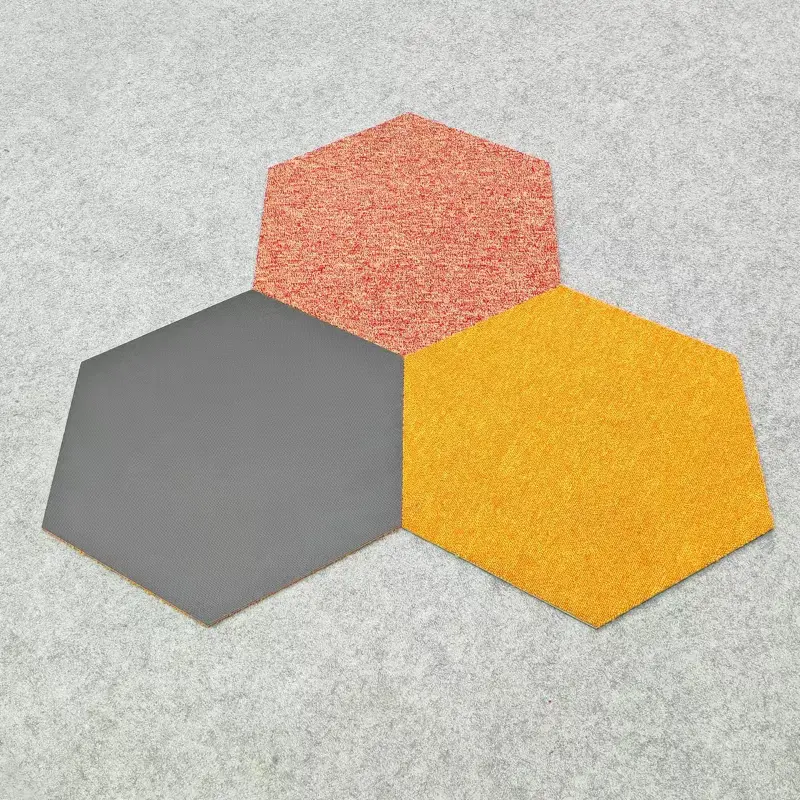
Width / Size 50 cm x 50 cm standard tile, 25 cm x 100 cm plank and custom sizes
Pattern Custom design available (artwork supplied by buyer, strike-off approved before production)
Surface / Technique Loop pile
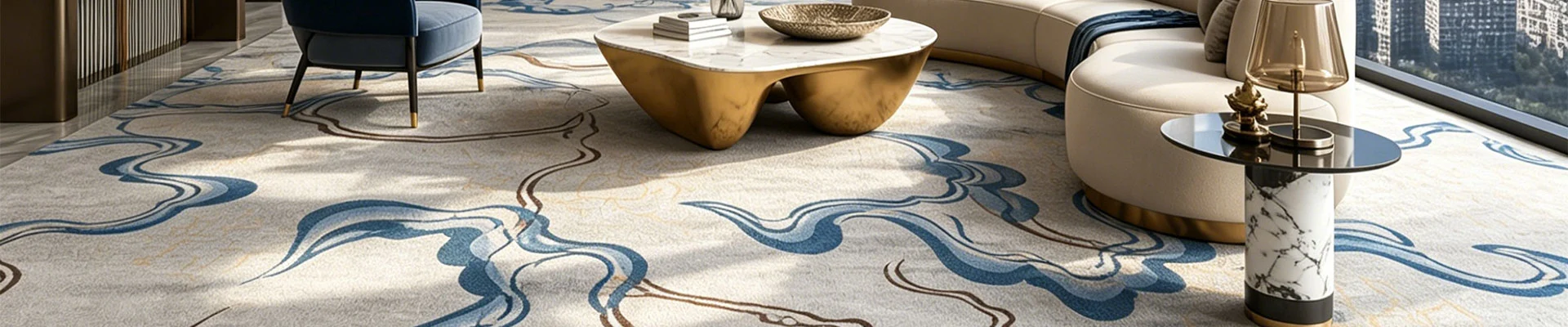
Printed loop tile earns its cost where the floor carries information as well as traffic. An airport pier uses colour to point passengers toward a gate. A hospital uses a coloured line to walk a visitor to a department. A supermarket separates fresh produce from the checkout run. In each case the graphic must survive the traffic over it, which is a construction question rather than an artwork question.
Two mechanisms work in a loop tile's favour. The arches scatter light in many directions, so a thin film of dust does not read as a dull patch the way it does on a flat cut surface. And because the print is dyed into the yarn, cleaning removes soil without lifting the design. Light fastness is graded Grade 6-7 to ISO 105-B02, which matters under a glazed roof.
The project-selected backing decides how the surface handles water. A PVC laminate gives the flattest lay on a smooth slab and the highest peel strength of the three, at 30 to 38 N/50 mm. A PE backing brings tile mass down for upper floors and raised access systems. An eco-friendly laminate removes bitumen and plasticiser from the build-up, at the cost of more care around a wet clean.
A municipal service centre in Copenhagen, Denmark, installed 1,600 m2 across a public hall, twenty counters and the queue lanes between them. The brief asked for a printed wayfinding scheme in the city's own colours, with numbers repeated on the floor at each counter and a directional band running to the exit. The floor takes roughly 2,100 visitors a weekday.
We printed 6,400 tiles in four colours, holding registration to within 1.5 mm so the counter numerals stayed crisp across tile joints, and matched each colour to the approved strike-off. The backing was a PVC laminate for flatness across a large open hall. Weekly cleaning time on the public floor fell by about 20 % against the cut pile it replaced, because the loop releases soil at the first vacuum pass.
A loop has one genuine weakness worth stating plainly. A sharp edge or a pawing animal can catch a loop and pull a snag where a cut pile would shed a fibre tip. The defence is anchoring force: tuft bind measured to ISO 4919 at 36 to 44 N means the loop resists being dragged out of the primary backing, and a snag can be trimmed level with scissors rather than replaced.
The second weakness is the traffic lane. A printed band down the middle of a corridor takes far more passes than the edges, and after a few years the lane looks lighter even though the print is intact. Break long runs by turning the graphic across the width at intervals, keep a walk-off zone of at least three metres at each entrance, and put patterned rather than plain ground in the lane.
A municipal service centre in Copenhagen, Denmark, rebuilt its public floor across 1,600 m2 of hall, queue lanes and counter aprons. The brief specified a wayfinding scheme in the municipality's own colours, with a large numeral at each counter and a directional band leading to the exit stairs. The building opens six days a week to around 2,100 visitors a day.
We produced 6,400 printed loop tiles in four colours at 600 g/m2, laminated to a PVC backing for flatness across the open hall. Registration held to within 1.5 mm so the numerals crossed tile joints without stepping. After 18 months the directional band showed no measurable colour loss against the retained strike-off, and the cleaning contractor recorded roughly 20 % less vacuuming time per week than on the cut pile removed from the same hall.
A fitter on a Copenhagen contract told us the printed tiles are the easiest graphic floor he has laid, because the sequence numbers were printed on the cartons. Sequence is only one control. Printing adds two checks to the standard list. Before lamination we verify registration across the tile and read colour against the approved strike-off; after lamination the batch runs the same programme as every tufted tile we make: abrasion to ISO 12947-2, tuft bind to ISO 4919, peel in N/50 mm, colour fastness to ISO 105-B02 and ISO 105-X12, dimensional stability to ISO 2551, static-load thickness loss to ISO 3416, and an indoor air screen to GB 18587-2001 Class A. Third-party inspection is available at our plant, and supplying a registered print file removes most production risk.
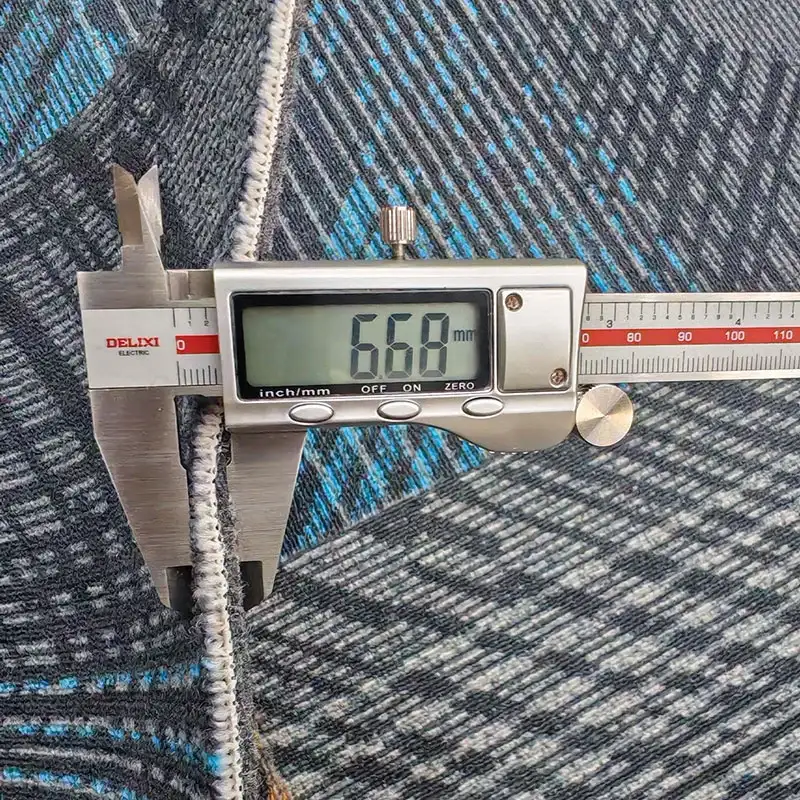
Yes, within limits. Logos, numerals, maps, geometric patterns and large-format illustrations reproduce well, and we will say when an image has detail too fine for a 5 mm loop. Photographic gradients work but soften slightly, because the loop top catches light from several angles. Send artwork at 300 dpi at final size, or vector files for logos and lettering.
It does not flake or peel, because colour is dyed into the yarn rather than laid on the surface, and abrasion runs 34,000 to 46,000 rubs under ISO 12947-2 at 5 kPa. A lane can read slightly lighter from compaction and soiling. Design the graphic so heavy lanes fall on patterned ground rather than a plain field.
Choose PVC where the slab is smooth and you want the flattest, most dimensionally locked tile. Choose PE where tile mass matters on an upper floor or a raised access system. Choose the eco-friendly laminate for recycled content or a low-odour condition during occupation. All three reach Bfl-s1 under EN 13501-1.
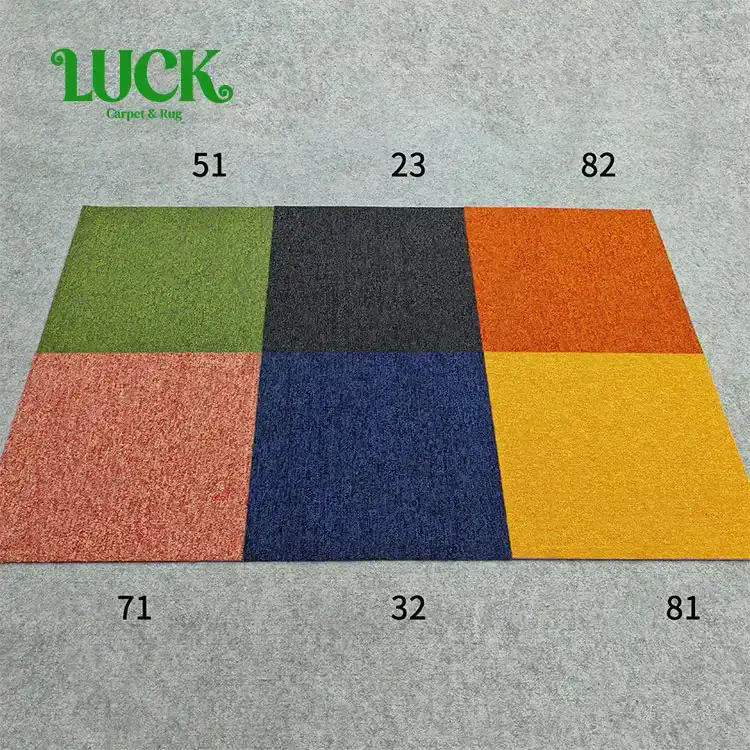
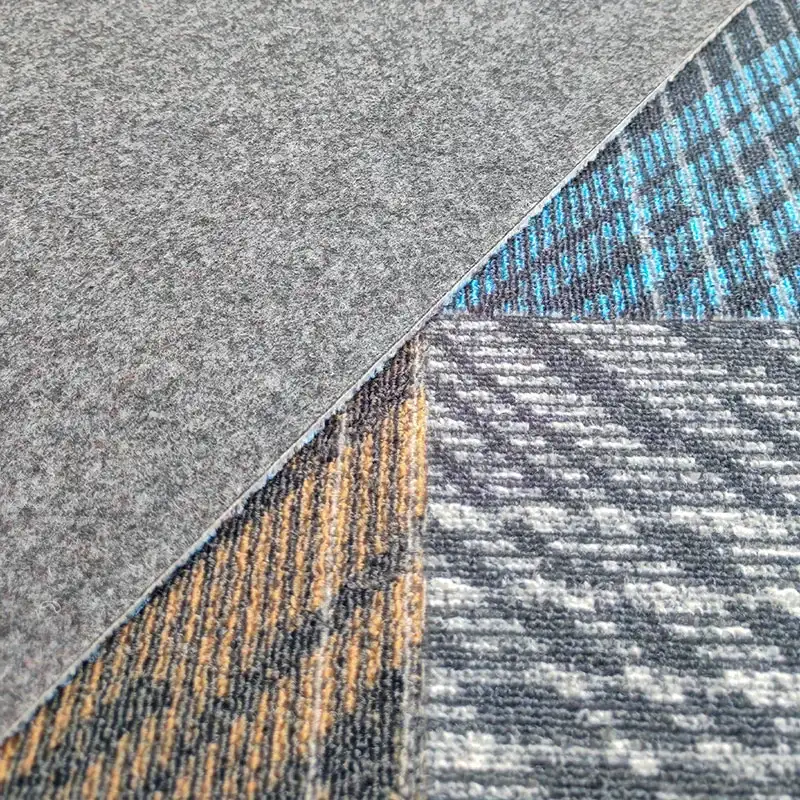
The printed surface has a soft matte look with fine linear shadowing from the loop, and colour sits deep in the pile rather than floating on it, so a dark navy reads as navy rather than black. Tiles arrive 50 cm x 50 cm or 25 cm x 100 cm, 20 per carton, with the batch code, colour references and production date on the label.
The tiles go down on a pressure-sensitive adhesive over a dry, level subfloor, kept in the supplied sequence so the graphic runs continuously. Order 8 % extra rather than 5 %, because cutting around a graphic uses more material than a plain field. Custom print runs take 25 to 35 working days from approved strike-off. Send LUCK Carpet your artwork and floor plan for a print layout and a sample tile.
Address
Shidaigongguan Building No.5 Office 1212, Haicheng east road, Duanzhou District, Zhaoqing City, Guangdong Province, China
Tel
Copyright © 2026 Zhaoqing Yunle International Trade Co., Ltd. All Rights Reserved.