Products


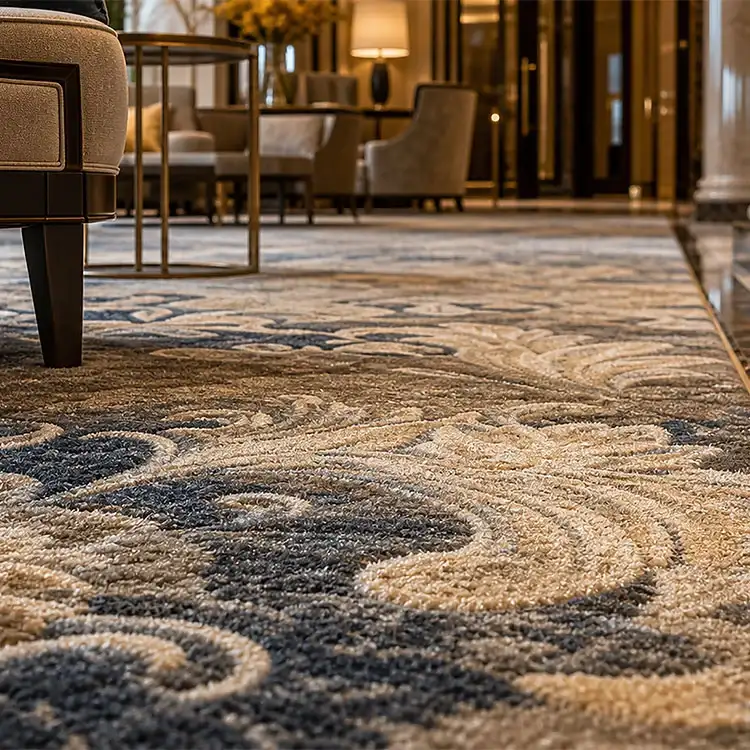
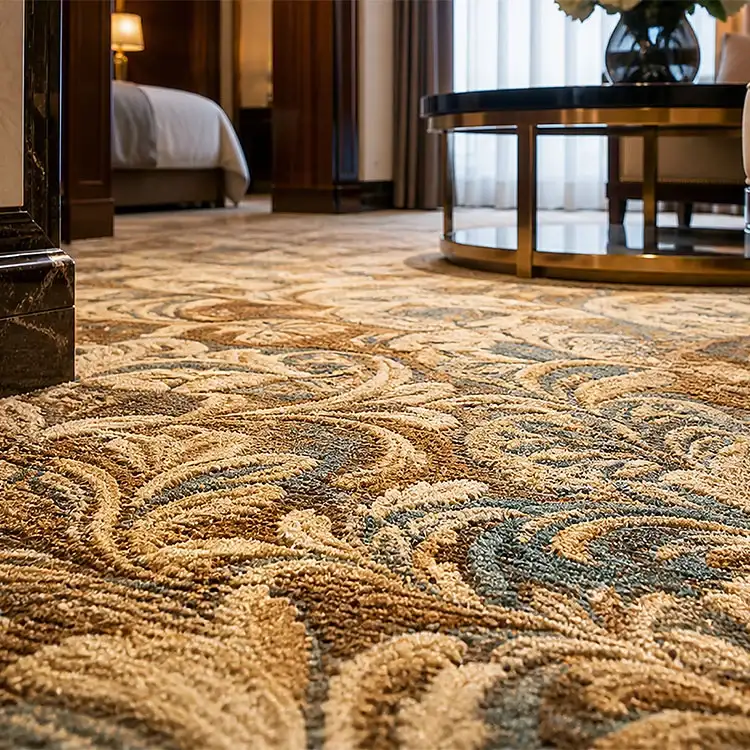
This wool printed wall to wall carpet is built by LUCK Carpet in Foshan, Guangdong, at a 26,000 m2 plant where 180 staff handle tufting, printing and finishing under one roof. The face is an 80/20 wool-nylon blend at a 1,200 g/m2 pile weight and a 10 mm cut pile, laminated to an anti-slip textile backing and classified Bfl-s1 to EN 13501-1. Rolls come 4 m wide, which decides how a ballroom is laid. This page covers pattern continuity across a long column-free span, where one visible break in the design is the failure everyone remembers.
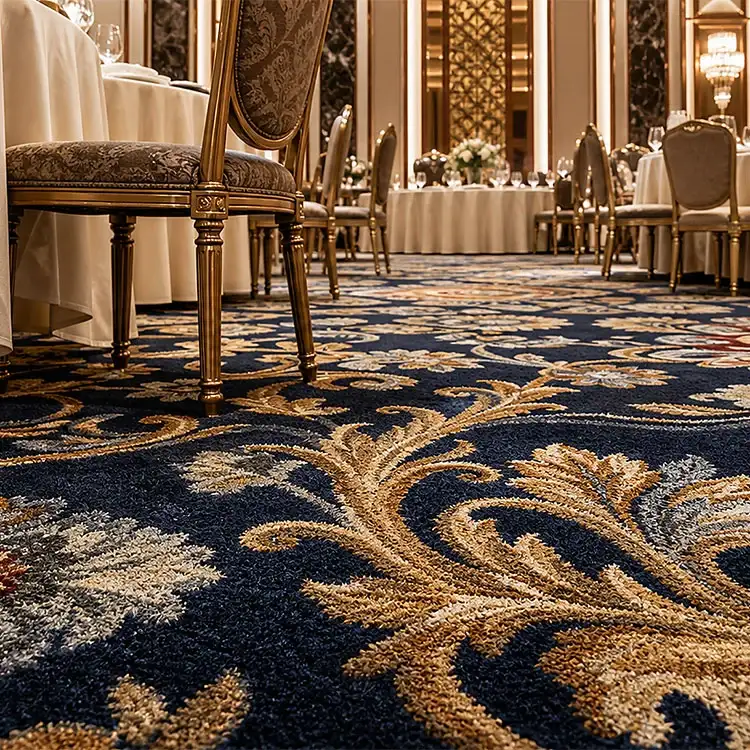
Remove the columns from a ballroom and you create a clear span of 30 m or more. Guests see that floor in one glance from the entrance, so a design that steps sideways at drop three spoils the room however good the print looks on a sample board. Most printed broadloom is made at 2 m or 3.66 m, which forces many joins. Our line prints at a 4 m usable width, so that span needs seven drops rather than ten.
Fewer joins is half the job. Every remaining join has to disappear at standing height, and that is a printing discipline rather than an installation trick. We print registration marks on the backing every 50 cm along each roll, so fitters align marks when they lay the next drop instead of reading the face pattern, which is unreliable on a large motif. That is how a four-drop run stays true to plus or minus 2 mm under raking daylight.
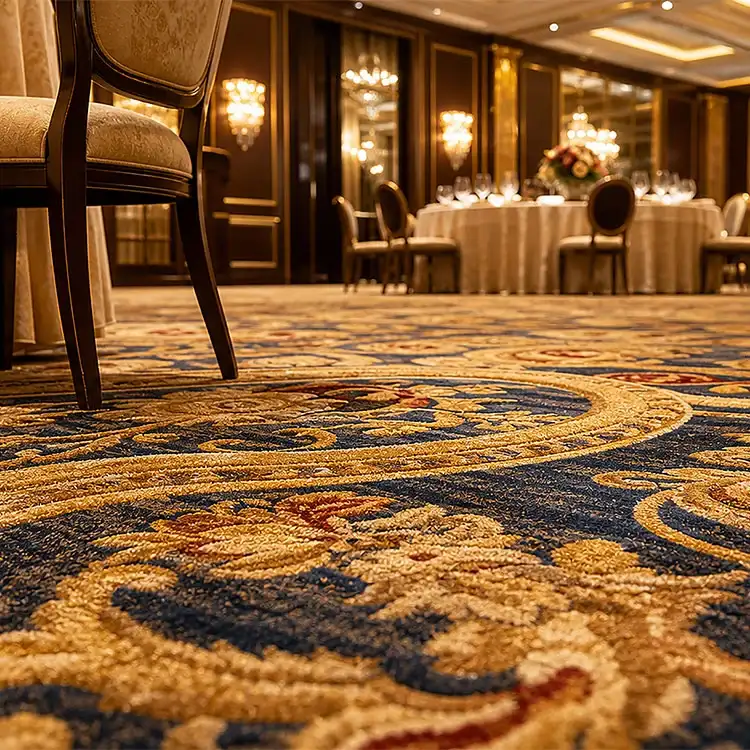
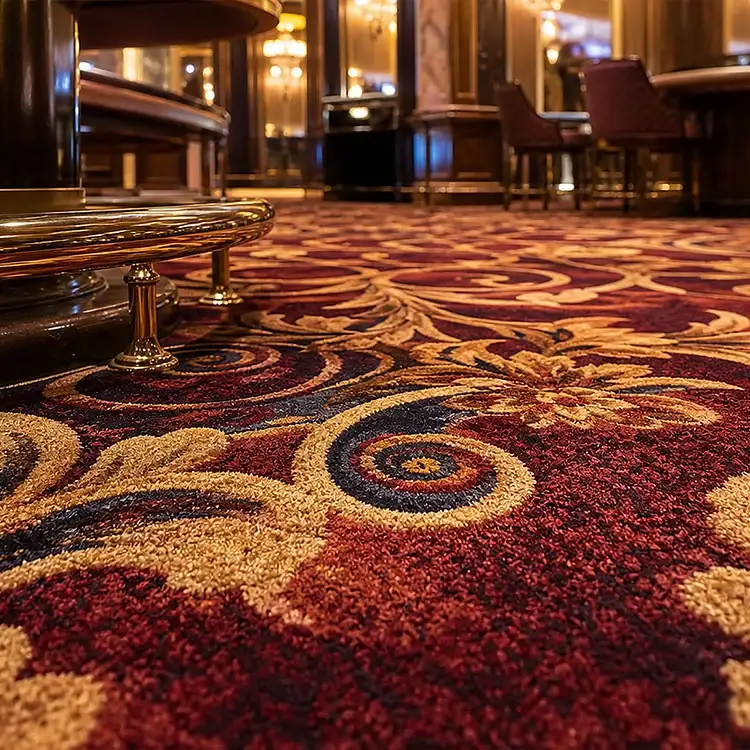
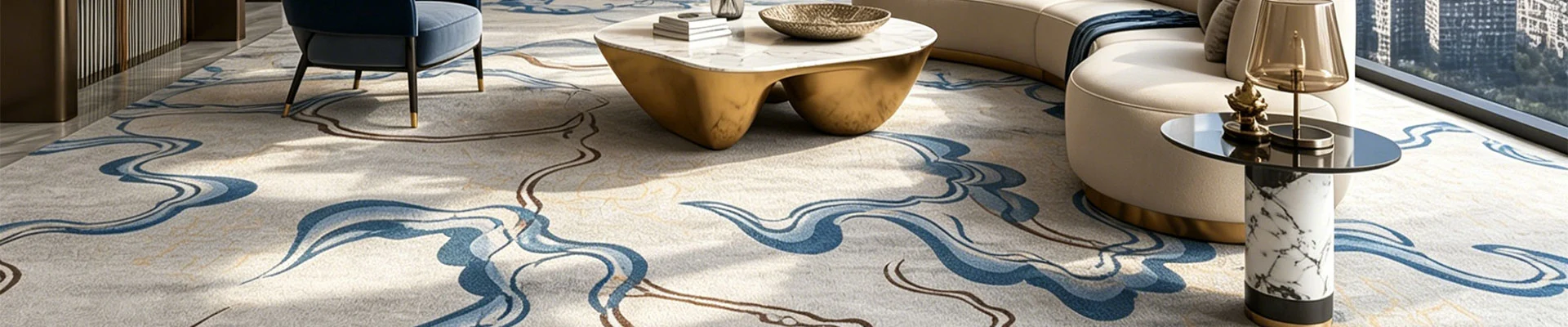
Ballroom designs are drawn at scale, and a damask motif can measure 1.8 m across while a border runs the length of a wall. Any technique with a fixed repeat length struggles with that, because the design has to break somewhere. High-definition digital printing removes the constraint, carrying the artwork across the full 4 m width in one pass with steam fixation and in-line washing afterwards.
Colour control matters more here than in a small room. Ballroom carpet is often ordered as one large batch and matched again years later, so we measure the strike-off and the first metres off the line on a spectrophotometer before every run. Dye take-up on wool is never identical twice. Light fastness sits at Grade 5-6 to ISO 105-B02 and rubbing at Grade 4-5 to ISO 105-X12.
The values below come from finished rolls tested in our Foshan laboratory, conditioned at 23 degrees C and 50 % relative humidity before measurement. Read the width row first, since it drives the whole laying plan, then the pile height, because a 10 mm cut pile shows a seam more readily than a low loop.
| Style | Wool Printed Wall to Wall Carpet for Ballrooms |
| Yarn type | 100 % Wool |
| Pile Height | 10 mm |
| Pile Weight | 1200 g/m2 |
| Backing | Anti-slip textile backing |
| Fire Resistance | Bfl-s1 (EN 13501-1) |
| Application | Ballroom |
| Width / Size | 4 m (13.1 ft) usable width |
| Pattern | Custom design available (artwork supplied by buyer, strike-off approved before production) |
| Surface / Technique | Cut pile |
A ballroom programme is four floors in one room. Guests cross the pre-function area with drinks, sit through a gala in the main hall, watch a stage, then leave through the same doors at midnight. The carpet survives a banquet set-up, a dance floor, a stage load-in and a full turnover in one day.
Pattern survival starts with how the design is composed. We ask for artwork three weeks before the print slot so our technical team can check motif scale against the roll width and flag anything landing exactly on a cut line. A border falling 20 mm inside a seam is a problem we solve on paper for nothing. Register then holds to plus or minus 2 mm across the full 4 m width.
Pile direction is the variable a fitter controls. Cut pile leans, so two drops laid in opposite directions read as two colours under stage lighting even when the print is identical. Every roll carries a direction arrow on the backing, plus batch number and roll length. Because the surface is a cut pile at 1,200 g/m2, the pile brushes back after a table is moved.
Pre-function areas take the concentrated spill risk, since guests stand with drinks rather than sit. A 1,200 g/m2 pile holds a spill near the surface long enough for a steward to blot it, and the wool-nylon blend resists wicking. The main hall carries the visible design, and the wear there is not uniform: round tables protect the carpet beneath them and leave every step between them, so the floor ages as a grid.
Stage and back-of-house need the plainest thinking. Portable staging is wheeled in over the carpet, and the load sits on a few castors. A dense 10 mm cut pile spreads that point load adequately for a normal load-in, but we tell clients to lay a plywood runner along the route when the staging is heavy or the truck is late.
The arithmetic is unforgiving. A hall of 40 m by 30 m laid in 4 m drops needs at least ten runs, and if the design is centred on the room axis the second and second-to-last joins fall close to the middle of the floor, which is where a mismatch gets noticed. We plan the layout to keep seams outside the central dance area and draw the join positions before the client signs the artwork.
Three controls prevent the rest. The roll layout drawing is approved before a metre is printed, registration marks every 50 cm give the fitter a reference that does not depend on the face pattern, and backing arrows keep pile direction consistent across every drop. When a seam still shows after handover, the cause is almost always pile direction or insufficient stretch rather than the print.
A heritage hotel in Vienna, Austria restored its grand ballroom ahead of a season of gala bookings. The brief called for one damask motif in a single colourway, centred on the room axis, with nothing that would read as a break during a wedding ceremony. The room measures 48 m by 30 m and is column free, and the original woven carpet had a 66 cm repeat that could not cross the axis without a step.
We printed 1,450 m2 in thirty-eight rolls of 4 m width and supplied a numbered roll layout that placed the joins two bays off the axis. Fitters worked to the backing registration marks rather than the face pattern. Nine months after handover, including a full wedding season, the hotel measured seam alignment at ten sample joins and found every one within 2 mm.


Ballroom flooring usually needs approval from a fire officer, an acoustician and a client committee, so our quality file answers all three. Abrasion is measured to ISO 12947-2 at 5 kPa, and this construction records 30,000 to 42,000 rubs to a defined change. Tuft bind is pulled to ISO 4919, peel strength is reported in N/50 mm, and dimensional stability to ISO 2551 stays under 0.3 % after three wet-cleaning cycles, the figure that matters when a room is cleaned between events. Reaction to fire runs through EN ISO 11925-2 and EN ISO 9239-1 into the EN 13501-1 class in the table.
Ask for raw values rather than a summary sheet, for the batch number on every roll label, and for a physical sample from the batch that actually ships. A test report without the method number beside each figure tells you nothing about how the number was produced. Third-party inspection at our plant is available on request.
Yes, if the phases are planned on paper first. We issue a roll layout showing which drops belong to each phase, and we hold the retained strike-off and print file so the later phase prints against the same reference. The client needs to store the later rolls flat and dry, and the same fitting crew should return for both phases.
It is, with two conditions. Keep the floor surface at or below 27 degrees C, the normal limit for textile floor coverings, and bring the heating up slowly over several days before laying so the screed is fully dry. A wool-nylon face handles the warmth, and the anti-slip backing behaves predictably as the slab expands.
We pack matching spare pieces from the same batch with the order, labelled with dye lot and production date, so a square damaged beside a trolley route or a stage leg can be cut out and replaced on site. For long-life venues we suggest an extra 10 % as spare blocks.
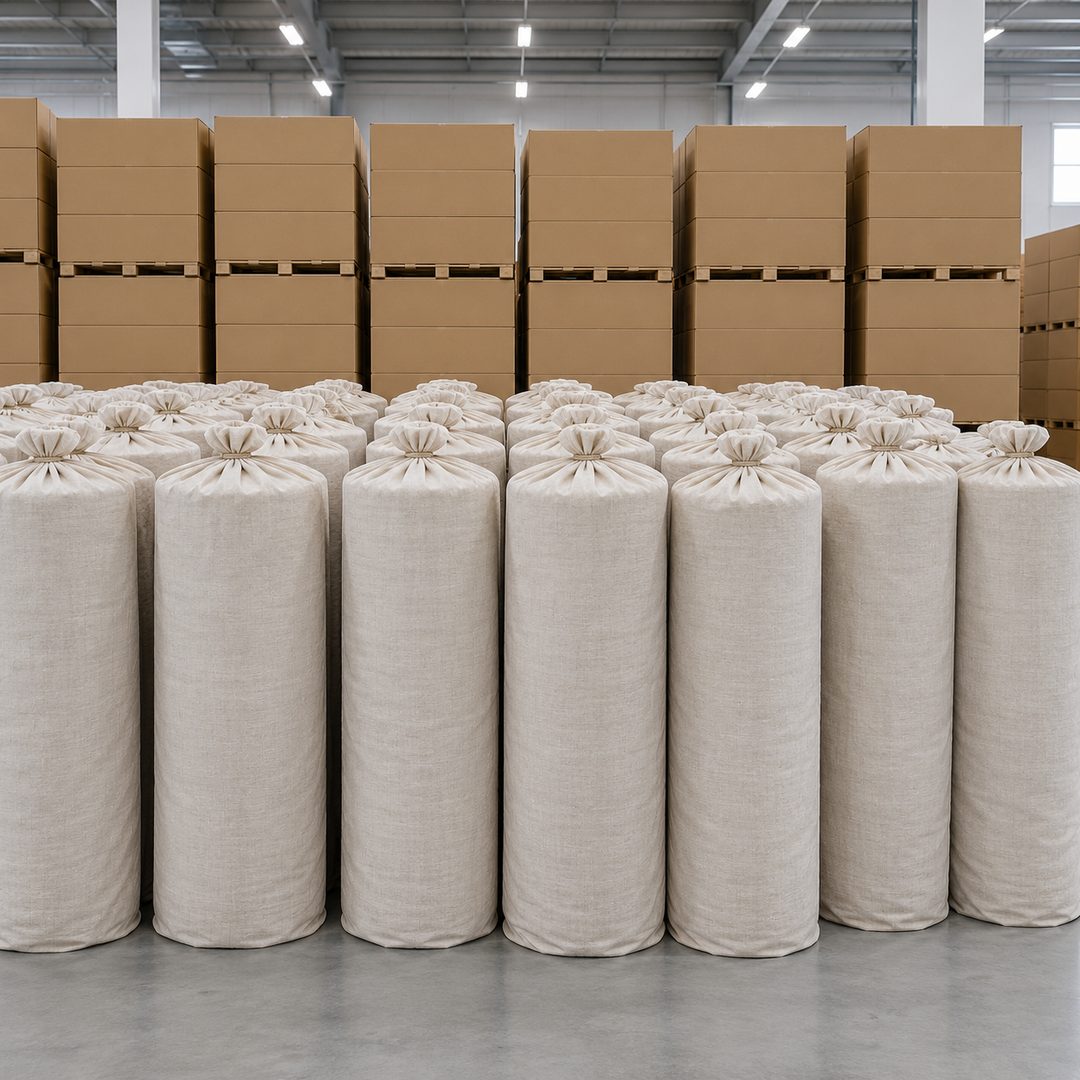
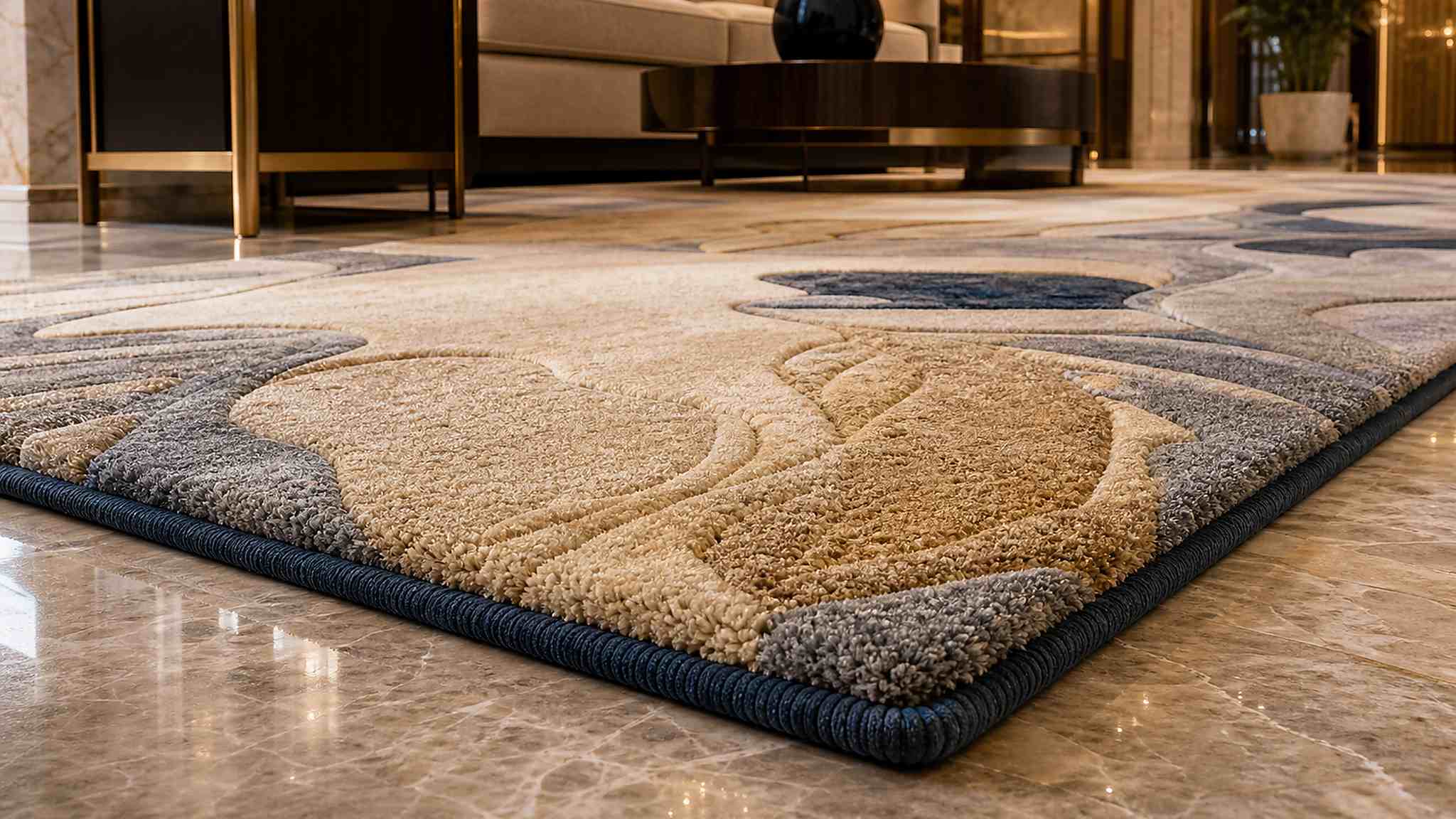
The face is a cut pile at 10 mm, sheared to an even top so stage lighting does not pick up banding. Printed colour sinks into the fibre, which softens the motif edge slightly and gives a matte finish across the floor. Each roll is 4 m wide, wound face in on a treated core and sealed in moisture-barrier film with batch number, register log and length on the label.
Ballroom installation normally uses tackless gripper with a felt underlay of 6 to 8 mm, and we send a seam placement drawing with the rolls. Lay drops in numerical order, keep the backing arrows pointing the same way, and allow 24 hours on site for the rolls to settle before cutting. LUCK Carpet makes this construction to order in Foshan, Guangdong.


Address
Shidaigongguan Building No.5 Office 1212, Haicheng east road, Duanzhou District, Zhaoqing City, Guangdong Province, China
Tel
Copyright © 2026 Zhaoqing Yunle International Trade Co., Ltd. All Rights Reserved.