News
Author: Young Lin | Role: Export & Project Planning Lead, Oneluck Carpet Factory | Updated: October 2026
Verified by our carpet production team, Zhaoqing | Broadloom, carpet tile & Axminster | Specification Data on Request
A carpet specification sheet decides whether a project receives the performance designed for it, or a product that merely looks similar. Six parameters control the result: fiber type, pile weight, pile height, tuft density, backing construction and dimensional tolerance. We recommend stating each one as a measurable value rather than a product name, because a brand reference removes your commercial leverage and still does not guarantee the performance you asked for. On our ranges, pile weight and pile height together define the construction, while the tolerance figure is what lets a site team verify the delivery against the document. In our experience the tension figure is the most commonly omitted line, and it is the first one a contractor asks for.
A carpet specification sheet decides whether a project receives the performance that was designed, or a product that merely looks similar. Buyers often copy a manufacturer's data sheet straight into the tender documents, which locks the project to one supplier and removes any commercial leverage later. The same shortcut also hides the parameters that actually carry the risk, because a copied sheet tends to list the flattering dimensions and leave the tolerances vague. We see this most often when a value engineered substitution is proposed and nobody can prove whether it meets the original intent.
This guide covers which parameters control carpet performance, how to write each one as a measurable requirement, and which tolerances to state so deliveries can be checked on site. It compares weak and strong wording for the six specification lines we review most often in tenders. It does not set out a universal specification, because the correct values depend on traffic, cleaning and subfloor conditions for each project.
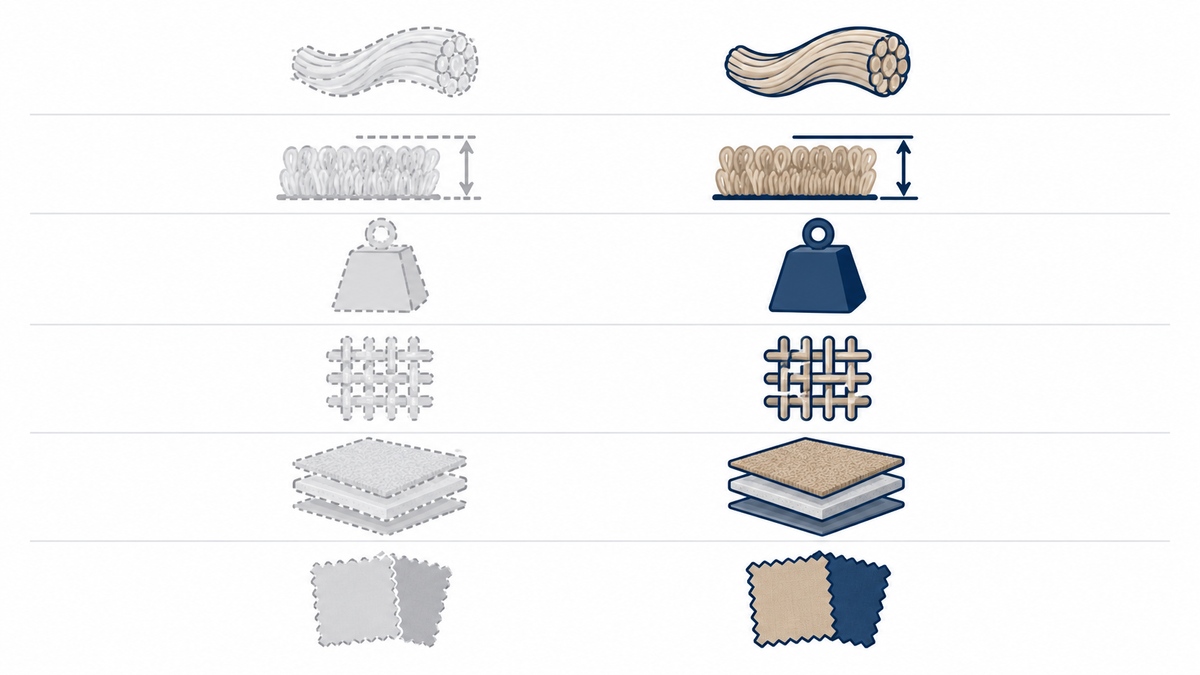
Figure 1: Weak versus strong specification wording across six carpet parameters. Source: Oneluck Carpet specification review records, 2026.
Every carpet specification sheet we review is built from the same six lines. The comparison below shows how the same requirement is written when it protects the client and when it leaves room for substitution:
| Specification Item | Weak Wording | Strong Wording | Why It Matters |
| Face fiber | Nylon or similar | 100% Solution-Dyed Nylon | Removes substitution risk |
| Pile weight | Heavy duty quality | Minimum 450 g/m² | Makes acceptance measurable |
| Pile height | Low pile | 4 to 7 mm | Controls comfort and wear |
| Backing | Stable backing | PVC compound with fiberglass scrim | Ensures dimensional stability |
| Tolerance | Good dimensional accuracy | Within 0.2% of nominal | Allows on-site verification |
| Color | Grey as shown | Pantone reference, Delta E 1.5 or less | Defines acceptable variation |
Pile weight should be stated as a minimum value in grams per square meter or ounces per square yard, and pile height as a range in millimeters. Our tufted broadloom carpet ranges from 4 to 10 mm in pile height and from 26 to 50 ounces per square yard in pile weight, while our Axminster woven broadloom ranges from 5 to 10 mm and from 1000 to 2000 g/m². Our Carpet Tile ranges from 3.5 to 7 mm and from 400 to 800 g/m². Stating both values together prevents a supplier from meeting the weight requirement with a construction that is too soft for the traffic the floor will actually receive.
Tuft density is the third line that belongs beside them. Our Axminster broadloom is woven at 7 rows per inch with approximately 85,000 to 100,000 individual tufts per square meter, while our Carpet Tile ranges from 140,000 to 200,000 tufts per square meter. Written into the specification, that figure stops a supplier from answering a pile weight requirement with a loose, tall construction that weighs the same but flattens within a year along a corridor center line.
Send us the draft specification and the intended application. Oneluck Carpet will return a marked up version showing which lines are measurable and which wording still allows substitution.
Request a Free Carpet Specification Review
The specification should name the backing system and the dimensional tolerance, because those two lines control stability after installation rather than appearance on the day of handover. Our Carpet Tile uses bitumen or PVC compound with fiberglass scrim and holds its dimensions within 0.2% of nominal size, which matters where humidity varies between air conditioned and service areas. A tile that moves outside that figure shows up as peaked joints and open seams long before the pile shows any wear, and by then the subfloor condition has usually been blamed instead of the backing.
Our broadloom ranges offer Action Back, Felt Back, Double Back and PVC Back, and our Axminster broadloom uses jute or synthetic woven backing. The choice between them follows from the installation method and the subfloor, so the specification line should pair the backing name with the method. PVC Back suits corridors and humid areas where the floor must stay flat under rolling loads, while jute backing suits traditional woven installations and synthetic woven backing adds moisture resistance where cleaning is frequent. Stating the backing without the method is one of the most common gaps we find, because the two are bought as a pair even though they are specified separately.
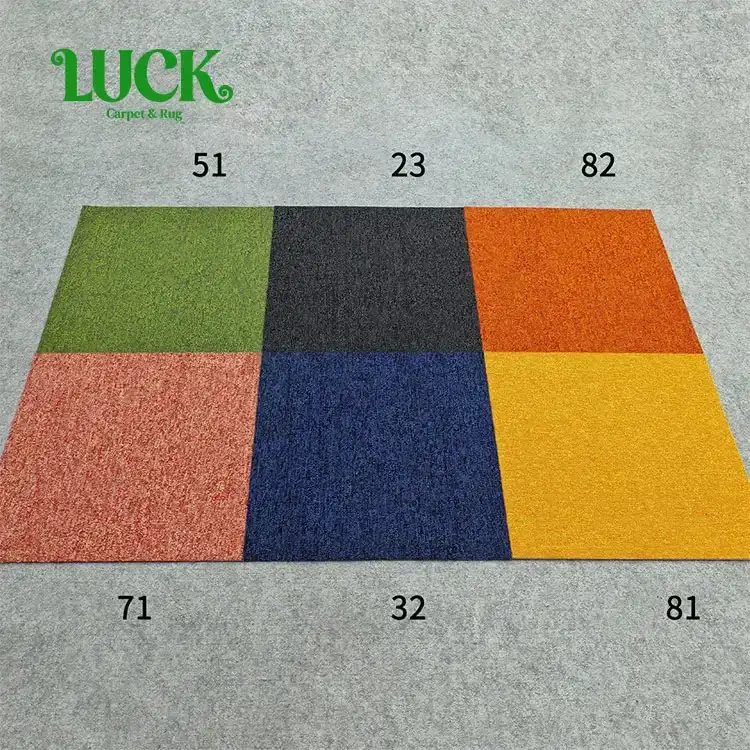
Color should be specified by a reference system plus a measurable tolerance rather than by a descriptive name, because a description cannot be measured on site. We hold color consistency at Delta E 1.5 or less on our Carpet Tile range and support Pantone matching for custom colors, which allows a project to define an acceptable variation objectively. Written that way, a delivered batch can be accepted or rejected against a number instead of an opinion, and a supplier knows exactly how much variation the design allows.
For woven broadloom we weave up to 12 colors per design at 7 rows per inch, so pattern complexity can be stated as a maximum color count. That single line protects the design intent without naming a supplier, because a competitor quoting the same floor has to match the color count and the row density rather than approximate the look. We also recommend retaining 3% to 5% attic stock from the original batch, and the specification sheet is the right place to record it, because attic stock bought from a later run will not match the original dye lot regardless of how it is stored.
Color approval is worth separating from color measurement. A sample approved under office lighting can read differently in a lobby with daylight and warm accent lighting, so where the design is critical we ask the client to approve the sample in the space rather than in a meeting room. Written into the specification sheet as a requirement, that step costs a day and prevents the most expensive form of color dispute, which is one where both parties are measuring correctly and still disagreeing about what they see.
1. State values, not adjectives: Replace heavy duty, low pile and stable backing with minimum pile weight, a pile height range and a named backing system, so every supplier quotes against the same measurable target.
2. Name the standard behind each number: Give the unit and the test basis for pile weight, pile height, tuft density and dimensional tolerance, so the delivery can be checked against the document rather than against a photograph.
3. Fix the color tolerance in writing: Specify a Pantone reference with a Delta E limit, and require a sample for approval, so acceptable variation is defined before production rather than argued about after delivery.
4. Record the attic stock allowance: Write the 3% to 5% spare allowance into the order itself, so the retained batch comes from the same production run as the installed carpet and can still be matched years later when a damaged section has to be replaced.
Can a specification avoid naming one brand?
Yes. State measurable performance values for fiber, pile weight, backing and tolerance, then allow suppliers to submit products that meet those values. That approach keeps the tender competitive while protecting the performance the project was designed around, and it gives you a defensible reason to reject a substitution.
What pile weight should a hotel corridor specification state?
Corridor projects in our range typically specify between 1000 and 1800 g/m² for woven broadloom, depending on traffic and construction. Dense nylon qualities are also common where the cleaning routine is aggressive rather than the traffic heavy, because the pile has to recover between cleaning cycles as well as between guests.
Should pile height be a single figure or a range?
A range is more practical, because production tolerances and the installation method both affect the finished pile height on site. A range also allows a supplier to meet the weight requirement without forcing an unnecessarily tall pile into a corridor where trolley wheels will flatten it.
How do we check the delivered carpet against the specification?
Compare pile weight, pile height, backing composition, tile dimensions and color tolerance against the values stated in the specification sheet. Where a project holds attic stock, check one roll or carton from that batch as well, since it may be installed years later after the original batch has been consumed by repairs.
Do you provide a technical data sheet for tenders?
Yes. We provide specification data covering fiber, pile height, pile weight, backing, tile or roll dimensions, tolerances and fire classification for the specified product. Send the application and traffic level and we will return the data sheet with the values already matched to your requirement, so the tender documents and the delivery refer to the same numbers.
Pile weight, pile height and tuft density ranges from our own carpet documentation.
Dimensional stability measured against nominal tile size on our Carpet Tile range.
Delta E 1.5 color tolerance with Pantone matching for custom colors.
Backing systems: Action Back, Felt Back, Double Back, PVC Back, jute and synthetic woven.
Does Carpet Pile Weight Determine How Long It Lasts? : how pile weight, height and density work as a set rather than as a single number.
Which Carpet Tile Backing Does Your Project Need? : matching non-woven, PVC, acoustic and moisture barrier backing to the subfloor condition.
How Do Carpet Importers Buy From a Chinese Factory? : color control, packaging and inspection terms for repeat order programmes.
Broadloom Carpet Collection : tufted and Axminster constructions with the pile weights and backings listed above.
Oneluck Carpet produces tufted broadloom, Axminster woven carpet and Carpet Tile, and issues specification data with pile weight, backing and tolerances named. Send your draft and we will mark it up.
Send Your Draft Specification for Review
Copyright © 2026 Zhaoqing Yunle International Trade Co., Ltd. All Rights Reserved.