Products

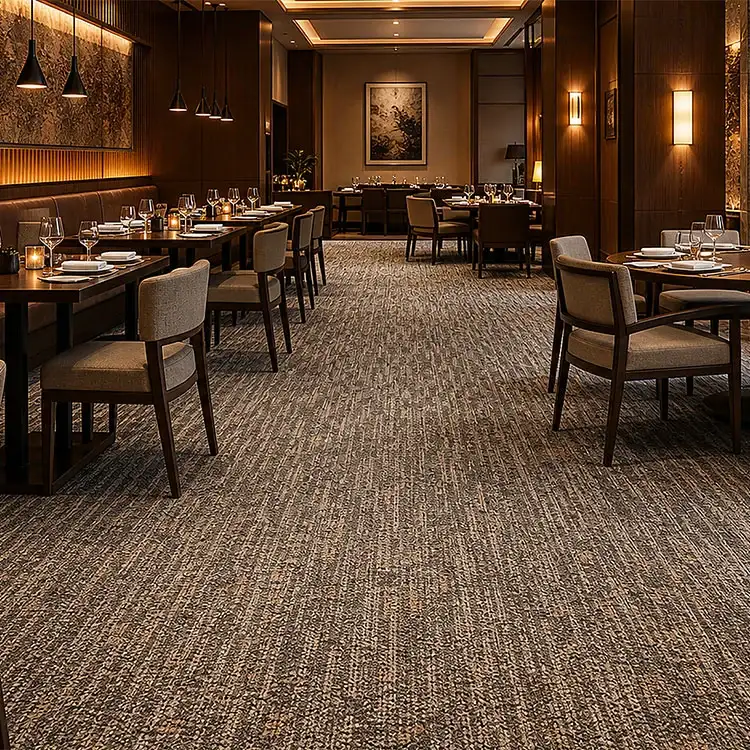
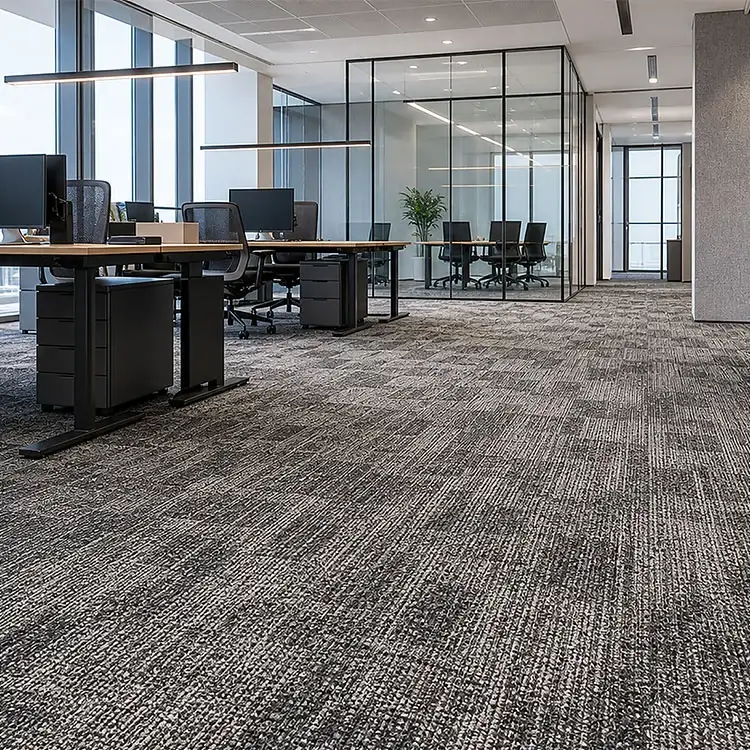
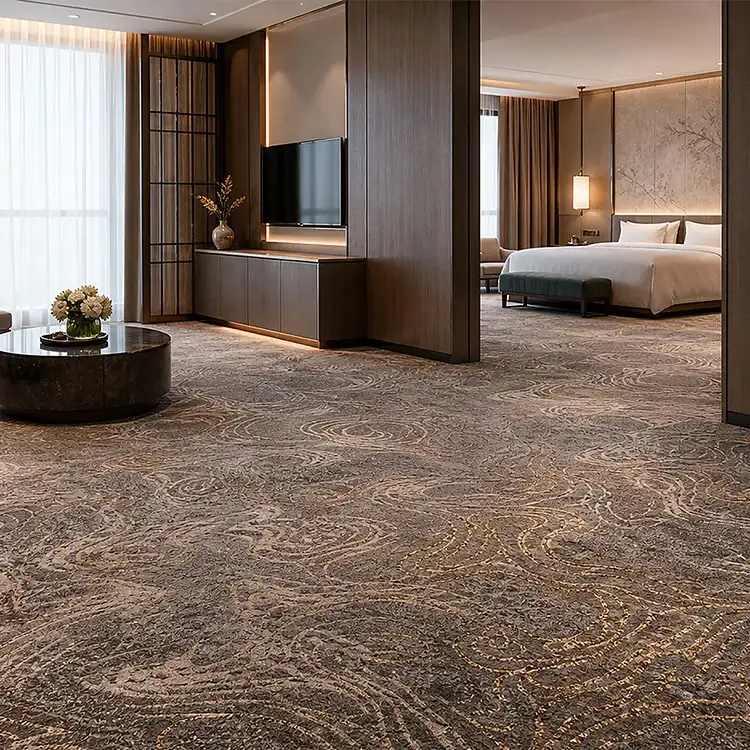
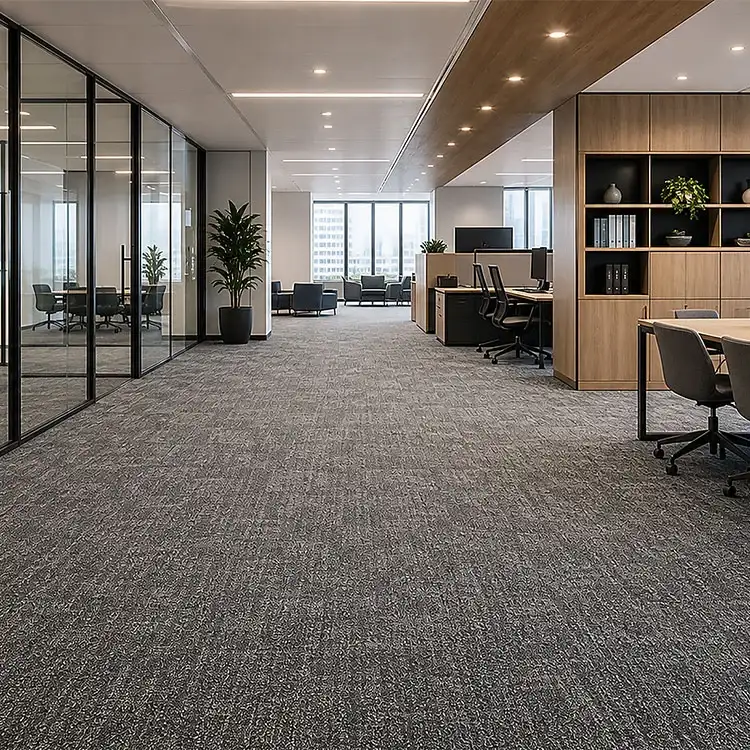
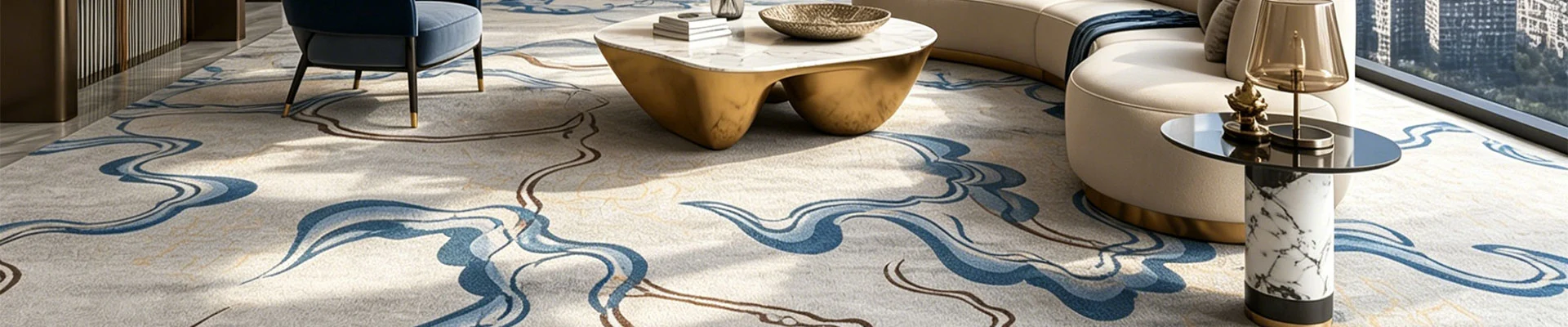
LUCK Carpet makes this tufted solution dyed yarn wall to wall carpet for financial interiors at our plant in Foshan, Guangdong. The polypropylene and polyester yarn is pigmented during extrusion, which is why the shade survives a trading floor cleaning cycle and a decade of daylight. Rolls come off our line as a cut pile at 5 mm on an anti-slip textile backing. Two demands shape this page: static control, and access to the void underneath.
Static build up is a system behaviour, not a carpet property. Charge gathers on the person, the chair and the floor, then leaves through whatever path to earth exists. A tufted textile floor with an anti-slip backing generates less charge than a polished hard floor, but it will not dissipate that charge either. Any supplier describing a standard broadloom as an anti-static floor is selling a word rather than a measurement.
What we specify instead is the assembly. A conductive underlay goes over the access panels, copper tape runs to the building earth, and the carpet is laid loose with the anti-slip backing holding it flat. Humidity is then held above the level at which charge accumulates on synthetic fibre. If a client needs a certified conductive floor tested to IEC 61340-4-1, this construction is not that product, and we say so.
A dealing room sits on raised access panels, and panels have to lift. Glue down carpet over a panel grid is a mistake we are asked to correct several times a year: adhesive bridges the joints, the panels behave as one floor, and lifting one means cutting the carpet above it. We specify loose lay over the anti-slip backing, cut to the panel module, so a technician lifts a section and lays it back.
Holding those cut edges together is the engineering task. Tuft bind measures to ISO 4919 at 42 N, backing laminate peel records 36 N/50 mm, and dimensional stability under ISO 2551 sits at 0.22 % length change after wet cleaning. Those three figures are why a loose laid section does not grow, curl at the edge or open a gap along the panel line after a year of air conditioning cycling.
Figures in the table come from rolls measured in our Foshan plant and are the values we accept on a purchase order. Fire classification is Bfl-s1 to EN 13501-1, supported by EN ISO 9239-1 and EN ISO 11925-2 reports. On a trading floor, read the backing row against your panel layout: it decides whether the floor can be opened at all.
Style Tufted Solution Dyed Yarn Wall to Wall Carpet for Financial
Yarn type Polypropylene / Polyester
Pile Height 5 mm
Pile Weight 700 g/m2
Backing Anti-slip textile backing
Fire Resistance Bfl-s1 (EN 13501-1)
Application Financial
Width / Size 4 m (13.1 ft) usable width
Pattern Custom design available (artwork supplied by buyer, strike-off approved before production)
Surface / Technique Cut pile
Financial interiors pull three ways at once. Equipment needs static controlled, the panel grid needs to stay accessible, and the room needs impact noise kept down so a dealing desk can hear itself across a divided screen. The sections below take those in turn: static dissipation on a carpeted floor, the three zones of a financial interior, and the cost of getting cable access wrong.
Charge control on a carpeted dealing floor comes from the assembly and the room, not from the pile alone. A conductive underlay bonded to a copper earthing grid gives charge a path off the floor, humidity control keeps generation low, and conductive castors close the loop between chair and floor. Remove one of those and protection drops, which is why we quote underlay, earthing and carpet as one package.
Melt pigmentation matters here for a dull reason. Solution dyed yarn carries no surface dye for a cleaning chemical to lift and no topical finish whose surface resistance changes as it wears. Rub fastness to ISO 105-X12 returns Grade 4-5, so the electrical behaviour designed into the assembly is not altered when a maintenance contractor switches to a stronger cleaner.
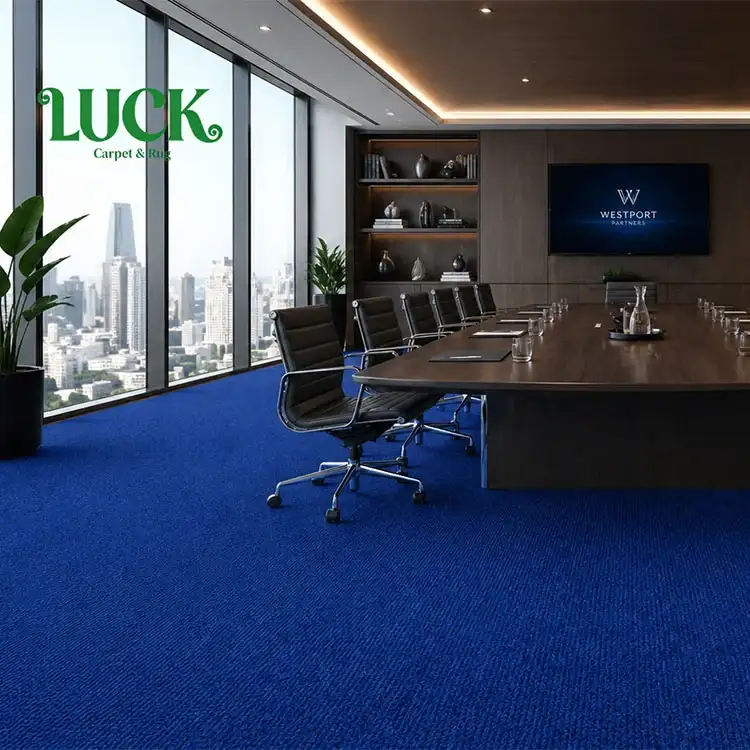
The dealing floor in Frankfurt, Germany that we return to in the case study below is the shape most of our financial work takes: an open trading room over a full cable void, a client suite at the perimeter, and a room next to the servers where the floor lifts most often. One carpet covers all three zones, and the only variable is the section size cut to the panel module.
Zone behaviour differs. A trading room needs thickness recovery where desks and chairs sit for ten hours, and static loading to ISO 3416 records 13 % loss, the figure to watch when a desk layout changes. A client suite needs appearance retention and a pile that hides footfall. The server room needs a floor that lifts in minutes, which loose lay gives and glue down takes away.
Two failures cost financial clients real money. The first is a floor that cannot be opened, discovered when a desk moves or a cable is added, then paid for as a cutting and patching exercise that never looks right. The second is static discharge into equipment, which seldom destroys a machine outright; it degrades boards and ports slowly, and the fault gets blamed on hardware.
Prevention is unglamorous and cheap. Loose laid sections over a conductive underlay, an earthing grid tested at handover, conductive castors, steady humidity, and one spare roll of the same lot in store for damage that happens anyway. Because the shade is locked inside the polymer, a section cut from that spare roll three years later will still match the dealing floor around it.
A wholesale bank in Frankfurt refitted its dealing room over an existing raised access floor: 2,600 m2 covering the trading hall, two client suites and a data-adjacent room. The order was 22 rolls. The brief set three conditions that usually conflict. The panel grid had to stay liftable without patching, static had to be controlled in a room full of screens and synthetic chairs, and impact noise had to stay out of the suites.
We supplied the carpet loose laid in panel modules over a conductive underlay, with a copper earthing grid taken to the building earth and tested before handover. Twenty months later the facilities team reports panels still lifting in minutes, no static complaints from desk users, and thickness loss of 13 % in the main aisle under ISO 3416. One spare roll on site has covered two cable additions without a visible patch.
Financial orders ship with a test pack. Our Foshan lab pulls a tuft from every shift and hangs it on the ISO 4919 rig; the trading floor grade has held 42 N or better across the last nine lots. Abrasion runs to ISO 12947-2 at 5 kPa, where this construction returns 36,000 rubs to defined change, while laminate peel is recorded at 36 N/50 mm and dimensional stability after wet cleaning is measured to ISO 2551 at 0.22 %. Impact sound reduction is reported to ISO 717-2 for the carpet and underlay as a system, with absorption measured to ISO 354. Fire classification is Bfl-s1 under EN 13501-1, emissions are Class A to GB 18587-2001, and the construction is classified under ISO 10874 and EN 1307.


It is not, and we will not describe it as one. The carpet is a standard commercial tufted construction; static control comes from the conductive underlay, the earthing grid and humidity held in a sensible band. What we can state plainly is that the backing and the yarn do not interfere with that system, and that we test the assembly at handover.
Yes, and that is how we recommend it for dealing rooms. Sections are cut to the panel module and loose laid over a conductive underlay, with the anti-slip backing doing the work that adhesive would otherwise do. Tight tolerances on the cut keep the joints closed, and dimensional stability under ISO 2551 is what keeps them closed through the seasons.
Panels lift by hand: the technician lifts the carpet section, works below, and lays it back in the same position and orientation. Pile direction is marked on the back of every section at installation so the piece goes home the right way round, because a section reversed on a cut pile reads as a shade change even from a genuinely identical lot.
Carpet is supplied as cut pile broadloom in a 4 m usable width, wound face in on a core and wrapped for container loading. For panel floors we cut to the module you specify and number every section against a layout drawing, so installation follows a plan. Edges are pre-trimmed and the backing is slip resistant on both faces, which lets a section sit flat without adhesive.
Colour is made to an approved strike-off, and custom patterns are available when artwork is supplied by the buyer and approved before production. Conductive underlay, copper earthing tape and installation guidance can travel in the same shipment. Allow three to four weeks for a stock shade and five to six for a new extrusion, with third party inspection here through SGS, Intertek or BV and an 8 year warranty on the face pile. Send LUCK Carpet your panel layout and earthing detail.


Address
Shidaigongguan Building No.5 Office 1212, Haicheng east road, Duanzhou District, Zhaoqing City, Guangdong Province, China
Tel
Copyright © 2026 Zhaoqing Yunle International Trade Co., Ltd. All Rights Reserved.