Products


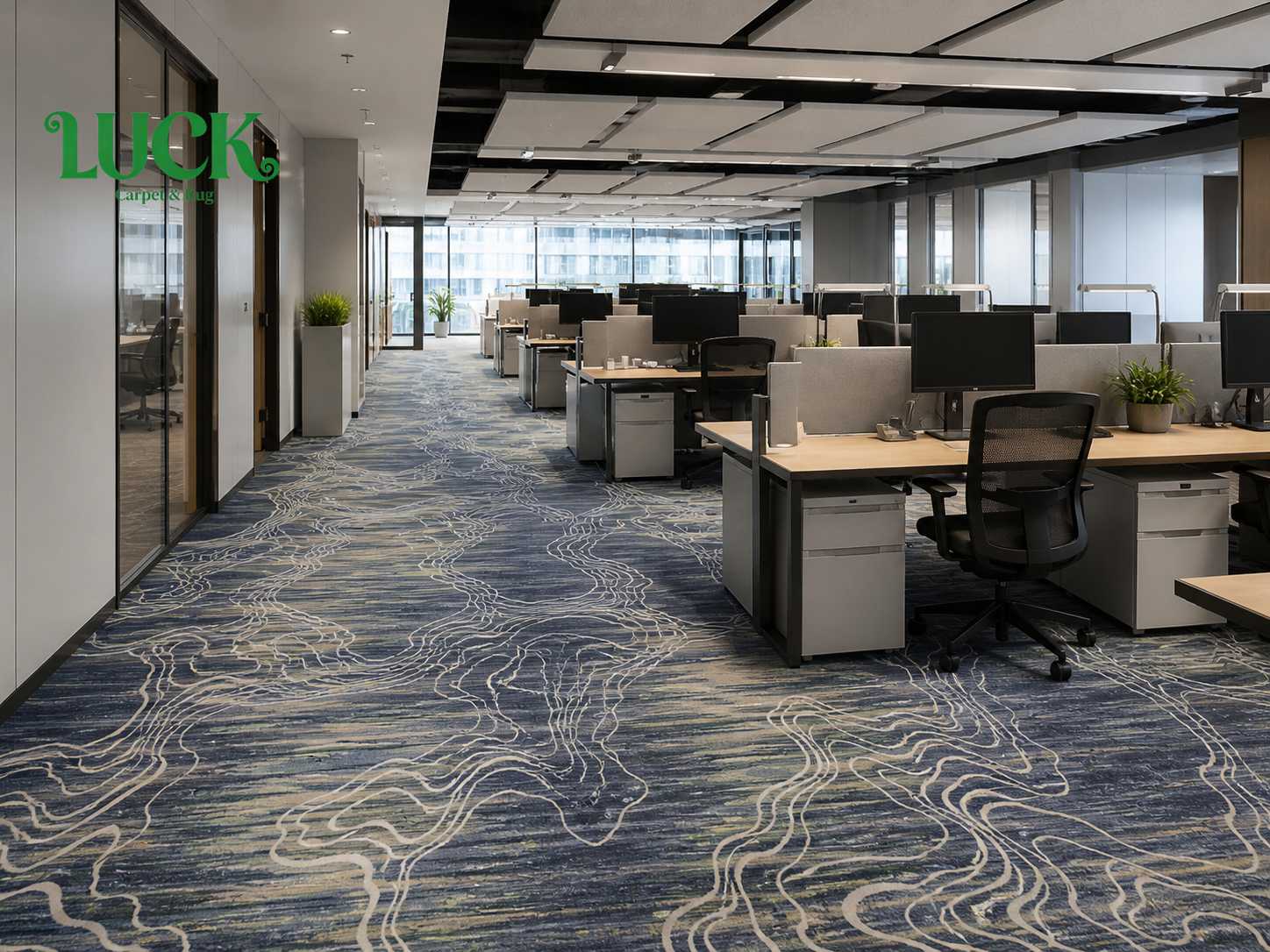
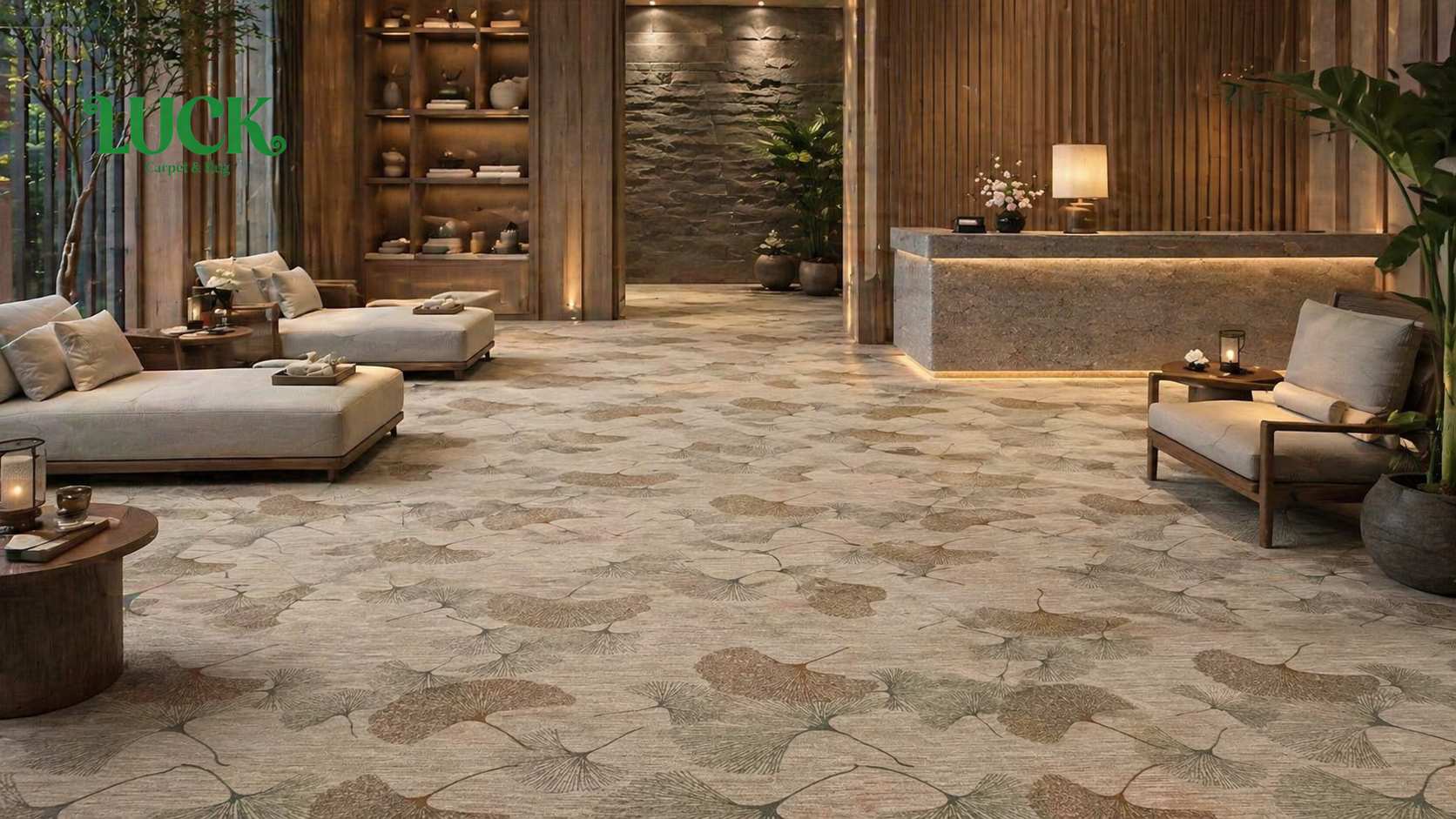
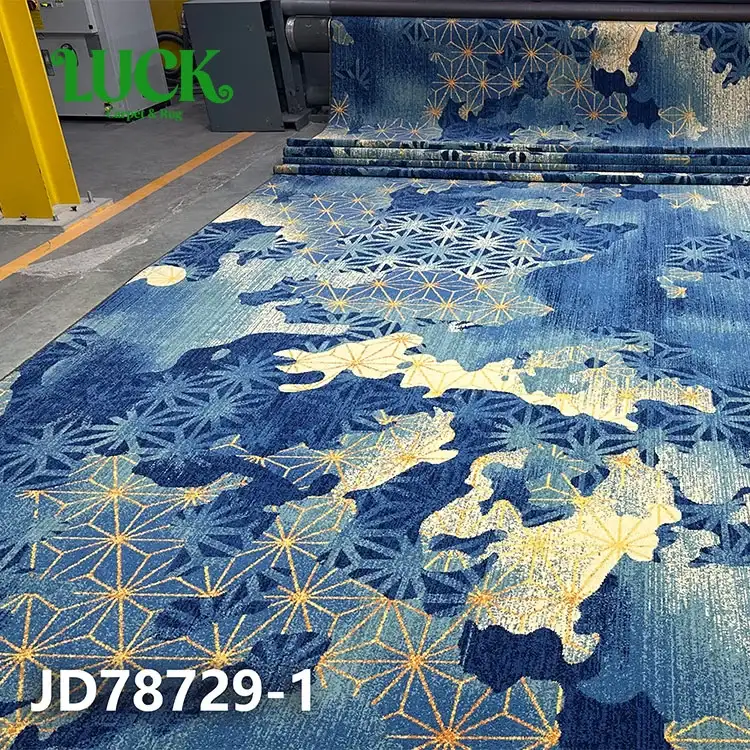
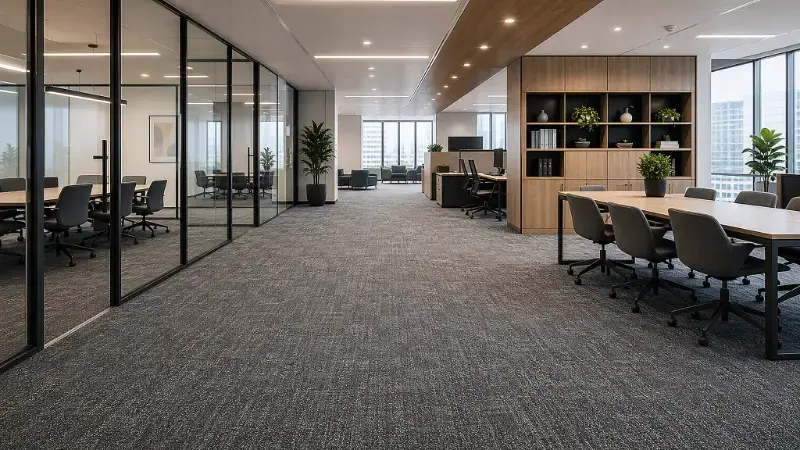
LUCK Carpet manufactures Axminster woven wall to wall carpet for hotels at our 26,000 m² plant in Foshan, Guangdong, with 180 staff and 14 years of export production. The face is a cut pile of wool and nylon at 7 mm and 1200 g/m2 over a natural jute backing, with every tuft inserted and cut as the loom runs. The pattern sits inside the carpet rather than on top of it, which is why designers specify this quality for hotel corridors, ballrooms and reception floors. This page covers the blend on the loom, the areas that suit the face, and how pattern length drives wastage.
Wool sets the hand, the density and the way light falls across a cut pile; nylon carries the abrasion. On an Axminster loom the two fibres are spun into one pile yarn before weaving, so the 80/20 ratio is fixed in the yarn and cannot be adjusted at the backing later. At that blend the face stays soft and deep in colour while the nylon supplies the tensile strength a cut tuft needs under a pivoting trolley wheel.
Cleaning behaviour comes from the same blend. Wool releases soil under hot water extraction, while the nylon share restricts dye transfer along a corridor wall. Our Foshan lab records Grade 6-7 light fastness to ISO 105-B02 and Grade 4-5 rubbing fastness to ISO 105-X12 on this construction, so a wine stain lifted with a spotting agent leaves no pale ring behind it.
An Axminster loom builds face and backing in one pass. Pile yarn is carried in clips, inserted into the warp and cut to a pre-set height as the loom advances, so nothing is tufted through a ready-made backing and nothing is printed afterwards. That explains the commercial behaviour of this product: a long pattern repeat and a precise multi-colour design are possible because the design is constructed, not applied. Pile height is held to plus or minus 0.5 mm across the roll.
Registration is the number a buyer should ask about. Our weave file is locked at strike-off, and a re-order lands within 3 mm of the original repeat, so replacing one corridor two years after handover is a repair rather than a re-carpet. The jute backing is laminated at 32 to 40 N/50 mm peel strength to keep the face flat over underlay.
Figures below are measured on the finished roll at our Foshan plant rather than quoted from a yarn supplier. Read the width row before the pattern row: the usable woven breadth dictates how repeats and seam positions are planned. Fire performance is a classification here, and the reports behind it ship with the order.
| Style | Axminster Woven Wall to Wall Carpet for Hotel |
| Yarn type | 80 % Wool + 20 % Nylon |
| Pile Height | 7 mm |
| Pile Weight | 1200 g/m2 |
| Backing | Natural jute |
| Fire Resistance | Bfl-s1 (EN 13501-1) |
| Application | Hotel areas |
| Width / Size | 4 m (13.1 ft) usable width |
| Pattern | Custom design available (artwork supplied by buyer, strike-off approved before production) |
| Surface / Technique | Woven (Axminster) |
Hotels do not buy carpet by the square metre. They buy the way a floor reads from the entrance door to the lift core, and how it looks in year six. One woven quality is asked to behave as a quiet corridor, a hard-used function floor and a brand statement on the same project. The sections below cover the look of the face, the areas that justify it, and the waste arithmetic.
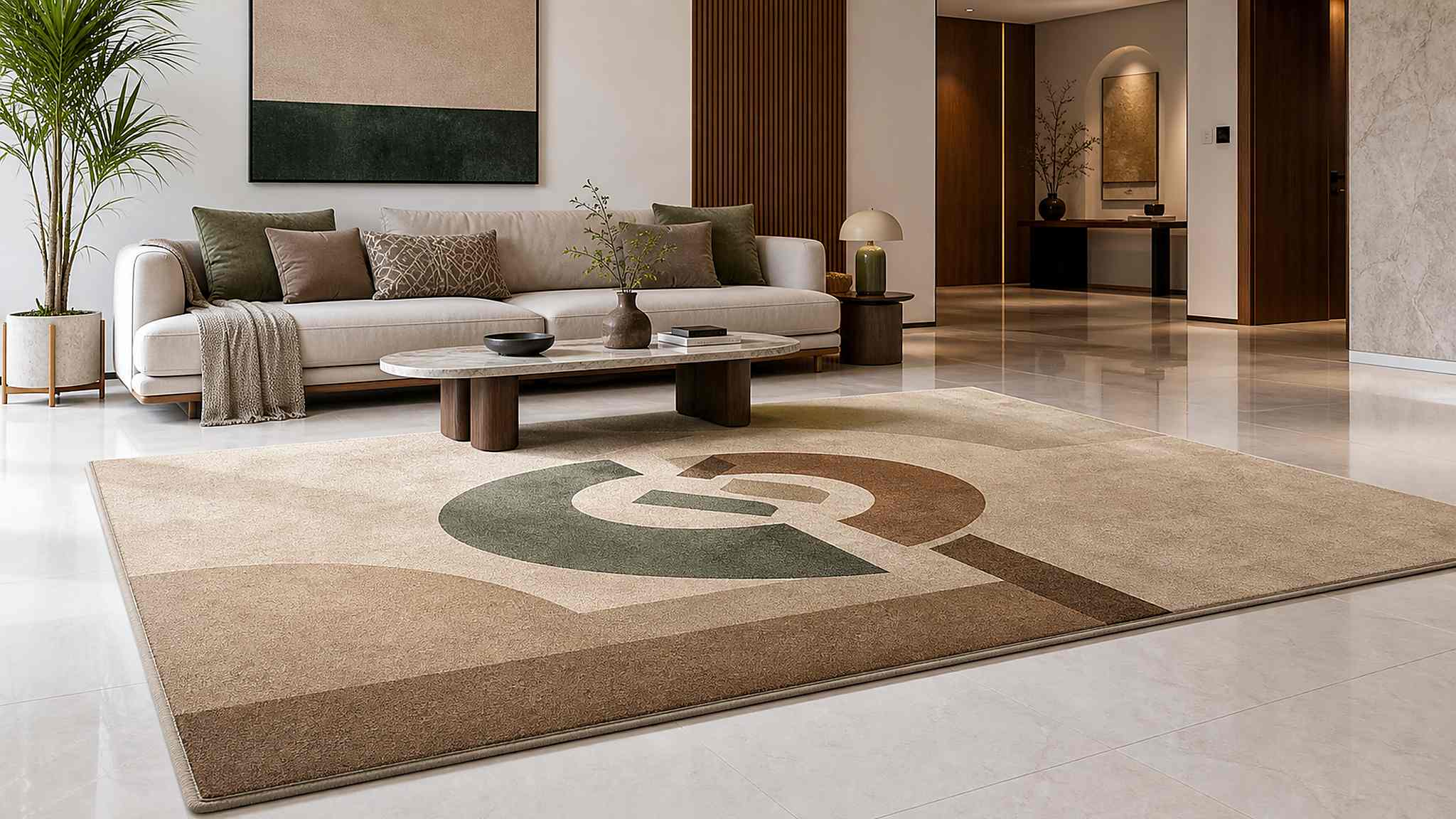
Tufted carpet is a pile pushed through a ready-made primary backing and locked with a latex coat, which gives a slightly soft surface with a faint direction to it. An Axminster face is assembled from individually cut yarn parcels, each standing at its own height, so the grain is finer and harder. A border stays a line and a crest stays legible.
Directional shading is the other practical gap. Tufted cut pile looks lighter walking one way along a corridor and darker walking back, because the pile leans as a sheet. On a woven face the pile is set during weaving, so a medallion in a ballroom foyer holds one colour from every approach. The loom can also carry a busy multi-colour design without the banding a printed surface shows.
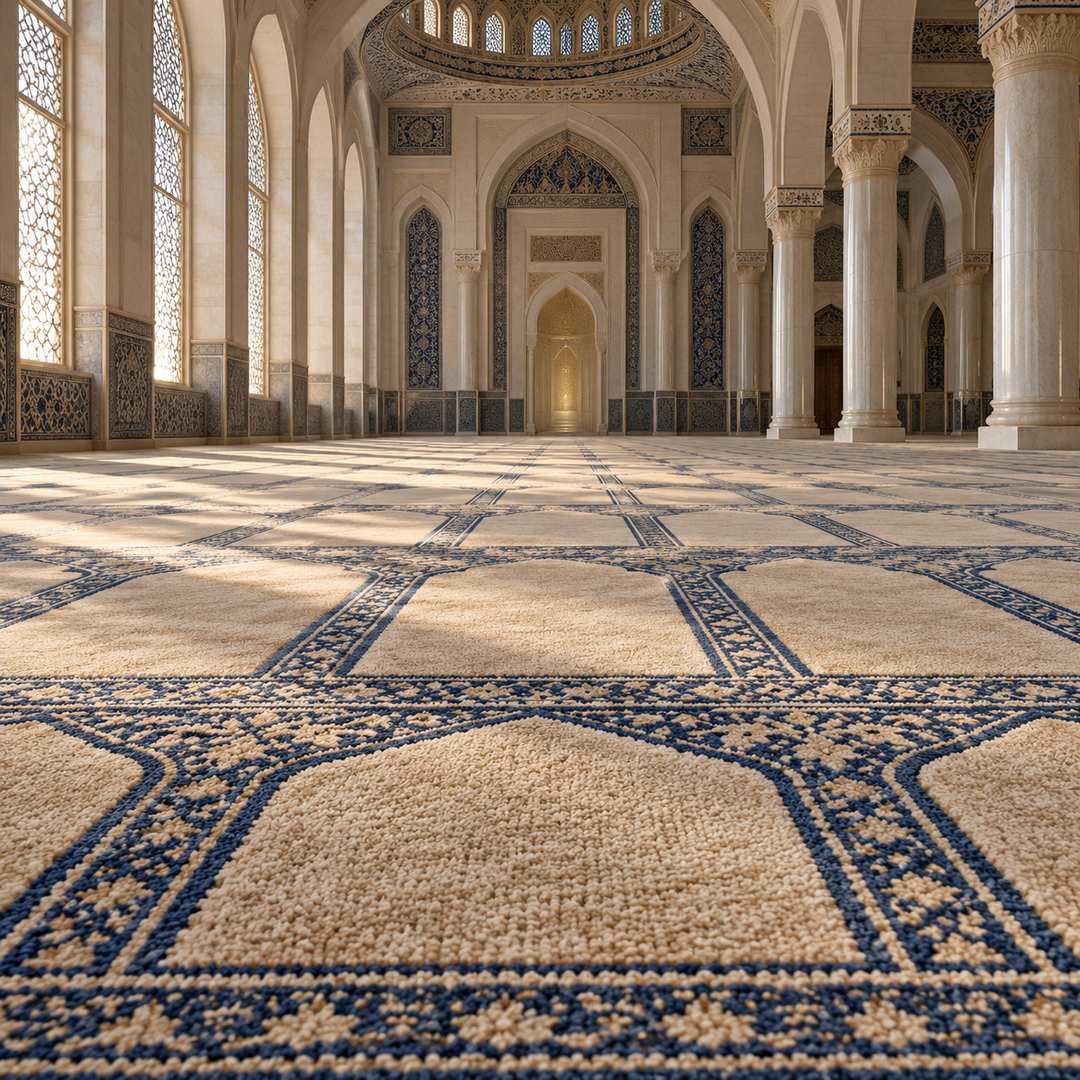
Ballrooms, pre-function foyers, the main restaurant and the floor behind a reception desk are where this quality earns its cost, because the pattern does work that paint and joinery cannot. Geometry matters too: the 4 m usable breadth trims to a 2.4 m guestroom corridor with one selvedge cut and covers a 12 m ballroom in three drops, keeping cross seams off the dance floor.
Back-of-house corridors worked by trolleys around the clock, staff stair landings and loading bays are better served by a tight loop tile, and a space cleaned with a rotary scrubber will punish a woven wool face. Guest bathrooms, spa wet areas and pool surrounds take no wool at all. Outdoor terraces and marquees are out of scope for the same reason.
Every woven programme is quoted on pattern repeat, not on floor area. If the design repeats every 1.8 m and the loom runs 4 m wide, each breadth carries two complete repeats and part of a third, and that part repeat is where the money goes. On a 900 m² ballroom, an 8 % waste factor is 72 m² of woven face that never reaches the floor.
Cut-and-join planning follows from that. Breadths are joined selvedge to selvedge with the pattern matched across the seam, so every drop carries an overlap allowance the installer trims back on site. We issue a laying plan with numbered drops, seam positions and the repeat start for each length. Crews who follow it report seams that disappear at one metre.
A 214-key hotel in London replaced 1,850 m² of corridor and lift-lobby carpet over eleven weeks without closing a guest floor. The brief asked for a custom damask carrying the operator's crest at each lift lobby, matched to a ballroom foyer border staying in service. We wove at the full breadth and cut drops to 2.2 m, which produced 18 rolls.
Pattern length protected the programme. The designer accepted a 2 m repeat instead of the 3.6 m originally drawn, which divides each breadth into two clean panels and cut waste from 11 % to 4 %. Eighteen months after handover the operator found no seam opening across the 14 join positions, and a 240 m² re-order for the club lounge matched the original weave.
Four test streams carry this specification: abrasion, colour fastness, dimensional stability and reaction to fire. Martindale runs to ISO 12947-2 at 5 kPa, and the last six batches of this quality averaged 46,000 rubs to defined change, inside the 40,000 to 60,000 band published for the woven family. Dimensional change after wet cleaning stays under 0.2 % length to ISO 2551. Fire classification is Bfl-s1 to EN 13501-1, supported by EN ISO 9239-1 and EN ISO 11925-2 reports. We publish no tuft bind figure, because ISO 4919 applies to tufted goods and this face is woven into the backing. Buyers who want an independent set of eyes can book SGS, Intertek or BV into the plant before shipment.


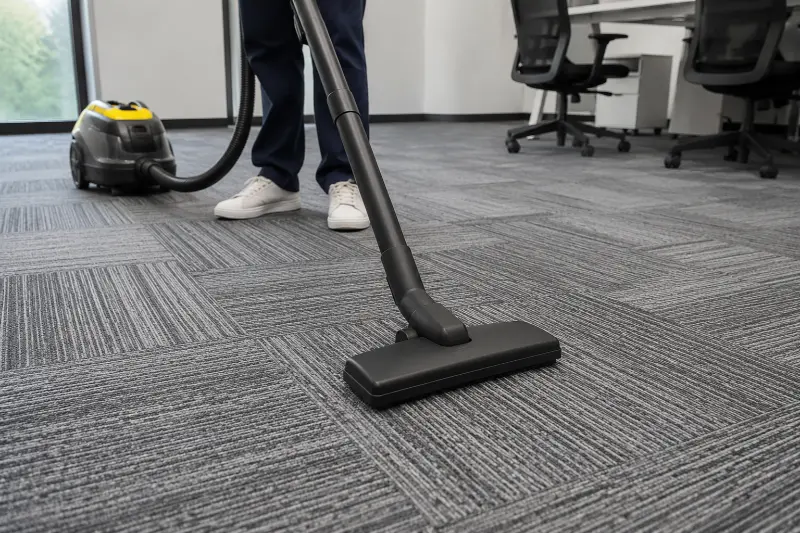
We warrant the face pile for eight years, and that is a floor rather than a ceiling. What decides the outcome is a mat well long enough to strip grit at the entrance, hot water extraction on a fixed cycle, and spare rolls held from the original order. Hotels that do all three reach a full refurbishment cycle without patching a single corridor.
Our weave file is kept on record, so a re-order is woven from the same design and yarn recipe rather than redrawn from a photograph. The repeat matches the original within the registration tolerance we publish, which is why we ask clients to store two spare lengths from the first delivery. A patched section then reads as part of the original floor.
Allow six to eight weeks of production from the approved strike-off, with artwork conversion and the physical strike-off adding roughly three weeks, then sea freight on top. A hotel with a fixed reopening date should freeze its design about three months out. Our minimum order is one loom run, quoted from the laying plan.
Colour sits inside the yarn, so a border reads as a solid line instead of a stippled one and pattern edges stay crisp where a light ground meets a dark ground. The face is a dense upright cut pile with the slightly dry hand a high wool content gives. Rolls are wound face out at the full woven breadth, both selvedges intact, each label carrying its length and drop number.
The jute backing accepts a standard tackless gripper or a full-spread adhesive over a 6 mm underlay, and on raised access floors we recommend adhesive with a pressure roller. Rolls ship wrapped and stood on end in laying sequence, with a spare length of the border colourway on orders above 1,500 m². Send the floor plan, the artwork and the fire requirement, and our team in Foshan returns a laying plan, a strike-off date and a firm price. LUCK Carpet, Foshan, Guangdong, China.


Address
Shidaigongguan Building No.5 Office 1212, Haicheng east road, Duanzhou District, Zhaoqing City, Guangdong Province, China
Tel
Copyright © 2026 Zhaoqing Yunle International Trade Co., Ltd. All Rights Reserved.