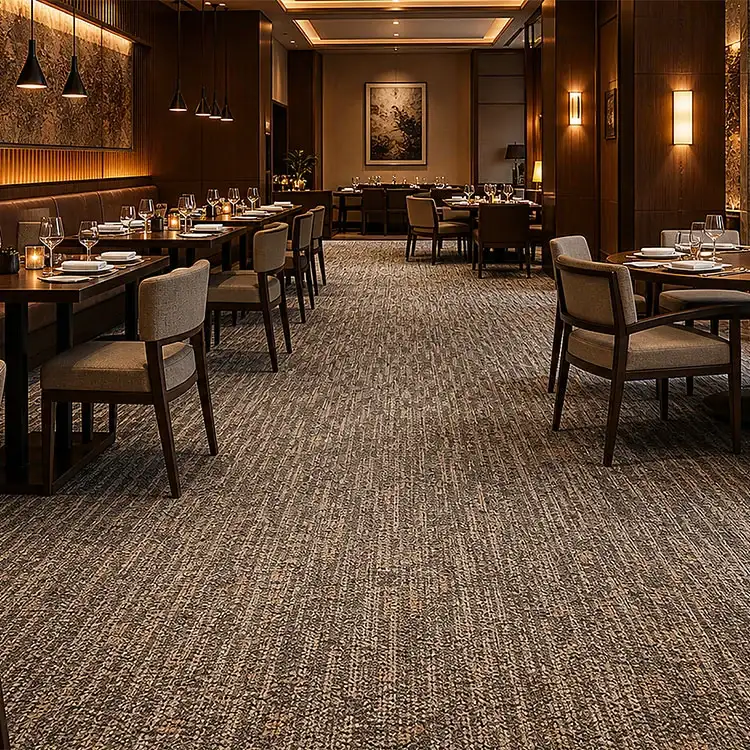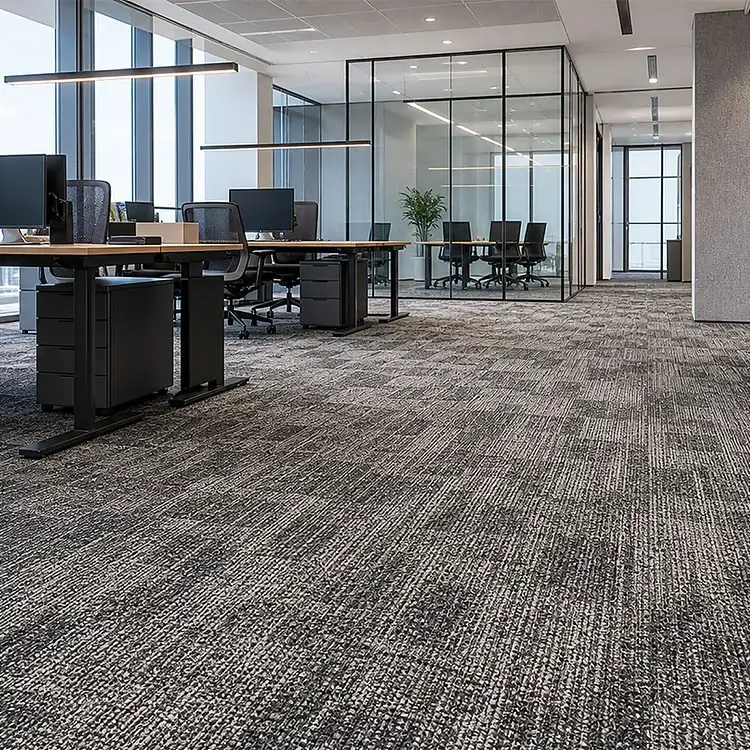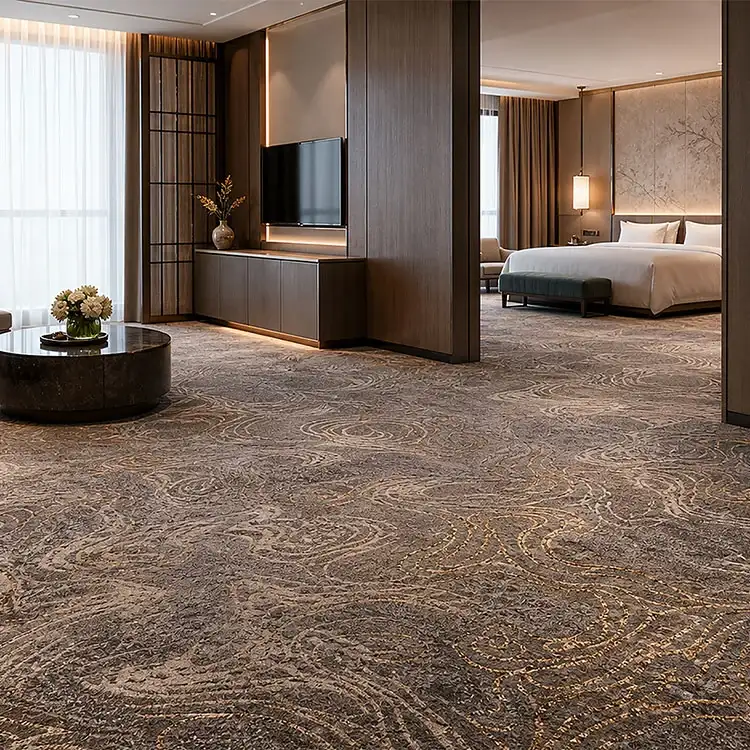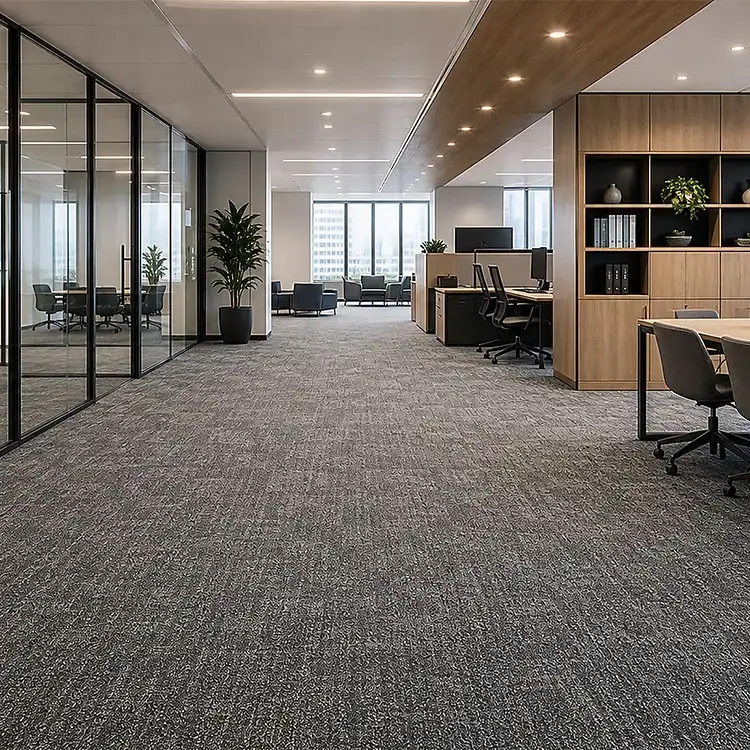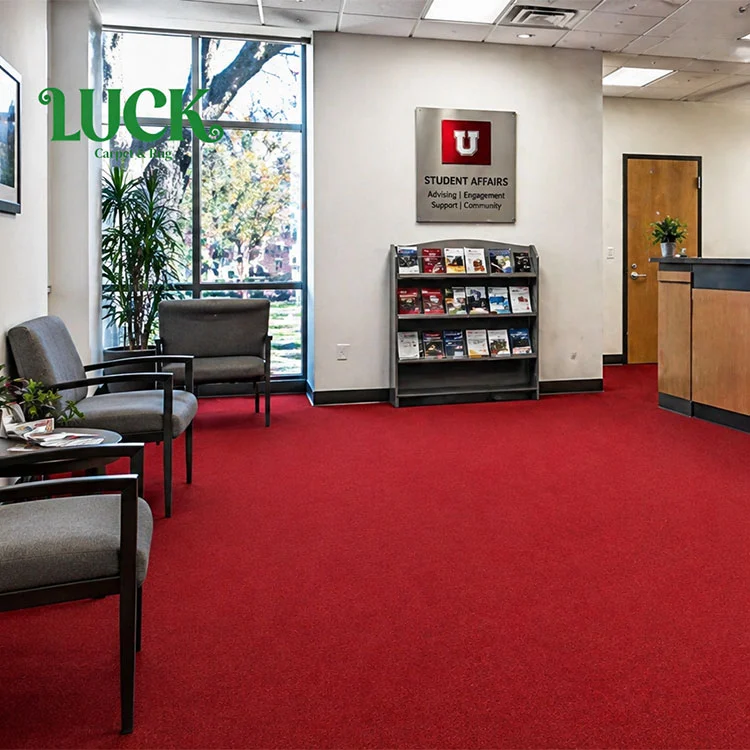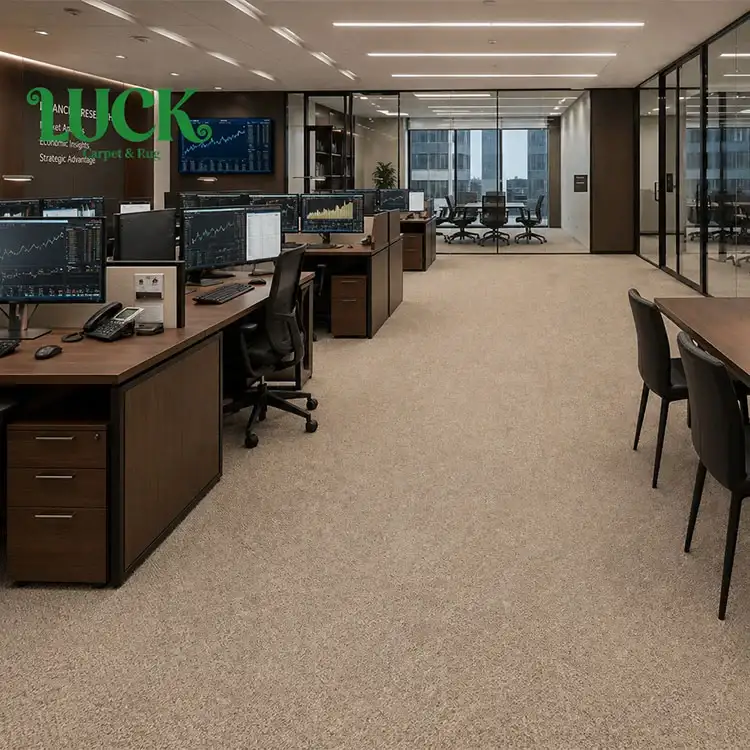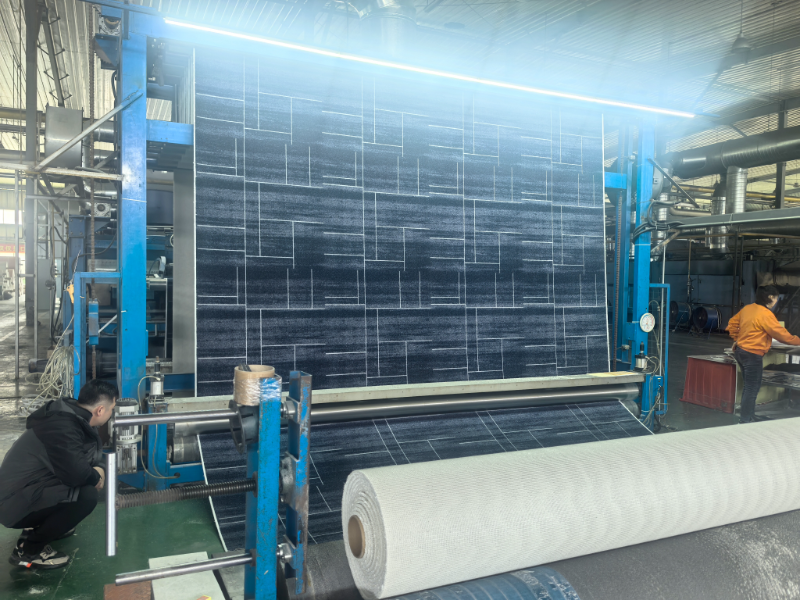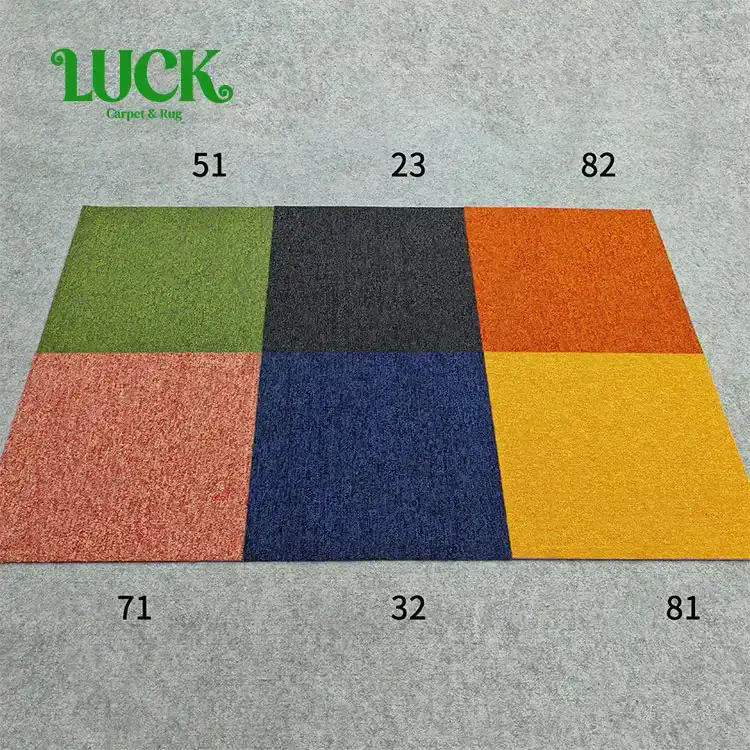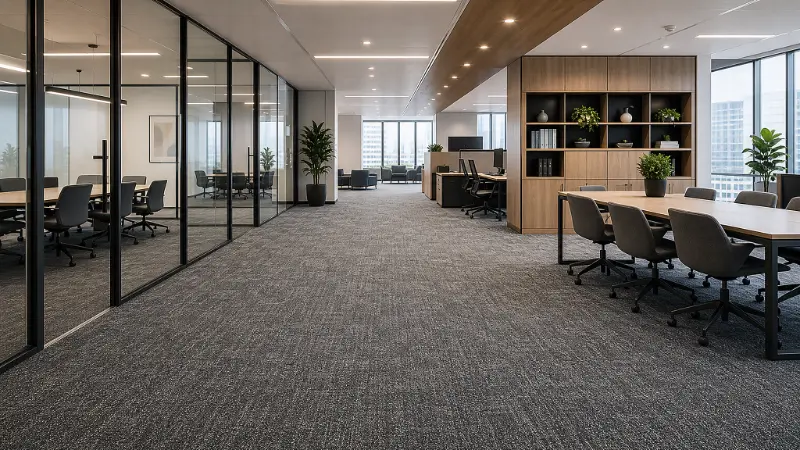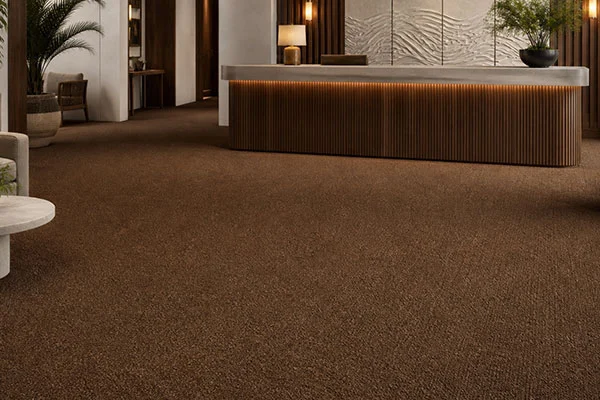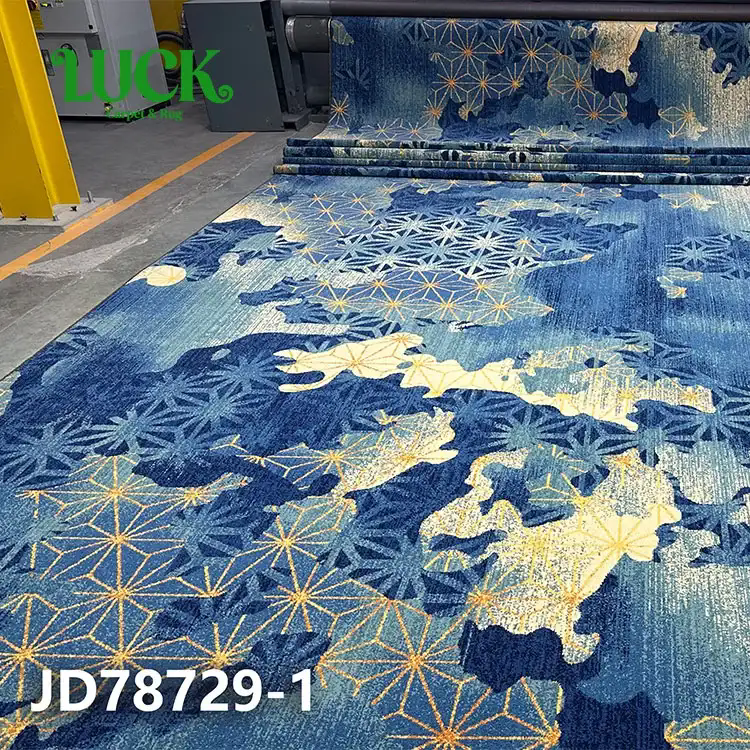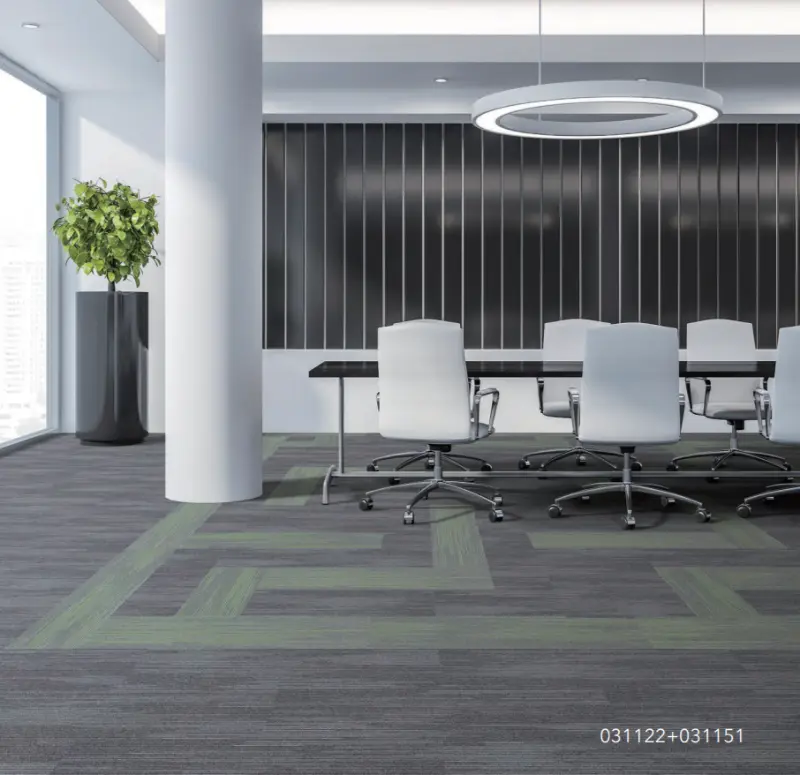
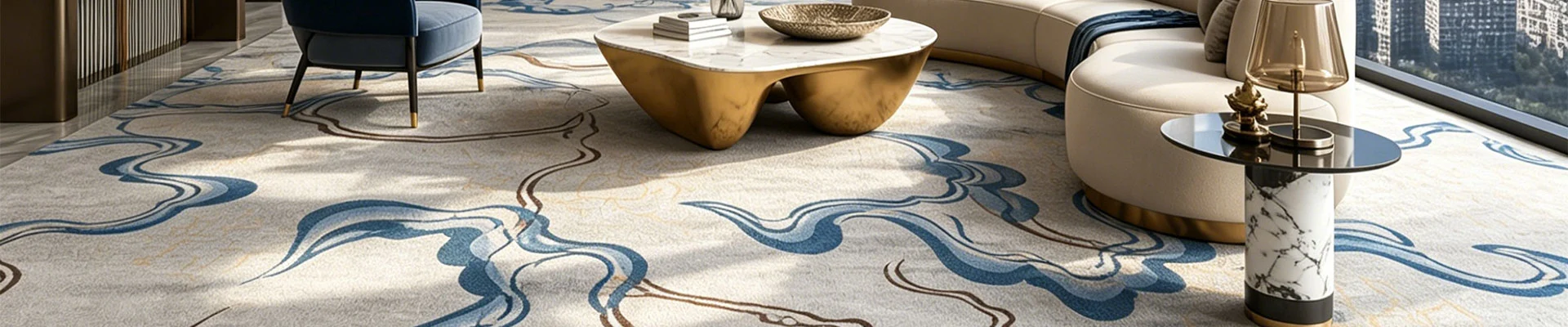
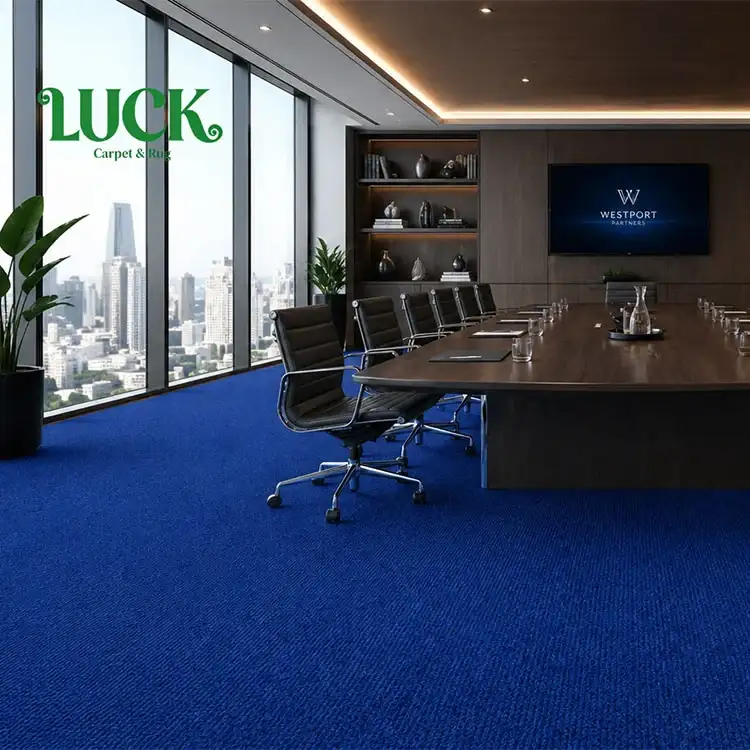
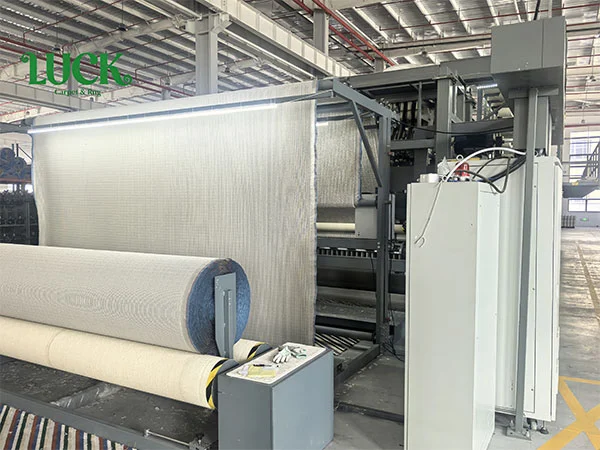
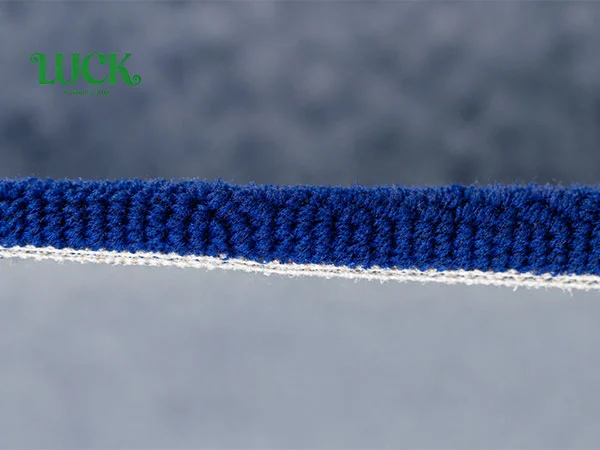
LUCK Carpet manufactures this tufted solution dyed yarn wall to wall carpet for boardrooms in Foshan, Guangdong, where extrusion, tufting, coating and final inspection sit under one roof. The polypropylene and polyester yarn is pigmented in the melt, so the shade belongs to the filament rather than to its surface, and the roll is finished as a cut pile at 5 mm on an anti-slip textile backing. This page is about speech that carries clearly and a build up low enough to leave doors working.
A boardroom is usually the hardest room on a corporate floor. Glass walls, a stone or veneer table, a raised access floor and a plasterboard ceiling leave very little to absorb sound, so voices bounce and the room develops a hollow drum effect that makes a speaker raise his voice. A textile floor interrupts that path at the largest surface in the room, and absorption here is tested to ISO 354.
Carpet alone will not create speech privacy, and any supplier who implies otherwise is overselling. What this construction does is shorten reverberation and cut impact noise from chairs and heels, and it does that better with our acoustic underlay, with impact sound reduction reported to ISO 717-2 as a system figure. If a client needs confidential speech containment, the ceiling, the partition and a masking system carry that load, and we say so.
Floor build up decides whether a boardroom refurbishment runs smoothly. A deep saxony plus a thick underlay can add enough height to foul a door leaf, expose a skirting shadow line and leave a table leg sitting on a step. This carpet finishes at 5 mm with the backing in the roll, so the gain over a bare screed is small enough that most existing door sets need no adjustment.
Low does not mean soft. Static loading to ISO 3416 records 9 % thickness loss on this construction, the lowest figure in our tufted family, and tuft bind measured to ISO 4919 holds at 43 N. A boardroom chair on hard castors puts its whole load through two small contact points, and a pile that recovers from that load decides whether the floor looks used or worn.
The table below is the specification we quote, measured on finished rolls in our Foshan plant rather than on a laboratory swatch. Fire performance is classified under EN 13501-1 and supported by EN ISO 9239-1 and EN ISO 11925-2 reports. Read the width row against your room dimensions before fixing a seam plan: an executive floor is usually cut to avoid a joint under the table.
| Style | Tufted Solution Dyed Yarn Wall to Wall Carpet for Boardrooms |
| Yarn type | Polypropylene / Polyester |
| Pile Height | 5 mm |
| Pile Weight | 700 g/m2 |
| Backing | Anti-slip textile backing |
| Fire Resistance | Bfl-s1 (EN 13501-1) |
| Application | Boardrooms |
| Width / Size | 4 m (13.1 ft) usable width |
| Pattern | Custom design available (artwork supplied by buyer, strike-off approved before production) |
| Surface / Technique | Cut pile |
Executive floors are small in area and unforgiving in detail. Three rooms may sit inside one refurbishment, each with different dimensions, door clearances and a table bought before the floor was chosen. The sections below take the three decisions that come up on nearly every boardroom project: the profile under the table, the wider executive floor, and the castor marking that decides year three.
A 5 mm profile is the reason this carpet suits a fitted boardroom. It clears the underside of a door leaf, sits below a glass partition base channel, and lets a table stand on the carpet without a visible height step. Because the backing is part of the roll and dimensionally stable to ISO 2551, finished height stays the same across the room instead of drifting where the substrate changes.
Thin floors expose their substrate, which is why the backing detail matters here. This construction uses an anti-slip textile backing that stays flat over screed, raised panels and existing hard floors without telegraphing the joints below. Installers can lay it direct with a pressure sensitive adhesive, and the seams close tightly enough that a table placed over a joint will not open it.
Our Foshan lab runs this construction through ISO 12947-2 at 5 kPa, and the boardroom grade has averaged 44,000 rubs to defined change. That figure is quoted to clients who ask whether a light coloured carpet can survive an executive floor where coffee is served four times a day. Colour comes from the polymer, so a spill blotted inside a minute leaves no mark.
The Amsterdam, Netherlands project we describe in the case study below covers an executive floor rather than a single room: three boardrooms, a reception area and a corridor, all cut from six rolls of one lot. Interior designers we meet at Shanghai Hospitality Design Week raise the same phasing question, because one room usually stays in use while another is fitted. Cutting every room from a single run stops a phased programme from producing three subtly different rooms.
Castor marking is the most common complaint on a boardroom floor, and it rarely comes from the carpet alone. A fixed table with a heavy pedestal base concentrates load in a small area, and a chair that pivots in the same arc every meeting leans the pile one way. Under low angle light, that lean reads as a ring of shadow around the table.
Three details control it. Pile density gives the tuft something to spring back to, and static loading to ISO 3416 keeps the recovery deficit at 9 % on this grade. Castor type matters as much as the carpet, so specify soft tread castors for executive chairs. Regular vacuuming with a rotating brush lifts the pile between meetings, and a floor this dense comes back with the brush rather than needing replacement.
Amsterdam, Netherlands was the site: a listed office building refurbished for a professional services firm, where the executive floor was rebuilt around three boardrooms of different sizes plus a reception gallery and a linking corridor. The area was 640 m2, supplied as six rolls from one production run. The brief asked for one continuous appearance, no change to existing door heights, and a surface quiet enough for a twelve person meeting with a speakerphone.
We cut all three rooms from the single lot, ran the seams clear of every table position, and specified the acoustic underlay under the two largest rooms. After two years the castor lane thickness loss measures 9 % under ISO 3416, below the figure we publish as typical, and no door leaf or threshold was altered during installation. Meetings no longer need the speakerphone turned up beyond its normal setting.
Boardroom orders are released against a test pack. Abrasion runs to ISO 12947-2 at 5 kPa, tuft bind is pulled to ISO 4919, laminate peel is recorded in N/50 mm and dimensional stability after wet cleaning is measured to ISO 2551, where this construction holds at 0.15 % length change. Acoustics are reported to ISO 354 for absorption and ISO 717-2 for impact sound reduction when the underlay is included. Fire classification is Bfl-s1 under EN 13501-1, indoor air emissions are Class A to GB 18587-2001, and use classification follows ISO 10874 and EN 1307. Ask any supplier to separate carpet performance from system performance.
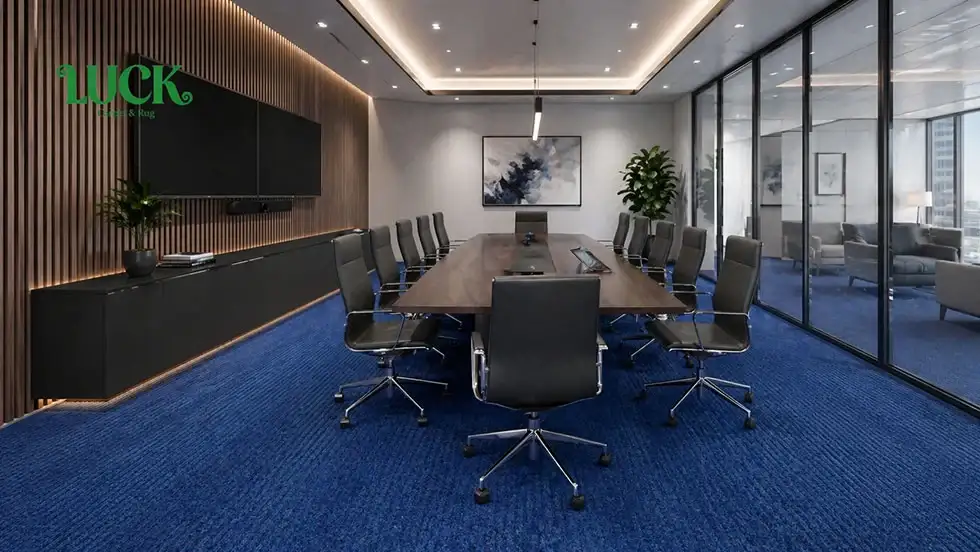
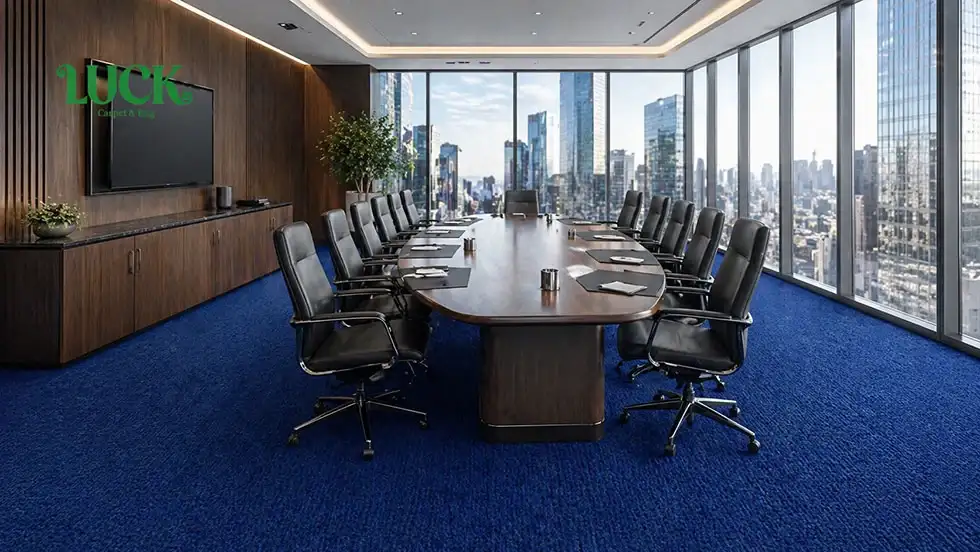
Reverberation drops noticeably because the floor is the largest uninterrupted surface in the room, and impact noise from chairs and heels falls further with the acoustic underlay, measured to ISO 717-2 as a system. Speech privacy between rooms is a different problem, solved by the partition, the ceiling and masking, and we will not claim it for a floor.
Yes. Laid direct over screed or access panels, the pile still absorbs mid and high frequencies and softens footfall, which is enough for most boardrooms. Add the underlay where the room sits above another occupied space or where a raised floor amplifies impact noise. It raises the finished floor height slightly, so check door clearances first.
Send the room dimensions and door positions at enquiry stage and we will produce a cutting plan before the order is placed. Rooms are nested across the usable width so offcuts from the largest boardroom become the corridor or a small meeting room. One production run for the whole floor also removes the shade risk that comes from buying rooms separately.
Broadloom is supplied in a 4 m usable width, wound face in on a core and wrapped for container loading, with pre-trimmed straight selvedges for tight butt joints. The surface has a firm, dry hand and a low sheen, which keeps reflections off a boardroom table and stops a dark shade reading grey under downlights. Pile direction is marked on every roll so the run stays consistent.
Colour is made to an approved strike-off, and custom patterns are available when artwork is supplied by the buyer and approved before production, which lets a firm tuft a mark or a wayfinding band into the pile. A stock shade is ready to ship in about four weeks, and a new colour adds two weeks for extrusion and strike-off, with third party inspection available here on request. The face pile is covered by an 8 year warranty. Send LUCK Carpet your room plan and table positions for a cutting plan.
Address
Shidaigongguan Building No.5 Office 1212, Haicheng east road, Duanzhou District, Zhaoqing City, Guangdong Province, China
Tel
Copyright © 2026 Zhaoqing Yunle International Trade Co., Ltd. All Rights Reserved.