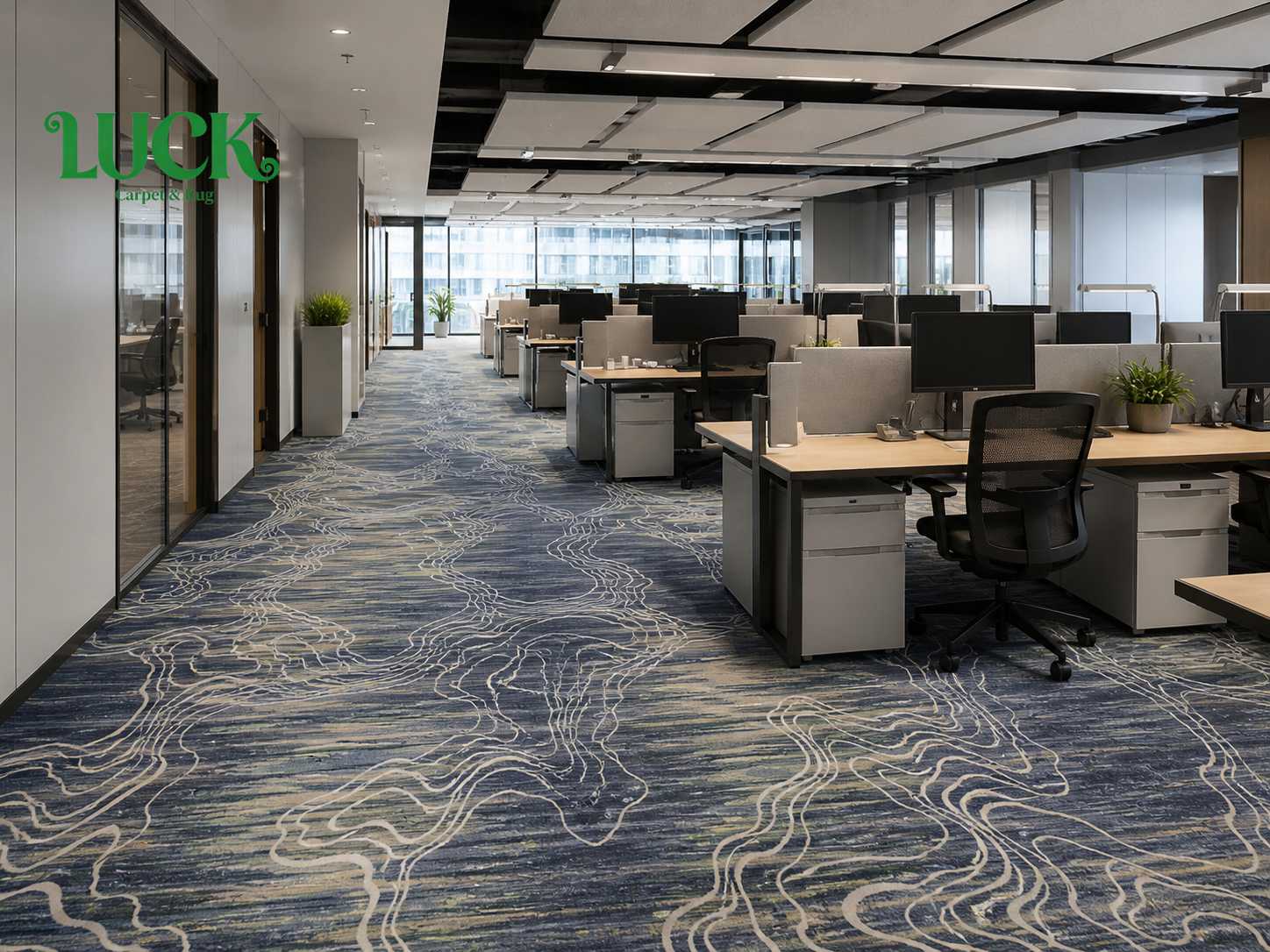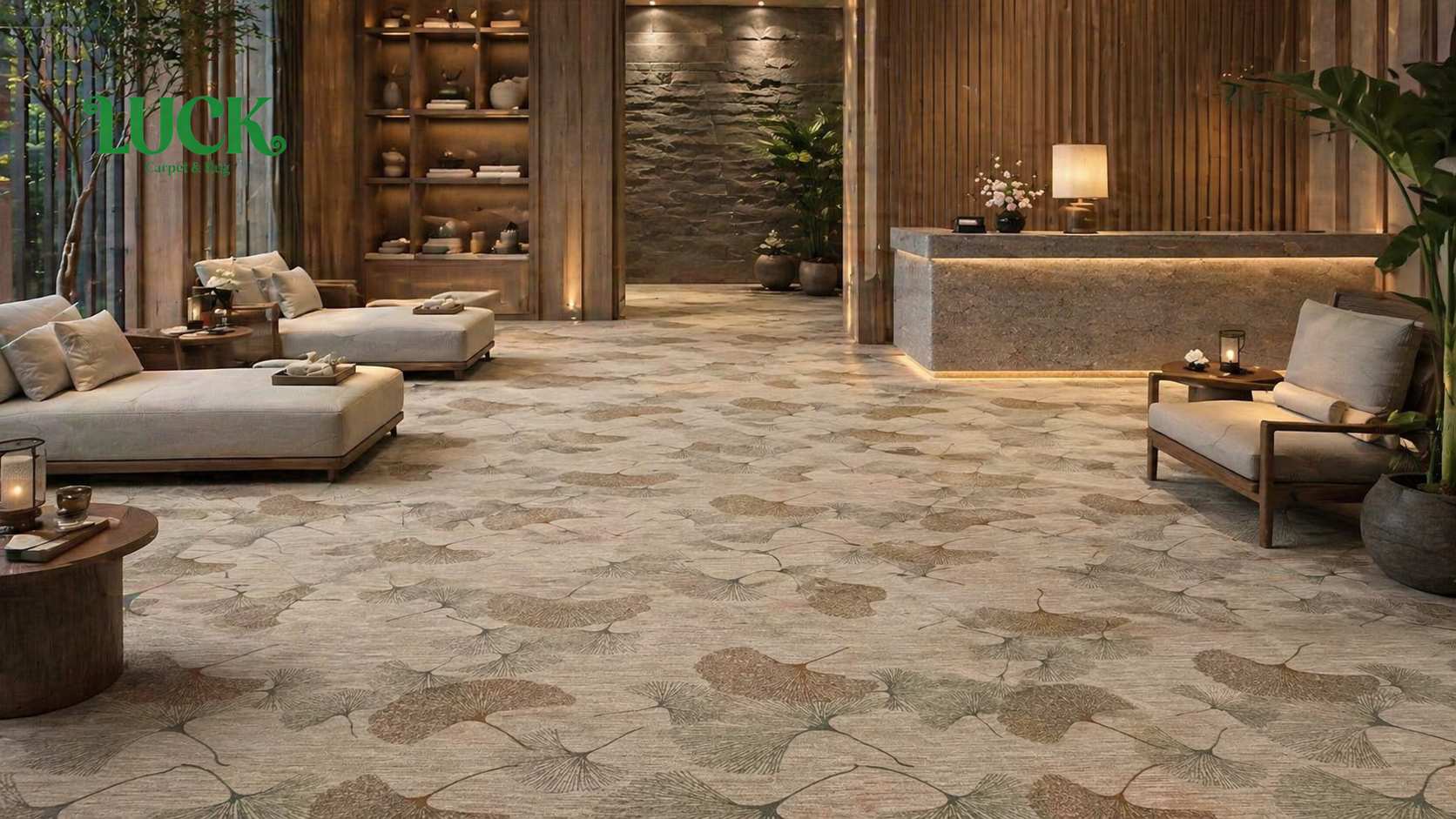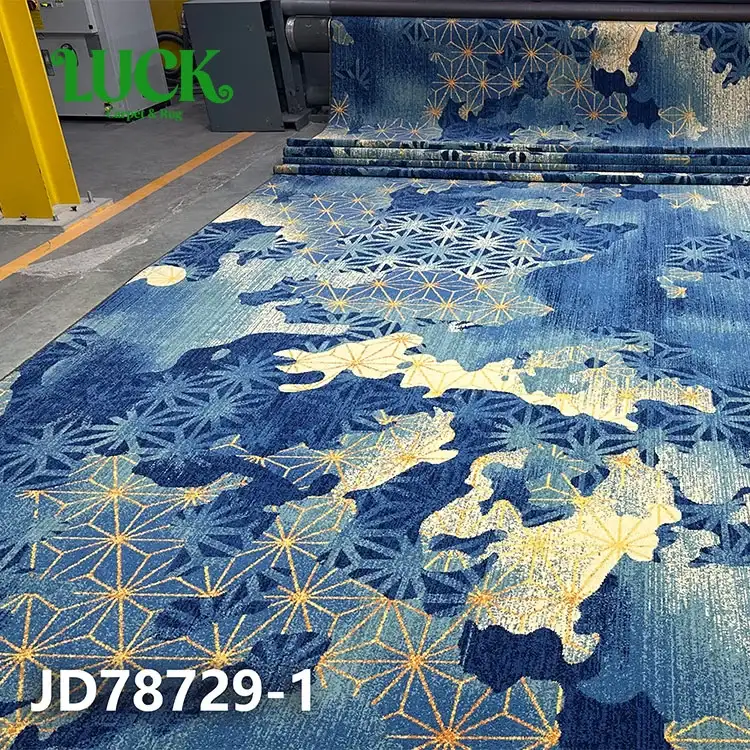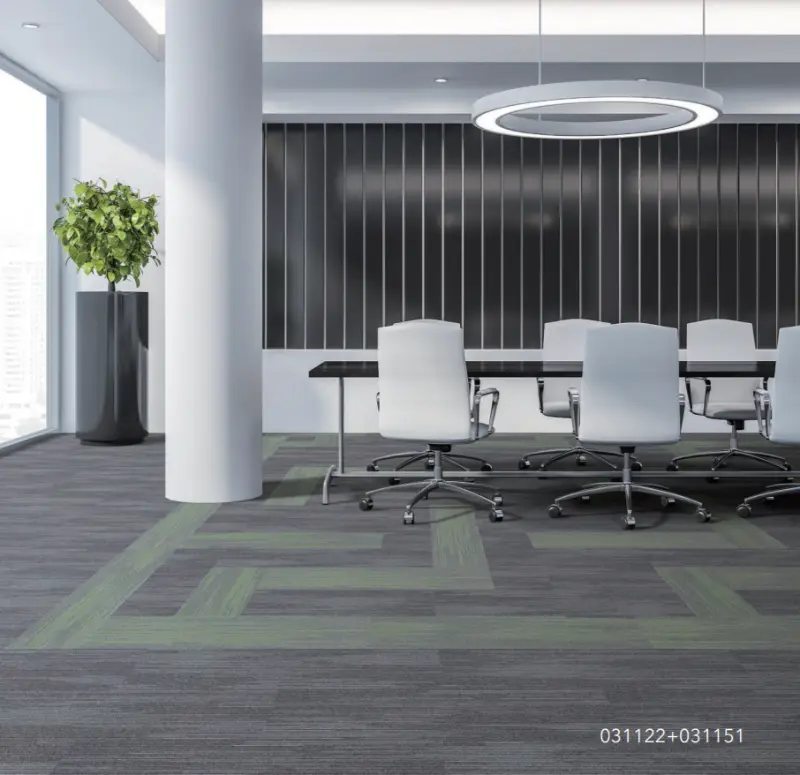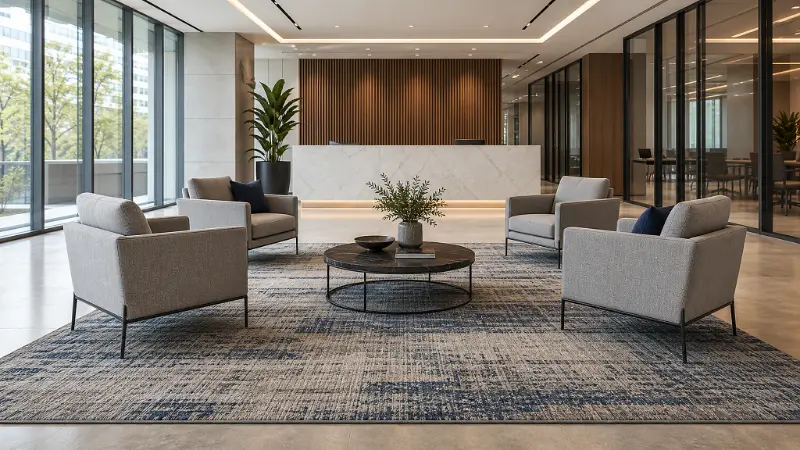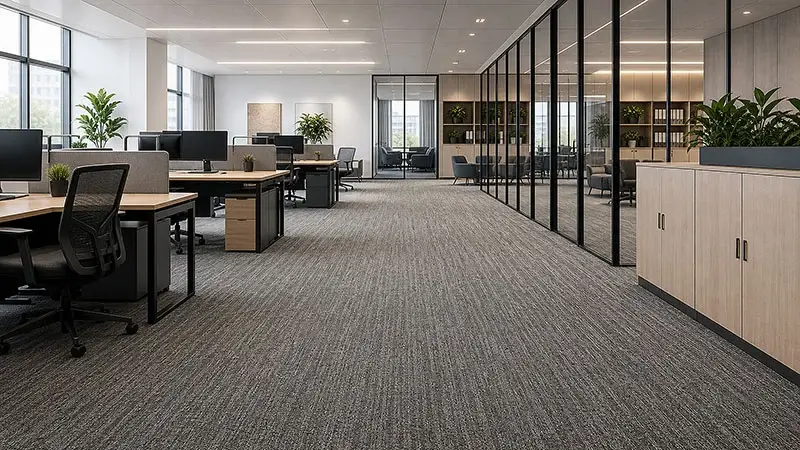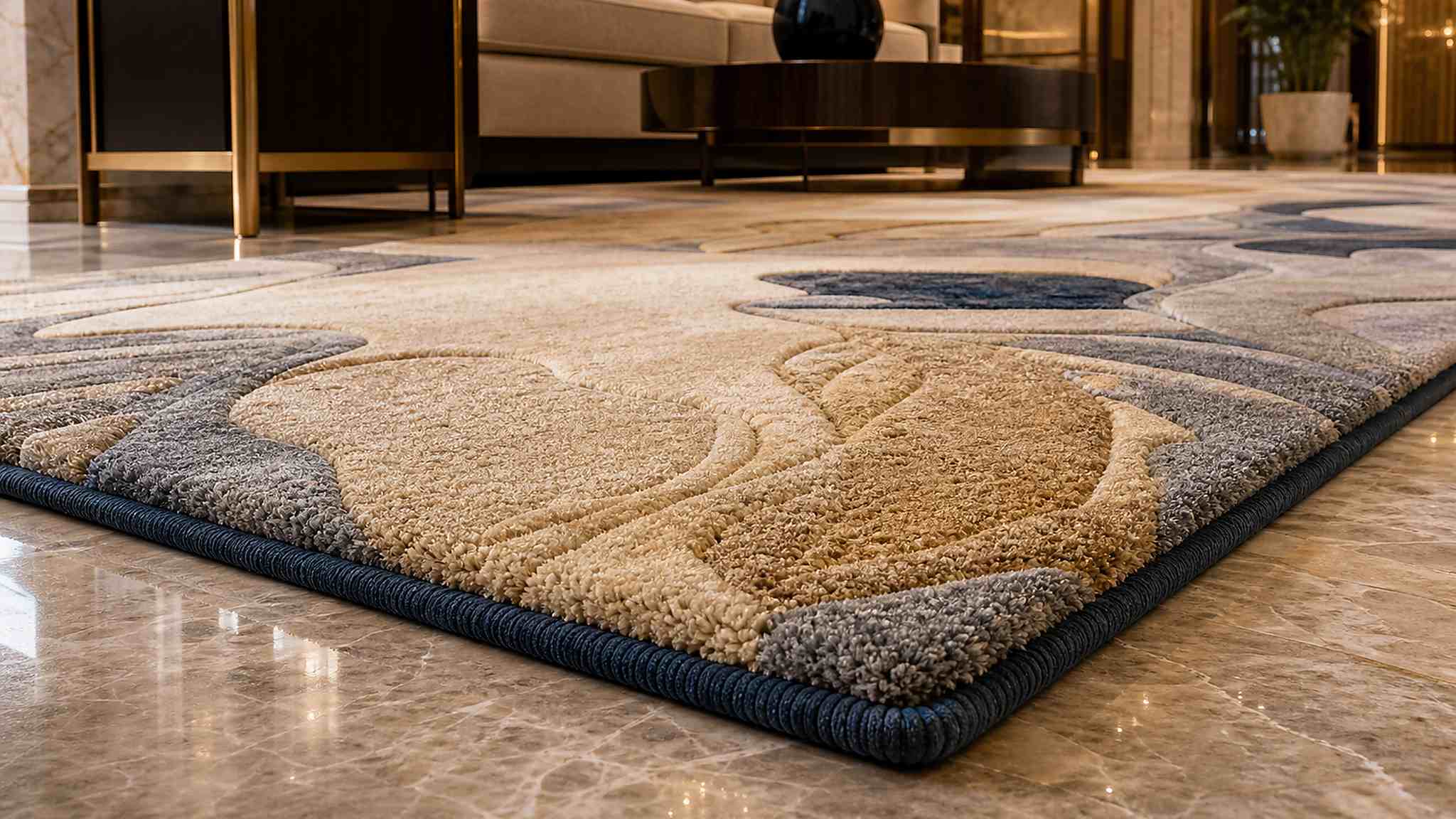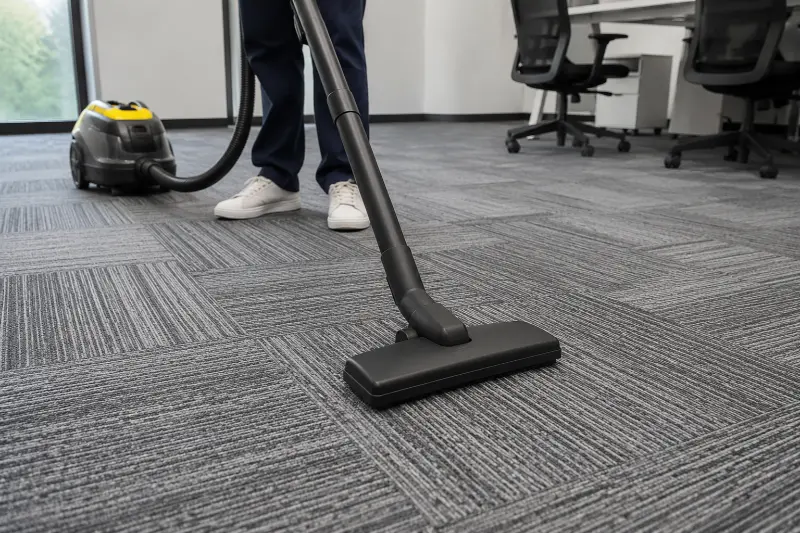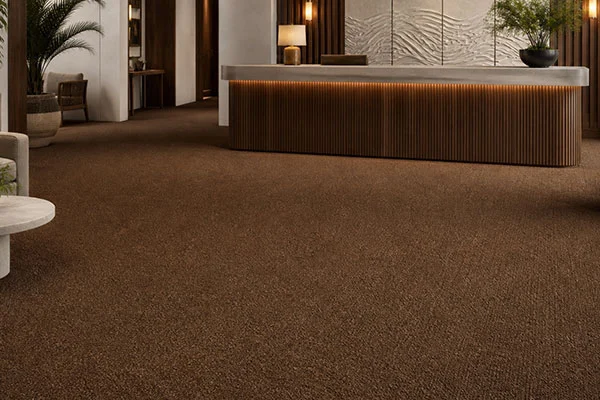
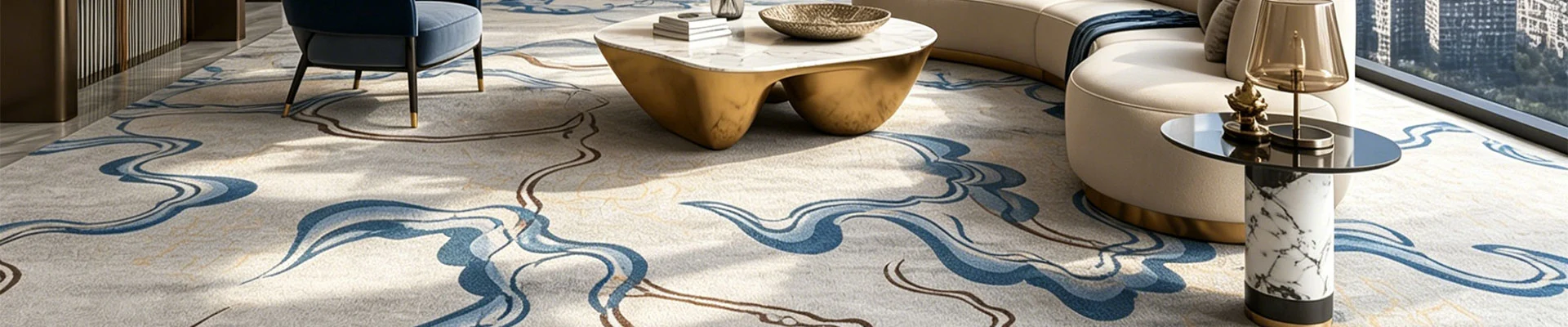


LUCK Carpet weaves Axminster wall to wall carpet for hospitality projects at our 26,000 m² plant in Foshan, Guangdong. The construction is an 80 % wool and 20 % nylon cut pile at 7 mm and 1200 g/m2 on a natural jute backing, classified Bfl-s1 to EN 13501-1. Guests meet this floor in the lobby, the corridor, the restaurant and the ballroom, and we deliver all of those zones from one woven quality in different colourways and pattern scales. This page deals with the problem that creates: one quality, many zones, and very different wear rates.
Specifying a separate carpet for each public area is how hospitality projects accumulate maintenance problems. Six qualities mean six pile heights, six cleaning regimes and six dye lots to reconcile when one area is refurbished in year four. A single woven quality removes most of that risk: one yarn blend, one backing and one loom, run across lobby, pre-function space, restaurant and corridor with only the colourway and the motif scale changing.
Face yarn is inserted and cut individually on the loom, so a change of colourway or scale is a new weave file on the same production route rather than a new production method. We hold ground colour, pile weight and pile height constant across zones and vary the motif to suit the room: a large medallion for the ballroom, a tighter repeat for a 2.4 m corridor, a simple border for the restaurant.
Hotel zones look different to a designer and identical to the laboratory, so one sample set covers the whole project. We run this quality through Martindale to ISO 12947-2 at 5 kPa, and the woven family sits between 40,000 and 60,000 rubs to defined change; recent hospitality batches came in at 52,000. Light fastness reads Grade 6-7 to ISO 105-B02, which matters behind a glazed atrium.
Two further results support the same specification in guestroom corridors. Impact sound reduction over a standard underlay measures 24 dB to ISO 717-2, and weighted absorption sits at 0.20 to ISO 354. Volatile organic compound emissions meet GB 18587-2001 Class A, and dimensional change after wet cleaning stays under 0.2 % length to ISO 2551. Pile height holds to plus or minus 0.5 mm, and the quality is classified for heavy commercial use under ISO 10874.
This table describes one woven quality rather than a list of options. The figures come from finished-roll measurement in our Foshan plant. Read the width row against the application row: corridors, guestrooms, restaurants and ballrooms each tolerate cross seams differently, so seam positions are planned zone by zone.
| Style | Axminster Woven Wall to Wall Carpet for Hospitality |
| Yarn type | 80 % Wool + 20 % Nylon |
| Pile Height | 7 mm |
| Pile Weight | 1200 g/m2 |
| Backing | Natural jute |
| Fire Resistance | Bfl-s1 (EN 13501-1) |
| Application | Hotel areaslobbies, corridors, guestrooms, restaurants, ballrooms |
| Width / Size | 4 m (13.1 ft) usable width |
| Pattern | Custom design available (artwork supplied by buyer, strike-off approved before production) |
| Surface / Technique | Woven (Axminster) |
Hospitality work rarely arrives as one room. It arrives as a floor plate with a lobby at one end, a ballroom at the other and a service corridor in between. That is the case for a single woven quality across the whole public floor, and it is what the sections below examine: the zones, the construction that serves them, and where the wear concentrates.
Colour continuity is the first commercial argument. A hotel that re-orders corridor carpet in year three from a different quality will see the change at every doorway where the two meet, because pile height and surface texture read differently under the same light. Running one woven quality from the start means the border, the corridor field and the restaurant ground share a construction.
Strike-off approvals shorten as well, because one sample covers the ground colour and border construction for the entire project, and zone variations are issued as weave file revisions. For the operator, one quality means one spare roll strategy: hold two rolls in the corridor colourway and one in the lobby.
Take a typical 400-key property. The arrival lobby is 520 m² of open floor, guestroom corridors total 2,100 m² at 2.4 m wide, the all-day restaurant is 430 m², and the ballroom with its pre-function gallery is 980 m². Each space is occupied differently: the lobby carries the highest footfall per square metre and the corridors take the most trolley passes.
A single woven quality handles that spread because the wear mechanism is the same in each case. A cut pile at this weight deflects under a load and recovers when the load is released, and the wool content gives it the elasticity to do that thousands of times without flattening. The zone that surprises operators is the all-day restaurant, which often out-wears the ballroom that consumed most of the design budget. Kitchens, wet spa areas and outdoor terraces sit outside this quality, and we say so at quotation stage.
Ballroom wear is easy to overstate. A large ballroom used three nights a week sees roughly 140 events in a year, and traffic concentrates around the doors, the bar and the staging edge rather than spreading across the dance floor. The pre-function area outside it is used every day, for coffee breaks, registration desks and buffet overflow, and it is usually a third of the ballroom area.
That is why we quote the pre-function space in the same quality as the ballroom but recommend a darker colourway and a tighter pattern scale, which hides the soiling produced by standing traffic and dropped food. Thickness loss under ISO 3416 tells the story after the first year: measured at the coffee station, the pre-function floor typically records three to four times the loss logged on the open ballroom floor.
Six zones of a 480-key beach resort in Abu Dhabi were replaced before the winter season: 6,400 m² from the arrival lobby and the 2.4 m guestroom corridors to two restaurants, a ballroom and a 700 m² pre-function gallery. The brief asked for one specification, four colourways from a single palette, and a delivery that could be installed zone by zone without closing any outlet.
The project ran on one woven quality across all six zones with only the weave file changing, which meant a single strike-off approval and one yarn lot. Our plant shipped 58 rolls, labelled by zone with a laying plan for each area. Fourteen months later the operator's condition survey recorded the deepest thickness loss at the all-day dining entrance, still inside the allowance set by its ISO 3416 result, and no zone has been brought forward for replacement.
Four streams carry this specification: abrasion, colour fastness, dimensional stability and reaction to fire. Martindale runs to ISO 12947-2 at 5 kPa, light fastness to ISO 105-B02, rubbing fastness to ISO 105-X12 and dimensional change to ISO 2551. Fire classification is Bfl-s1 to EN 13501-1, with EN ISO 9239-1 and EN ISO 11925-2 reports issued alongside it. The jute backing is laminated at 32 to 40 N/50 mm peel strength. We publish no tuft bind figure, because ISO 4919 applies to tufted constructions and this face is woven into the backing.
At Shanghai Hospitality Design Week we asked 58 hotel operators which public area they replace first. Thirty-four named the all-day dining room, not the ballroom they had spent the budget on. Third-party inspection at our plant can be arranged through SGS, Intertek or BV, and we will test the sample from your own production roll rather than a stock swatch.


It can, with two adjustments. The corridor usually takes a tighter motif, and the colourway shifts one or two steps darker than the lobby to hide trolley soiling. Pile weight, pile height and backing stay identical, so abrasion performance and cleaning method do not change between zones.
We dye the yarn for the whole project in one lot and hold the balance in our warehouse until the last zone is called off. If a project needs staged dyeing, we weave a master swatch set first and match every later lot against it. A re-order of the same design lands within 3 mm of the original repeat.
Our minimum is one loom run, and a loom run is set by the pattern rather than by the area, so a small boutique property and a 500-key resort are quoted on the same basis. Borders, crests and zone colourways form part of that same run.
Depth of colour comes from dyed yarn, so a deep ground survives years of extraction cleaning without the grey wash that printed surfaces develop. The face is a dense upright cut pile with a dry wool hand and a matte finish under artificial light. Rolls are wound face out at the 4 m usable breadth, both selvedges woven and intact, and each one is labelled with its zone, length and drop number.
For phased projects we deliver by zone in the installation sequence and hold the remaining yarn lot in Foshan until the final call-off. The jute backing accepts tackless gripper or full-spread adhesive, and a fitting specification accompanies each laying plan. Our export team has handled hospitality deliveries for 14 years and exhibits at DOMOTEX Hannover. Send the floor plate and the zone list, and LUCK Carpet will return a single specification covering all of it.


Address
Shidaigongguan Building No.5 Office 1212, Haicheng east road, Duanzhou District, Zhaoqing City, Guangdong Province, China
Tel
Copyright © 2026 Zhaoqing Yunle International Trade Co., Ltd. All Rights Reserved.