Products


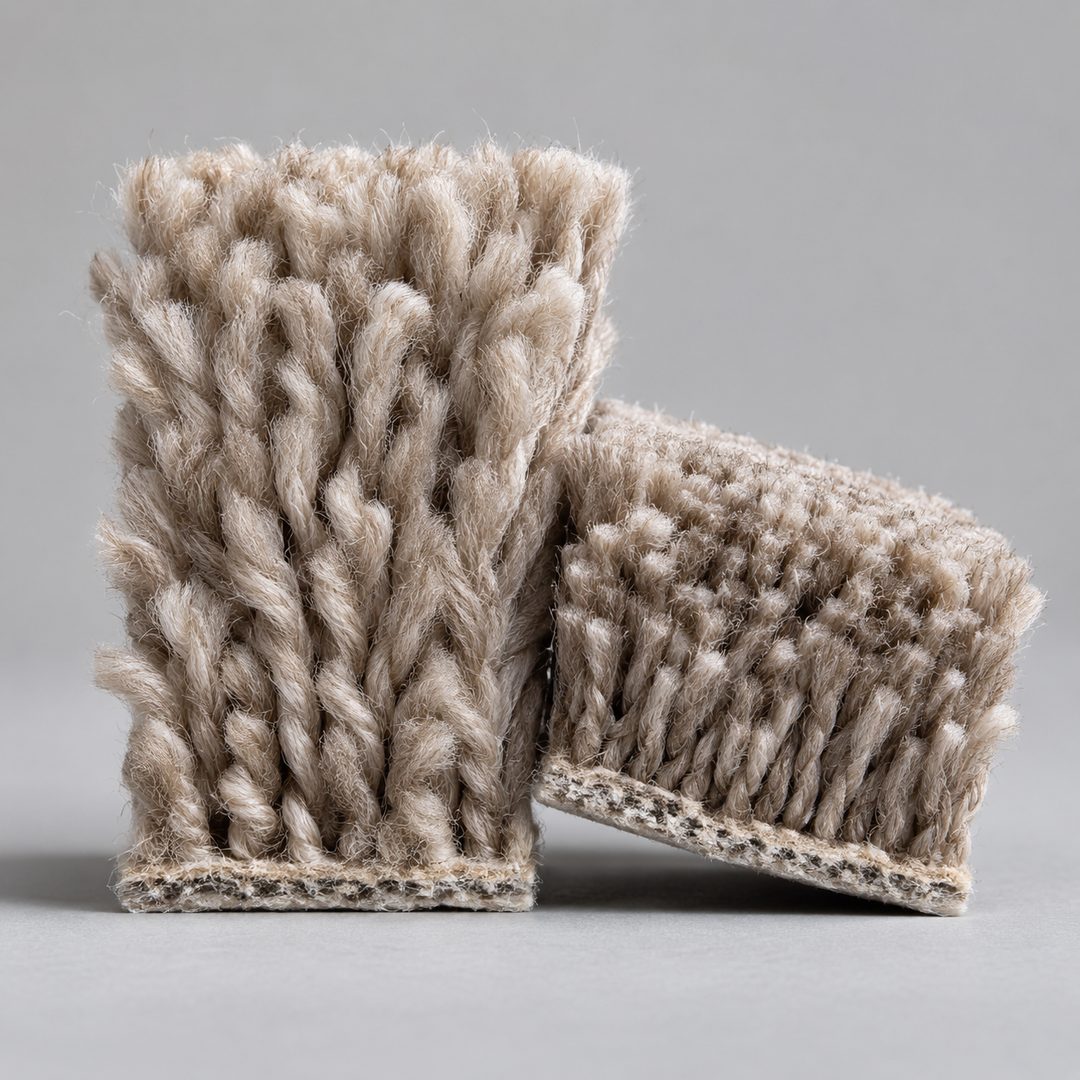
LUCK Carpet builds this nylon tufted carpet tile at our 26,000 m2 plant in Foshan, Guangdong. The face is 100 % nylon tufted into a 5 mm loop at 550 g/m2 and laminated to a PVC backing reinforced with glass-fibre. That combination exists for one job: holding appearance on a floor that takes castors, trolleys and cleaning machines daily. We supply it as a 50 cm x 50 cm tile or a 25 cm x 100 cm plank, mostly for high-traffic offices.
Buyers assume that more pile weight means a longer-lasting floor. On a rolling-load floor the opposite can be true, because tufts recover only while the fibre still has room to spring back once the load has passed. At 550 g/m2 into a 5 mm loop, the tuft keeps that openness and breathes back after a chair castor crosses it. Abrasion runs 34,000 to 46,000 rubs under ISO 12947-2 at 5 kPa, and static-load thickness loss sits at 8 to 14 % recovery deficit to ISO 3416.
Colour decides how a plain floor ages too. Here it sits in the yarn rather than on top of it, so light fastness reaches Grade 6-7 to ISO 105-B02 and rubbing holds at Grade 4-5 to ISO 105-X12. On a pale grey field running past a glazed facade, those grades stop one half of the floor reading warmer than the other after a few summers of sun.
Everything above the backing depends on what sits underneath it. A woven glass-fibre mat runs through the PVC layer, and glass has a very low coefficient of thermal expansion, so the tile resists the growth that makes unreinforced modules gap and curl. We laminate the mat into the plastisol while the compound is still fluid, gauge the sheet flat, then apply the face and cut.
Tuft bind, pulled to ISO 4919, lands between 36 and 44 N, the force holding a tuft in the backing when a vacuum passes over a seam. Laminate peel strength runs 30 to 38 N/50 mm, and dimension is measured to ISO 2551 at under 0.25 % length change after repeated wet cleaning. The fire class is Bfl-s1 under EN 13501-1, reached through the EN ISO 9239-1 radiant panel test.
These figures were measured on finished tiles from our Foshan line after 24 hours of conditioning at 23 degrees C and 50 % relative humidity. One reading note before you price the job: the PVC backing carries real mass, so verify dead load and door clearances on a raised access floor.
| Style | Nylon Tufted Carpet Tile with PVC Backing |
| Yarn type | 100 % Nylon |
| Pile Height | 5 mm |
| Pile Weight | 550 g/m2 |
| Backing | PVC with glass-fibre reinforcement |
| Fire Resistance | Bfl-s1 (EN 13501-1) |
| Application | High-traffic offices |
| Width / Size | 50 cm x 50 cm standard tile, 25 cm x 100 cm plank and custom sizes |
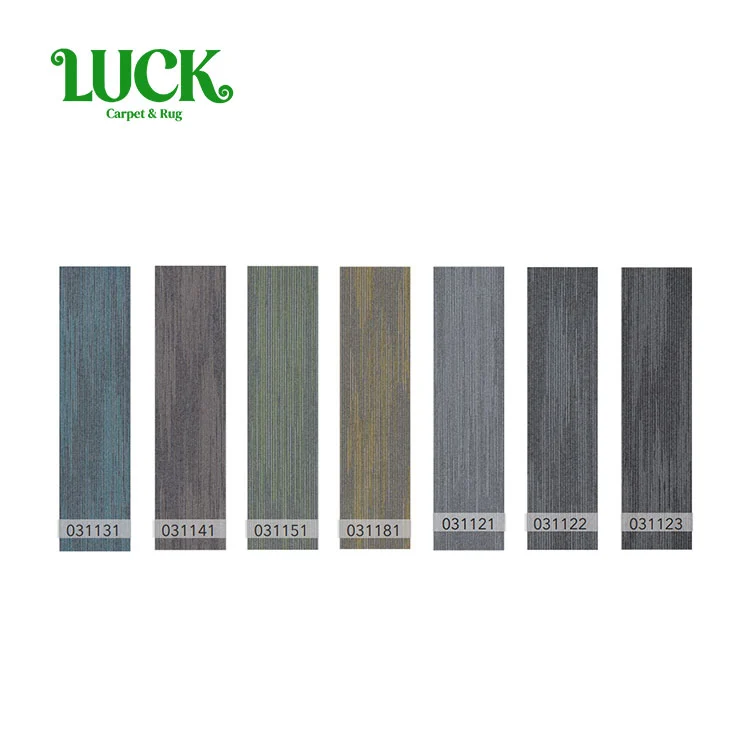
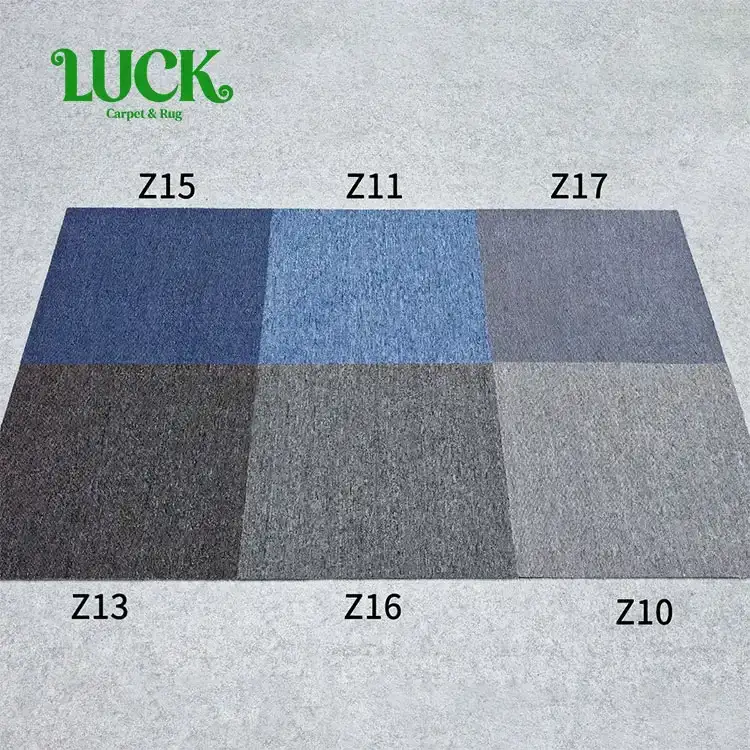
| Pattern | Custom design available (artwork supplied by buyer, strike-off approved before production) |
| Surface / Technique | Loop pile |
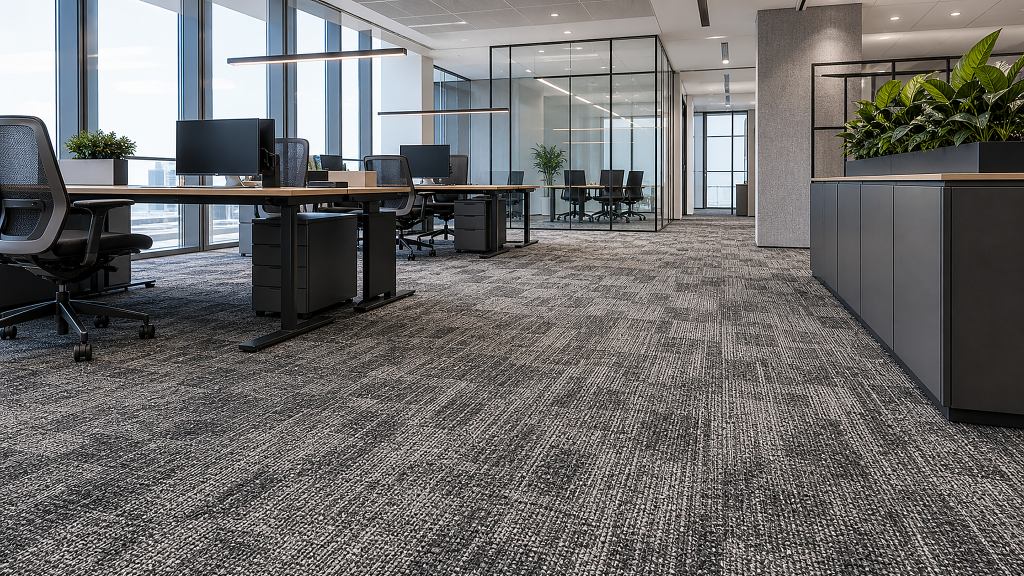
A high-traffic office is not one floor. There is the reception everyone crosses once, the workstation field the same 300 people cross eight times a day, the corridor that funnels them past one point, and the print room where a loaded trolley turns on the spot. One tile can serve all four if layout, adhesive and spare stock are planned around how each one wears.
A trolley wheel does not abrade carpet the way a shoe does. It concentrates the load onto a contact patch a few millimetres wide and holds it there while the wheel turns, compressing the tufts sideways. Damage appears first as a flattened track along the wheel line. This tile anchors its loop at 36 to 44 N to ISO 4919 and shows an ISO 3416 recovery deficit of 8 to 14 %, which is the honest way of saying the pile returns but not to zero. A facility manager who specified this tile in Chicago told our team that he now buys replacement stock with the original order rather than waiting for a failure.
Rotating tile direction every few rows, or running the 25 cm x 100 cm plank so plank joints fall across the trolley route, spreads that load over more tufts instead of letting one narrow strip carry the floor's traffic history.
A financial services floor in Chicago, United States, occupies 2,400 m2 over a dealing room and its circulation. The brief asked for one tile running from the lift lobby across the trading floor, with no hard-set adhesive to slow a future cable move. We supplied 9,850 tiles in a quarter-turn layout, loose laid with a tackifier at the perimeter and every third row. The facility team later swapped its first 40 damaged modules in a night.
A glazed tower takes direct sun across the east third of that plan each morning, and the sunlit zone ran six degrees warmer than the core in our site readings. Because the colour sits in the fibre, both areas stayed visually matched.
Every open office develops one. It is the line people take between the lift core and their desk, and after a year it reads as a lighter stripe across an even floor. The cause is compaction, not abrasion: the same tufts are loaded in one direction thousands of times and the loop leans. Break that channel so the walking line crosses tile joints at an angle, and put a walk-off zone of at least three metres at the entrance, because tracked-in grit abrades a loop from the inside.
Be direct about the limit here: no carpet tile is immune to a compacted channel in a 300-person office. This construction keeps the channel recoverable instead.
A capital markets tenant in Chicago, United States, refitted 2,400 m2 across a dealing floor, two client meeting suites and the lift lobby. The intent was a single grey loop surface laid quarter-turn so the four-way rotation produced a faint checker. Two conditions governed the brief: the floor had to lift for cable access without damage, and the finished surface had to stay inside the landlord's floor-loading allowance. We shipped 9,850 tiles from one batch.
A pressure-sensitive tackifier at the perimeter and every third row replaced full-spread adhesive, so modules lifted cleanly for two cable reconfigurations. After 18 months and a second winter of dry indoor air, joint gaps held under 1 mm across the dealing floor. The client reordered 200 tiles for a new meeting suite, colour confirmed against the retained batch sample.
That habit matches what our own lab sees. Every batch of this construction is tested in our own QC lab. Abrasion goes to ISO 12947-2, tuft bind to ISO 4919, backing peel in N/50 mm, colour fastness to ISO 105-B02 and ISO 105-X12, dimensional stability to ISO 2551, and static-load thickness loss to ISO 3416. Fire classification follows EN ISO 9239-1 and EN ISO 11925-2 into the EN 13501-1 class in the table, and emissions are screened to GB 18587-2001 Class A. Ask for raw values with method numbers, not a summary.


Yes. Use a pressure-sensitive tackifier at the perimeter and every third row rather than a full spread, and a tile lifts with a suction cup without disturbing its neighbours. Fully loose layouts migrate under trolley traffic. On a raised access floor, check the panel gaps first, because the tile follows any step.
The glass-fibre mat in this backing exists for that condition. Dimensional stability to ISO 2551 sits under 0.25 % length change after repeated wet cleaning, and the reinforcement controls movement across seasonal swings. What no backing absorbs is standing water, so test the slab and apply a liquid damp-proof membrane where the reading is high.
Stock colours ship from our Foshan warehouse in five to seven working days. Custom shades run 25 to 35 working days from approved strike-off. Our production minimum for custom work is 500 m2, though smaller trials can be quoted. Sea freight to the United States adds roughly four weeks.
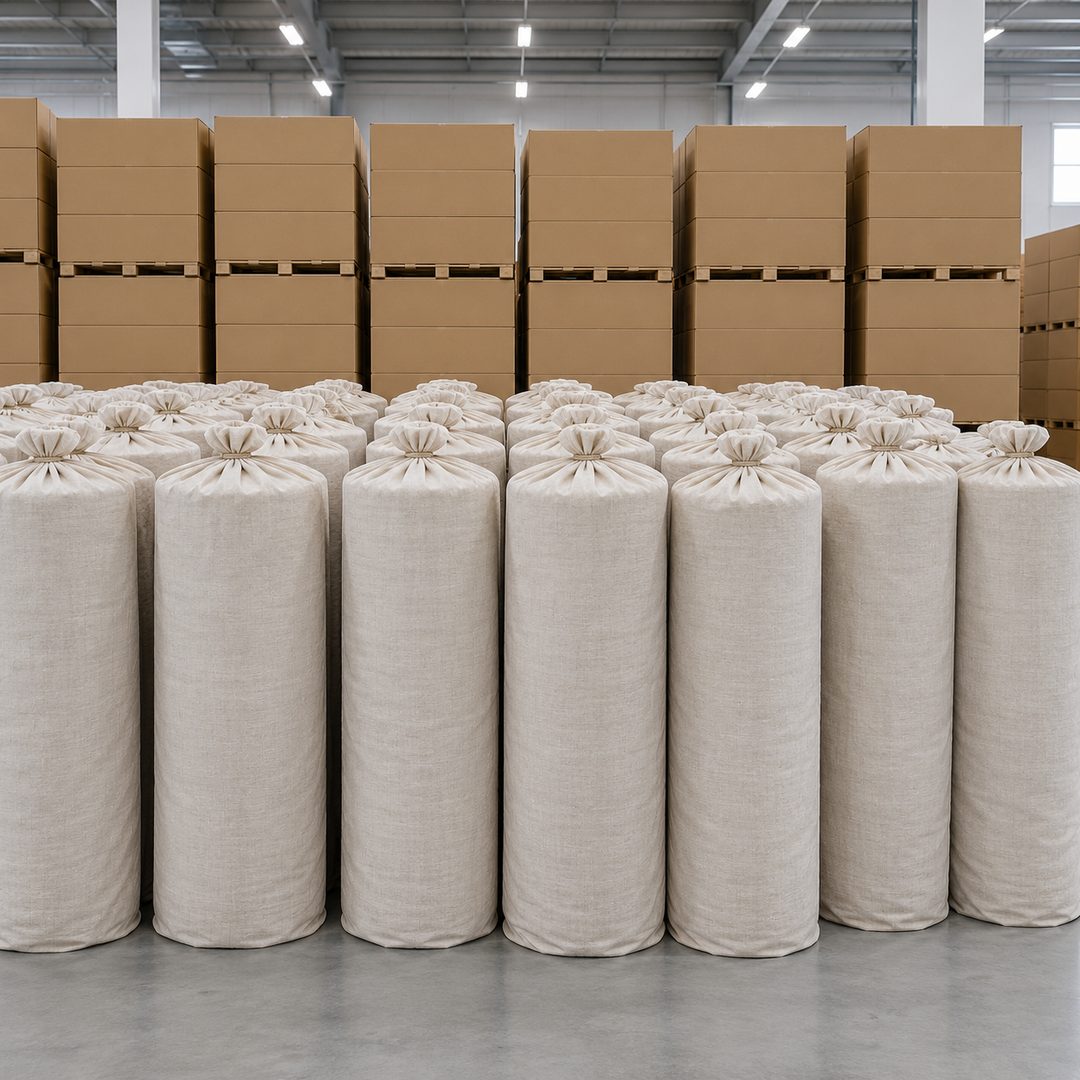
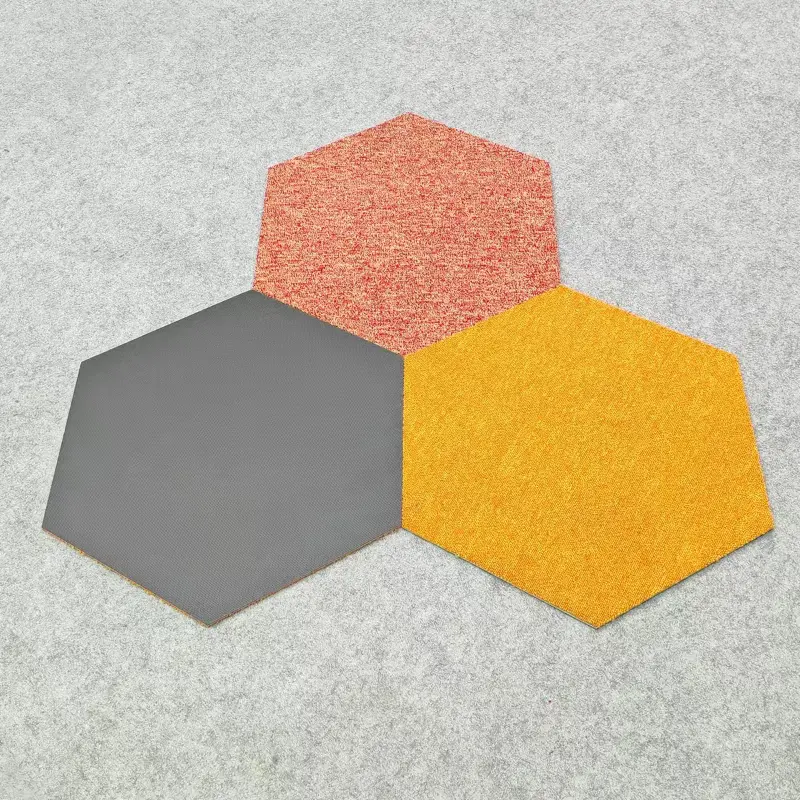
The surface is a low, even loop with a slight ridge that catches light in fine bands, giving a plain grey tile a woven look. Underfoot it feels firm and dense with a little give, and it does not polish into shine the way cut pile can. Tiles arrive 50 cm x 50 cm or 25 cm x 100 cm, 20 per carton, palletised in moisture-barrier film with the batch code and production date on the label.
Set the tiles on a dry, level, sound subfloor and acclimatise the cartons for 24 hours. For most offices we recommend a pressure-sensitive tackifier rather than a hard-set adhesive. Order the area plus 5 % for cutting waste. From LUCK Carpet in Foshan, Guangdong, send your floor plan and we will return a tile layout and delivery schedule.


Address
Shidaigongguan Building No.5 Office 1212, Haicheng east road, Duanzhou District, Zhaoqing City, Guangdong Province, China
Tel
Copyright © 2026 Zhaoqing Yunle International Trade Co., Ltd. All Rights Reserved.