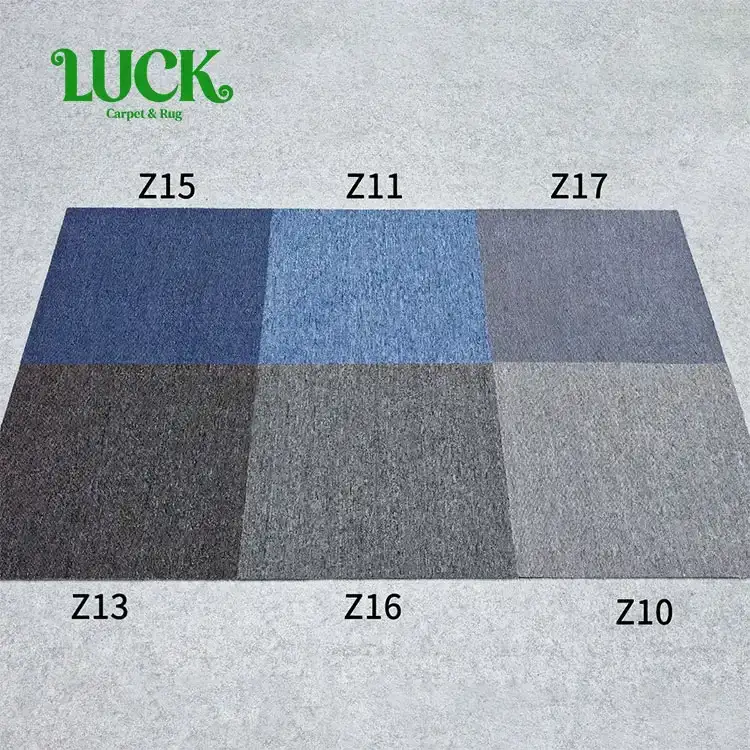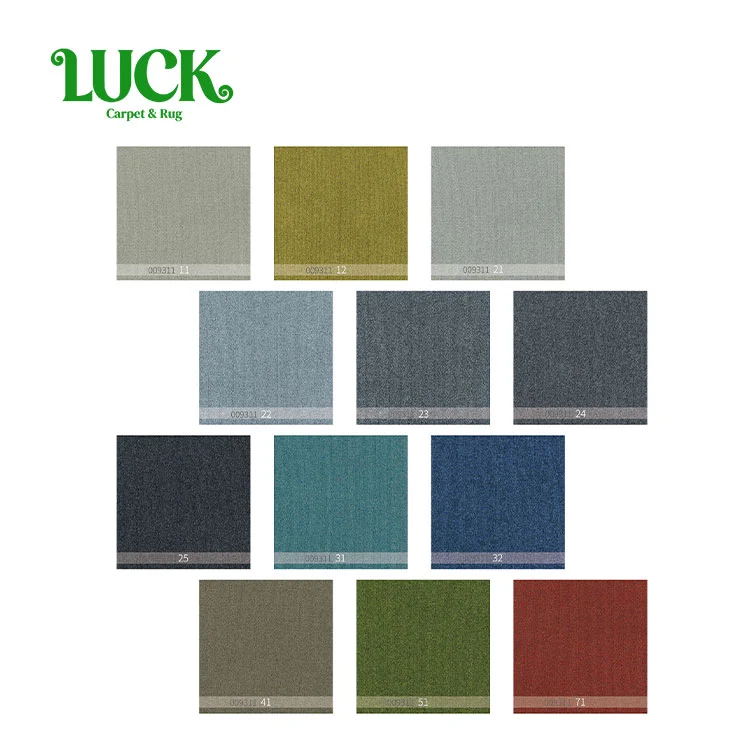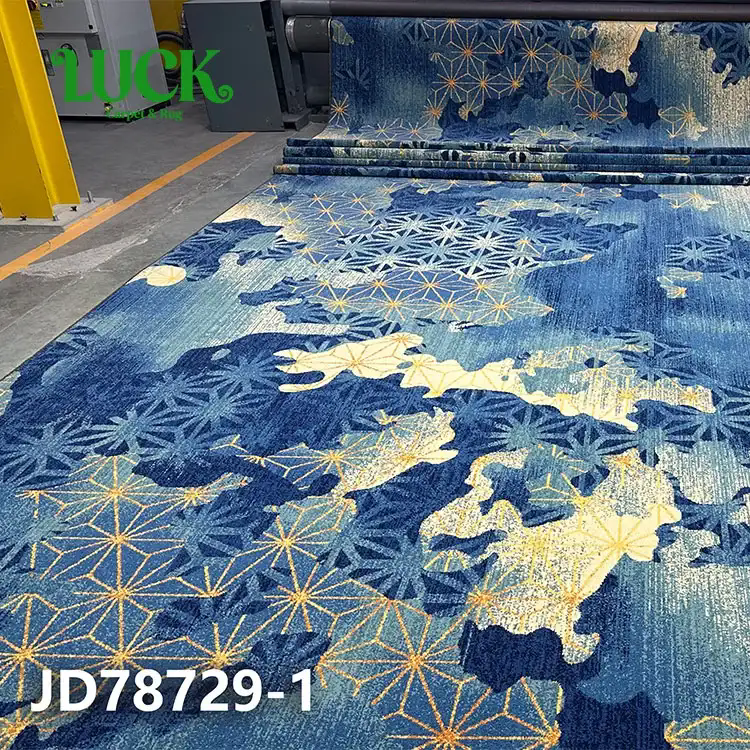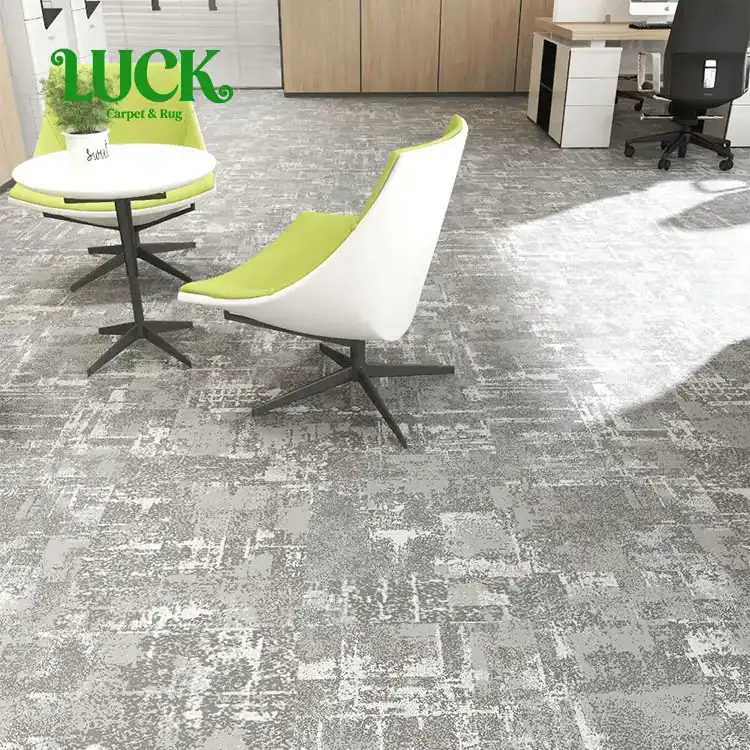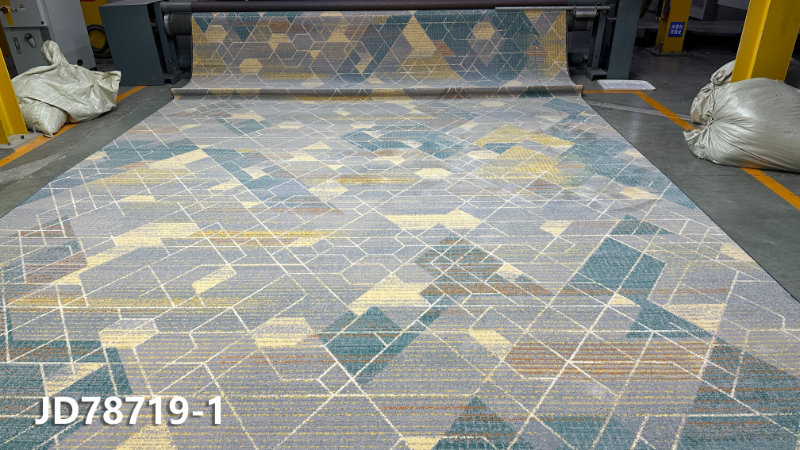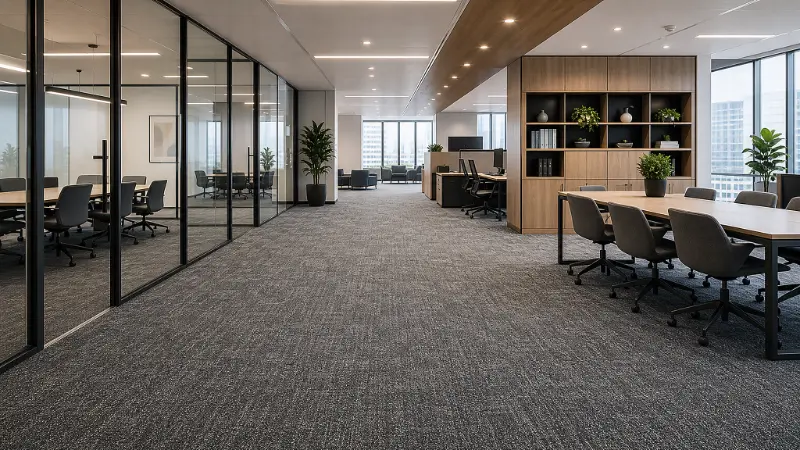
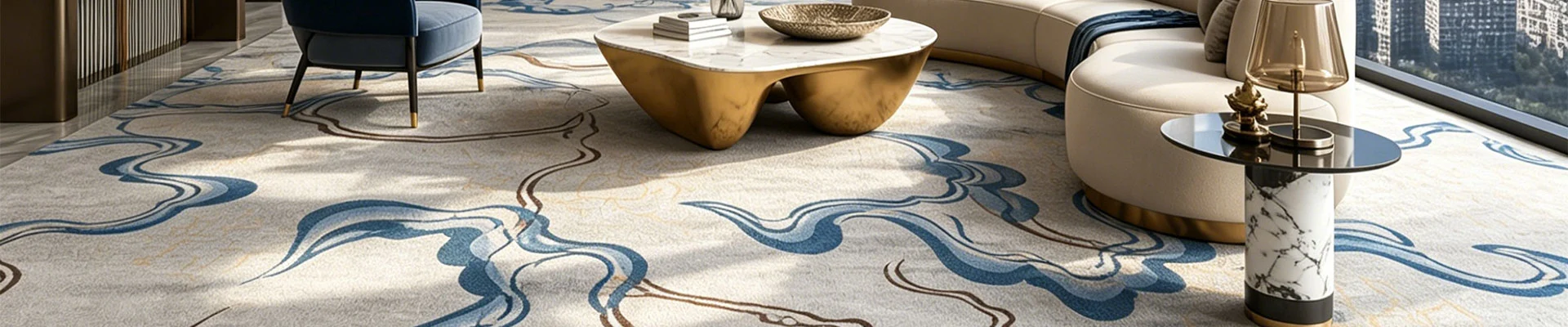
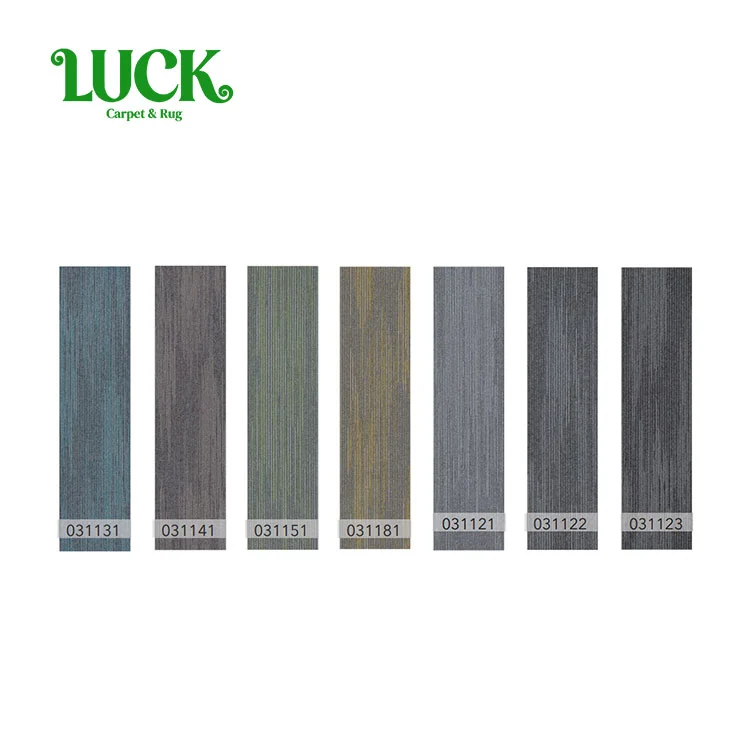
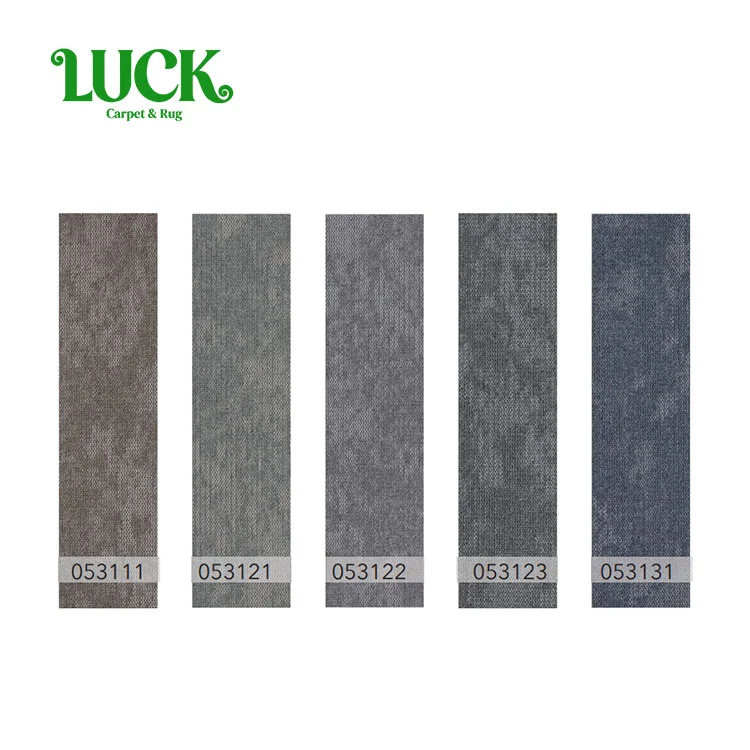
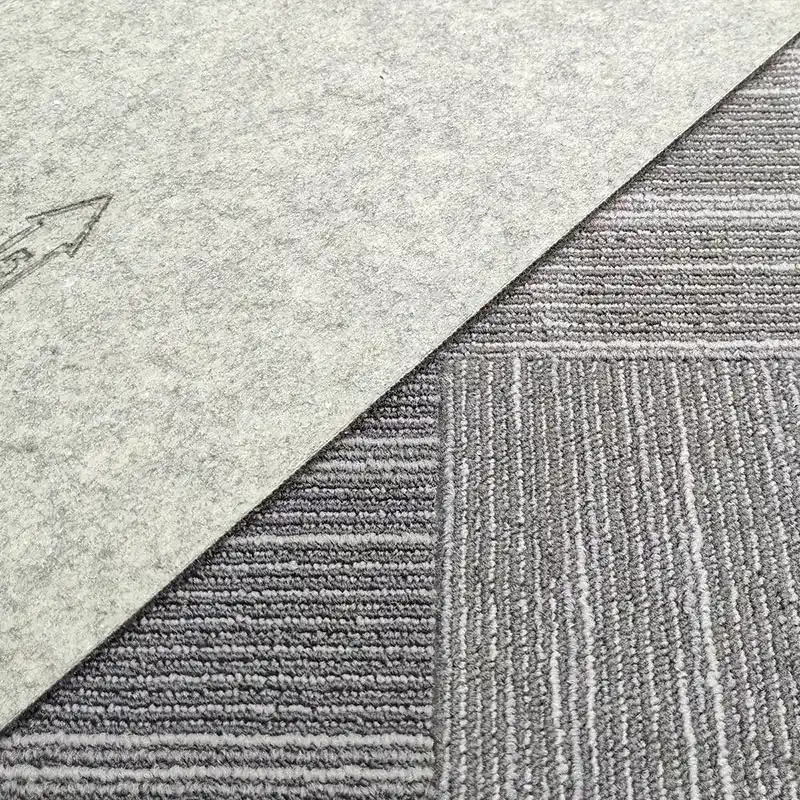
LUCK Carpet manufactures this nylon tufted carpet tile in Foshan, Guangdong, on lines that have supplied our export customers for 14 years. The face is 100 % nylon at 600 g/m2 tufted into a 5 mm loop and laminated to a bitumen-free backing built from recycled PET. It is the heavier of our two nylon constructions, and the extra 50 g/m2 of yarn exists for colour work. We supply 50 cm squares or 25 cm x 100 cm planks into commercial interiors where the palette matters as much as the wear.
Colour on a tufted tile does not arrive from a printer. It arrives from the yarn, and two batches of one recipe can differ enough that a buyer sees a seam where none exists. We buy solution-dyed nylon, with pigment dispersed into the polymer before extrusion, so the shade runs through the cross-section and a tuft worn at the tip still matches its neighbours.
Colour fastness here is graded Grade 6-7 to ISO 105-B02 for light and Grade 4-5 to ISO 105-X12 for rubbing. Those are the two readings a designer should ask for, because a colour-led floor fails in daylight or under a cleaning cloth long before it fails underfoot. The heavier face helps: more yarn per square metre means more dyed surface to read, so a saturated mid-tone holds its depth.
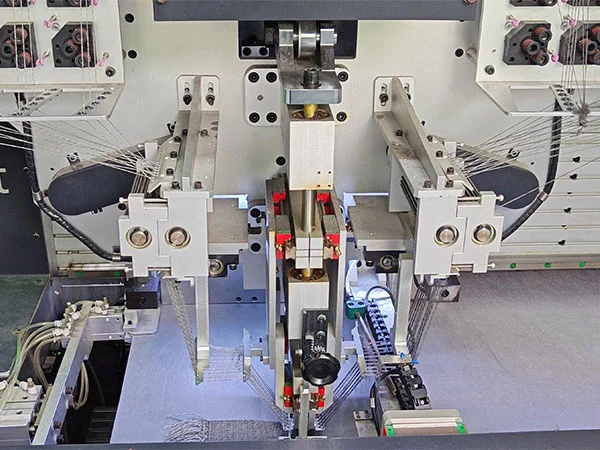
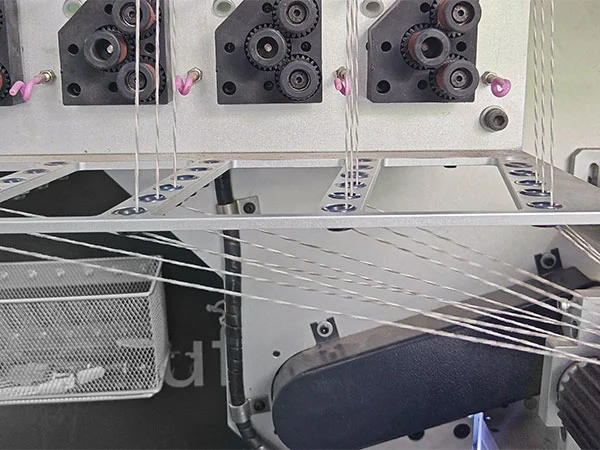
A consistent shade also depends on how evenly the yarn is laid down. Every tufting line here runs a tension controller that holds yarn feed steady across the width, because a slack end tufts a taller loop and reads lighter under raking light. Loop height is checked at the start and end of each shift. Abrasion records 34,000 to 46,000 rubs under ISO 12947-2 at 5 kPa, and tuft bind holds at 36 to 44 N to ISO 4919.
Batch control closes the loop. Yarn lot is traceable from polymer batch through tufting, lamination and cutting, so a reorder two years later is pulled from the original recipe rather than guessed at. Peel strength on the recycled-PET backing runs 30 to 38 N/50 mm and the tile classifies Bfl-s1 under EN 13501-1.
Values below come from finished tile tested in our Foshan QC lab after conditioning at 23 degrees C and 50 % relative humidity. Read the backing line with care: a recycled-PET laminate is not the same product as a PVC tile and behaves differently under a wet clean. Ask which chemistry your supplier is quoting before comparing prices.
Style Nylon Tufted Carpet Tile with Eco-Friendly Backing
Yarn type 100 % Nylon
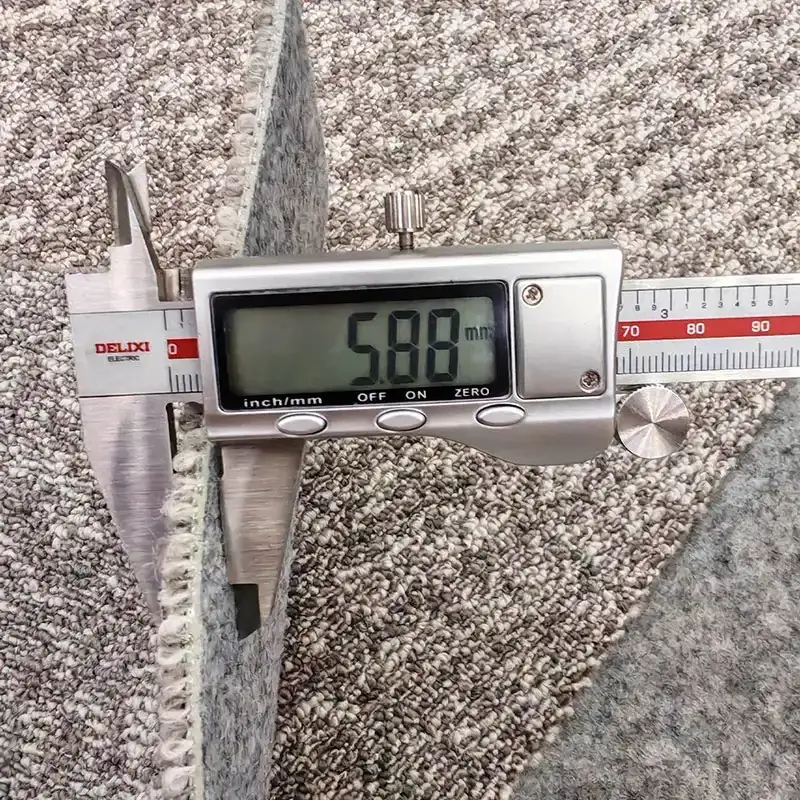
Pile Height 5 mm
Pile Weight 600 g/m2
Backing Eco-friendly backing (recycled PET / bitumen-free)
Fire Resistance Bfl-s1 (EN 13501-1)
Application commercial interior
Width / Size 50 cm x 50 cm standard tile, 25 cm x 100 cm plank and custom sizes
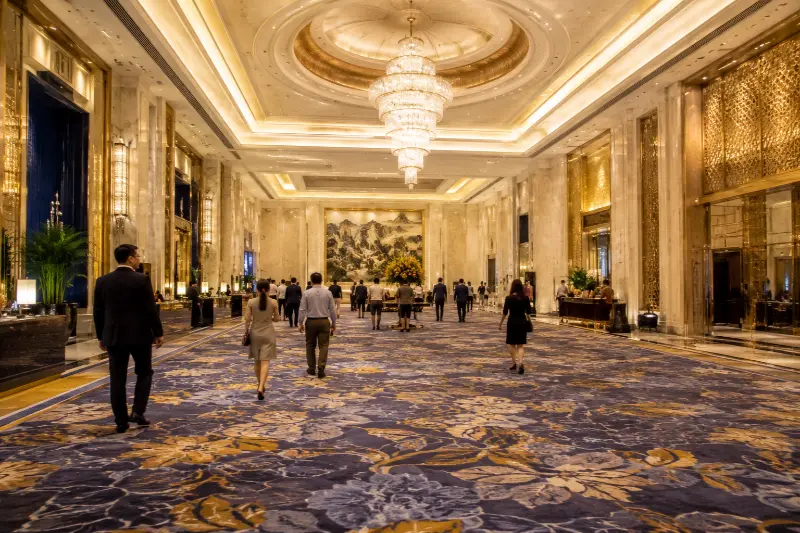
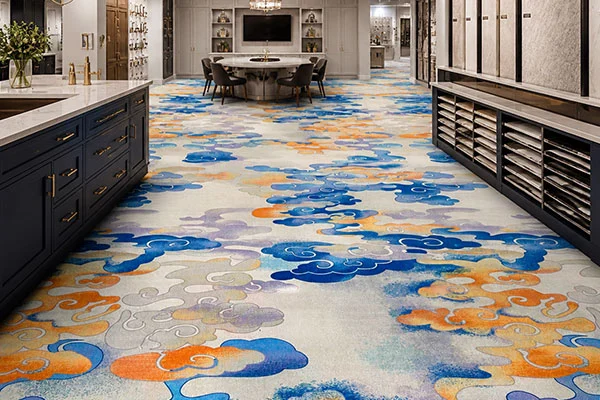
Pattern Custom design available (artwork supplied by buyer, strike-off approved before production)
Surface / Technique Loop pile
This tile suits a client who has chosen a colour and needs a floor that still matches it in five years: a brand rollout across forty branches, a hotel group with a signature green, or a refurbishment where the architect has picked a deep teal. Where the brief is purely functional, our PVC-backed tile costs less.
A colour-led brief needs three controls. The first is the dye route: solution dyeing, at Grade 6-7 light fastness to ISO 105-B02, keeps a saturated shade stable in a glazed atrium. The second is pile weight, because 600 g/m2 of dyed yarn holds depth where a 400 g/m2 loop reads thin and grey. The third is a sealed, dated master swatch held by both the buyer and our QC lab. A distributor in Lisbon asked us how we could promise a shade two years ahead of a reorder, and the only honest answer is measurement rather than memory.
We reject any run that drifts beyond Delta E 0.9 against the master. That gate is tight on purpose, because colour is the one property a client cannot fix on site.
A boutique hotel group in Lisbon, Portugal, refurbished 1,280 m2 of corridors, a breakfast room and two lounges in a 1930s building. The designer specified a deep olive that had to read identically along a thirty-metre corridor with daylight at one end and warm lamps at the other. She rejected a printed tile for the job, because a printed ground shows the print layer wearing at the thresholds long before the corridor itself tires.
We tufted 5,250 tiles in the olive shade from a single yarn lot and shipped them with the sealed master swatch. Thresholds took a denser loop in the same shade. Two years on, the hotel reports no visible shade break between the daylight end and the lamp-lit end, and the 120 spare tiles on site still match the floor.
The most common colour complaint we see is not a manufacturing fault. It is a phase-two order that arrives from a second yarn lot and gets laid beside phase one. Under raking light the two areas separate, and cleaning does not reconcile them. Order the whole floor against one lot, and where a project is phased, insist every phase is cut from one production run with the batch code on the drawing.
If a second lot is unavoidable, blend it rather than laying it in blocks: mix tiles from both lots across the transition in a checker pattern and the eye stops hunting for a line. Keep five per cent attic stock from the original lot flat and wrapped. A reorder from our retained recipe runs 25 to 35 working days, colour-checked against the sealed master before it leaves Foshan.
A 42-room boutique hotel in Lisbon, Portugal, refurbished 1,280 m2 of corridor, breakfast room and lounge space inside a 1930s building with tall windows at each end of the plan. The brief named a single deep olive for every public floor and asked that it read as one colour from the lift lobby to the roof stair.
We proposed 5,250 tufted nylon tiles at 600 g/m2 from one yarn lot, with a denser loop at the four thresholds where trolley traffic concentrates. Colour was checked against the sealed master on a spectrophotometer at Delta E under 0.9. After two years: no reported shade break across the corridor, none of the 260 threshold tiles showed edge lift, and the 120 spare tiles matched the floor when three were used after a plumbing repair.
Our Foshan QC lab treats shade as a measured property. Every batch is read on a spectrophotometer against the sealed master, with abrasion to ISO 12947-2, tuft bind to ISO 4919, backing peel in N/50 mm, colour fastness to ISO 105-B02 and ISO 105-X12, dimensional stability to ISO 2551, and static-load thickness loss to ISO 3416. Fire classification is Bfl-s1 under EN 13501-1, and third-party inspection is welcome at our plant.
We retain the yarn recipe and the sealed master swatch, so a reorder is produced to the original reference rather than a fresh visual judgement. Expect a close match, not a mathematical identity, because dye lots move slightly even inside our tolerance. Send a lifted tile and we will read it before production, correcting the new run to the floor you have.
Yes, provided the surface temperature stays under 27 degrees C and the adhesive is a low thermal-resistance grade. The backing is dimensionally stable to ISO 2551 at under 0.25 % length change after wet cleaning and does not embrittle the way a heavily filled thermoplastic can. Bring the floor up to temperature gradually over 48 hours, never during the fitting.
Two differences decide it. This tile carries 600 g/m2 of face yarn against 550 g/m2, giving a designer more dyed surface to read, and its backing is bitumen-free, so odour and plasticiser content fall. Choose the PVC-backed tile instead where the subfloor is uneven, the budget is tight, or the floor is cleaned with large amounts of free water.
The face is a dense 5 mm loop with a fine linear grain, and the extra yarn weight gives it a deeper look than a 500 g/m2 loop without losing the firm feel underfoot. Colour reads evenly in daylight and holds under warm lamp light, so it suits corridors lit by mixed sources. Tiles arrive 50 cm x 50 cm or 25 cm x 100 cm, 20 per carton, batch code and shade reference on every label.
The tile goes down over a dry, level subfloor on a pressure-sensitive adhesive, with the perimeter expansion gap set out in the installation guide. Order 5 % extra for cutting and 2 % attic stock from the same lot. Custom colours run 25 to 35 working days from approved strike-off. Send LUCK Carpet your colour reference and floor plan for a master swatch, a layout and a batch schedule.
Address
Shidaigongguan Building No.5 Office 1212, Haicheng east road, Duanzhou District, Zhaoqing City, Guangdong Province, China
Tel
Copyright © 2026 Zhaoqing Yunle International Trade Co., Ltd. All Rights Reserved.