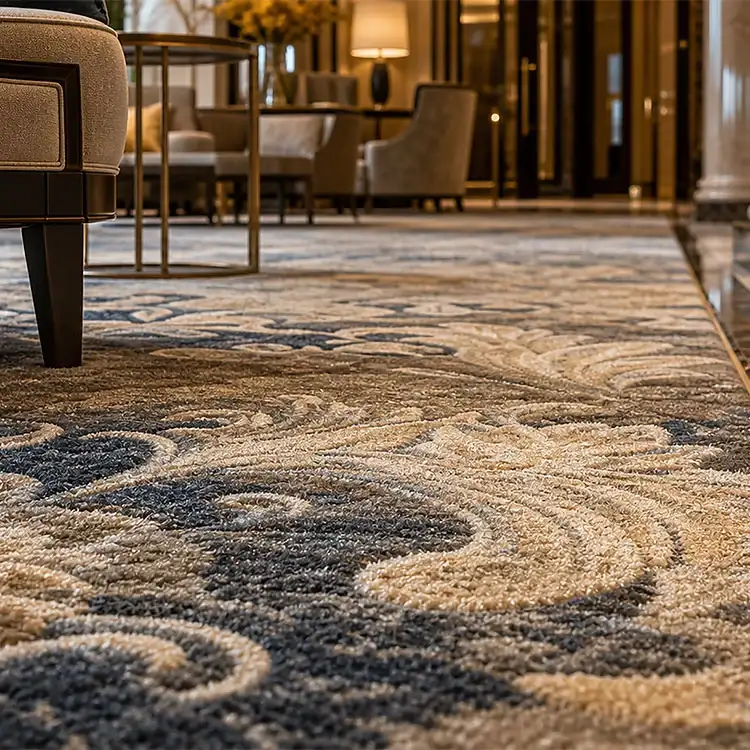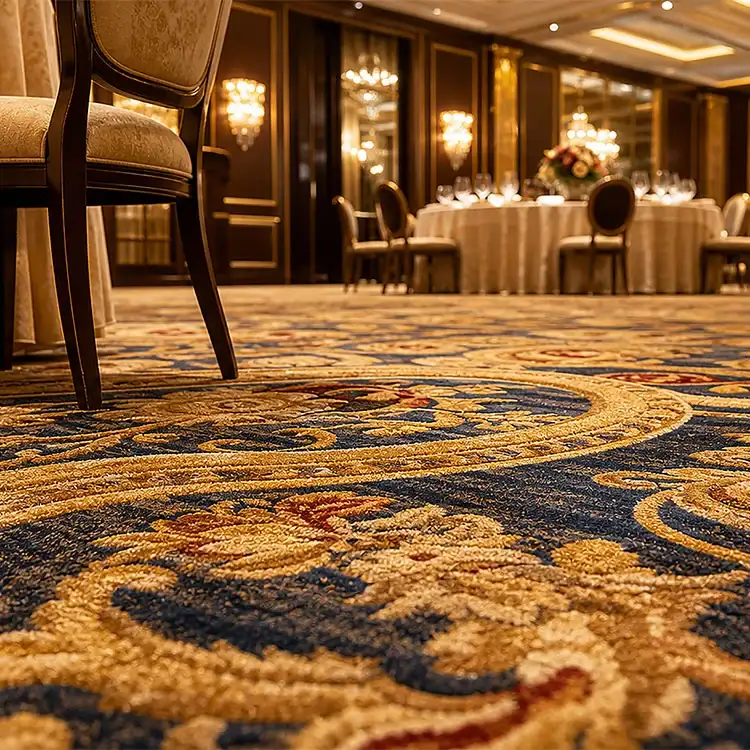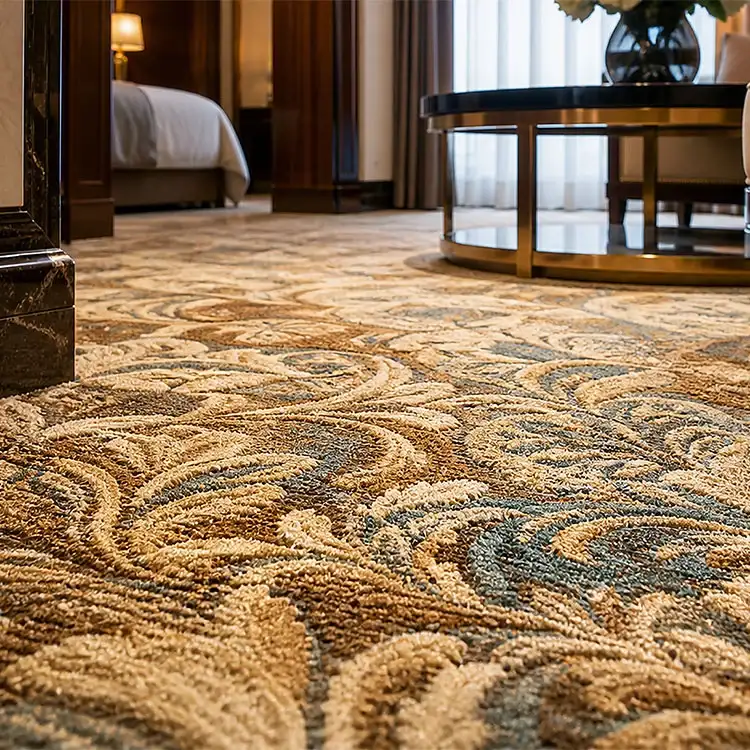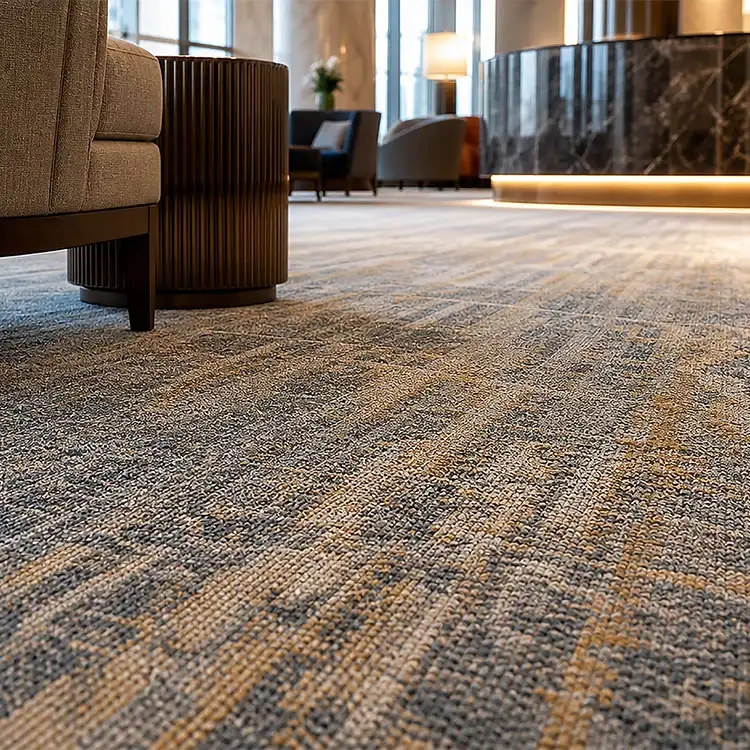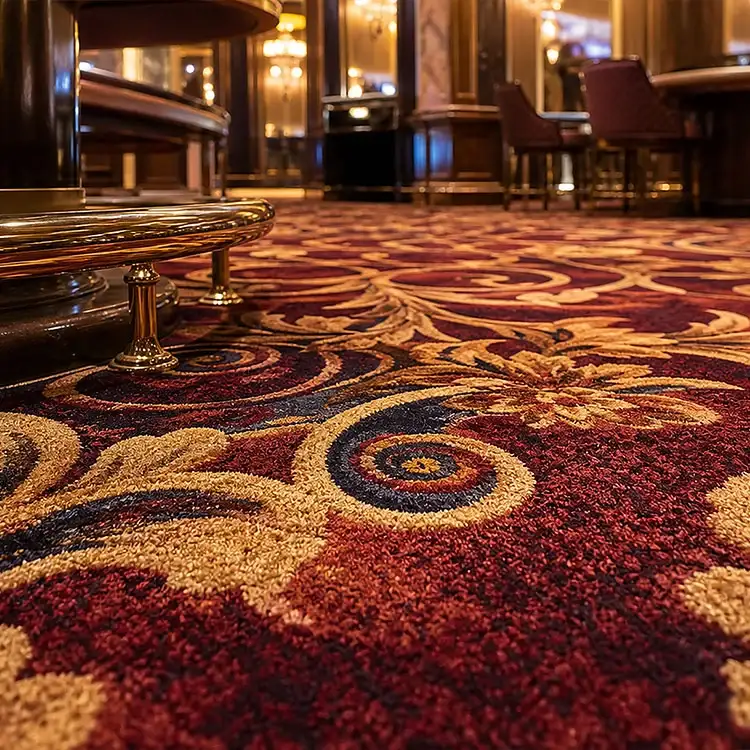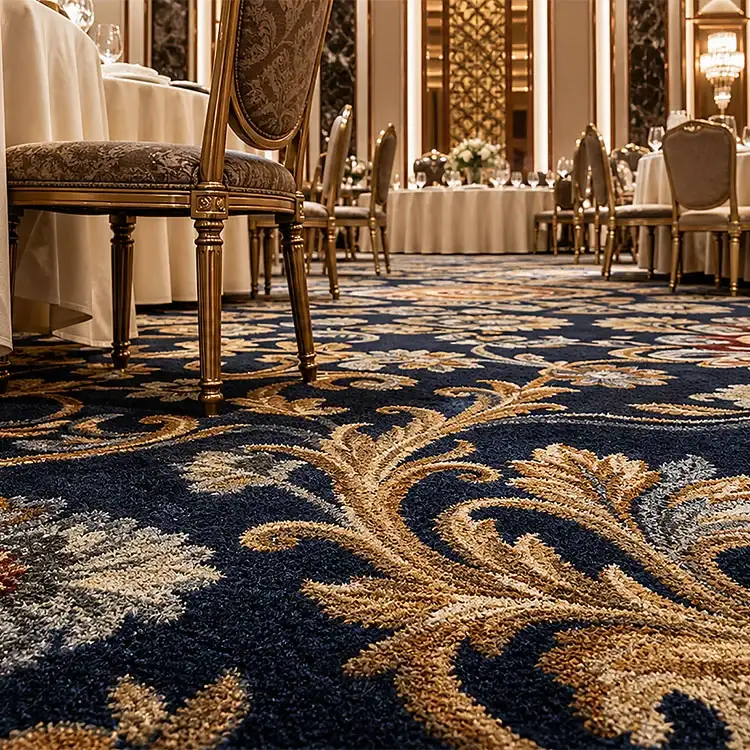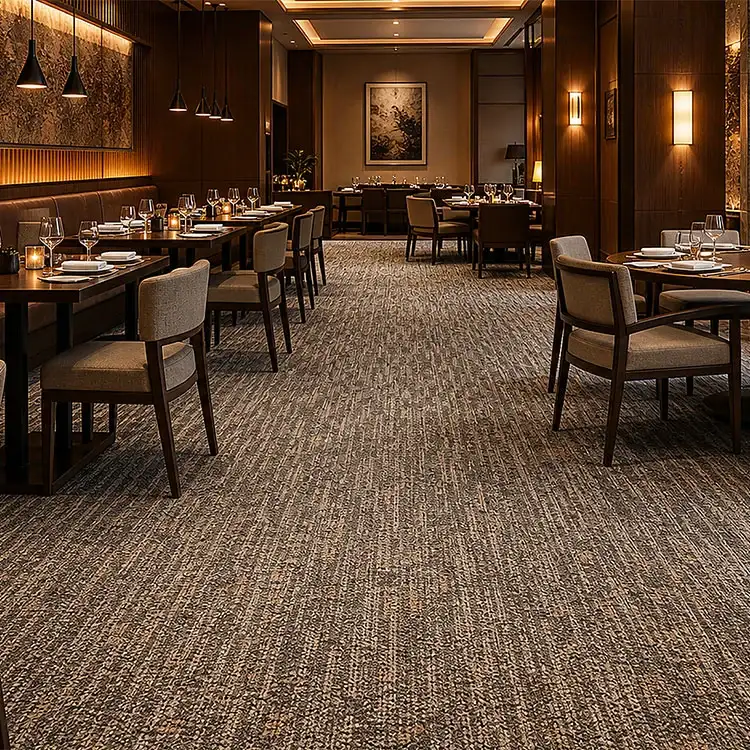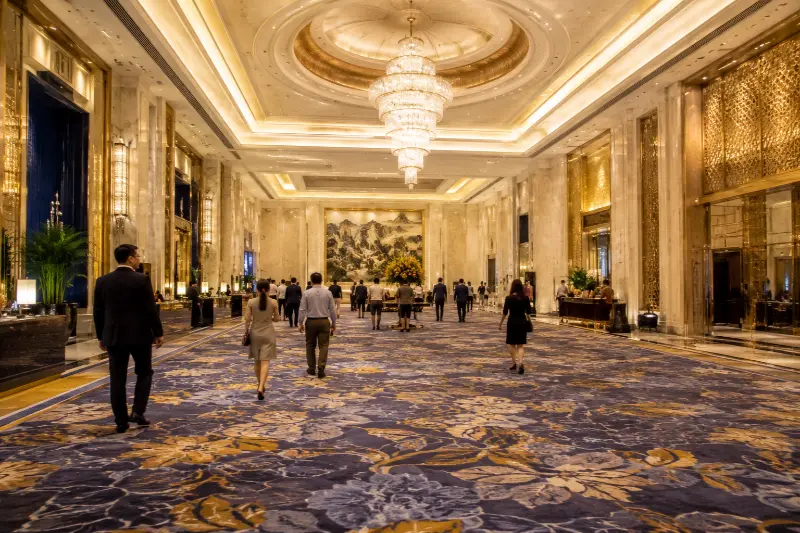
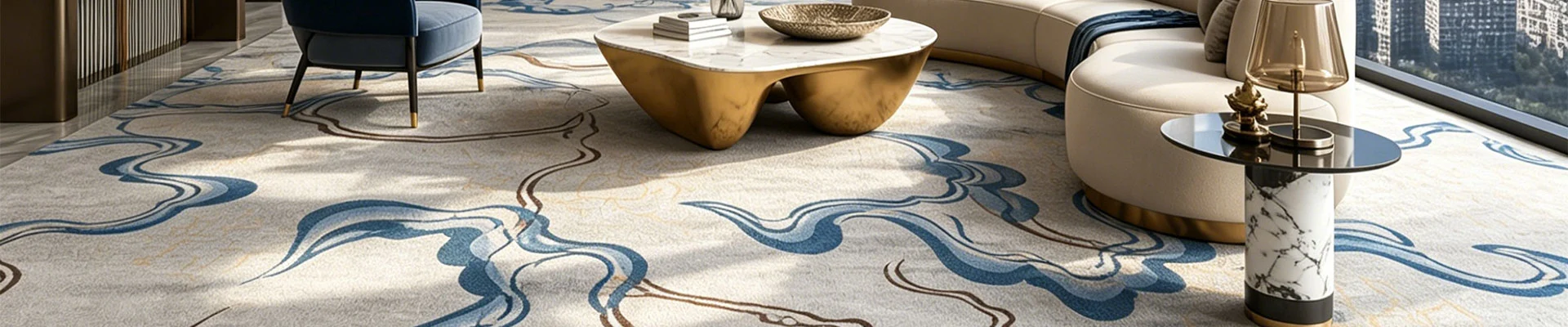
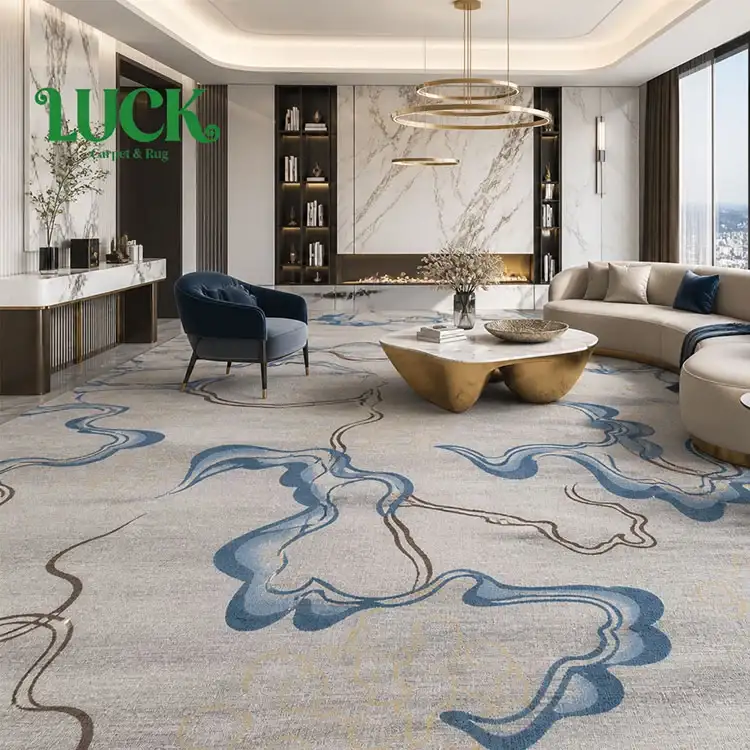
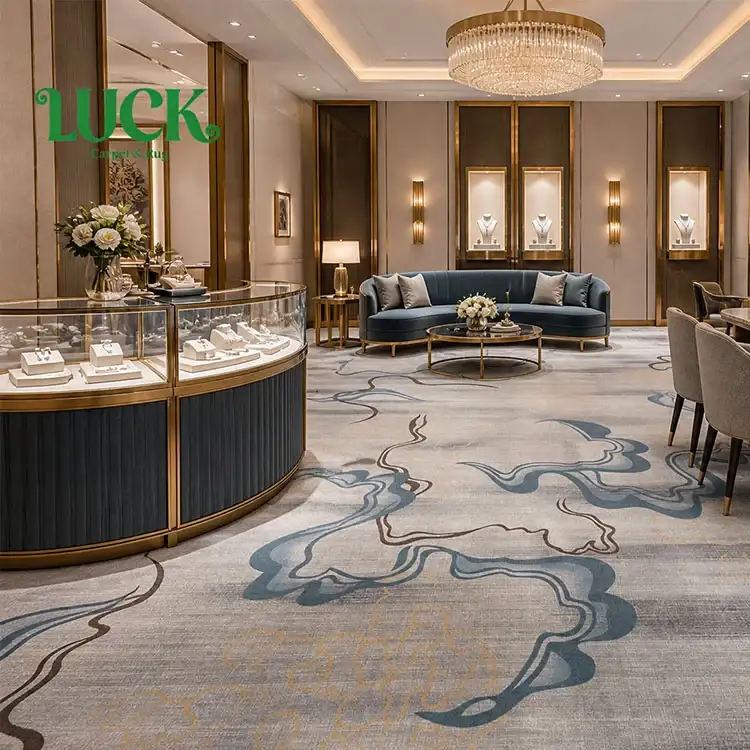
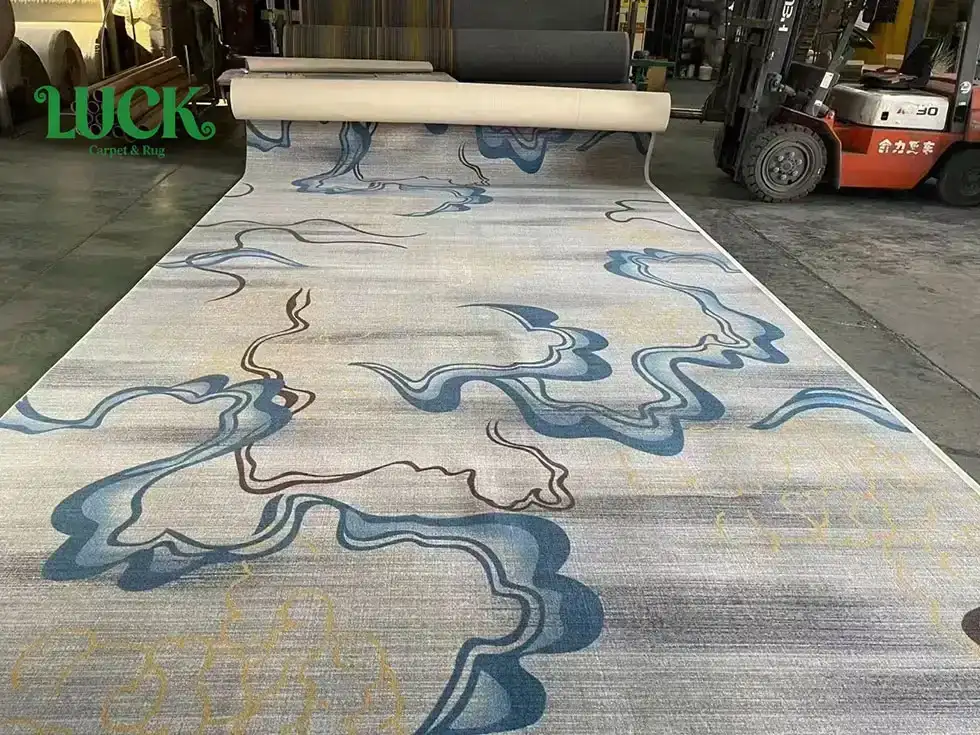
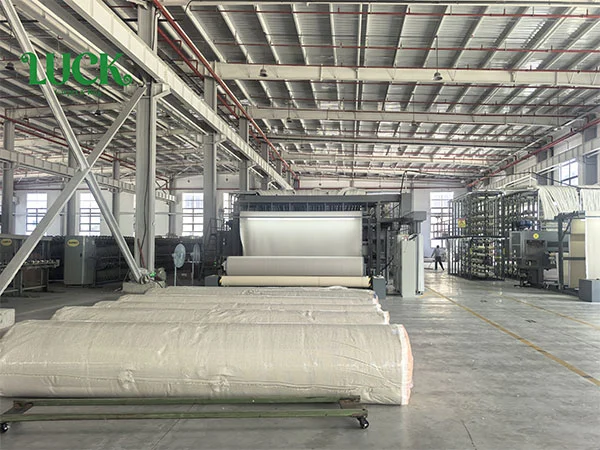
LUCK Carpet makes this wool printed wall to wall carpet at our 26,000 m2 plant in Foshan, Guangdong, where 180 staff and 14 years of export work sit behind every roll. The face is an 80/20 wool-nylon blend, tufted as a 10 mm cut pile at 1,200 g/m2, laminated to an anti-slip textile backing and printed edge to edge from buyer artwork. Rolls run 4 m wide, so a large room needs very few joins. Specifiers write it into arrival halls, salons, retail flagships and private dining rooms. This page covers the blend ratio and the fire-testing chain.
Twenty per cent nylon sounds like a small addition until you put it against the pile weight. At 1,200 g/m2 face weight, the synthetic share is roughly 240 g/m2 of yarn, and it runs through the full 10 mm height rather than sitting only in the backing. That distinction decides how the carpet ages. Wool supplies the matte lustre, the warmth underfoot and the moisture buffering that make a luxury interior feel expensive. Nylon supplies the mechanical scaffold that keeps tufts standing after a few hundred thousand shoes have crossed them.
We learned the difference on a 2019 hotel corridor trial where the nylon had been dosed only into the backing laminate. That version reached 30,000 rubs and then flattened visibly at the lift lobby. Moving the nylon into the face yarn lifted the same construction to 37,000 rubs before a defined change, measured to ISO 12947-2 at 5 kPa. Light fastness holds at Grade 5-6 to ISO 105-B02, and rubbing holds at Grade 4-5 to ISO 105-X12, which matters when pale printed grounds meet leather handbags and luggage wheels. Dimensional stability was checked to ISO 2551 as well: under 0.3 % length change after three wet-cleaning cycles, so a printed panel stays on its register.
A fire classification is shorthand, and luxury projects deserve the long version. EN ISO 11925-2 puts a small flame against the surface and asks whether ignition takes hold. EN ISO 9239-1 spreads a radiant panel underneath and measures how far the flame front travels and at what heat flux it stops. EN 13501-1 combines those results with smoke and droplet behaviour to award the class. This construction lands at Bfl-s1, with critical heat flux above 8.0 kW/m2.
Wool does most of that work unaided. The fibre holds moisture inside its cortex and carries a nitrogen-rich protein structure, so it chars and self-extinguishes instead of sustaining flame. We reinforce the effect with a non-halogenated treatment applied during yarn extrusion and a second finish in the backing lamination. Our Foshan lab pulls three samples from every batch, conditions them for 48 hours and runs the radiant panel, rejecting any batch whose flame spread passes 120 mm. Tuft bind to ISO 4919 averaged 35 N across our last twelve batches.
Every figure was measured on the finished roll in our Foshan plant after 24 hours of conditioning at 23 degrees C and 50 % relative humidity, not copied from a yarn supplier datasheet. One reading note: cut pile reflects light differently depending on which way you look at it, so agree the laying direction on the drawing before anything is cut.
| Style | Wool Printed Wall to Wall Carpet for Luxury Place |
| Yarn type | 100 % Wool |
| Pile Height | 10 mm |
| Pile Weight | 1200 g/m2 |
| Backing | Anti-slip textile backing |
| Fire Resistance | Bfl-s1 (EN 13501-1) |
| Application | Luxury |
| Width / Size | 4 m (13.1 ft) usable width |
| Pattern | Custom design available (artwork supplied by buyer, strike-off approved before production) |
| Surface / Technique | Cut pile |
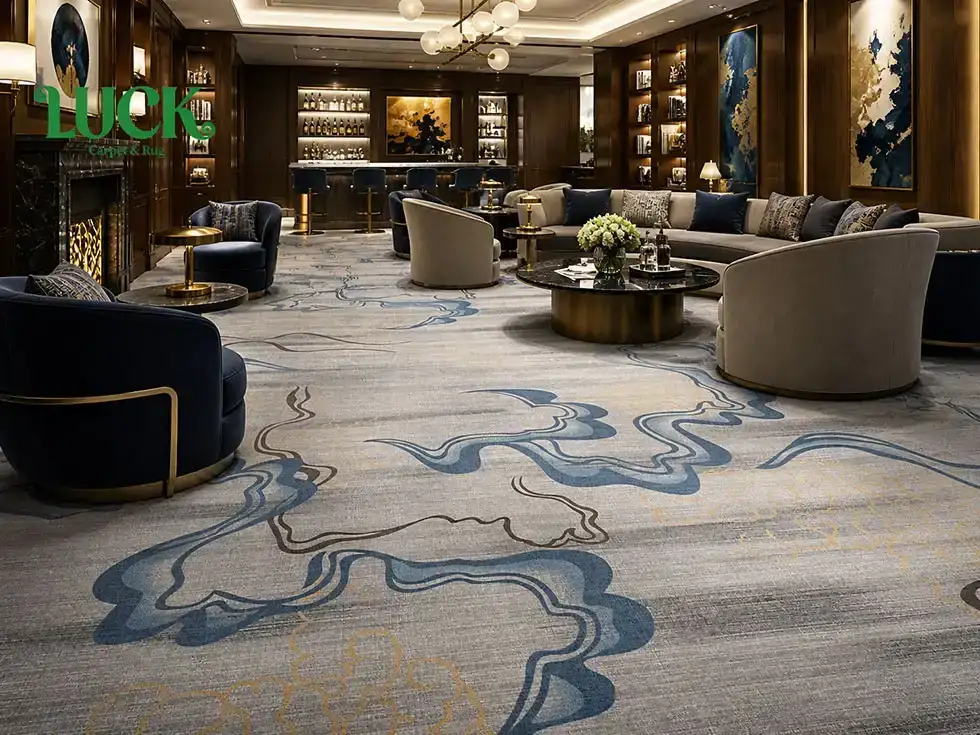
Luxury is not one traffic profile. An arrival hall takes luggage wheels and cleaning machines, a salon takes chair castors, a retail flagship takes a thousand pairs of shoes on a Saturday, and a private dining room takes wine and trolley legs. Those floors share a finish standard but not a wear pattern.
Wide printed carpet lives or dies on register. Our presses hold print register to plus or minus 2 mm across the full 4 m width, and colour is measured on a spectrophotometer against the approved strike-off before every print run. That second control is the one designers should care about, because it lets roll four of a reorder be compared numerically with roll one instead of argued about under site lighting.
Printing itself is high-definition digital with steam fixation and in-line washing. Steam fixation drives dye into the fibre rather than leaving pigment on the surface, which is why rub fastness reaches Grade 4-5 to ISO 105-X12 and light fastness reaches Grade 5-6 to ISO 105-B02. Behind a glazed facade, that light grade decides whether a pale ground still looks intentional after three summers. The anti-slip textile backing holds a peel strength of 28 to 34 N/50 mm, so it will not lift along a sunlit perimeter where underfloor heating runs warm.
An arrival hall is the hardest of the four. Trolley wheels concentrate load on a narrow track, and the run from door to desk takes every one of those passes. The 10 mm cut pile at 1,200 g/m2 does the work here: enough density that a wheel track recovers overnight, and enough height that a printed motif reads as a woven effect rather than a flat graphic.
Private dining adds chair legs to the same carpet, and a heavy chair dragged back forty times a night abrades a floor faster than any footfall. Furniture glides belong on the schedule beside the carpet sample. Our 8-year warranty on face pile covers wear through to backing under normal commercial use, and a 4 m roll cannot deliver a join-free floor across an irregular plan.
Printed wool is the wrong answer for a spa wet area, a service corridor behind a kitchen, and any floor mopped twice a day with alkaline detergent. Wool is a protein fibre, and repeated exposure to high-pH cleaners dulls the surface and shortens the life of the face. Basements with rising damp are also a poor match, because the anti-slip textile backing is not a moisture barrier.
Budget is the other honest limit. A printed wool face at 1,200 g/m2 in a 4 m width is a genuine luxury line, and a 400 m2 salon costs more than the same area in solution-dyed nylon. If the client's number will not reach, cut the area rather than the specification, and put a harder plain floor in the back of house.
A private banking house in the 8th arrondissement of Paris refurbished a reception and dining floor inside a listed building. The brief asked for a hand-drawn toile motif in two colourways with as few joins as possible, because the ceilings are high and visitors look down a long enfilade. The architect's first intent was woven Axminster, but a woven route could not hold the fine line work at that scale, and its lead time sat past handover.
Working from the artwork, we printed 640 m2 in eleven rolls of 4 m width, running the motif across the room axis so the two doorways and the stair landing fell on plain ground. The strike-off was approved in Paris before production, and every roll was colour-checked on the spectrophotometer against that piece. No pattern break is visible at any join, and the client reordered a second colourway fourteen months later.
Each batch of this construction goes through the same list in our Foshan QC lab. Abrasion sits at 30,000 to 42,000 rubs under ISO 12947-2 at 5 kPa to a defined change. Tuft bind is pulled to ISO 4919 and backing peel strength is recorded in N/50 mm. Colour fastness to light and to rubbing is graded to ISO 105-B02 and ISO 105-X12, and dimensional stability is measured to ISO 2551. Reaction to fire follows the EN ISO 11925-2 and EN ISO 9239-1 route into the EN 13501-1 class in the table, and emissions are screened to GB 18587-2001 Class A.
Ask any supplier for raw values with the method number beside them, the batch number on every roll label, and a physical sample from the delivered batch. A certificate summary with no values is an unfinished answer. Third-party inspection at our plant is available through SGS, Intertek or BV.
No, and be suspicious of anyone who says otherwise. A 4 m usable width means a 15 m hall needs at least four drops. What the width does is reduce the number of joins and move them off the main sight line, which is why we ask for a reflected plan before quoting. In Paris the motif was composed so every join landed on plain ground.
We retain a strike-off and the print file for this construction, and colour is measured on a spectrophotometer against that reference rather than judged by eye. Expect a close match rather than a mathematical identity, since wool is a natural fibre and dye lots drift. Send a lifted corner sample and we will read it before printing.
Our production minimum for a custom printed wool design is 200 m2. Lead time runs 30 to 40 working days from approved strike-off, and a physical strike-off takes about 12 days from usable artwork. Peak season in the third quarter adds a week, and we quote against the strike-off date because that is the milestone we control.
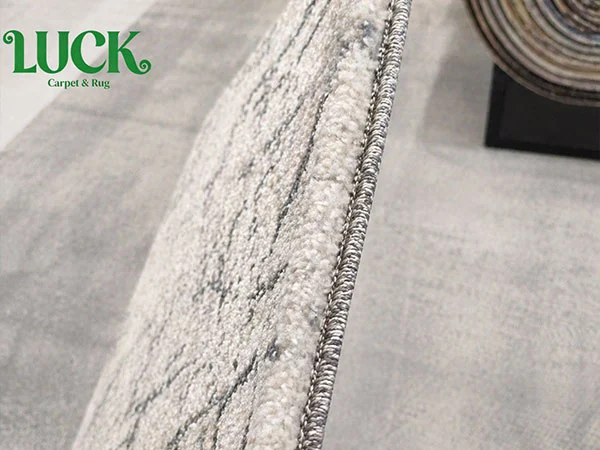
The finished surface is a cut pile with a short, even top and a print that sits inside the fibre rather than on it, so the design softens at an angle and gains depth from the wool's own light scattering. Colour reads matte rather than flat, and the pile springs back within a few seconds of a step. Rolls arrive 4 m wide, wound face in on a treated core and wrapped in moisture-barrier film.
Lay the carpet over a smooth, dry, sound subfloor with standard tackless gripper and, where specified, a felt underlay of 6 to 8 mm. Let the rolls acclimatise on site for 24 hours before cutting, and trim the selvedge only after the first drop is stretched. This construction is made to order in Foshan, Guangdong. Send artwork, room plan and handover date, and LUCK Carpet will return a strike-off schedule and a roll layout.
Address
Shidaigongguan Building No.5 Office 1212, Haicheng east road, Duanzhou District, Zhaoqing City, Guangdong Province, China
Tel
Copyright © 2026 Zhaoqing Yunle International Trade Co., Ltd. All Rights Reserved.