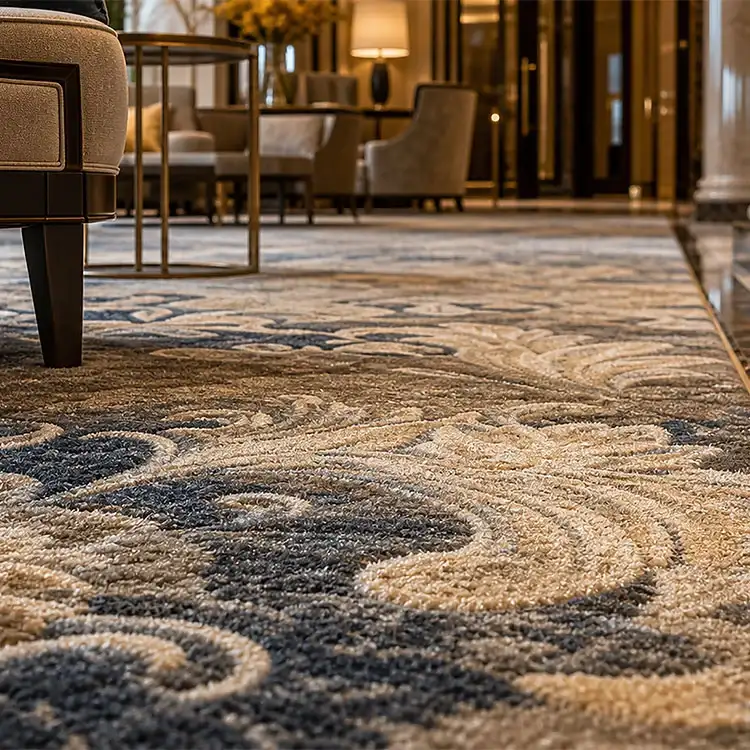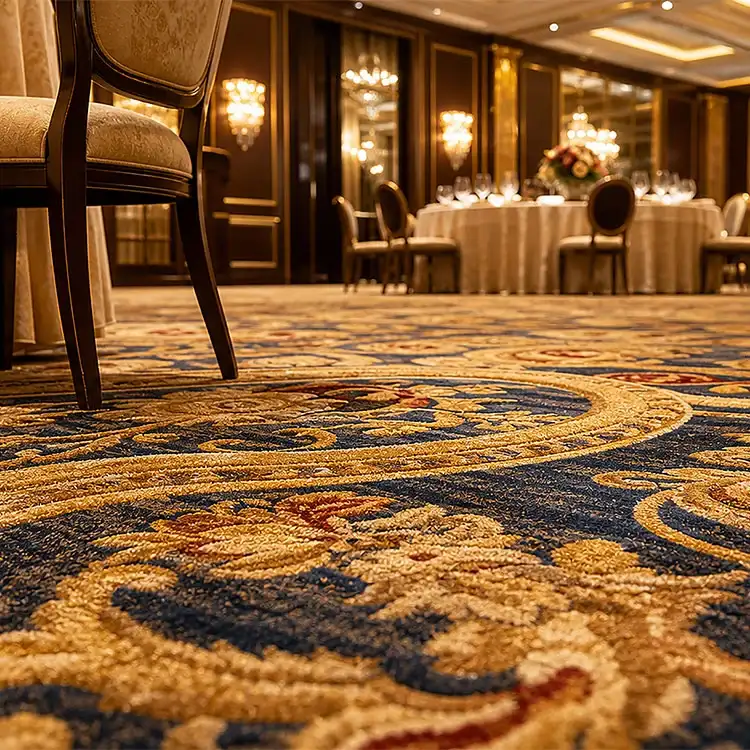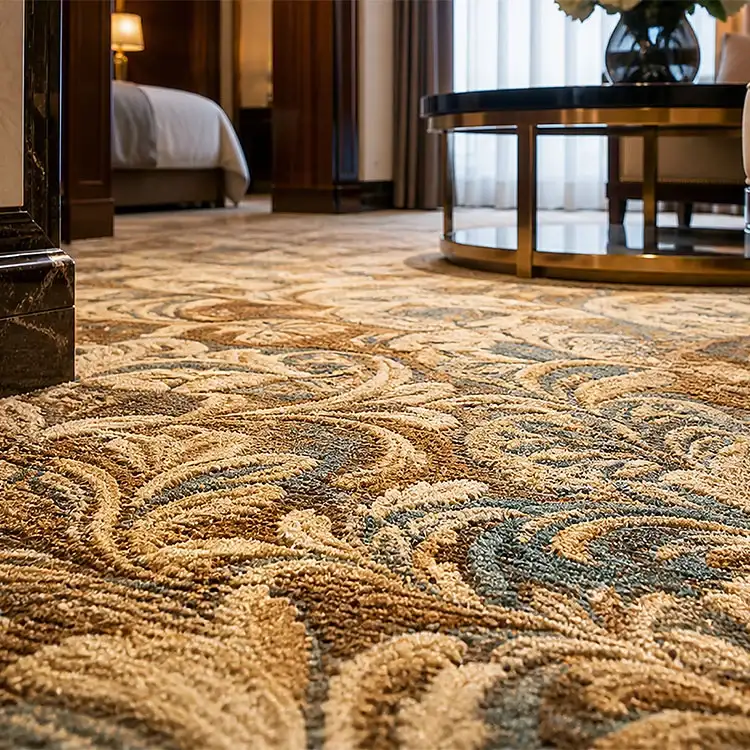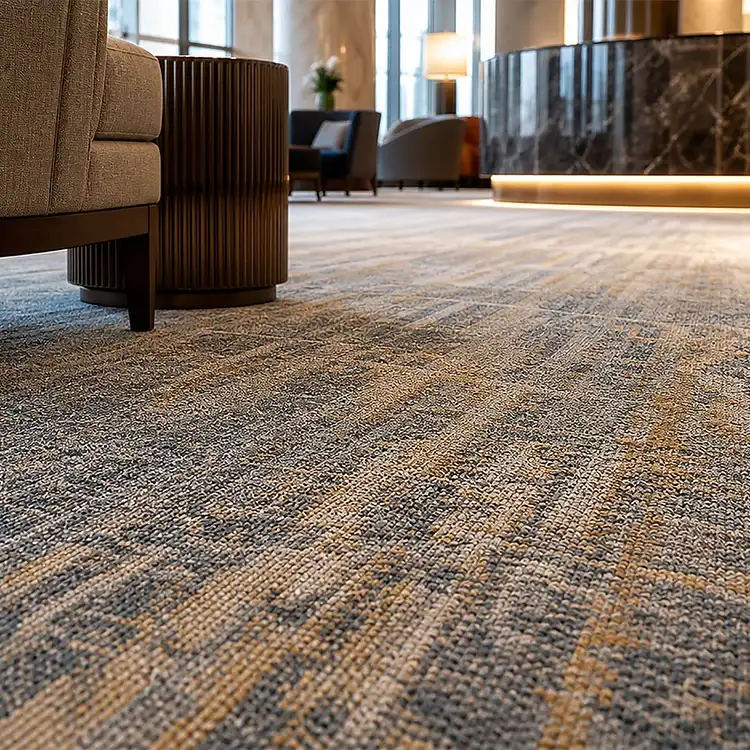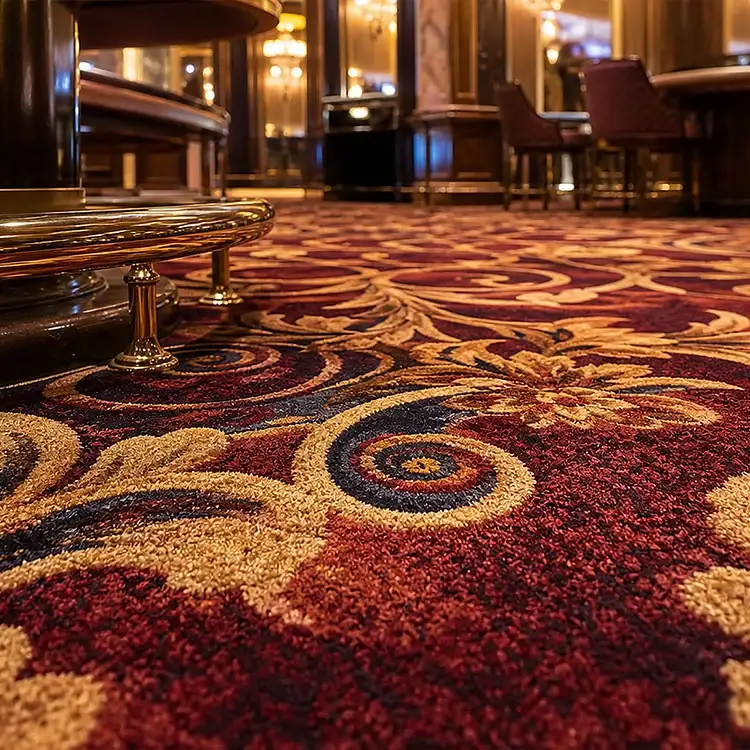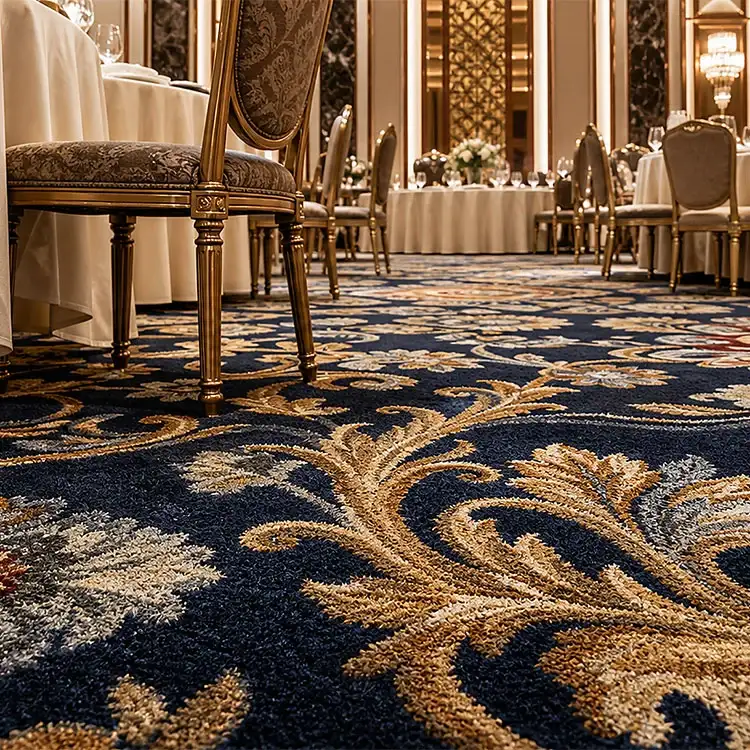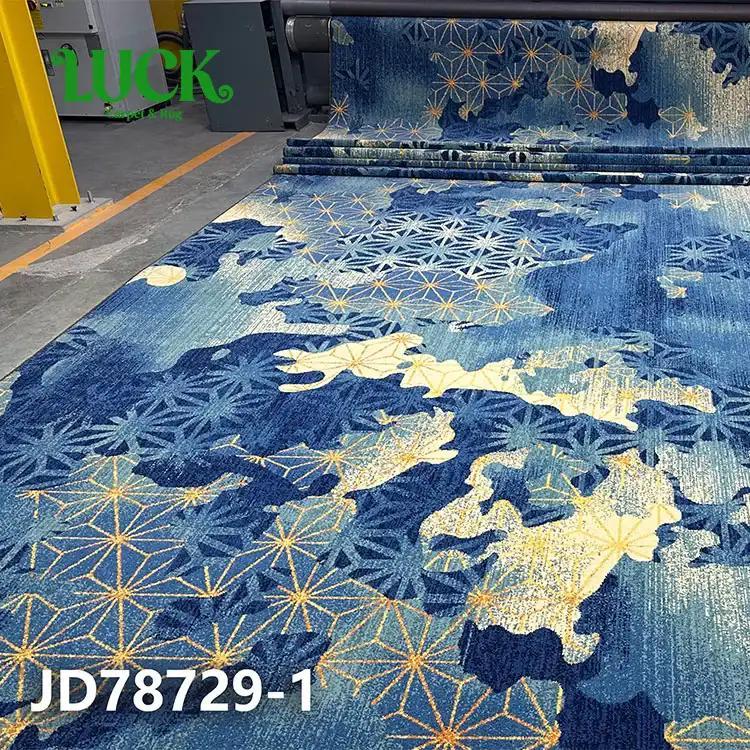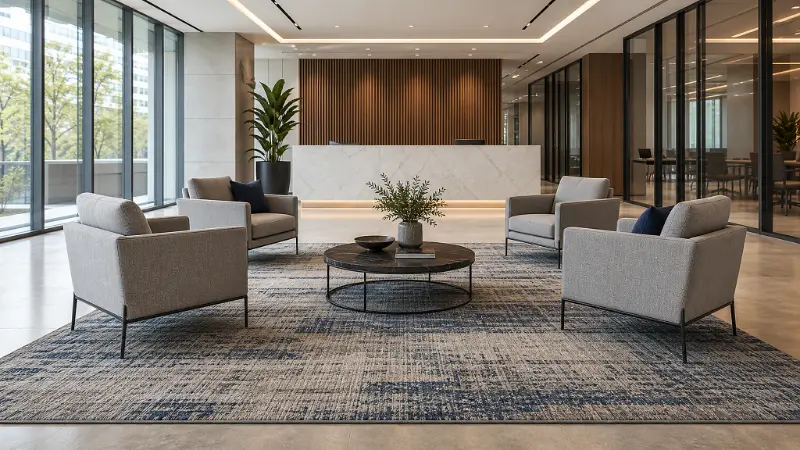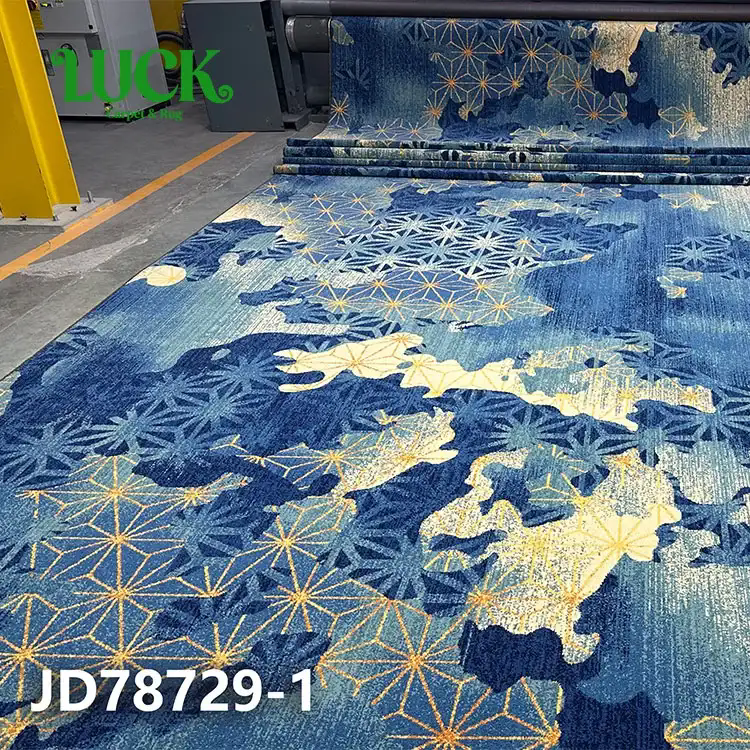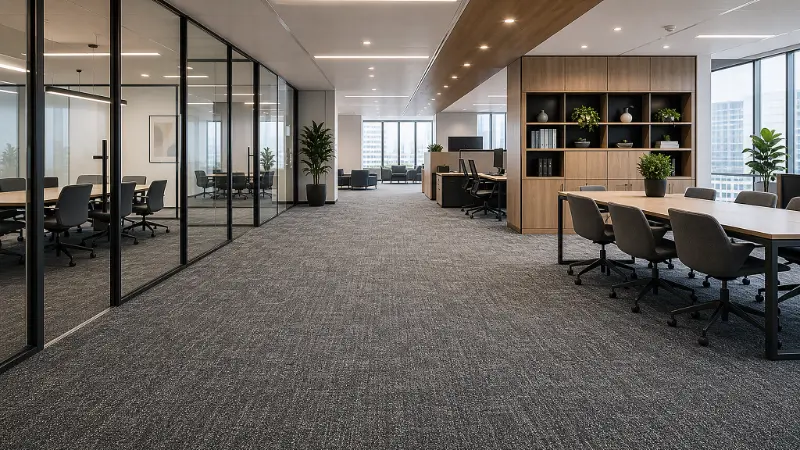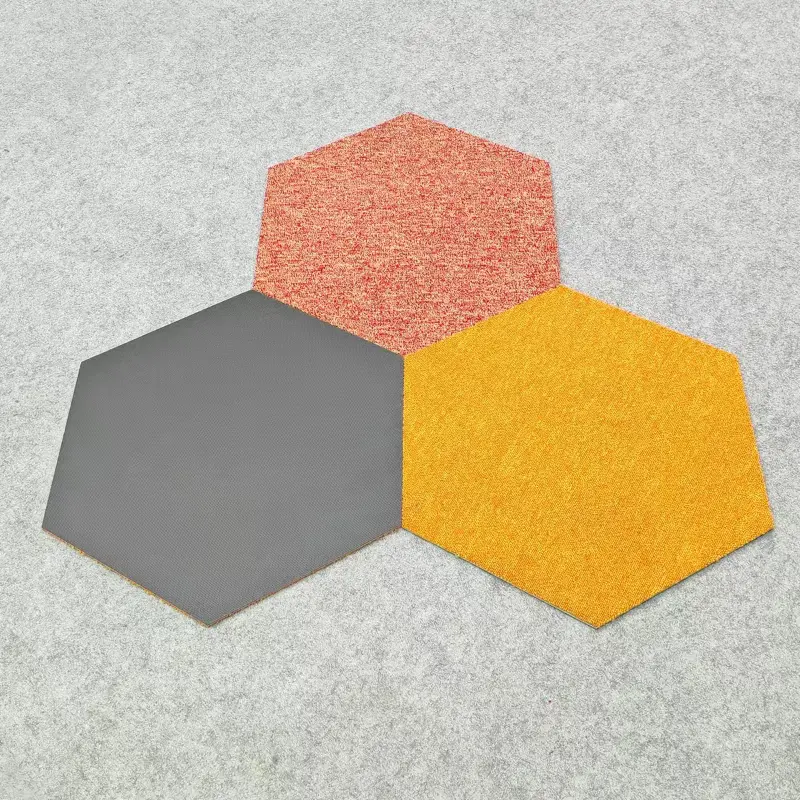
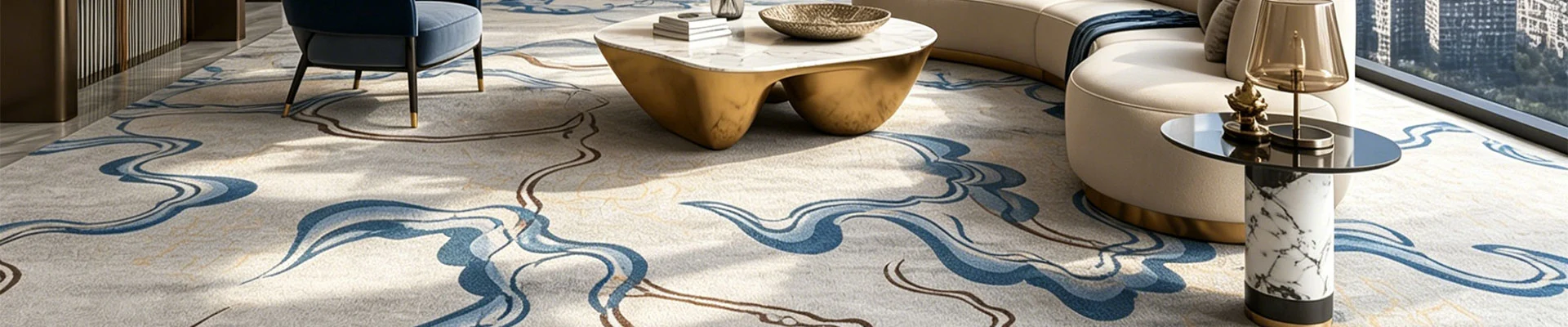

LUCK Carpet makes this wool printed wall to wall carpet for hotel guest areas at our 26,000 m2 plant in Foshan, Guangdong, where 180 staff and 14 years of export production sit behind every roll. The construction is an 80/20 wool-nylon blend in a 10 mm cut pile at 1,200 g/m2 on an anti-slip textile backing, printed from the hotel's own artwork at a 4 m usable width and classified Bfl-s1 to EN 13501-1. Hoteliers buy it for corridors, rooms and suites, where guests judge the floor with their ears as much as their eyes.
Sound in a hotel corridor arrives two ways: through the air as footsteps and voices, and through the structure as impact vibration from heels, trolleys and doors. Carpet is the cheapest tool a hotel has against both. A 10 mm wool pile at 1,200 g/m2 absorbs impact energy at the point of contact, and the open fibre structure takes mid and high frequency energy out of the air as well.
Measured over a felt underlay of 6 to 8 mm, this construction reduces impact sound by Delta Lw 23 dB to ISO 717-2 and returns a weighted absorption coefficient of alpha w 0.20 to ISO 354. Those numbers will not rescue a badly built wall, and we say so plainly to hotel clients. What they do is remove the footstep signature that guests recognise through a door at 1 a.m., which is the complaint that reaches the front desk.
Wool buffers humidity. The fibre takes up moisture from the air and releases it again, so a room feels less dry in winter and less clammy in a coastal summer. Thermal resistance for a 10 mm wool pile is modest, around 0.15 m2K per watt, which matters if the hotel runs underfloor heating, because the floor surface should stay at or below 27 degrees C.
Indoor air quality is the other half of guest comfort, and hotels are increasingly asked about it. Emissions from this construction are screened to GB 18587-2001 Class A, and the printed face is fixed with steam rather than solvent. Wool also holds odour less stubbornly than nylon, because it lacks the same affinity for the oily compounds in tobacco smoke and cooking.
The values below were measured on finished rolls in our Foshan laboratory after 24 hours of conditioning at 23 degrees C and 50 % relative humidity. For a hotel order, read the pile weight row with your corridor traffic in mind, and note the 4 m width, which lets a guest corridor run wall to wall with one lengthwise join rather than three.
| Style | Wool Printed Wall to Wall Carpet for Hotel |
| Yarn type | 100 % Wool |
| Pile Height | 10 mm |
| Pile Weight | 1200 g/m2 |
| Backing | Anti-slip textile backing |
| Fire Resistance | Bfl-s1 (EN 13501-1) |
| Application | Hotel |
| Width / Size | 4 m (13.1 ft) usable width |
| Pattern | Custom design available (artwork supplied by buyer, strike-off approved before production) |
| Surface / Technique | Cut pile |
Guest areas are quiet by design. A corridor at 11 p.m. is a listening test, a suite is where someone sleeps off a flight, and a treatment room needs a floor that does not announce a therapist's steps. One printed design runs through all of them, which lets a hotel keep a single visual language from the lift lobby to the top floor.
Two acoustic figures carry most of the weight in a hotel specification. The first is impact sound reduction, Delta Lw, measured to ISO 717-2, because footfall on a hard floor is the noise that travels into the room below. The second is absorption, alpha w, measured to ISO 354, which governs how much reflected sound stays in a corridor. This construction records Delta Lw 23 dB over a 6 to 8 mm felt underlay.
Thermally, a wool face is a comfort product rather than an insulation product, and nobody should buy carpet to cut a heating bill. What it delivers is a floor that never feels cold to a bare foot at 21 degrees C, which matters at a bathroom threshold or beside a bed. Where a hotel has underfloor heating, keep the surface at or below 27 degrees C.
Each guest area wants a different balance. Standard rooms need a pattern that reads calm at close range and hides the marks that come with 250 occupancy nights a year. Suites want the same design at a larger scale, so a guest moving from the corridor into a suite feels a change rather than a repeat. A spa treatment wing needs a hard threshold strip where it meets a wet area.
Corridors tie the floor together and are the hardest working surface in the building, because every guest, every trolley and every housekeeping cart uses the same 1.5 m width. Acoustic performance there is measured to ISO 354, and the printed design should carry its interest at eye level rather than underfoot. An independent hotel in Edinburgh rebuilt its guest floors on this reasoning, and the next section sets out the numbers.
Two complaints dominate hotel reviews of flooring. The first is noise: a door closing at midnight, a housekeeping trolley at eight, a guest walking past in hard shoes. Carpet absorbs the impact and the reflection, but it cannot stop a sound travelling through a stud wall, and a hotel with thin walls should spend on the wall first. The second is smell, and wool holds less of it than nylon.
Where a hotel still permits smoking on balconies or in a designated lounge, we suggest a darker printed ground for that zone and a stronger cleaning schedule rather than a different carpet, since a change of construction mid-corridor shows in the seams. Abrasion life runs 30,000 to 42,000 rubs to ISO 12947-2 at 5 kPa, which suits a corridor with trolley traffic and a refresh cycle of seven to ten years.
A 96-key independent hotel in Edinburgh, United Kingdom refurbished its guest floors in phases over two winters without closing. The brief asked for one printed design that could run through corridors, standard rooms and suites at three different scales, with quiet as the headline requirement: the property sits on a busy street and had a recurring noise complaint pattern in rooms above the entrance.
We printed 2,100 m2 in fifty-two rolls of 4 m width, delivering the four floors as four separate drops to match the phased programme. Corridors were laid over an 8 mm felt underlay to reach the ISO 717-2 impact figure, and rooms used a 6 mm underlay to keep door clearances. Six months after the final phase, noise complaints were down by roughly a third, and phase four matched phase one.


Hotel carpet is bought once and lived with for a decade, so the paperwork matters as much as the sample. Each batch of this construction is tested in our Foshan QC lab: abrasion to ISO 12947-2 at 5 kPa, recording between 30,000 and 42,000 rubs to a defined change, tuft bind to ISO 4919, backing peel strength in N/50 mm, colour fastness to ISO 105-B02 and ISO 105-X12, dimensional stability to ISO 2551, reaction to fire through EN ISO 11925-2 and EN ISO 9239-1 into the EN 13501-1 class in the table, acoustic performance to ISO 717-2 and ISO 354, and emissions to GB 18587-2001 Class A.
Ask for every value with its method number, a retained strike-off, and batch labels on the rolls. A hotel that holds those three things can extend a floor five years later and prove it still matches, which is what a refurbishment programme depends on. Third-party inspection at our plant is available through SGS, Intertek or BV before shipment.
Carpet removes footfall noise, not street noise. Delta Lw 23 dB to ISO 717-2 over a felt underlay cuts the impact sound that travels through the floor structure, which is what a guest hears from the corridor or the room above. Traffic noise through single glazing is a glazing problem, and we will tell a client that rather than sell carpet against it.
That is the normal pattern for hotels and we plan for it. We retain the approved strike-off and the print file for this construction, and colour is measured on a spectrophotometer against that reference before each phase is printed. We also hold a physical sample from every batch, so phase four rolls are checked against phase one rather than against a memory.
A felt underlay of 6 to 8 mm is the useful range. Go thicker in corridors where impact sound matters most, but keep room underlays at 6 mm so door clearance and threshold heights stay workable with the existing joinery. A dense rubber crumb underlay adds impact performance but feels harder underfoot.
The 10 mm cut pile is sheared level, which gives a firm, quiet surface that reads as a soft matte field under corridor downlights. Print sits inside the fibre, so the design softens slightly at the motif edge and does not glare when a housekeeping cart passes. Rolls come 4 m wide, wound face in on a treated core and sealed in moisture-barrier film, labelled with batch, register log and length.
Send the floor plans and the phasing dates, and our technical team will calculate cut waste per floor and mark where joins fall relative to guest room doors, which is where a badly placed seam is most visible. Deliveries leave Foshan, Guangdong, by sea or air. LUCK Carpet has supplied printed wool carpet to hotel groups for over a decade. Ask for a strike-off and a corridor layout drawing.


Address
Shidaigongguan Building No.5 Office 1212, Haicheng east road, Duanzhou District, Zhaoqing City, Guangdong Province, China
Tel
Copyright © 2026 Zhaoqing Yunle International Trade Co., Ltd. All Rights Reserved.