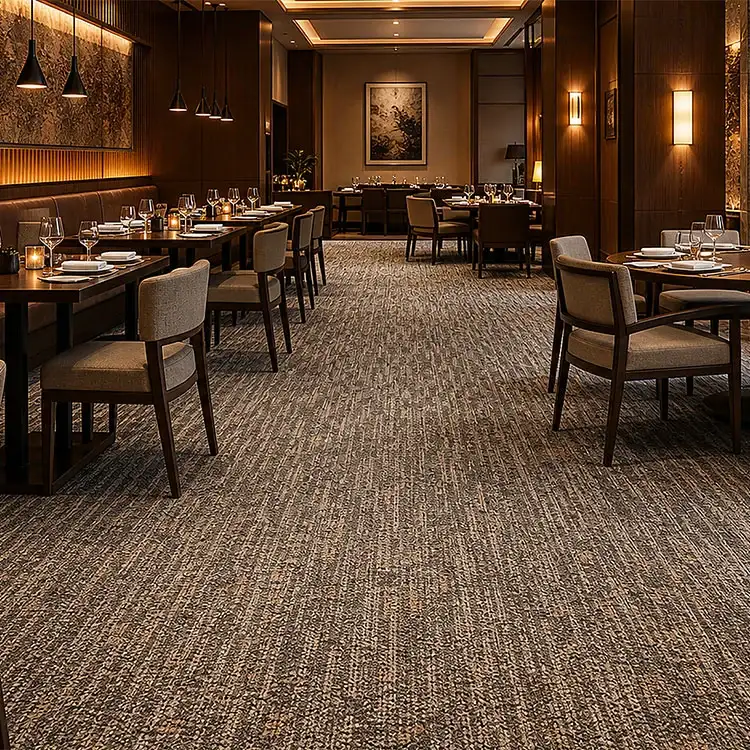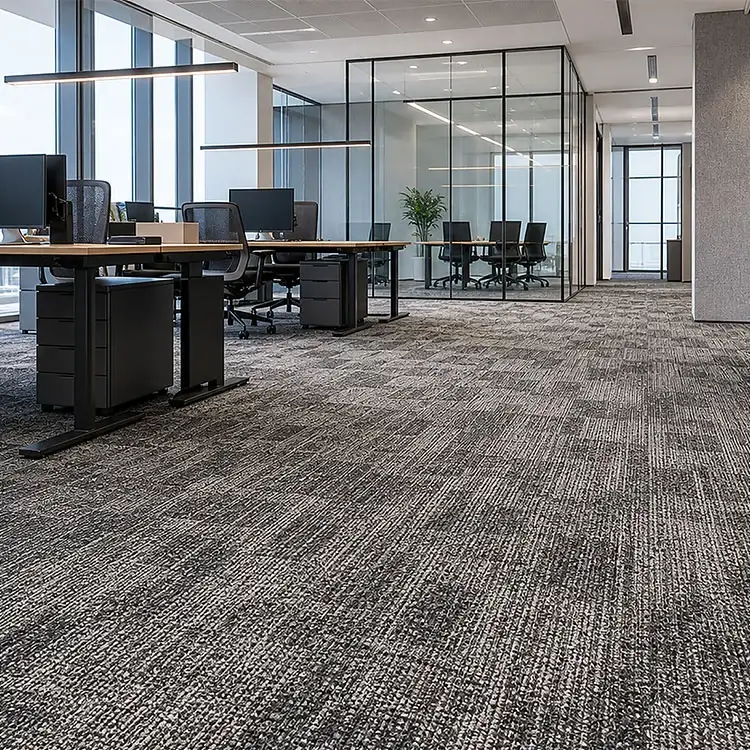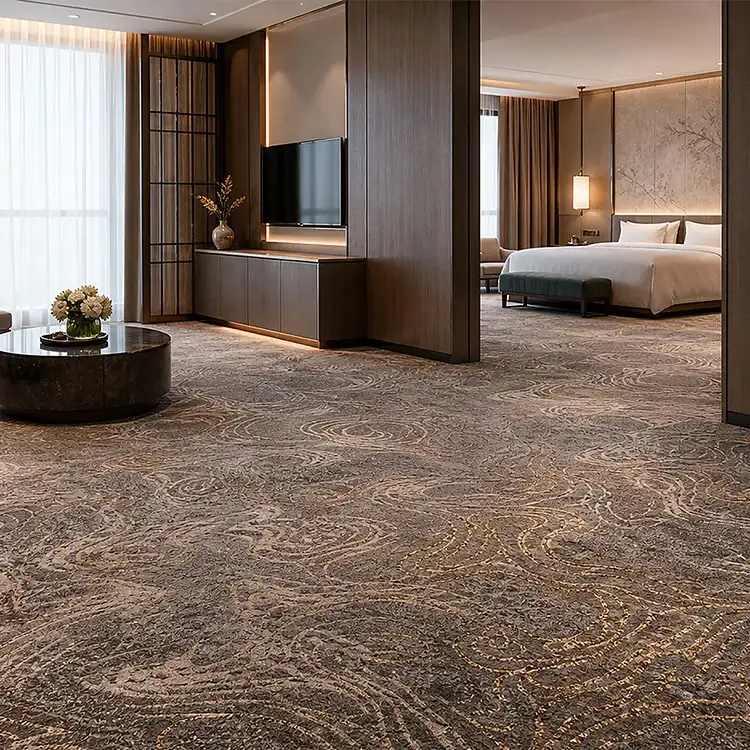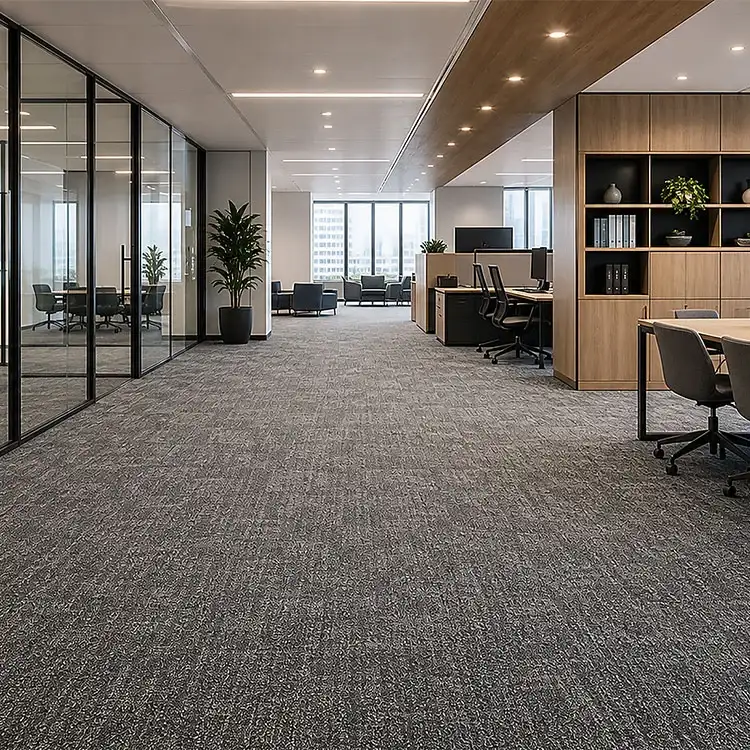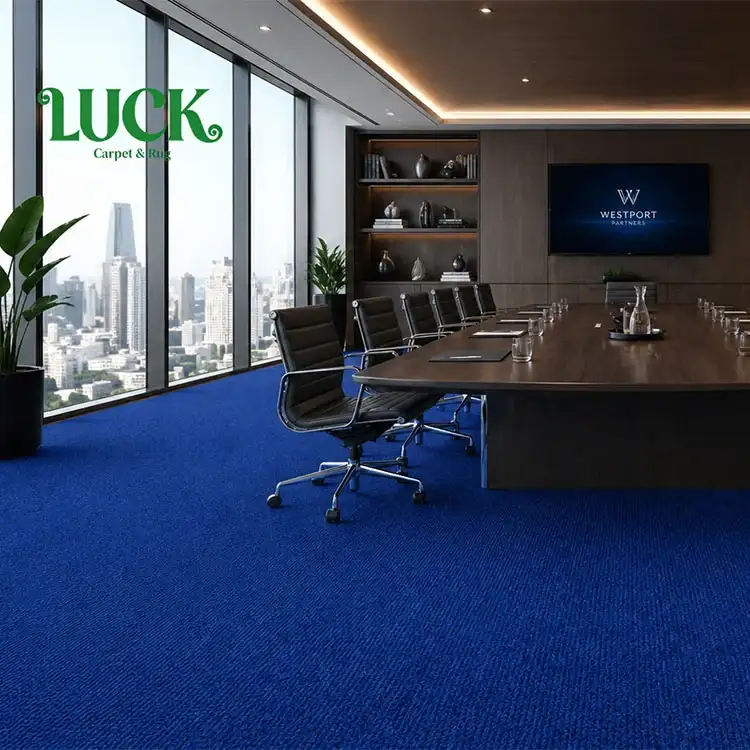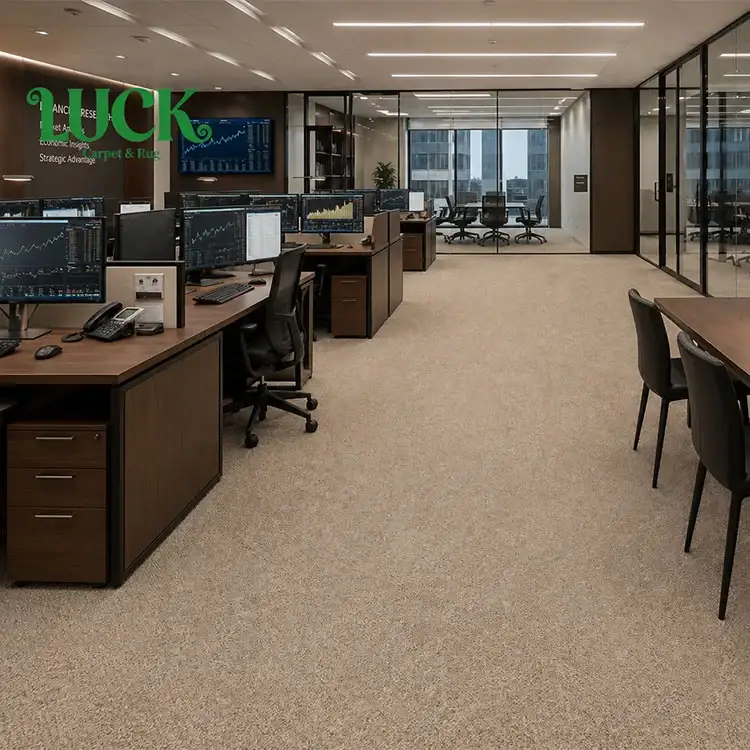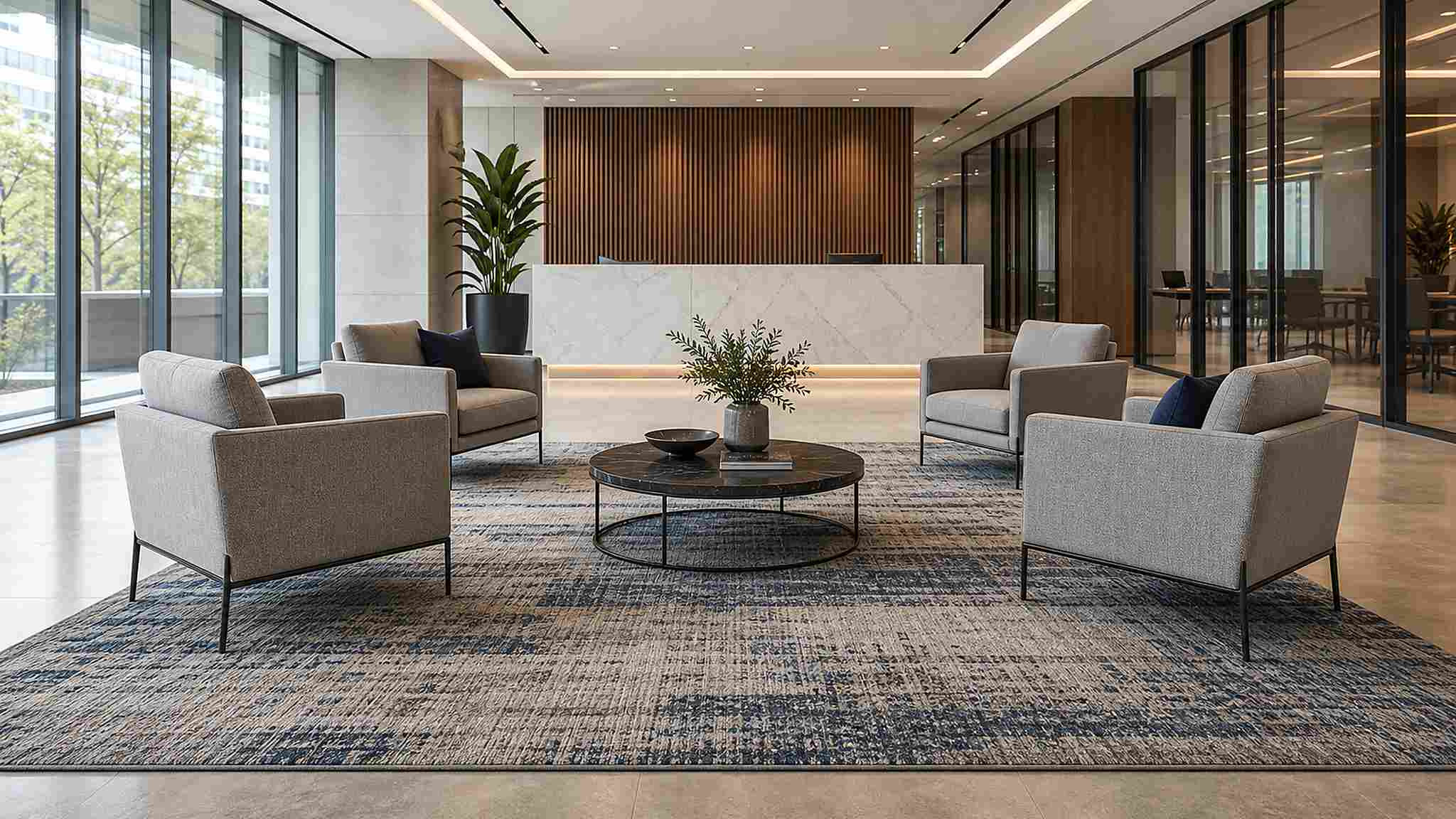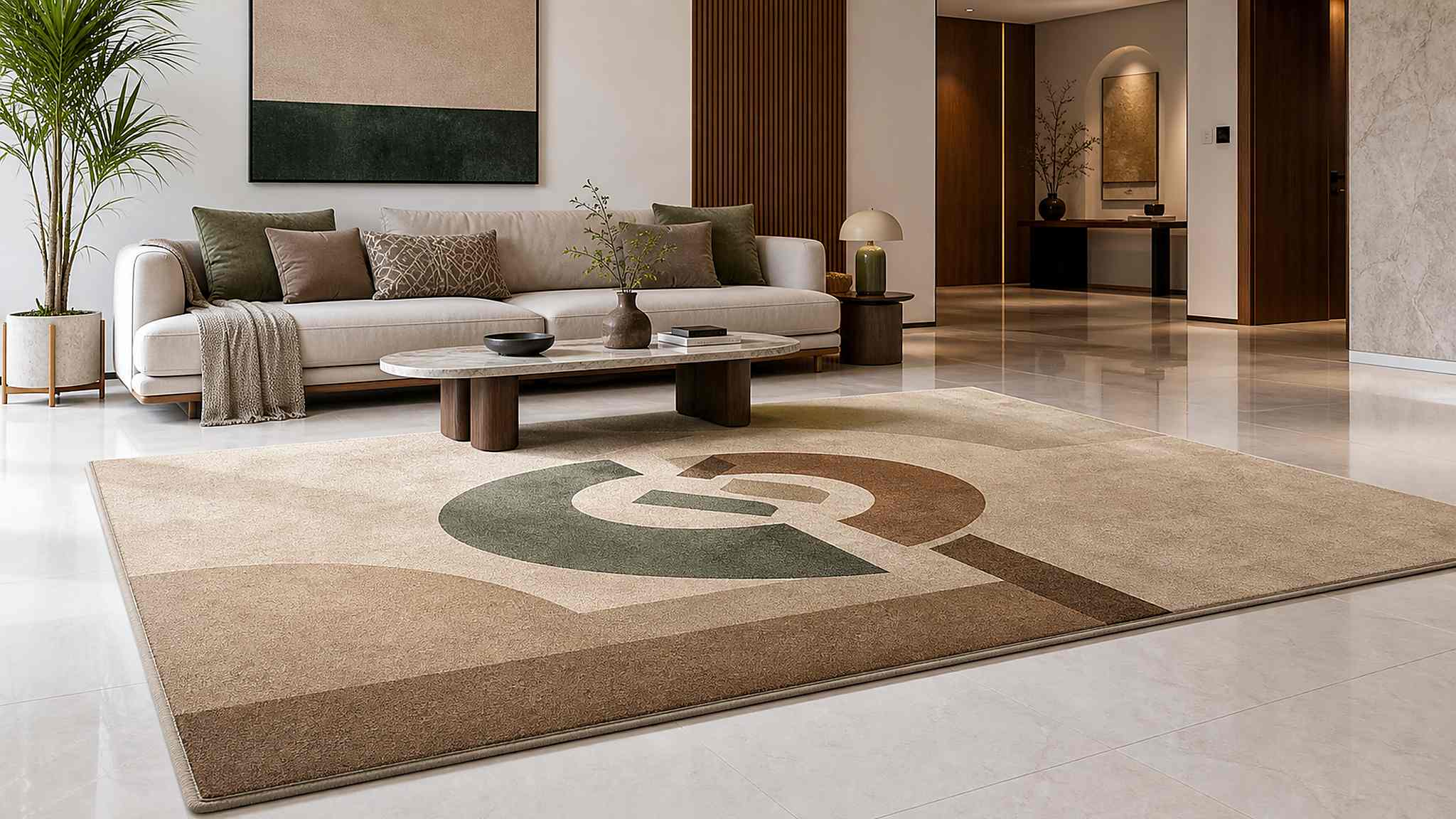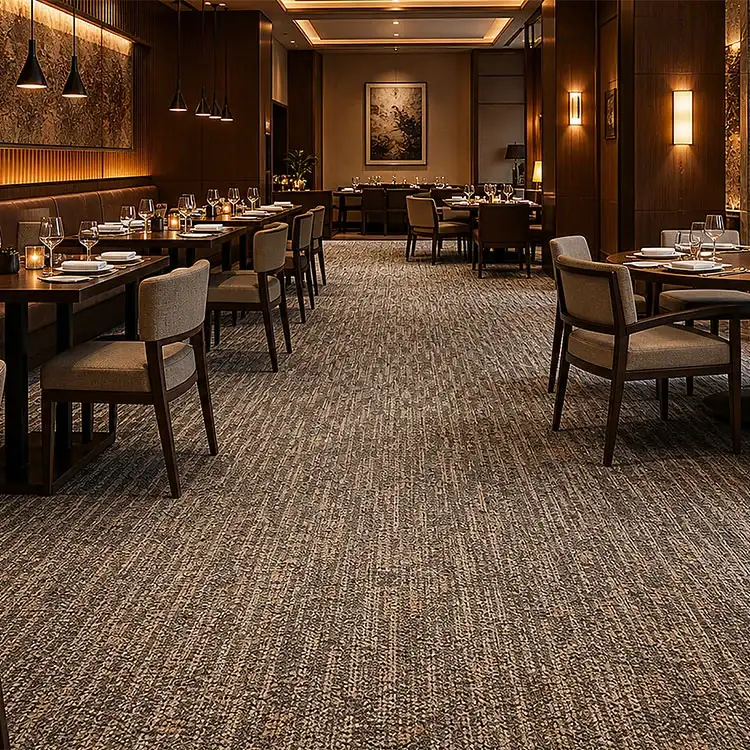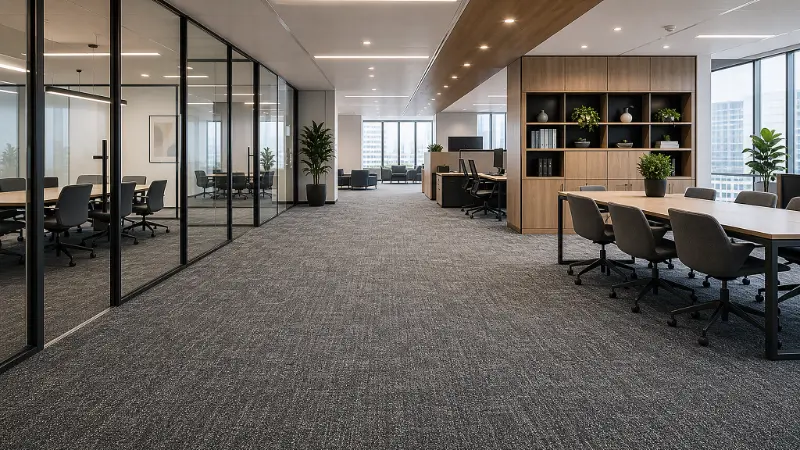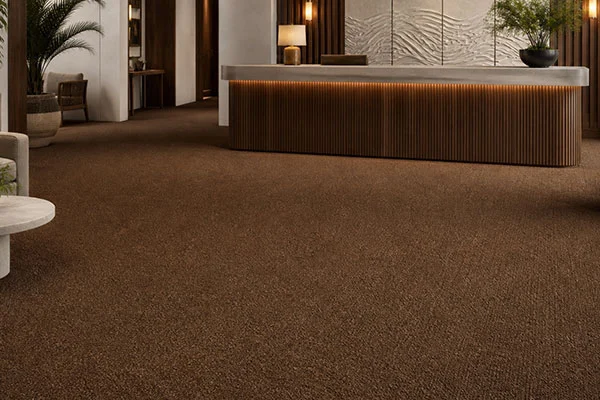
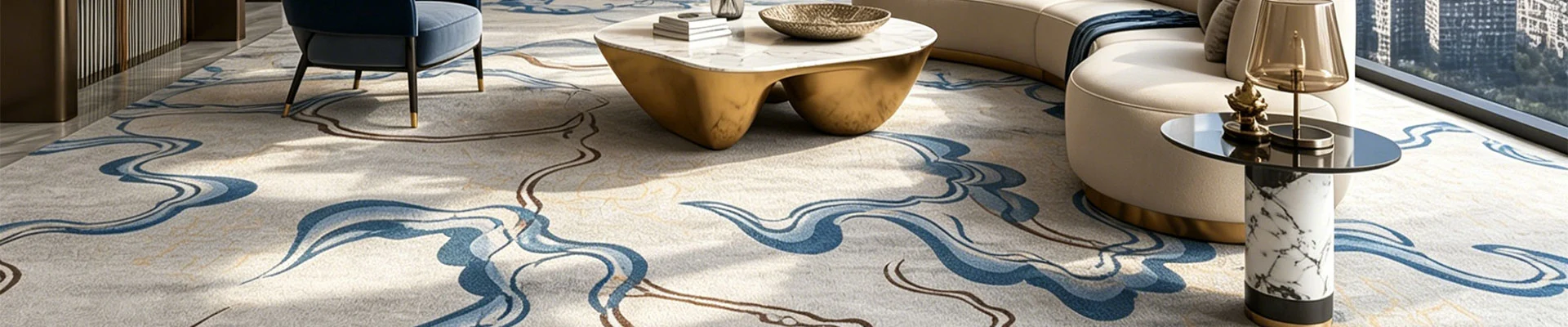

LUCK Carpet manufactures this tufted solution dyed yarn wall to wall carpet for institutions at our 26,000 m2 plant in Foshan, Guangdong, where 180 staff run extrusion, tufting and finishing. Colour is compounded into the polymer before extrusion, so no part of the pile depends on a surface dye or a topical finish. The construction is a cut pile at 5 mm on an anti-slip textile backing, supplied in a 4 m usable width for schools, clinics, libraries and government buildings. This page is about the cleaning regime those buildings run.
Institutional cleaning is not gentle. School corridors are mopped daily, clinic waiting areas are wiped with chlorine based disinfectant, and library floors take a stronger agent whenever something spills. A carpet dyed on the surface loses colour from the top of the tuft down, and the pale core underneath shows as patchy lightening. Melt pigmentation puts colour where a mop cannot reach, and rub fastness to ISO 105-X12 holds at Grade 5.
Some rooms should not have carpet at all, and we say so at tender stage. A sterile operating theatre, a wet room, a commercial kitchen and a laboratory bench area belong to sheet vinyl or resin. Carpet suits the corridors, classrooms, libraries, waiting areas and offices around them. Where an infection control team asks for antimicrobial protection we can add a treated yarn.
Hot water extraction is the maintenance method that separates a commercial carpet from a domestic one. A facility may clean the same corridor eight or ten times a year, and every pass puts water into the backing. Dimensional stability to ISO 2551 is the test that matters, and static loading to ISO 3416 keeps thickness loss on this construction at 12 % where trolleys and beds roll every day.
Structure holds the rest together. Yarn is tufted into a woven primary and locked with a pre-coat before the anti-slip textile backing is laminated, so a tuft resists being pulled out by a trolley wheel or a chair castor. Tuft bind measures to ISO 4919 at 38 N and laminate peel at 31 N/50 mm, figures a maintenance manager can quote back to us if a floor ever delaminates in service.
The values below are measured on finished rolls in our Foshan plant and are the ones we accept on a purchase order. Fire classification matters more here than in an office: Bfl-s1 is classified under EN 13501-1 and supported by EN ISO 9239-1 and EN ISO 11925-2 reports, which is what a school corridor on an escape route needs. Read the pattern row early, because wayfinding often means a custom design.
| Style | Tufted Solution Dyed Yarn Wall to Wall Carpet for Institutions |
| Yarn type | Polypropylene / Polyester |
| Pile Height | 5 mm |
| Pile Weight | 700 g/m2 |
| Backing | Anti-slip textile backing |
| Fire Resistance | Bfl-s1 (EN 13501-1) |
| Application | Institutions |
| Width / Size | 4 m (13.1 ft) usable width |
| Pattern | Custom design available (artwork supplied by buyer, strike-off approved before production) |
| Surface / Technique | Cut pile |
Four building types share one problem. A school, a clinic, a library and a government office clean on a schedule set by someone other than the person who chose the floor, against a biological or legal standard rather than an aesthetic one. The sections below cover disinfection regimes, the institution types we supply, and the three stains that decide how a floor ages.
Disinfection is a chemical exposure that repeats. Diluted sodium hypochlorite, quaternary ammonium compounds and accelerated hydrogen peroxide all attack a surface dyed pile, and the first sign is a lighter patch around a door handle or a bed bay. Because the pigment sits inside the filament, the agents that lift a surface dye have nothing to lift, and clean water rinsing at the end of the shift removes the residue.
Light fastness matters in the same buildings for a different reason. School atria, clinic waiting halls and library reading rooms are often glazed to the floor, and ISO 105-B02 returns Grade 6 for this construction. With an abrasion record above 40,000 rubs to ISO 12947-2, the surface keeps its appearance long enough to outlast a refurbishment cycle.
At DOMOTEX Hannover we asked 71 specifiers working on school and healthcare projects what they check first on a carpet sample. The largest group, thirty-four of them, said the same thing: what the floor will look like after a winter of grit and a year of mopping. That answer shapes our institutional case study, a campus in Helsinki, Finland that combines a school with a health centre.
Physical conditions differ between the four building types and the specification absorbs them. A school needs a surface that tolerates sand, road salt and chair castors in the same corridor. A clinic needs cleanable surfaces along the circulation route and a pile that hides trolley tracks. A library needs quiet and light stability. A government building needs appearance retention where visitors judge the interior in the first ten metres.
Three marks define an institutional floor. Ballpoint ink travels on hands and bags and wicks into a fibre treated with an oil based stain guard. Chewing gum is pressed into the pile and cannot be wiped off. Disinfectant leaves a residue that holds soil at the pile base, so a floor that was cleaned looks dingy a week later. None of those is a colour problem; all three look like one.
Solution dyed yarn changes the cleaning method rather than the chemistry of the spill. Ink lifts with a solvent spotter because there is no topically applied guard to strip at the same time. Gum comes out with a freezing aerosol or a citrus gel, which a pile this dense tolerates without matting. Disinfectant residue rinses away with clean water, and the shade underneath is the shade that was delivered.
A campus in Helsinki, Finland brought a comprehensive school and a municipal health centre under one roof and specified a single carpet for the shared circulation, classrooms, library and waiting areas. The area was 4,300 m2, supplied as 36 rolls. The brief asked for one surface that could take a school cleaning regime on one side of the building and a clinical disinfection regime on the other.
We supplied the institutional grade with no topical treatment, so maintenance teams use the same neutral cleaner and hot water extraction method on both wings. After five extraction cycles the sample length change measured 0.19 % under ISO 2551, well inside the dimensional band we publish, and no patchy fading was recorded at door handles or bed bays. The annual floor complaint count fell from thirty eight to nine.
Institutional orders are released against a written test pack. Abrasion runs to ISO 12947-2 at 5 kPa and this construction returns 42,000 rubs to defined change. Colour fastness is recorded to ISO 105-B02 for light and ISO 105-X12 for rubbing, tuft bind to ISO 4919, and dimensional stability after wet cleaning to ISO 2551. Fire classification is Bfl-s1 under EN 13501-1 with EN ISO 9239-1 and EN ISO 11925-2 reports, and indoor air emissions are Class A to GB 18587-2001. Slip performance is reported under EN 13893, and we run DIN 51130 on the backing for insurers. Use classification follows ISO 10874 and EN 1307. Ask what happens to appearance after cleaning, not just before it.


In most cases yes, at the dilution the manufacturer specifies for hard surfaces. Chlorine based products should be rinsed with clean water afterwards so residue does not hold soil at the pile base. Send us the product data sheet and we will confirm compatibility in writing before the tender goes out, because it is cheaper to change a cleaning product than a floor.
Gum is frozen with an aerosol or softened with a citrus gel, then lifted with a spatula without cutting the tuft. Ballpoint ink comes out with a solvent spotter applied to a white cloth and worked from the outside of the mark inwards. Avoid oil based stain guards on this product, because they lock ink in rather than keeping it out.
Yes. The construction is classified Bfl-s1 under EN 13501-1, supported by EN ISO 9239-1 and EN ISO 11925-2 test reports, which is the class most European school specifications call for. Wall to wall textile flooring also stays in place underfoot when a corridor empties quickly, which is an argument hard flooring does not win.
The carpet is supplied as cut pile broadloom in a 4 m usable width, wound face in on a core and wrapped for container loading, with straight pre-trimmed selvedges for butt jointing. The surface is dense and matte, which hides trolley tracks and footfall in a corridor, and the anti-slip backing is stable enough for direct glue down over a prepared screed. Stair nosings, cove bases and entrance matting can be supplied to match.
Custom designs are available when artwork is supplied by the buyer and approved on a strike-off before production, which is how schools get house colours and wayfinding bands. We quote four weeks on a stock shade, six when the yarn has to be extruded to a new recipe, and SGS, Intertek or BV can inspect the rolls here before they ship. Warranty on the face pile runs to 8 years. Send LUCK Carpet your room schedule and cleaning products.


Address
Shidaigongguan Building No.5 Office 1212, Haicheng east road, Duanzhou District, Zhaoqing City, Guangdong Province, China
Tel
Copyright © 2026 Zhaoqing Yunle International Trade Co., Ltd. All Rights Reserved.