Products

LUCK Carpet manufactures this polypropylene tufted wall to wall carpet at our 26,000 m² plant in Foshan, Guangdong, for shop floors where the entrance, the till run and the back store wear at three different speeds. It is a 4 mm loop pile at 500 g/m2 on an anti-slip textile backing in 4 m (13.1 ft) usable width. Fourteen years of exporting retail flooring taught us to quote it for the sales area, not the loading bay. This page covers front-of-store definition, what real footfall does to a 500 g/m2 face, and how trolleys treat a till run.
A shop is read from the doorway, so the floor does signposting work before a customer reaches the first fixture. A solid shade on a tight level loop gives a clean line where carpet meets vinyl or tile, and it lets a manager zone the sales area with nothing more than colour: entrance dark, aisle mid tone, till run back to the entrance shade.
Shade discipline matters more in retail than in any other venue we supply, because patches have to disappear. A visible design makes every repair obvious. Each order is pigmented from a single masterbatch, light fastness measures Grade 6 to ISO 105-B02, and 10 % spare material ships with the order to cover cuts and future patches.
Abrasion on this construction measures 39,000 rubs to defined change on ISO 12947-2 at 5 kPa, and tuft bind is 37 N to ISO 4919. Both are respectable for a budget loop, and neither describes a shopping trolley. Trolley wheels point-load the pile, and a castor that stops and turns on the same square metre is harder on the face than an abrasion test suggests, which is why the till run ages before the aisle.
Backing peel is 31 N/50 mm, length change after wet cleaning is 0.15 % to ISO 2551, static loading leaves a 10 % recovery deficit to ISO 3416, and slip resistance measures 0.34 as a dynamic coefficient of friction to EN 13893 on a dry screed. Reaction to fire is class Bfl-s1 to EN 13501-1, the document a landlord will ask to see.
Values were measured on the finished roll in our Foshan plant, and pile weight counts face yarn only. Read this construction as a class 23 light commercial product to EN 1307, not a class 33 heavy contract floor. It belongs in a boutique, a showroom or a shop aisle, not in the entrance of a superstore where thousands of trolleys cross one threshold.
| Style | PP Tufted Wall to Wall Carpet for Retail Floors |
| Yarn type | Polypropylene |
| Pile Height | 4 mm |
| Pile Weight | 500 g/m2 |
| Backing | Anti-slip textile backing |
| Fire Resistance | Bfl-s1 (EN 13501-1) |
| Application | Retail Floors |
| Width / Size | 4 m (13.1 ft) usable width |
| Pattern | Custom design available (artwork supplied by buyer, strike-off approved before production) |
| Surface / Technique | Loop pile |
A shop floor is four floors in one: entrance, aisle, till zone and back store, each with its own traffic and cleaning routine. The sections below cover how the 500 g/m2 face reads against real footfall, how those four zones behave, and what trolleys do at the till run.
Half a kilo of polypropylene per square metre is a light commercial face, and it performs best where one square metre does not take everything. A store turning over a few hundred customers a day will get years out of this floor. A store turning over a few thousand will see it flatten at the door inside a season, and better cleaning will not change that: the limit is the mass of yarn in the pile.
Below roughly 10,000 passes a day this construction is a sensible budget decision at a fraction of the cost of a nylon loop. Above that, 900 to 1,100 g/m2 of nylon is the right spend and we will quote one. Inside the shop, an entrance mat of 3 m to 5 m does more for floor life than any upgrade, since it takes the grit that would otherwise be walked into the pile.
The entrance takes grit and moisture, so it needs the most aggressive cleaning and the largest patch stock. Aisle traffic is fast and even, and a solid shade earns its keep there. The till zone takes standing feet and trolley wheels in the same few square metres. The back store takes roll cages, pallets and almost no cleaning.
The 2,300 m² Birmingham retail park floor in the case study below sat on an open-plan sales area behind a glazed frontage, so the entrance took daylight, grit and trolley traffic at once. The store could not close, so the fit ran in four overnight phases, one zone at a time, with the entrance last.
At a retail facilities meeting in Birmingham we asked 41 store managers which part of the shop floor they replace first; thirty-one said the till run, and none said the aisle. Trolley wheels are hard, small and loaded, and they pivot on the spot when a customer turns to pack. A loaded roll cage is worse: several hundred kilos on four steel wheels, dragged rather than rolled, cutting wherever a cage is pulled out of an aisle.
Three measures extend this floor at the till run. Patch a gouge the same week rather than the same year. Fit a steel or aluminium trolley strip under the till exit where cages cross the same line daily. And put soft polyurethane castors on roll cages, which cuts both point load and noise. Where a store runs cages all day, a hard floor in that zone beats any carpet.
A home and garden retailer at a Birmingham retail park in the United Kingdom needed a 2,300 m² sales floor re-covered without closing, in one shade for the shop and a darker one for the back store. We supplied 23 rolls of 4 m by 25 m plus three spares, warranted the sales area on the 8-year face pile terms, and worked the fit into four overnight phases with the entrance covered last.
Fourteen months on, the lab measured 10 % thickness loss to ISO 3416 at the till run against 4 % in the mid aisle, which matches the traffic. A 1.8 m² gouge from a roll cage was patched in 35 minutes from spare stock with no pattern to align, and the store opened on time that morning. Cleaning in the entrance zone fell from about 3.5 hours a week to 2.2 hours, because a dark solid shade hides tracked-in grit.
Retail orders get the same sheet as every PP tufted roll from the Foshan lab: abrasion 39,000 rubs to ISO 12947-2 at 5 kPa; tuft bind 37 N to ISO 4919; peel 31 N/50 mm; length change 0.15 % to ISO 2551; static load thickness loss 10 % to ISO 3416; slip resistance 0.34 dynamic coefficient of friction to EN 13893; light fastness Grade 6 to ISO 105-B02 and rub fastness Grade 4-5 to ISO 105-X12; Class A to GB 18587-2001 on indoor air; and class Bfl-s1 to EN 13501-1 backed by EN ISO 9239-1 and EN ISO 11925-2 reports. SGS, Intertek or BV can inspect at the plant before loading.


Plan on 10 % of the floor area and keep it in the store, not in the yard. Retail damage is usually a gouge, a burn or a bleach spill, all of which are patched rather than cleaned, and a patch needs the same production batch. We supply the allowance measured to cover installation cuts and future repairs.
Yes, if an aisle can be spared for an hour. The fitter trims the damage into a clean rectangle, cuts a matching patch from the spare roll, and tapes or heat-seals the join. With a solid shade there is no pattern to align, so the repair is hard to spot from standing height. We send a fitting guide with every retail order.
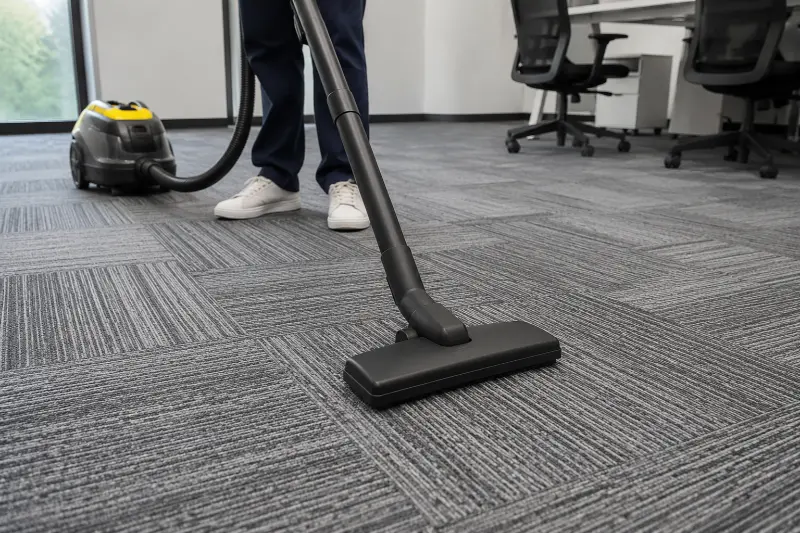
An upright brush-roller vacuum through the entrance and till zones every evening, and the quieter aisles every second day. Blot spills rather than rubbing them. One hot water extraction a year is enough in a shop, and we do not recommend more often. That routine is what the 8-year face pile warranty assumes.
Class Bfl-s1 to EN 13501-1, tested through EN ISO 9239-1 and EN ISO 11925-2, and those reports ship with the order. Most landlords and shopping centres accept them for a sales floor. Check the lease and the insurer as well, because a few older units still call for a national class rather than the European one.
The surface is a 4 mm level loop in a solid shade, supplied as 4 m by 25 m rolls on cores wrapped in moisture-proof film, with the batch code on the wrapper for patch matching. Edges are cut square. We recommend a pressure-sensitive adhesive over a dry screed, or tackless strip with underlay where the store wants a softer walk.
Standard shades run 15 to 20 days after deposit and custom designs 25 to 30 days from strike-off approval, with a minimum order of 500 m² per shade. Because we run four to six tufting lines, a chain roll-out can ship store by store from one masterbatch. Send the floor plan and the trading hours, and LUCK Carpet will return a phased fit programme with the quotation.


Address
Shidaigongguan Building No.5 Office 1212, Haicheng east road, Duanzhou District, Zhaoqing City, Guangdong Province, China
Tel
Copyright © 2026 Zhaoqing Yunle International Trade Co., Ltd. All Rights Reserved.