Products

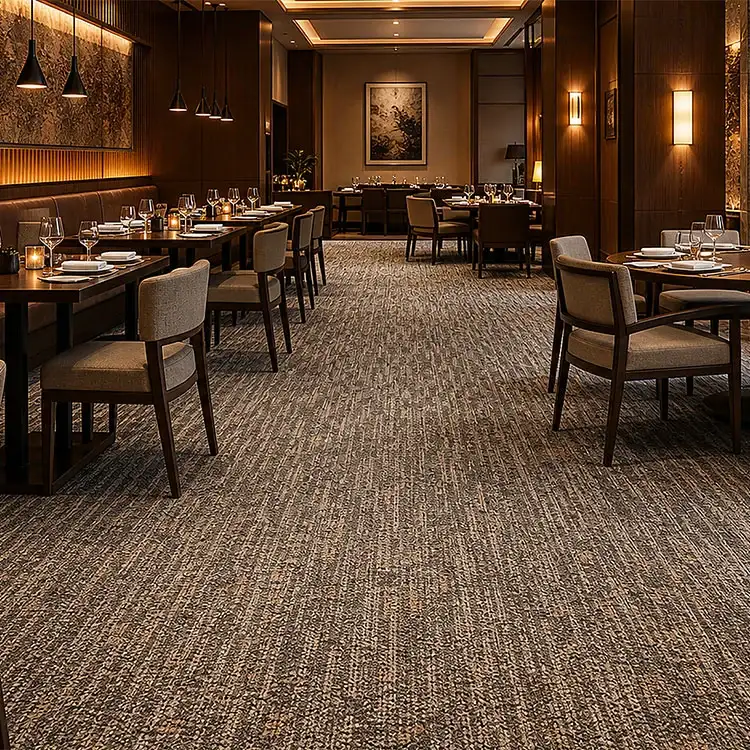
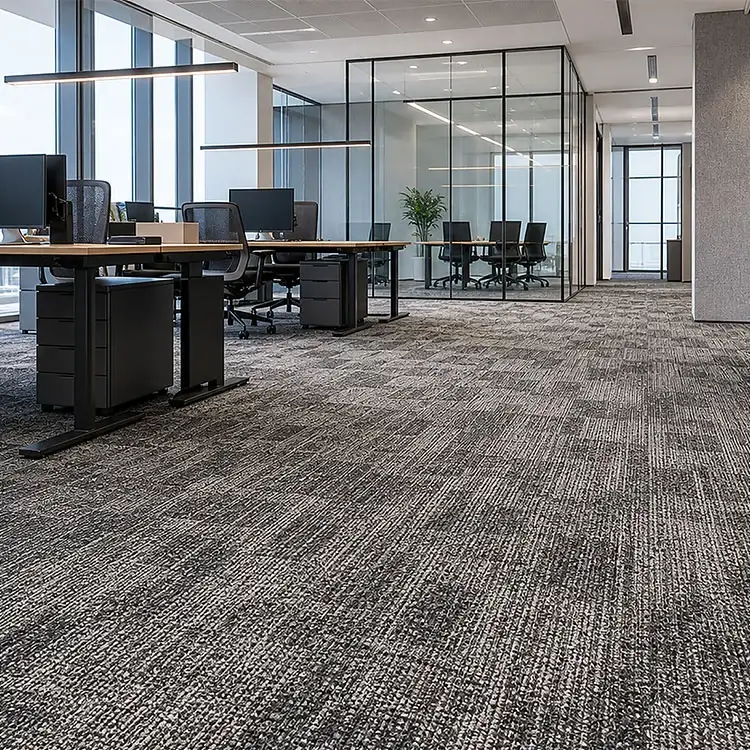
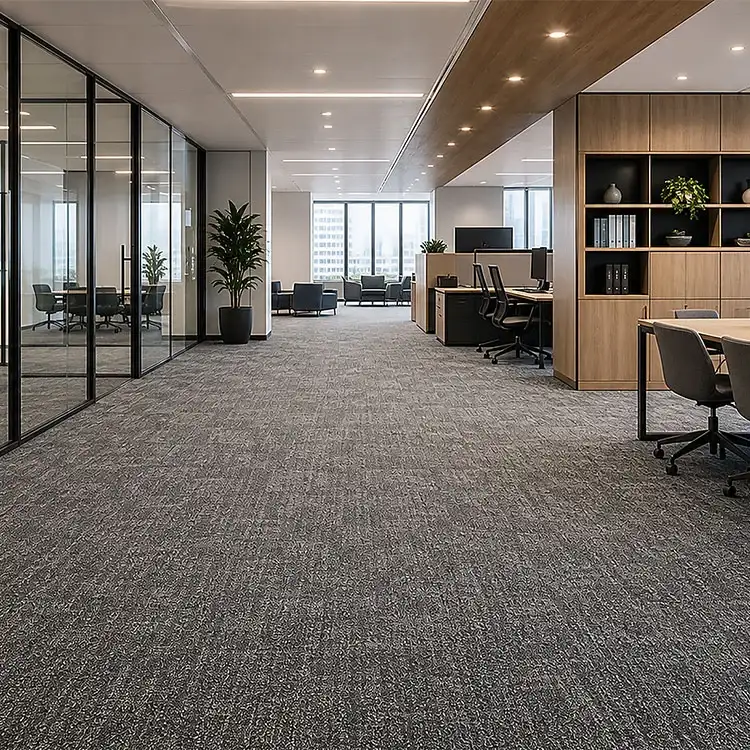
LUCK Carpet manufactures this polypropylene tufted wall to wall carpet at our 26,000 m² plant in Foshan, Guangdong, where 180 staff run the tufting and backing lines, for the booth floors that make a stand look finished before the lighting rig goes up. It is a 4 mm loop pile at 500 g/m2 on an anti-slip textile backing, 4 m (13.1 ft) usable width, which cuts most stands from a single drop with no seam through the middle. Fourteen years of exporting stand flooring taught us that a booth is judged on two things: the boundary line, and how the pile looks on day three.
Boundary definition is a texture problem before it is a colour problem. A level loop reflects light evenly across the stand, so the fascia line and the carpet edge read as one straight shadow. A cut pile with a soft lean smears that line and shows every footprint. Keep the pile direction parallel to the fascia on all four sides and the booth looks square from the aisle, even where the hall slab is not.
Cutting is where the line is won or lost. We cut booth floors on the roll against a steel straightedge and deliver them numbered by stand, so the fitter does not trim on site. A 6 m by 3 m linear stand comes from one 6 m drop; a 6 m by 6 m island takes two, with the seam under the central display wall. Corners are cut square.
Day-three appearance depends on the backing more than on the pile. Tuft bind on this construction measures 42 N to ISO 4919 and backing peel 36 N/50 mm, so the face does not work loose where visitors pivot on the stand edge. Abrasion tested to ISO 12947-2 at 5 kPa reached 44,000 rubs to defined change. The anti-slip textile backing holds the drop on a bare hall floor without adhesive.
Static loading is the honest test for a booth. Under a stand-sitter and a table leg the lab records a 9 % recovery deficit to ISO 3416, which is why day three looks softer than day one even with good fibre. Dimensional change after wet cleaning is 0.22 % to ISO 2551. Reaction to fire is class Bfl-s1 to EN 13501-1, with EN ISO 9239-1 and EN ISO 11925-2 reports for stand approval.
Values below come off the finished roll in our Foshan plant. Pile weight counts face yarn only, so the finished roll is heavier than the pile figure suggests. Venue fire checks are run on the roll, not on a sample, so keep the wrapper label and ask us for the batch number printed beside the EN 13501-1 class.
| Style | PP Tufted Wall to Wall Carpet for Booths |
| Yarn type | Polypropylene |
| Pile Height | 4 mm |
| Pile Weight | 500 g/m2 |
| Backing | Anti-slip textile backing |
| Fire Resistance | Bfl-s1 (EN 13501-1) |
| Application | Exhibition Booths, Stands, Pavilion Floors, Aisles |
| Width / Size | 4 m (13.1 ft) usable width |
| Pattern | Custom design available (artwork supplied by buyer, strike-off approved before production) |
| Surface / Technique | Loop pile |
Booth flooring is three decisions: how the stand footprint gets marked on a bare hall floor, how the chosen stand format is cut, and what happens at the visitor edge when people lean, sit and pivot for three days.
At a stand-builders' briefing in Las Vegas we asked 48 booth contractors what they check first on a stand floor; thirty-three named the boundary line. Most organisers will not allow a platform, so that line has to be made by the carpet itself. We cut every drop to the stand drawing and number it, leaving a 20 mm turn-down at the rear where the wall panel sits on top. That gives a crisp perimeter with no frame, no drilling and no adhesive on a hall floor you do not own.
Where two stands share a line, the fitters lay both drops in the same direction and butt them with tape under the shared wall. An anti-slip backing holds each drop independently, so a neighbour striking early does not drag your floor with it. On dusty concrete, mop the slab before laying: grit trapped under the backing is what starts an edge curling.
Linear stands from 3 m by 3 m to 6 m by 3 m take one drop and one cut. Corner stands add a return, so we rotate the second piece 90 degrees and keep the pile lean running away from the aisle. Peninsula and island stands open on two or four sides, and those are the ones that need the seam hidden under the central wall or the storage counter, never across the open front.
A Las Vegas exhibition house fitting 46 stands for a technology client took 1,850 m² in 19 rolls plus three spares. The floor was a worn slab with a 12 mm step at the service trench, which we cut on site and taped flat. Each stand was numbered on the roll wrapper, so build crews laid their own floors from a plan rather than from a pile of carpet.
The visitor edge is where a booth floor dies. Chairs sit in the same 600 mm band for three days, and the pile under them crushes while the rest of the stand still looks new. In a crushed loop the yarn bends at the base of the tuft and casts a darker patch. With 4 mm of pile there is little depth to hide it, and at a shallow angle the patch reads from the far aisle.
Recovery is measurable and mostly happens overnight. We tell exhibitors to shift the chairs 300 mm at close and vacuum the band with a brush head. On the Las Vegas stands the pile came back to within 3 % of nominal thickness after six hours, measured with a gauge, against a 9 % deficit straight after close. Where a stand keeps permanent seating for a full week, specify a heavier pile or add a mat.
A Las Vegas exhibition house was contracted to fit 46 stands for a technology client at a convention centre, on a three-day build with a fixed opening. The brief asked for one continuous floor tone across every stand so the client's island booth did not read darker than its neighbours. We supplied 1,850 m² as 19 rolls of 4 m by 25 m plus three spares from a single masterbatch, cut and numbered by stand.
Build crews finished the floors in two shifts, and venue inspection passed on the EN 13501-1 Bfl-s1 documents the organiser requested on the first morning. After three show days the lab measured 9 % thickness loss to ISO 3416 in the seating band against 4 % in the open aisle. At strike the boundary lines had not crept: edges stayed within 2 mm of the fascia line across all 46 stands.
Booth customers rarely ask for test data until a venue does. Our Foshan lab keeps the full sheet on this construction: abrasion to ISO 12947-2 at 5 kPa, averaging 44,000 rubs; tuft bind 42 N to ISO 4919; peel 36 N/50 mm; dimensional change 0.22 % to ISO 2551; static load thickness loss 9 % to ISO 3416; colour fastness Grade 5 to ISO 105-B02 and Grade 4 to ISO 105-X12; Class A to GB 18587-2001 on indoor air. Ask your supplier for the EN ISO 9239-1 and EN ISO 11925-2 reports behind the fire class, and for the batch code on the roll wrapper. SGS, Intertek or BV can inspect here before loading.


Yes. The anti-slip textile backing holds on a clean, dry screed, which suits venues that forbid glue and fixings alike. Sweep or damp-mop first, because grit is what lets a drop creep. If the stand carries heavy equipment on castors, tape the perimeter or add a low fixing strip hidden under the rear panel.
Under the central wall, the storage counter or a service spine, never across the open front. Two drops laid in the same pile direction with tape under the wall panel disappear from two metres away. If the stand has no central element, order the 4 m width and cut it from one drop.
Call us before you cut. Spare rolls are cut long, and a 4 m wide drop usually leaves 2 m of extra length on a stand of this size. If the added area is larger than the spare, we can air-freight a matching roll from the same masterbatch within five days, which is why the batch record is held for two years.
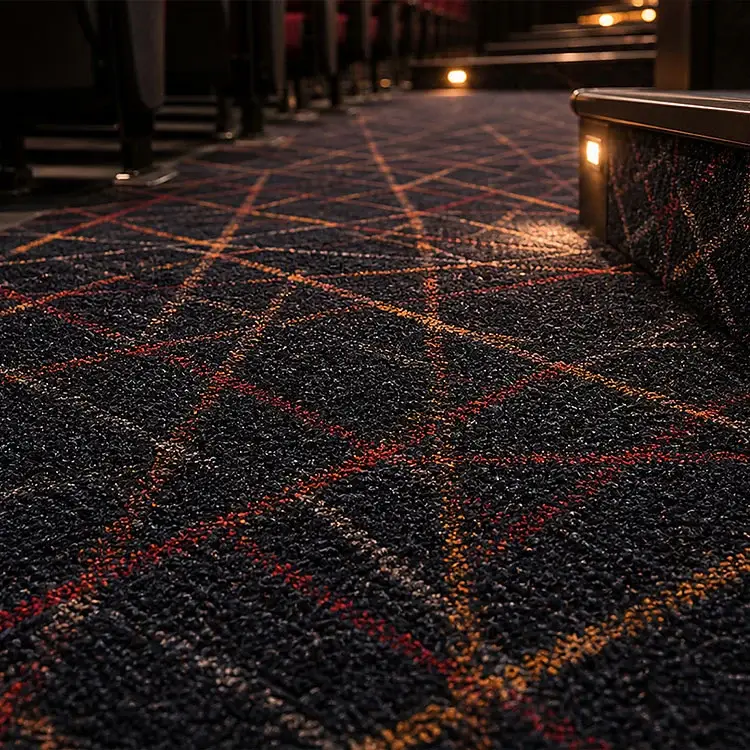
Booth orders ship as 4 m by 25 m rolls on cores, wrapped in moisture-proof film, with the stand number printed on the wrapper and a cutting plan inside the first roll. The surface is a tight level loop with a low sheen, and the reverse is an anti-slip textile backing that grips screed but slides on polished stone, where we advise taping the perimeter. Edges are cut square and unsealed.
Standard shades ship 15 to 20 days after deposit, and a custom shade or logo design needs 25 to 30 days from strike-off approval. Minimum order is 500 m², and a 3 m by 3 m booth uses about 12 m². Send the stand drawings and the build schedule, and LUCK Carpet will return numbered cutting plans with the quotation.


Address
Shidaigongguan Building No.5 Office 1212, Haicheng east road, Duanzhou District, Zhaoqing City, Guangdong Province, China
Tel
Copyright © 2026 Zhaoqing Yunle International Trade Co., Ltd. All Rights Reserved.