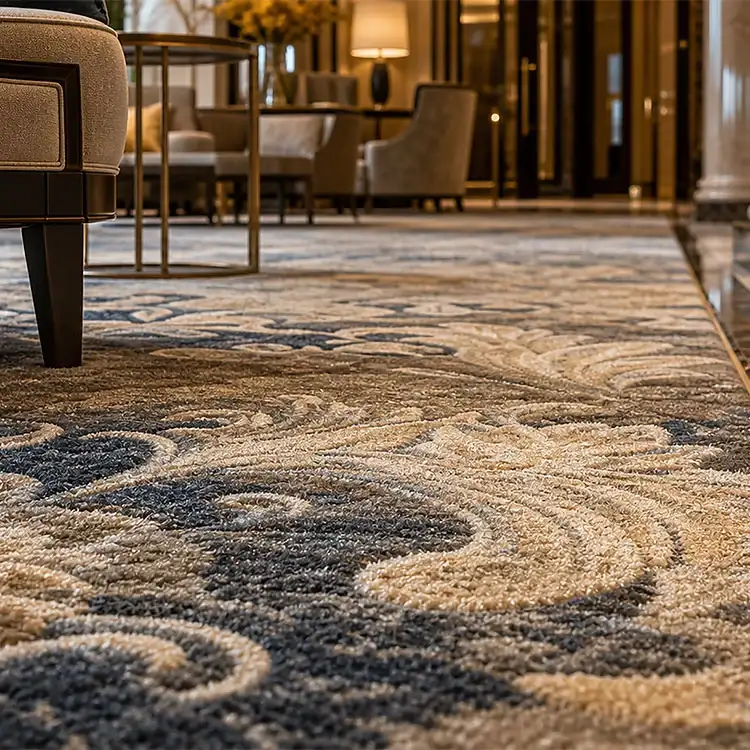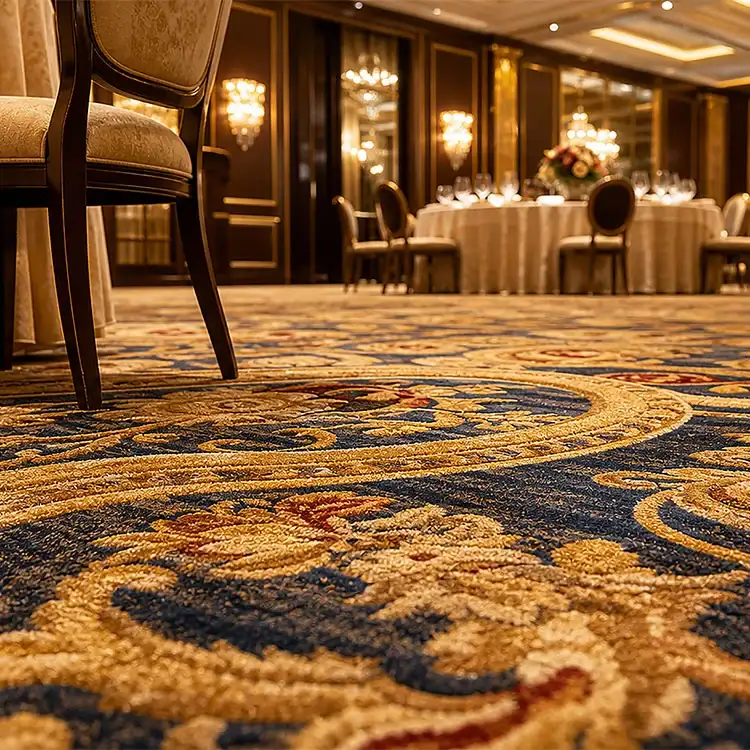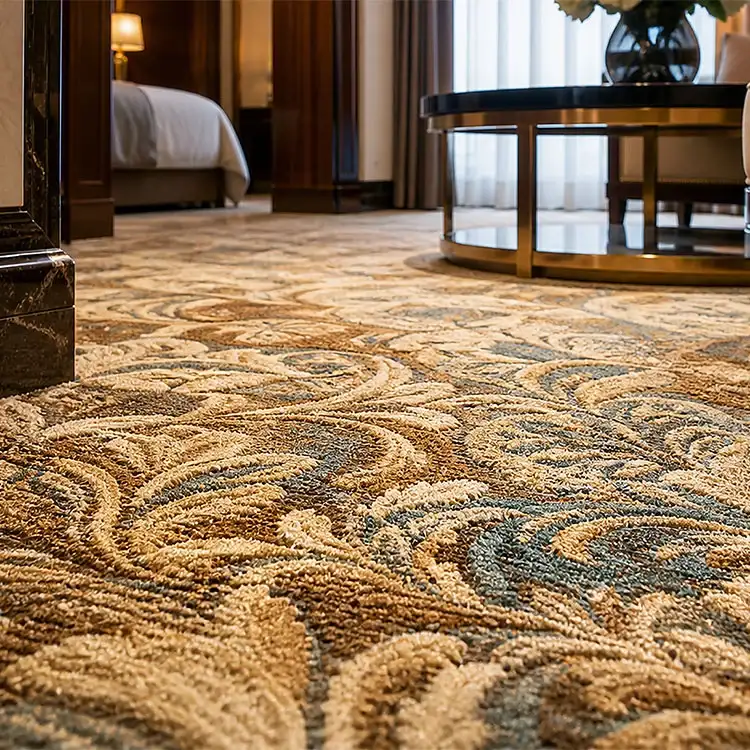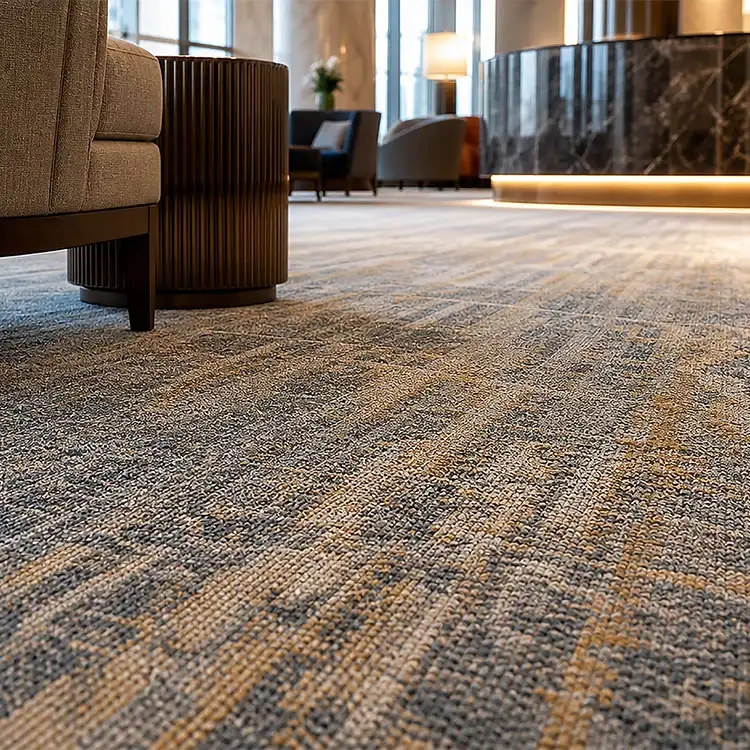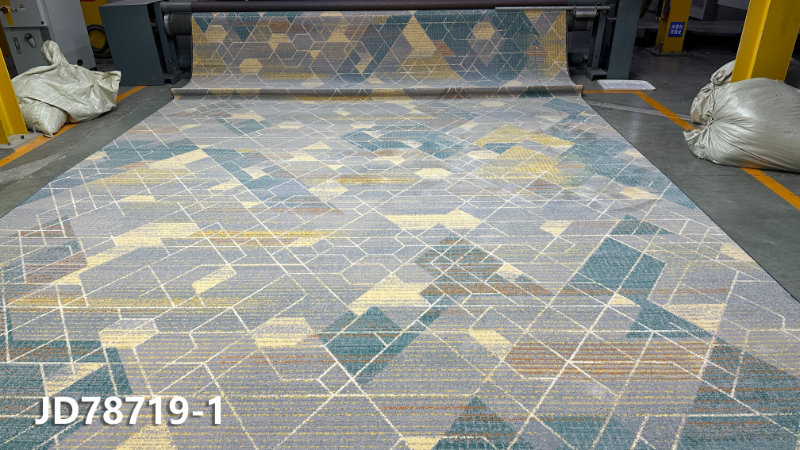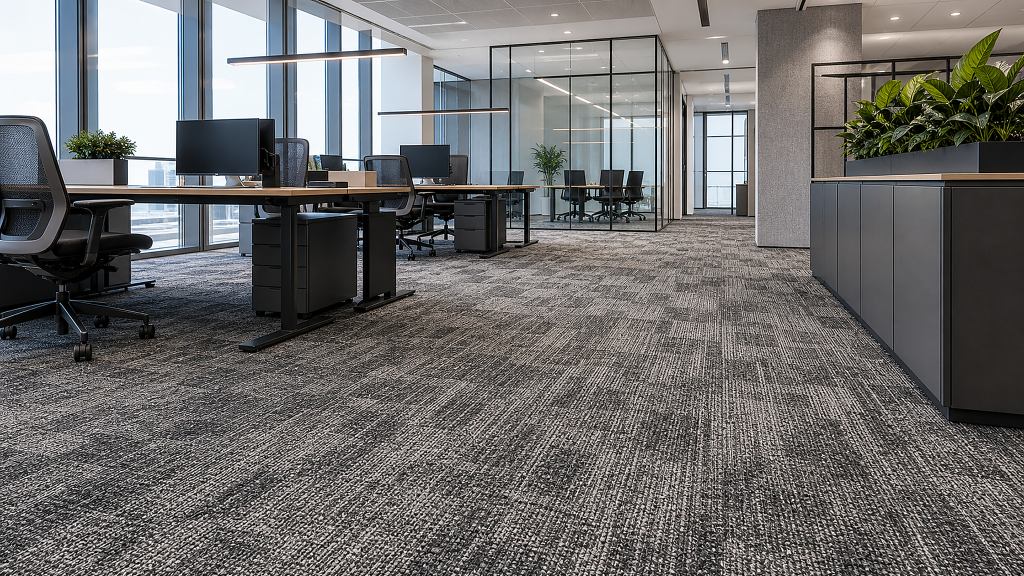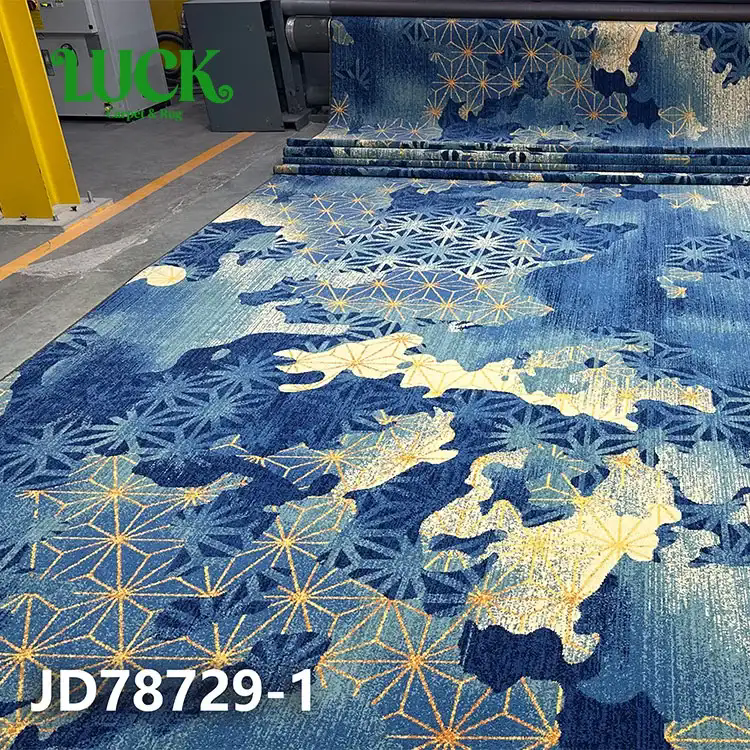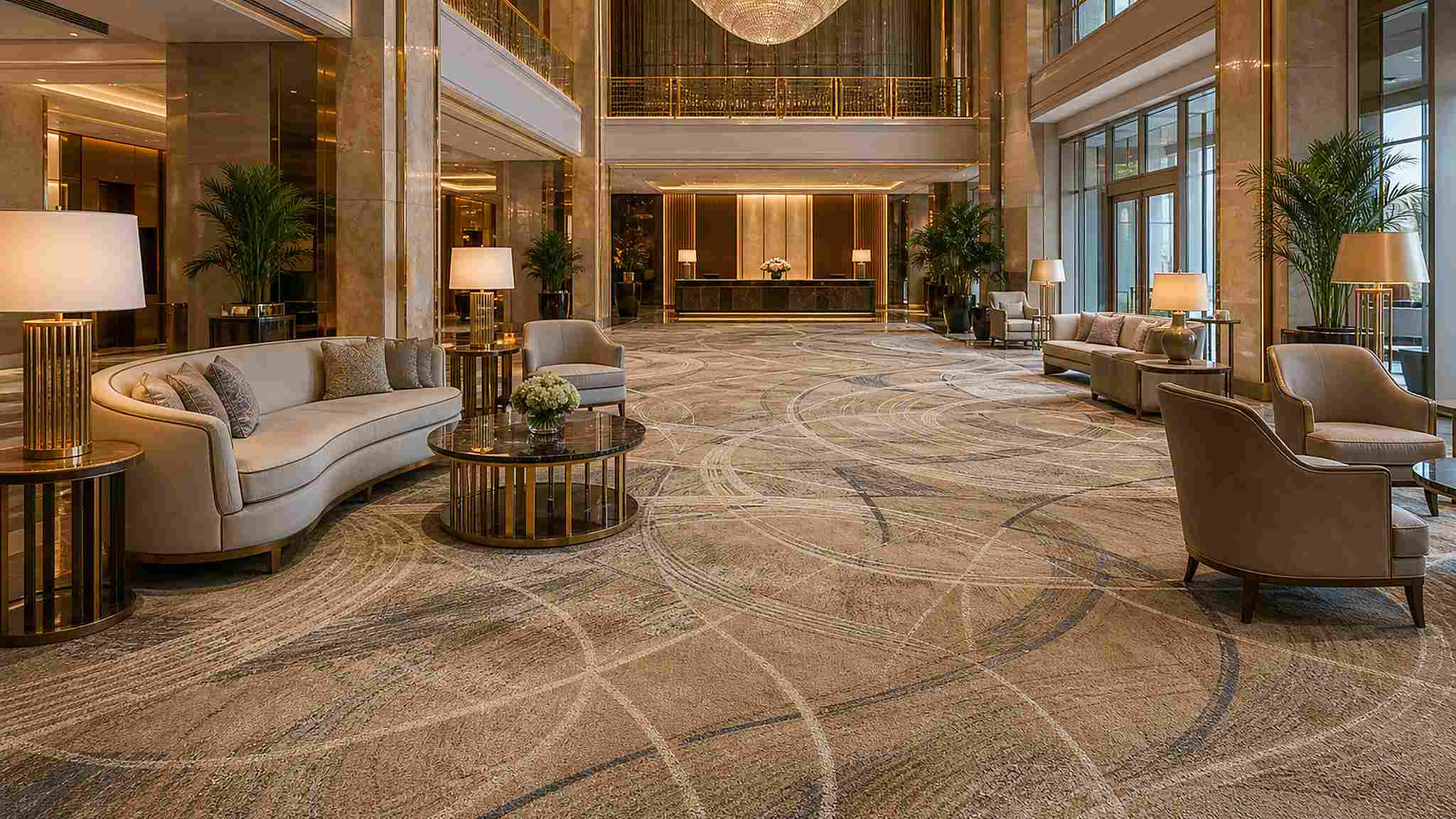
LUCK Carpet is a printed broadloom manufacturer in Foshan, Guangdong, with a 26,000 m² plant and 180 staff. This page covers our Polyester Printed Wall to Wall Carpet for Showroom: 100 % polyester, a 5 mm cut pile at 600 g/m², printed on a high-definition digital line with steam fixation and in-line washing, then laminated to an anti-slip textile backing. Two things are examined here: how the pile recovers after weeks under a display cabinet, and how the floor comes out again when the fit-out changes.
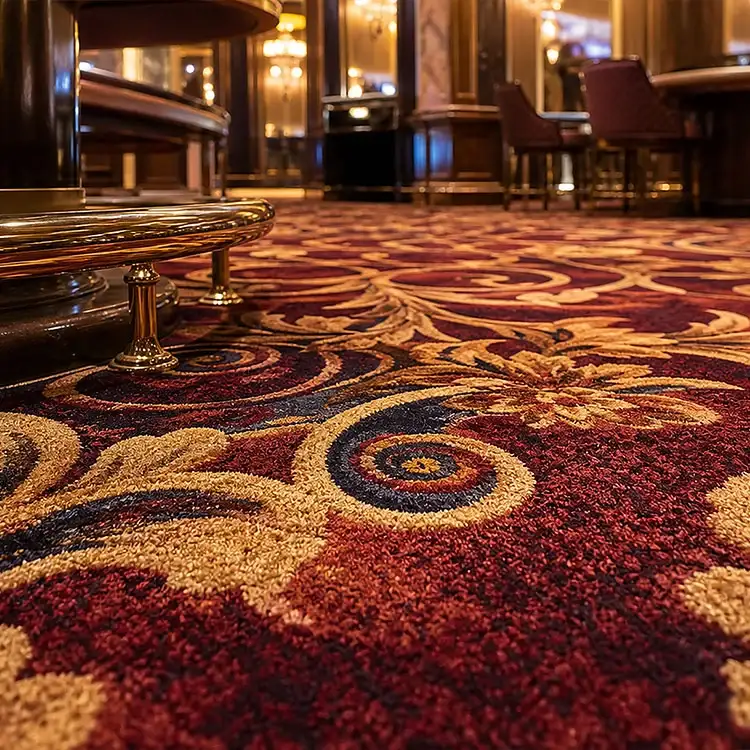
Static load is the enemy of a showroom floor. A display cabinet standing in one place for six weeks applies a slow, constant pressure, and a pile that cannot push back stays flat once the cabinet moves. Polyester filament at 600 g/m² over a 5 mm pile has enough tufts per square metre to spread that load across many contact points rather than a few, so deflection stays shallow. Short and dense is the right shape here; long and thin is not.
Backing matters as much as the face. An anti-slip textile backing gives the tufts a stable base to push against, which turns shallow deflection into full recovery, and its grip stops the carpet creeping when a cabinet is dragged a metre to the left. Finished rolls are tested for backing peel strength, currently 33 N/50 mm, and tuft bind is measured to ISO 4919 on the finished roll.
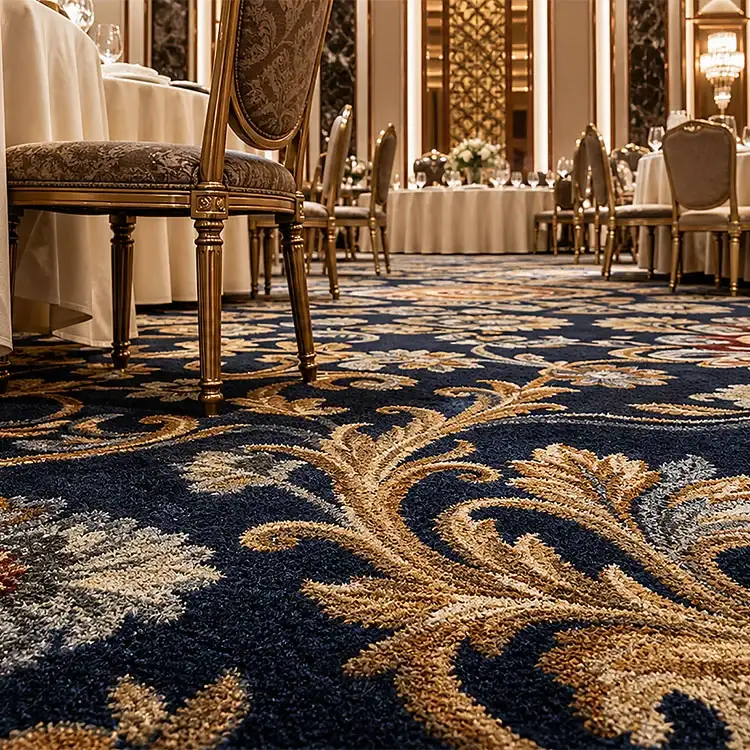
Showroom floors rarely fail slowly; they fail on a schedule. A quarterly reset means heavy furniture walks across the pile, a stand is assembled on top of it, and the surface is expected to look new for a launch evening. Our lab puts this construction through ISO 12947-2 at 5 kPa, and the last six printed batches averaged 38,900 rubs to defined change. Dimensional stability is measured to ISO 2551 after three wet-cleaning cycles.
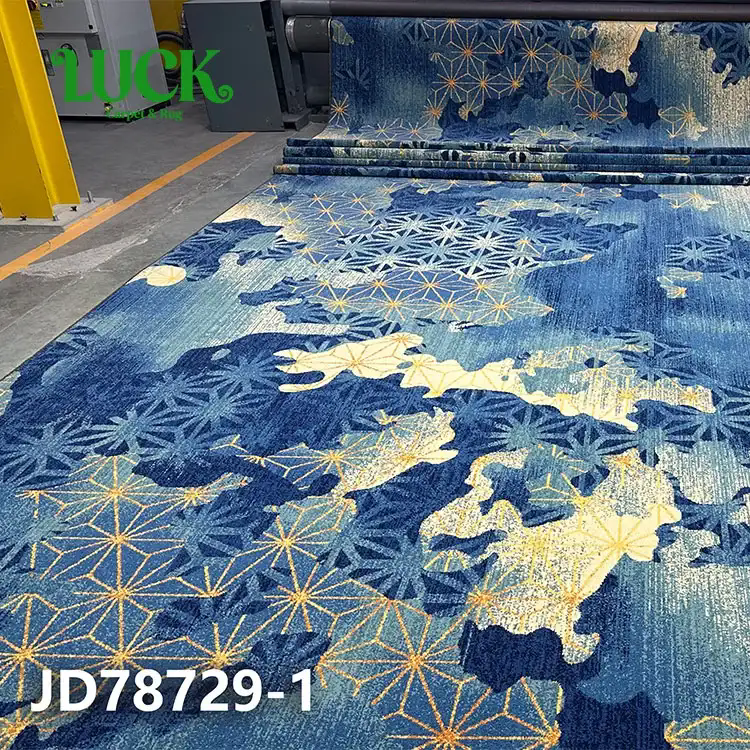
Print quality has to survive the same treatment. We measure the approved strike-off on a spectrophotometer and archive it, then read the start of every print run against that reference, so a second showroom floor ordered a year later matches the first. Register is held to plus or minus 2 mm across the 4 m usable width. Light fastness is Grade 5 to ISO 105-B02 and rubbing is Grade 4 to ISO 105-X12.
Figures below are the finished-roll specification from our Foshan plant, measured after printing, steaming and washing. Read two lines carefully for showroom work: a 5 mm pile at 600 g/m² describes a low, dense construction that resists crushing, and the backing line confirms the anti-slip textile layer that makes glue-free installation possible. Fire class is Bfl-s1 to EN 13501-1.
| Style | Polyester Printed Wall to Wall Carpet for Showroom |
| Yarn type | 100 % Polyester |
| Pile Height | 5 mm |
| Pile Weight | 600 g/m2 |
| Backing | Anti-slip textile backing |
| Fire Resistance | Bfl-s1 (EN 13501-1) |
| Application | Showroom |
| Width / Size | 4 m (13.1 ft) usable width |
| Pattern | Custom design available (artwork supplied by buyer, strike-off approved before production) |
| Surface / Technique | Cut pile |
A showroom is a floor that has to look untouched while being used hard. Cabinets sit in one place for weeks, a delivery trolley crosses the carpet on its way to a display, and the layout may change before the next season opens. What the surface looks like on the morning of a launch decides whether the fit-out budget was spent well.
Recovery is measurable, and the figure a buyer should ask for is not pile height but tuft bind. A 5 mm pile at 600 g/m² supports a cabinet foot through hundreds of tufts, each carrying a small share of the load. Where tufts are anchored at 37 N on the ISO 4919 test, they return to vertical once the weight comes off. A low-density pile leaves a ring that no vacuuming lifts.
Two habits keep a showroom floor even. Move display footprints on a rota, so no single area carries the same load for two seasons running, and vacuum with a rotating brush rather than a suction-only head, because mechanical lift is what brings tufts back upright. Where a very heavy item has to stay in place, a spreader mat under the feet shares the load across a wider area.
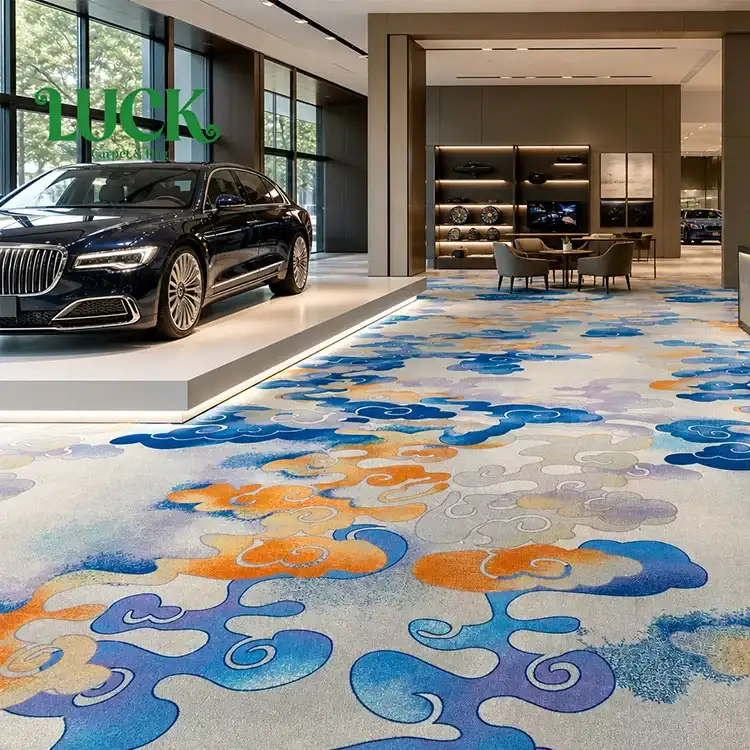
Four showroom types behave differently on one specification. Vehicle showrooms put tyre load on the floor and need a field colour that hides rubber marks. Furniture showrooms tip sofas onto their sides and slide them across the pile, so abrasion resistance carries the load there. Kitchen showrooms bring water and cleaning spray, where thin vinyl look-alike prints lose their edge.
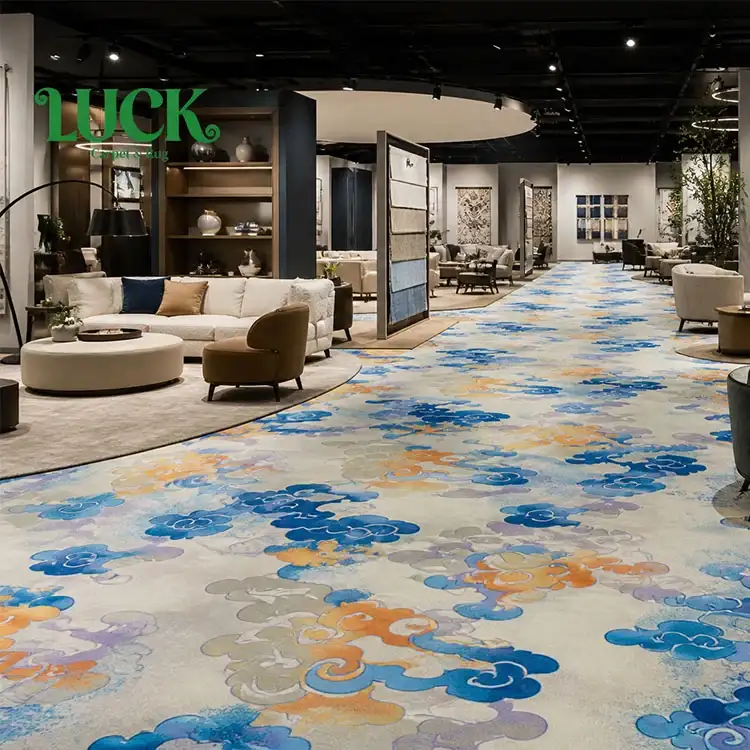
The Dubai project behind this page was a 1,460 m² furniture and kitchen showroom with a layout redrawn roughly every eight weeks. The floor was specified with low-tack adhesive rather than a full spread, so a display island could be moved without cutting carpet and the hall could be lifted and relaid at the end of a season. We delivered thirteen rolls at the 4 m usable width, printed in one run.
What we hear most from showroom operators is not wear, it is the mess left behind when a floor comes up. A full-spread adhesive leaves ridges of cured glue that have to be ground off the screed before anything else goes down. The anti-slip textile backing releases from a low-tack pressure-sensitive adhesive and lifts off tack strip pins without fraying the selvedge, so a slab is ready for the next floor the same day.
Crushing under cabinets is the other recurring issue, and it usually starts at the edge of a plinth. This construction came through three wet-cleaning cycles with a length change inside the 0.3 % ceiling on the ISO 2551 test, so a panel does not grow on a floor that is spot-cleaned weekly. Where a cabinet stands for more than a year without moving, a rigid plinth spreader is a cheap addition. At DOMOTEX Hannover we asked 34 showroom contractors what they replace first after a refit. Twenty-three named the same thing: the carpet is usually fine, but the adhesive residue on the screed costs more to remove than the floor cost to buy.
Furniture and kitchen showroom, Dubai, UAE: a floor built for a quarterly reset
One Dubai furniture group redraws its layout every eight weeks: display islands move, new kitchen sets arrive, and opening night has to look untouched. The technical brief was a floor that could be lifted in sections without leaving adhesive on the screed. We printed one design across the hall in a single run and specified low-tack adhesive with tack strip at the perimeter.
After the first year, with the hall reset five times, the group measured what the decision had saved. Lifting and relaying the original carpet in sections came to about a day of installer time per reset, against a full replacement each time. Two panels of 90 m² were replaced where trolley traffic had marked them, both cut from the original roll batch, so the colour matched with no visible patch.
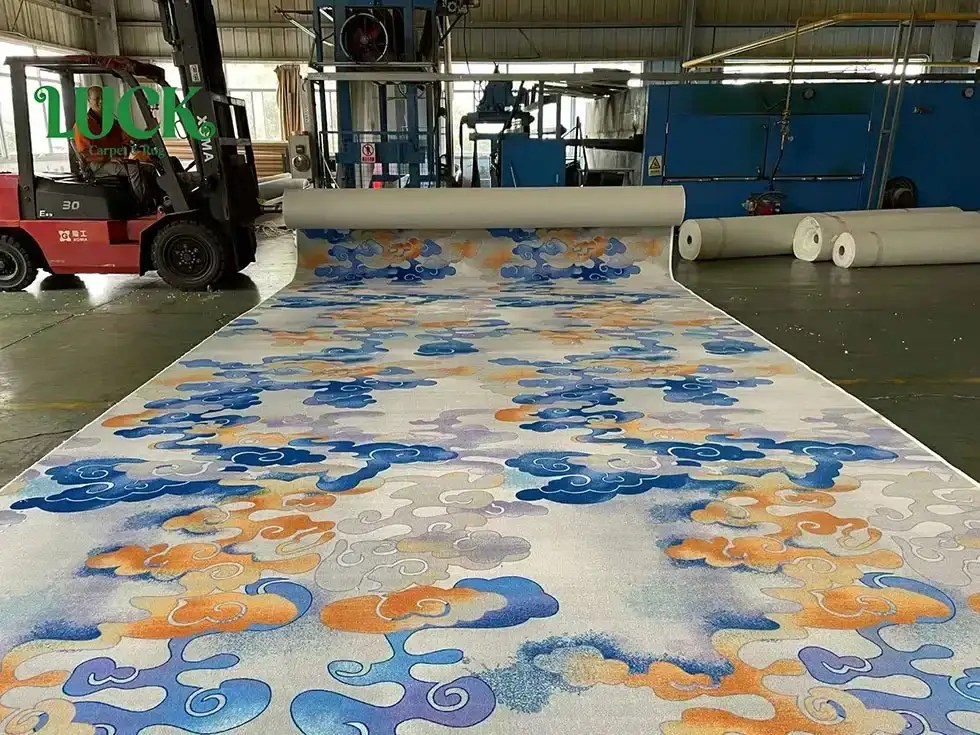
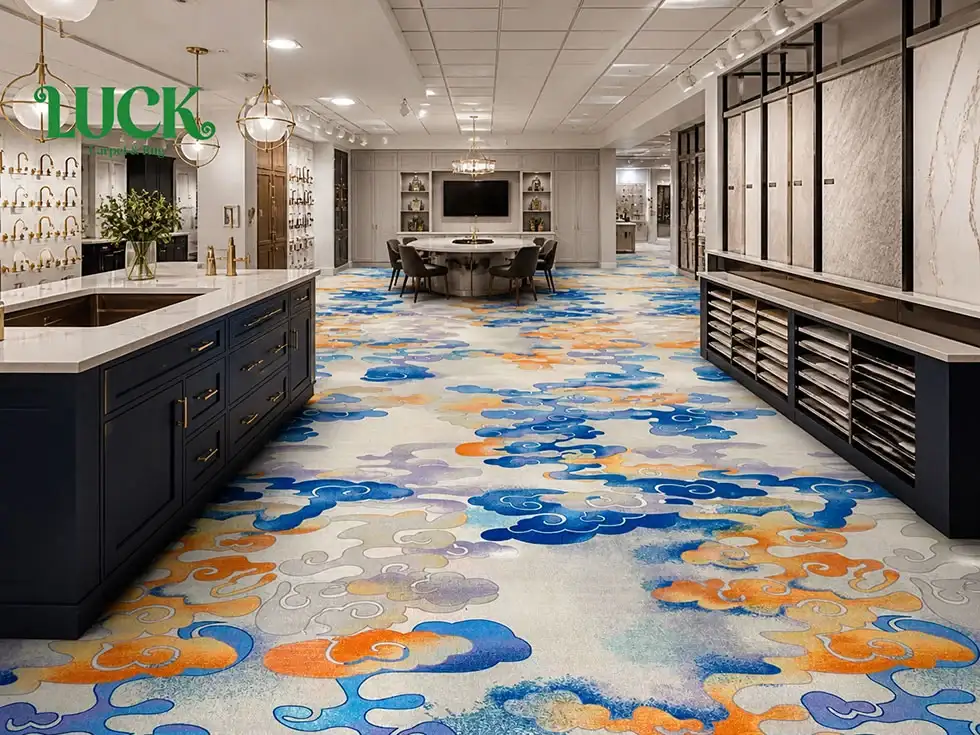
Batches for a showroom order are checked on the same schedule as every other printed order. Abrasion runs to ISO 12947-2 at 5 kPa, and the last six batches averaged 38,900 rubs to defined change. Tuft bind to ISO 4919 is reported in Newtons, currently 37 N, with backing peel at 33 N/50 mm. Dimensional stability is ISO 2551 after three wet-cleaning cycles, currently 0.18 % length change. Light fastness is ISO 105-B02 at Grade 5 and rubbing is ISO 105-X12 at Grade 4.
Yes, with the right adhesive. A low-tack pressure-sensitive adhesive holds the floor flat through a season and releases without leaving cured ridges on the screed, and the anti-slip textile backing lifts off tack strip pins without fraying. Lift in full-width drops rather than cutting around fixtures, roll face outward on a core, and never store a roll on its side.
Compression followed by recovery is what a dense pile does. At 600 g/m² over a 5 mm pile the weight spreads across many tufts, and tuft bind is tested on the finished roll so the fibres spring back once the cabinet moves. A cabinet left in place for several years may leave a faint footprint that vacuuming reduces but does not erase.
It is, with two conditions. Keep the surface contact temperature inside the range your heating installer specifies, and use a loose-lay or low-tack installation so the carpet can expand and contract without stress. The anti-slip textile backing and the printed polyester face are stable through the temperature swings a showroom sees between a cold night and a heated trading day.
Surface feel is firm rather than plush: a short cut pile with a matte finish, printed in flat colour or photographic detail depending on the artwork. At 5 mm it reads as a finished interior rather than a bedroom carpet. Rolls are wound face inward on cores, selvedges are trimmed straight so drops butt cleanly, and each roll is bagged in moisture-proof film.
Ordering starts with artwork or a Pantone reference plus a floor plan. We return a digital proof, then a physical strike-off for approval; bulk printing begins after your sign-off. Minimum order is four rolls for a custom print and one roll for a stock design, and face pile carries an 8-year warranty. Send the layout to LUCK Carpet and we will return a roll plan with the seams marked.
Address
Shidaigongguan Building No.5 Office 1212, Haicheng east road, Duanzhou District, Zhaoqing City, Guangdong Province, China
Tel
Copyright © 2026 Zhaoqing Yunle International Trade Co., Ltd. All Rights Reserved.