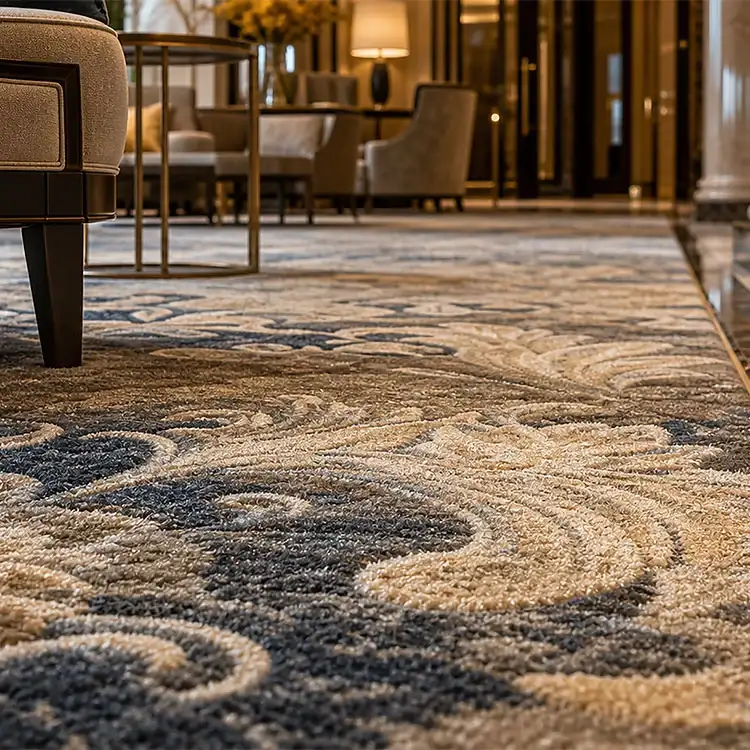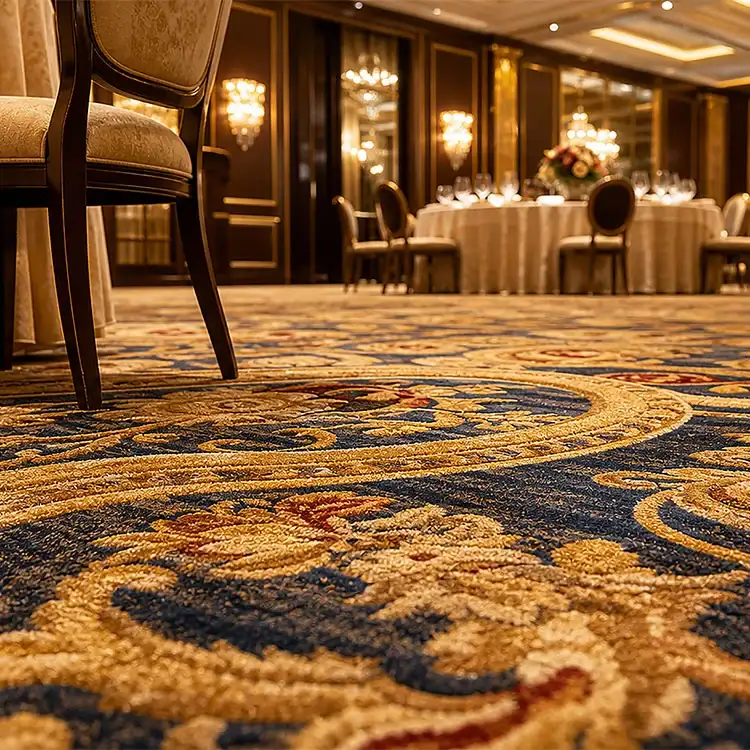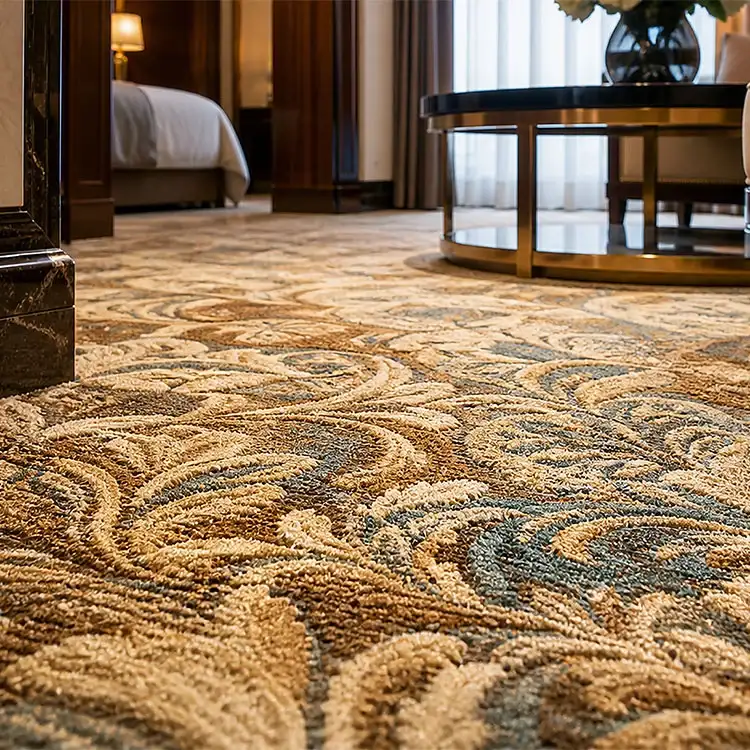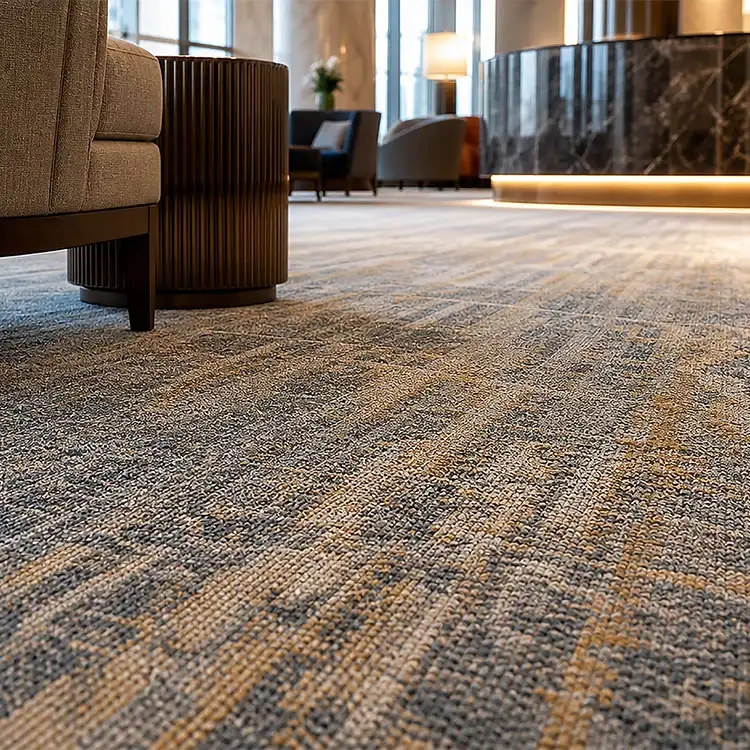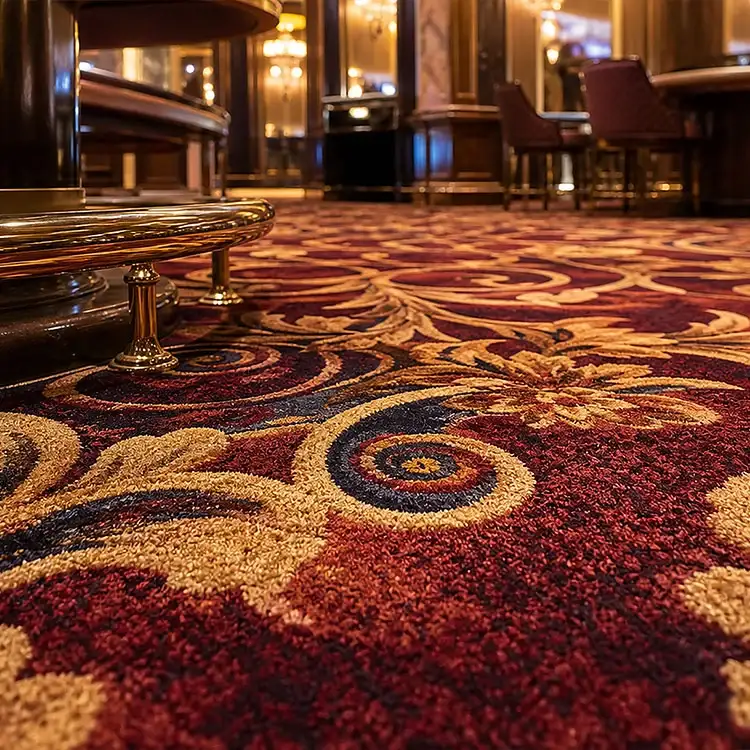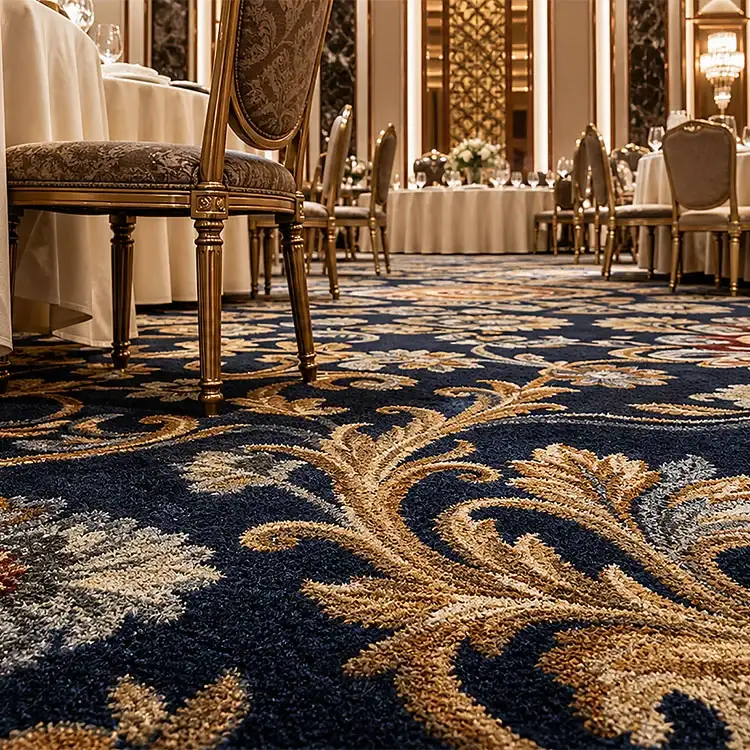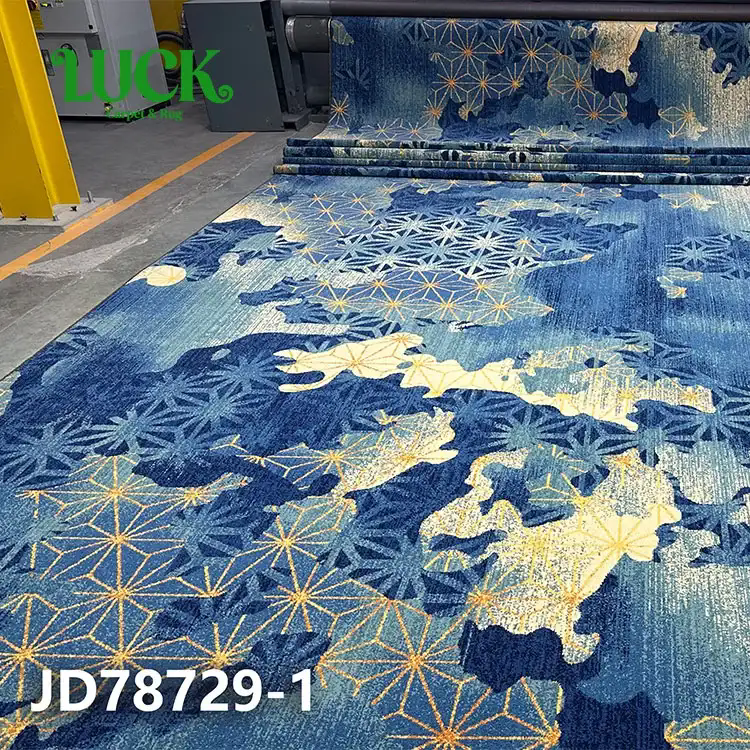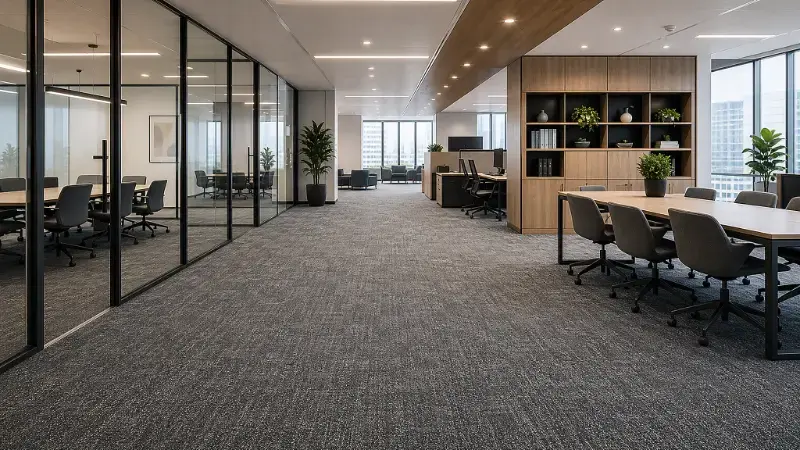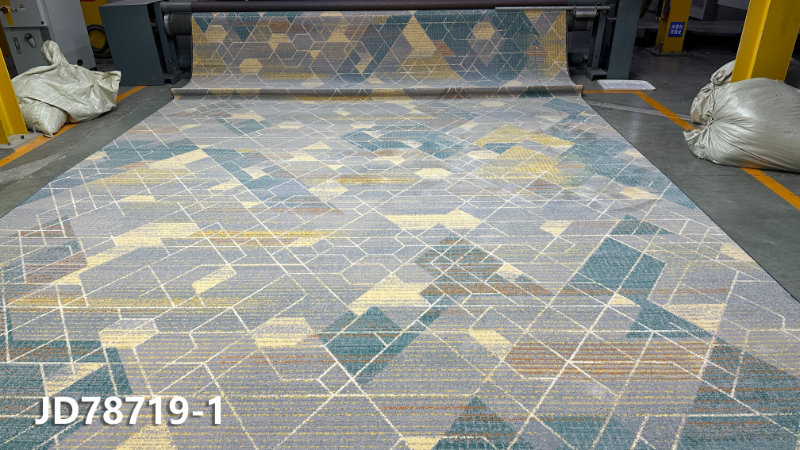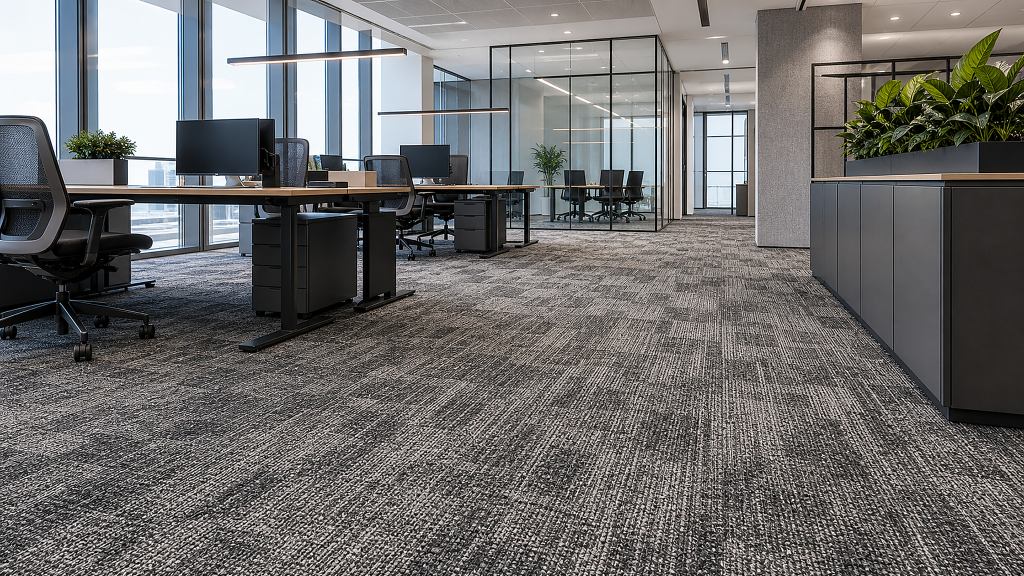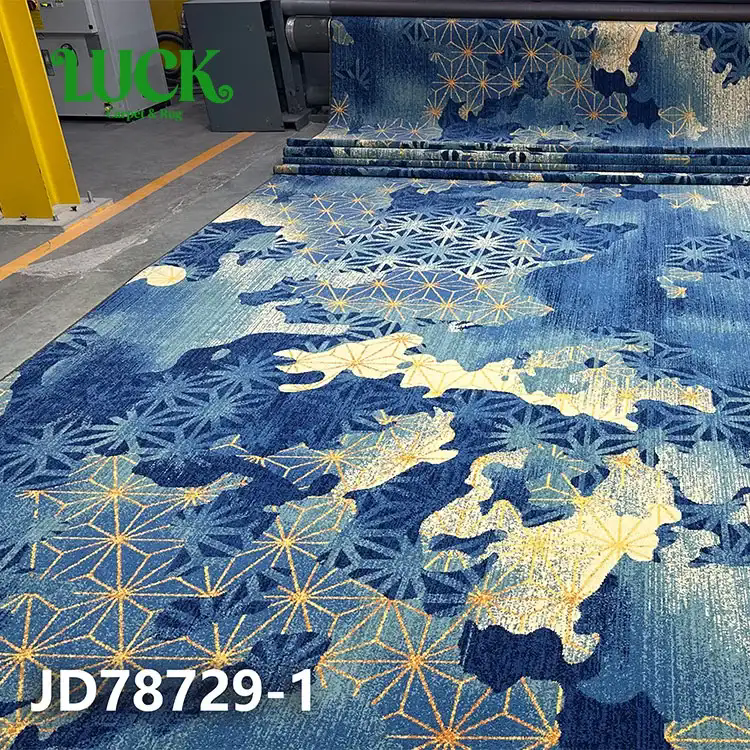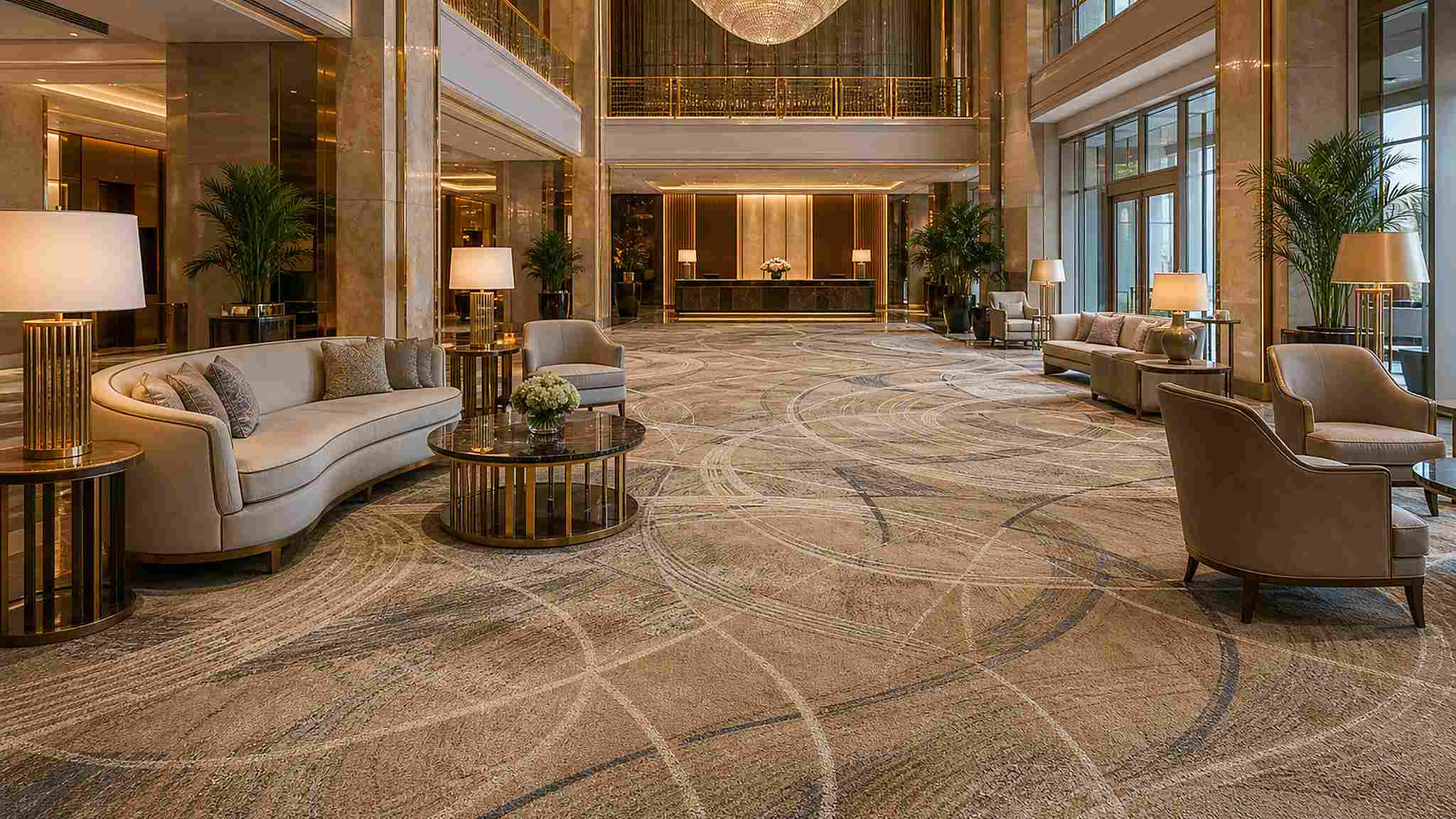
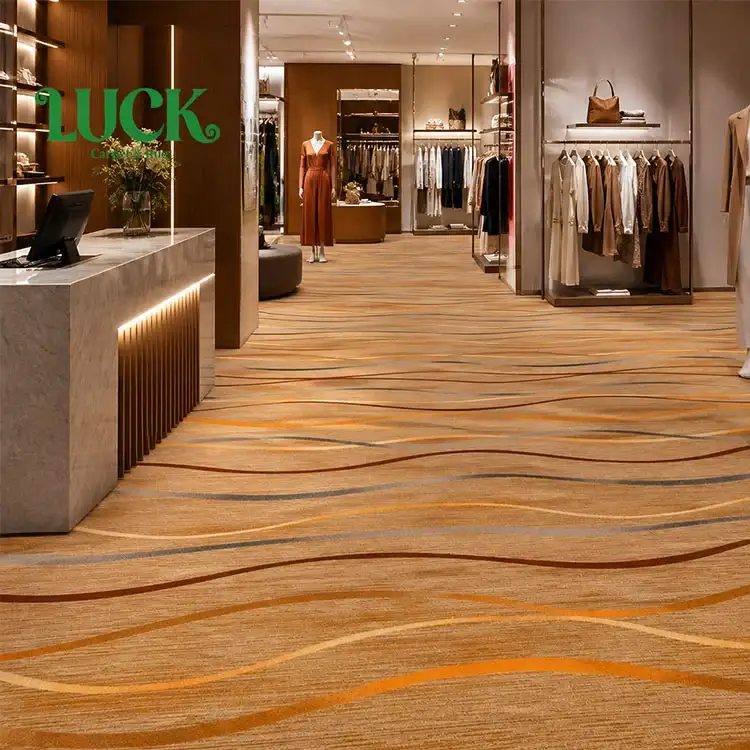
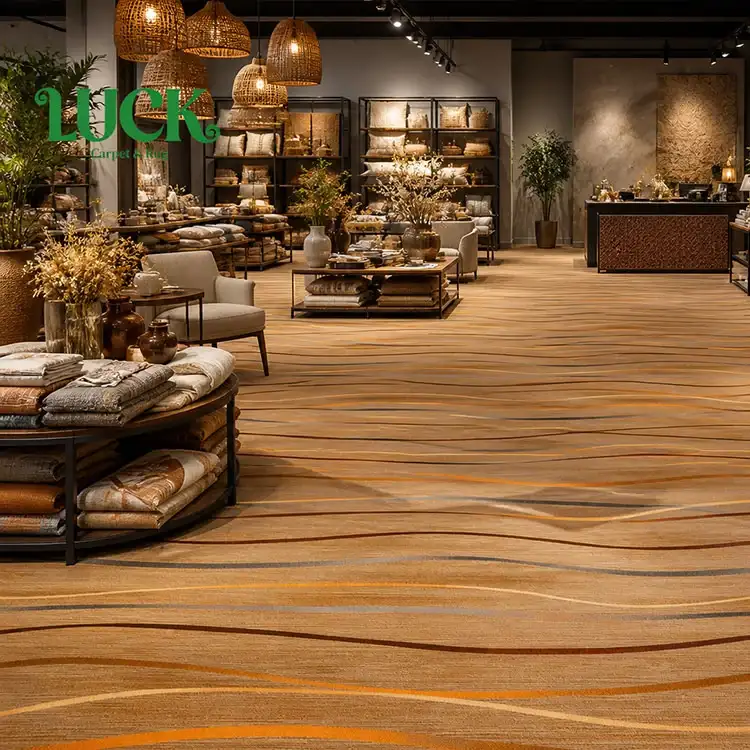
LUCK Carpet prints broadloom at its 26,000 m² plant in Foshan, Guangdong, where 180 staff have exported printed carpet for 14 years. This page covers our Polyester Printed Wall to Wall Carpet for Retail Floors: 100 % polyester, a 5 mm cut pile at 600 g/m², printed on a high-definition digital line with steam fixation and in-line washing. Colour fidelity under retail lighting is the subject here, and third-party inspection by SGS, Intertek or BV can be arranged on site.
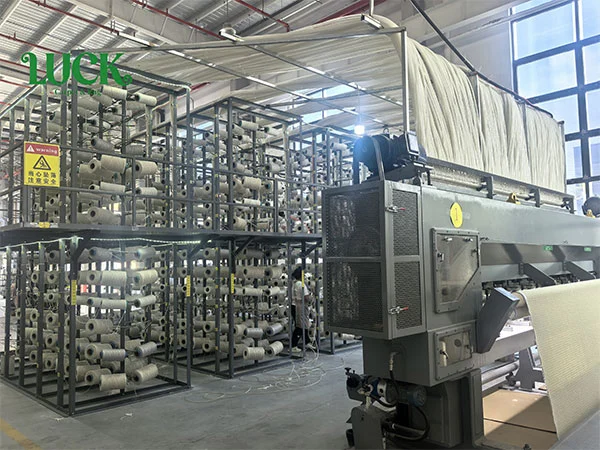
Printed retail floors fail in one of two ways: the pattern goes chalky, or the shade shifts between the sample and the third re-order. Disperse dye is applied to the greige pile and steamed, which opens the polyester filament and lets dye molecules migrate into it. An in-line wash then removes dye that never bonded. Surface colour is what scrubs off under trolley wheels and shopping bags.
Fixation also sets the limit of what we can print. Where a brand palette depends on a shade that disperse dye cannot reach on polyester, we say so at the sampling stage; an adjusted tone that holds for years beats an exact match that fades in one. Measured results sit at Grade 6 for light fastness to ISO 105-B02 and Grade 5 for rubbing to ISO 105-X12, the top of the band we record for this family.
Colour decisions happen at the head of the run, not in the complaints file. We measure the approved strike-off on a spectrophotometer and archive it with the artwork, then read the start of every run against that reference. A 4 m usable width lets a boutique floor plate out in one or two drops, and register is held to plus or minus 2 mm across it.
The rest of the line is about stability. Steaming fixes the dye, washing clears the unfixed fraction, drying and heat-setting lock the dimensions. Finished rolls hold under 0.3 % length change after three wet-cleaning cycles to ISO 2551, and the most recent batch measured 0.25 %. Tuft bind to ISO 4919 sits at 33 N and backing peel at 29 N/50 mm, which keeps a short pile from shedding tufts at a fitting-room threshold.
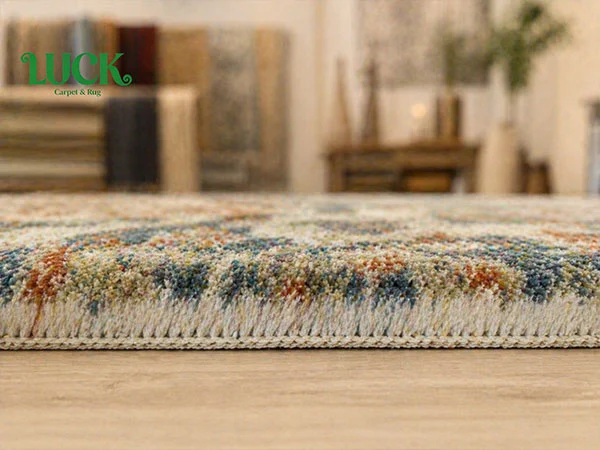
These figures come off the finished roll in our Foshan plant after printing and washing, and they travel with the shipment on the batch data sheet. Two reading notes matter for retail. A face weight of 600 g/m² over a 5 mm pile is a low-profile commercial construction, chosen so shopping bags and garment racks pass over it without drag. Fire performance is the European class, Bfl-s1 to EN 13501-1.
| Style | Polyester Printed Wall to Wall Carpet for Retail Floors |
| Yarn type | 100 % Polyester |
| Pile Height | 5 mm |
| Pile Weight | 600 g/m2 |
| Backing | Anti-slip textile backing |
| Fire Resistance | Bfl-s1 (EN 13501-1) |
| Application | Retail stores, boutiques, department stores, showrooms, exhibition halls |
| Width / Size | 4 m (13.1 ft) usable width |
| Pattern | Custom design available (artwork supplied by buyer, strike-off approved before production) |
| Surface / Technique | Cut pile |
Every retail floor carries a brand argument and a physical load at the same time. A boutique wants a shade that reads correctly at 4,000 K, a department store wants a surface that survives ten hours of footfall, and an outlet wants both at a price that survives a roll-out across twelve sites.
Retail lighting is unforgiving. A track spot at 4,000 K will show a half-grade shift in a shade that daylight hides, which is why light fastness matters more in a shop than in an office. This construction measures Grade 6 to ISO 105-B02 and Grade 5 to ISO 105-X12, with abrasion at 34,200 rubs to ISO 12947-2 at 5 kPa.
Where this is the wrong product: back-of-house corridors used by pallet trucks, loading docks, food courts and wet entrances. A 5 mm cut pile at 600 g/m² is a display-floor construction, and heavy rolling loads in a stockroom will flatten it. On the selling floor the balance is right: the lower pile keeps cost per square metre down, and the anti-slip backing allows tack strip or low-tack adhesive.
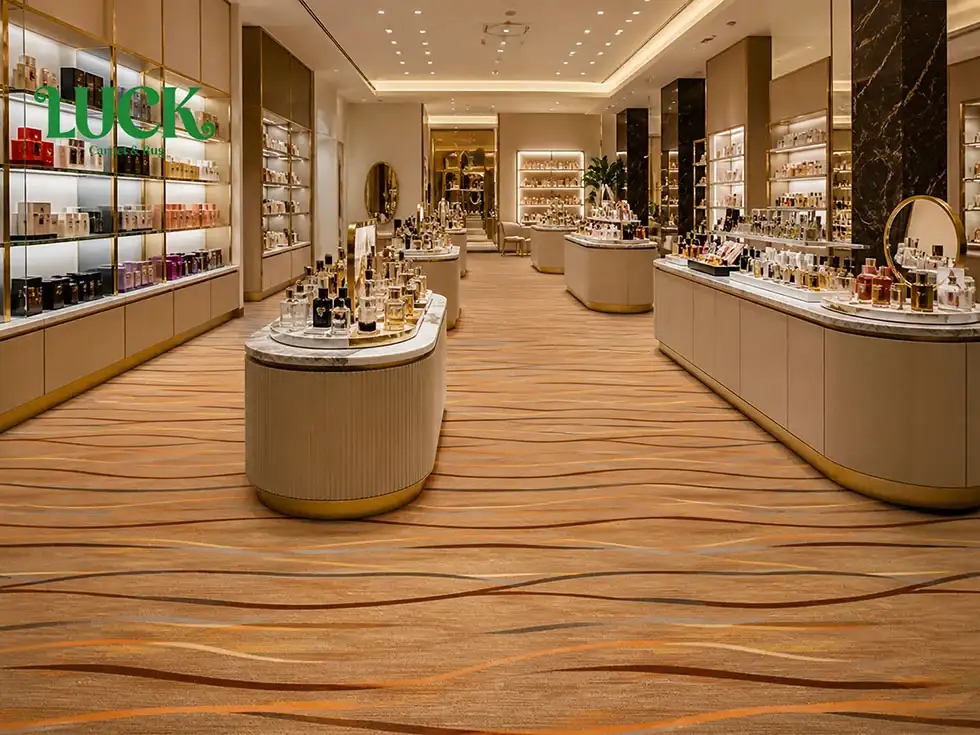
Different retail formats ask different things of the same roll. A boutique wants one graphic read as a single gesture, so we print the whole floor in one run and plan the seams behind fixtures. A department store wants zones: a beauty hall, a handbag floor and a circulation spine in one palette. An outlet wants the plainest field, because pattern mismatch across a twelve-store roll-out makes a chain look inconsistent.
Behind this page is a Milan project, a 1,240 m² beauty hall and fitting area inside a department store. Eleven 30 m rolls were printed from one strike-off and cut so the seams fell under the lighting track, where a join is hardest to see. The brief was a single brand pink across four zones, which only works if colour is measured rather than judged by eye.
Two complaints arrive from retail floors more than any other. The first is fading around a shopfront window. Accelerated testing to ISO 105-B02 records Grade 6 here, and because the dye sits inside the filament rather than on it, any change is gradual and even rather than patchy. The second is pile shading: where a cut pile lies in different directions, one colour reads lighter at a seam.
Shading is a fitting problem, and it is solved before the carpet is cut. We supply a roll layout with pile direction marked so every drop runs the same way, and we recommend cutting in sequence from consecutive rolls. Under 4,000 K track lighting the effect is worst where light grazes the floor at a shallow angle, so those zones are flagged on the layout.
Milan supplied the brief: a department store group refitting its ground floor, one printed floor carrying a single brand pink from the entrance, through the beauty counters, into eight fitting rooms and out along the circulation spine, with no visible colour break at any seam. We printed the order in one run from one approved strike-off and delivered it in eleven rolls with a roll layout attached.
At handover we measured two things. Colour was read on the spectrophotometer against the archived strike-off at six points across the floor, and print register at each seam held within 2 mm. Fourteen months later the same client ordered 680 m² for the second floor, and the new print landed inside tolerance against the original reference, so both levels match under identical lighting.
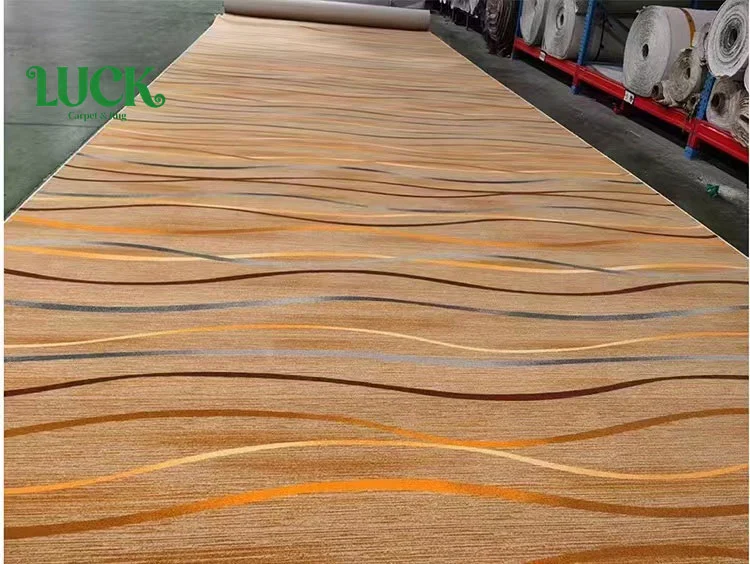
Our Foshan lab runs every printed batch through ISO 12947-2 at 5 kPa, and the last six batches of this retail construction averaged 34,200 rubs to defined change. Tuft bind to ISO 4919 is reported in Newtons, currently 33 N. Light fastness is ISO 105-B02 at Grade 6, rubbing is ISO 105-X12 at Grade 5, fire is EN 13501-1 class Bfl-s1, dimensional stability is ISO 2551 after three wet-cleaning cycles at 0.25 %, and VOC performance is GB 18587-2001, Class A.
By printing the whole order from one approved strike-off and reading the head of every roll against it on the spectrophotometer. Roll-to-roll variation is a printing problem before it is a carpet problem. Above roughly 2,000 m² we reserve the greige yarn, print in a single campaign and ship in roll sequence, so a fitter lays neighbouring drops from neighbouring rolls.
Light fastness on this construction is Grade 6 on the ISO 105-B02 blue wool scale, the upper end of what we record for printed polyester. Glass filters some ultraviolet light but not visible light, so a west-facing window works on any textile floor over years. Because the dye sits inside the filament, whatever change occurs happens evenly rather than in a patch under the glass.
Use a dense fibre pad under tack strip for most selling floors. It keeps the 5 mm pile sitting flat, adds resilience for staff who stand all day, and lets a shopfitter lift and relay a section when a fixture moves. Where the client wants the floor fully anchored, a low-tack pressure-sensitive adhesive works with the anti-slip textile backing.
A matte cut pile finish shows no directional sheen, so the surface takes 4,000 K spots without a glare band. Colour depth on a printed polyester face comes from the print, so photographic gradients and flat brand colours are both reachable; large solids are the harder test. Rolls are wound face inward on cores and bagged in moisture-proof film with batch and roll numbers.
For a chain roll-out we hold the strike-off and the print file, so store number nine matches store number one. Ordering runs from artwork or a Pantone reference to a digital proof, then to a physical strike-off for approval; bulk printing starts after sign-off. Minimum order is four rolls for a custom print, and stock designs ship from one roll. Face pile carries an 8-year warranty. Send LUCK Carpet the floor plan and fixture layout, and we will return a roll plan with seams and pile direction marked.
Address
Shidaigongguan Building No.5 Office 1212, Haicheng east road, Duanzhou District, Zhaoqing City, Guangdong Province, China
Tel
Copyright © 2026 Zhaoqing Yunle International Trade Co., Ltd. All Rights Reserved.