Products


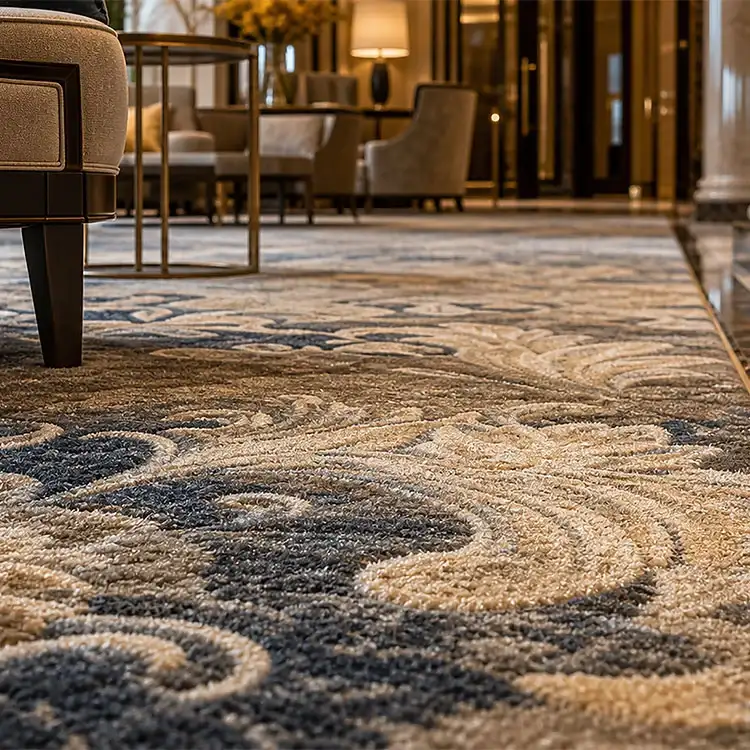
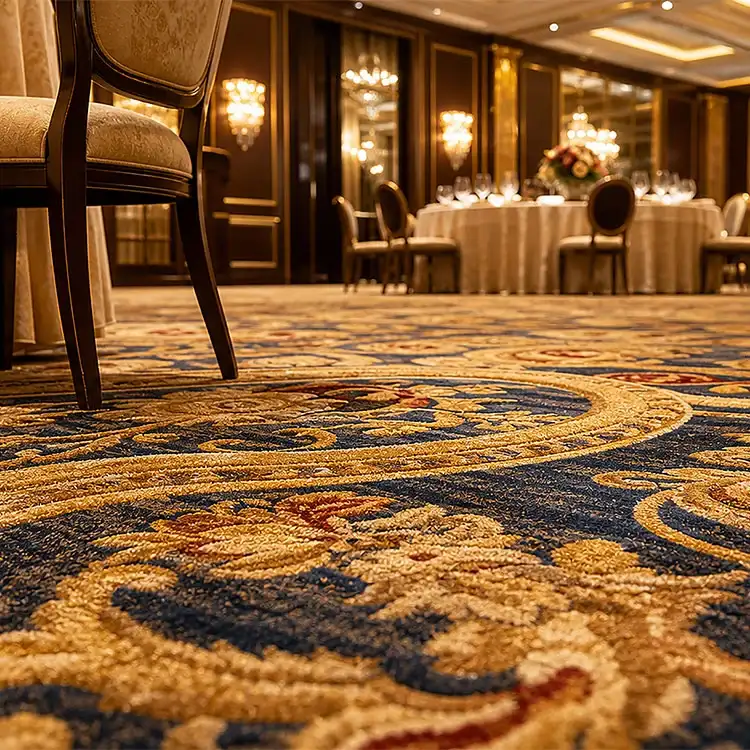
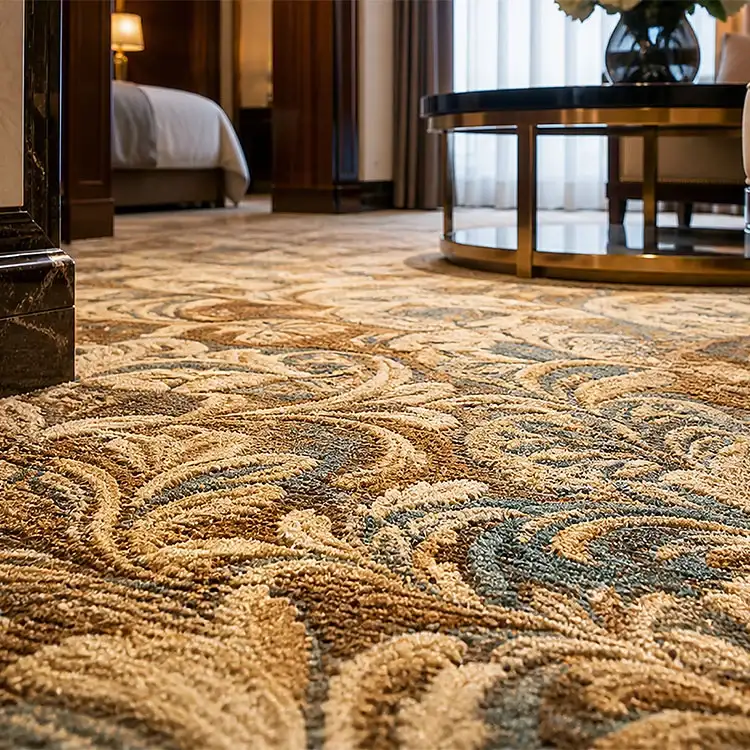
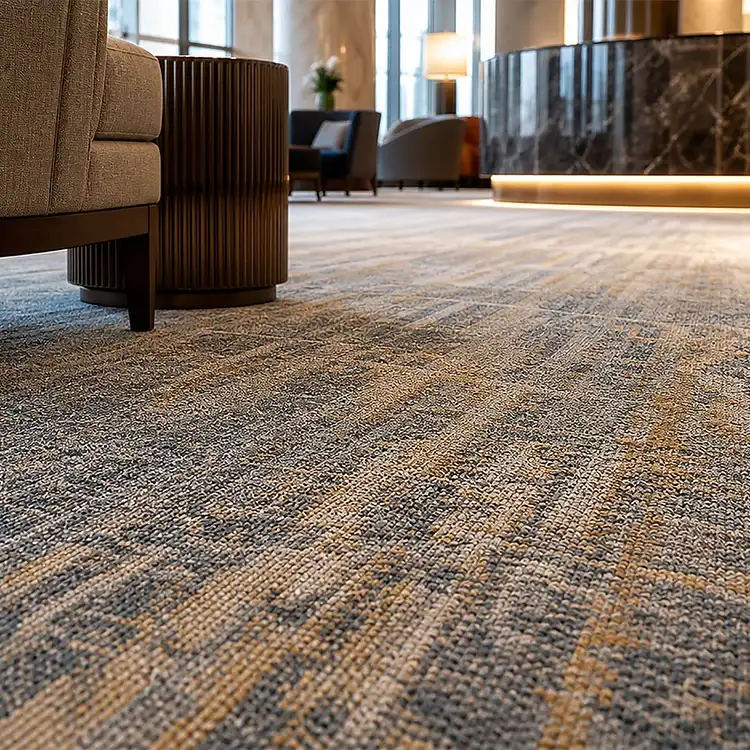
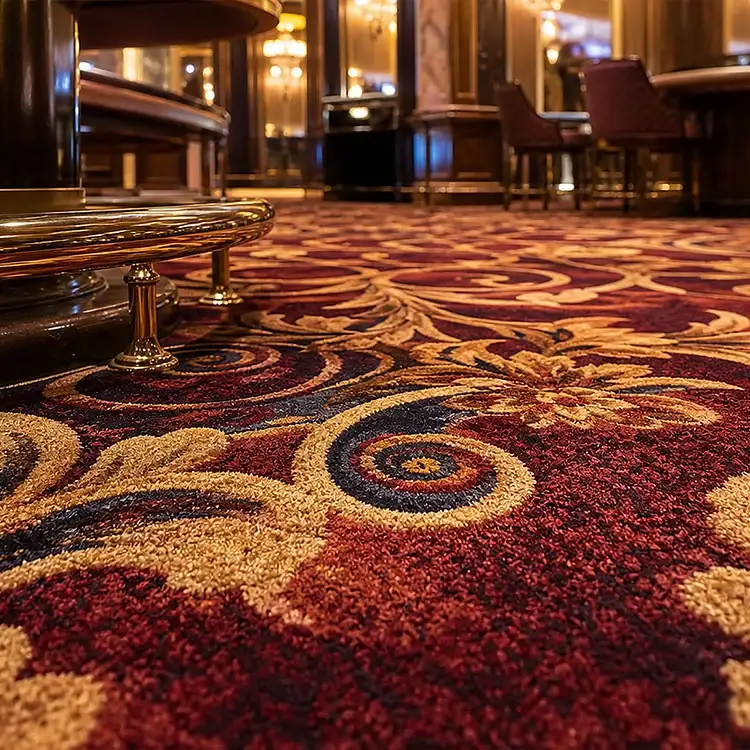
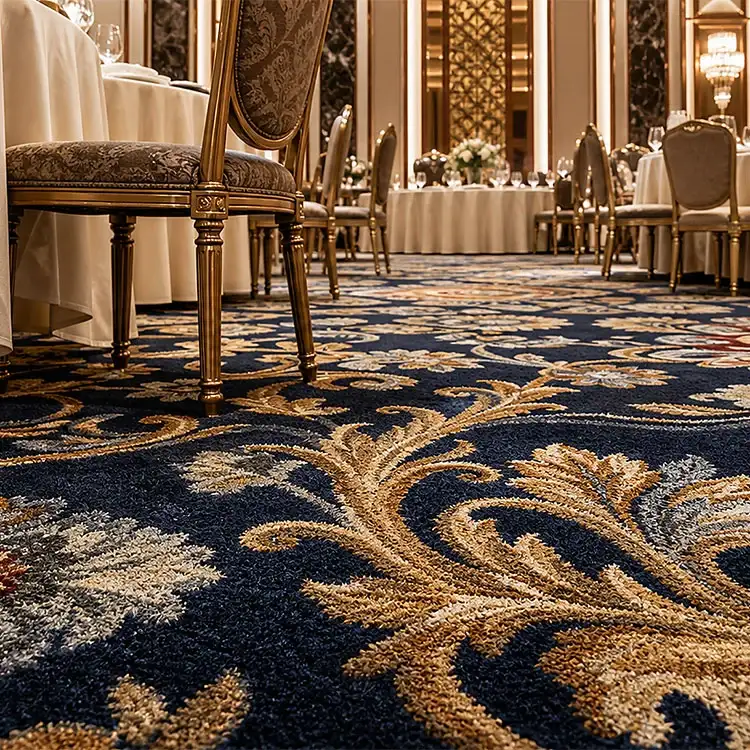
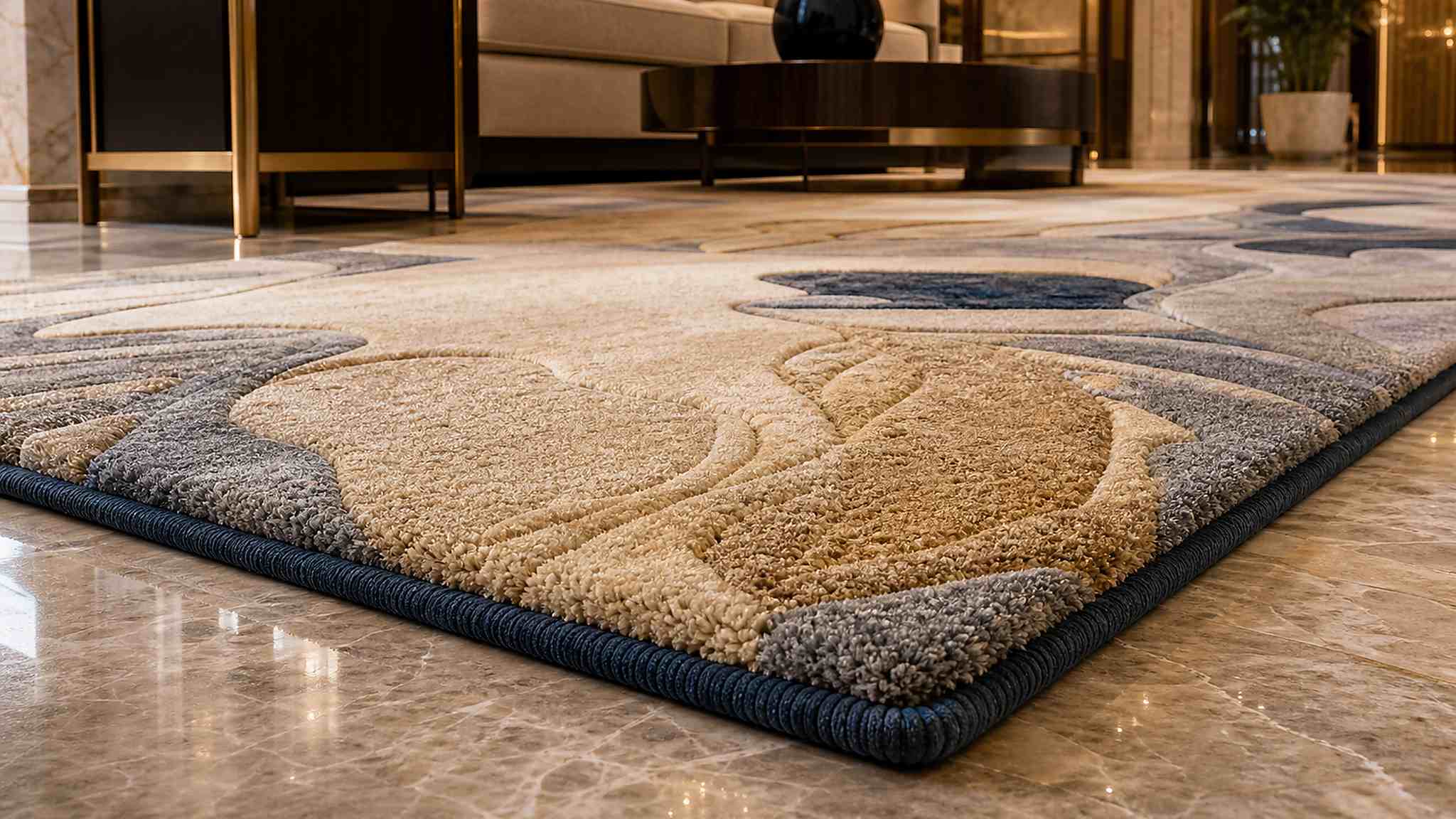
LUCK Carpet is a printed broadloom manufacturer in Foshan, Guangdong, with a 26,000 m² plant and 180 staff, exporting printed carpet for 14 years and exhibiting at DOMOTEX Hannover, The Canton Fair in Guangzhou and Shanghai Hospitality Design Week. This page covers the printed exhibition broadloom we build for halls and stands: 100 % polyester, a 6 mm cut pile at 800 g/m², printed digitally, steamed, washed in line and laminated to an anti-slip textile backing.
An exhibition floor lives two lives: three days under a stand and eleven months on a roll. Each punishes something different. Six millimetres of cut pile at 800 g/m² is the balance for a hall, deep enough to take stand feet and trolley wheels, short enough that a heavy display leaves no permanent footprint, and dense enough that a storage crease flattens instead of cracking.
Polyester helps here for one reason: it takes up very little water. A natural-fibre face stored in a humid warehouse holds moisture in the yarn, and a wet roll is a heavy roll, a musty roll and eventually a mouldy one. Polyester filament dries quickly and does not feed the mould growth a damp natural fibre does, so an unheated hall between shows is a safe place to store it.
Printing decides whether an exhibition order works, because the deadline is a fixed date on a hall contract. We check the artwork for printability, return a digital proof, then produce a physical strike-off on the same yarn and printer as the bulk order, which takes five working days. Bulk production runs after your sign-off, and a typical hall order ships within three weeks.
Consistency across a multi-roll order is controlled at the line. We measure the approved strike-off on a spectrophotometer and archive it with the artwork, then read the head of every roll against that reference, so a 500 m² stand printed in March still matches an extension printed in September. Register is held to plus or minus 2 mm across the 4 m usable width.
Figures below are the finished-roll specification from our Foshan plant, measured after printing, steaming and washing. A 6 mm pile at 800 g/m² is a dense hall construction that recovers from stand feet between shows, and the anti-slip textile backing allows installation on tack strip or loose-lay tape instead of glue, which is the difference between a reusable floor and a one-show floor.
| Style | Polyester Printed Wall to Wall Carpet for Exhibition |
| Yarn type | 100 % Polyester |
| Pile Height | 6 mm |
| Pile Weight | 800 g/m2 |
| Backing | Anti-slip textile backing |
| Fire Resistance | Bfl-s1 (EN 13501-1) |
| Application | Exhibition |
| Width / Size | 4 m (13.1 ft) usable width |
| Pattern | Custom design available (artwork supplied by buyer, strike-off approved before production) |
| Surface / Technique | Cut pile |
Exhibition flooring is bought twice: once from the supplier and once from the installer who lifts it, stores it and lays it again. A floor that survives one show is a consumable. A floor that survives four shows changes the cost per square metre per event, and that calculation is what this specification is built around.
Arithmetic first. A one-show printed floor is bought, laid, cut around a stand, lifted and thrown away, so the whole cost lands on three days. A floor that goes back on the roll spreads the same square metres across every show in the set's life. What limits reuse is not the print, it is the backing and the edges, so this construction is built for tack strip or loose-lay tape.
Where reuse is not worth it: a one-off national pavilion where carpet is cut and shaped around built structures, or a show where the organiser supplies and disposes of the aisle carpet. In those cases a cheaper non-woven is the rational buy, and we will say so. For a company exhibiting four times a year behind a modular stand, a printed set pays for itself inside two seasons.
Three jobs on one show floor need different answers. A stand floor is a brand surface, printed with the company design and cut to the stand footprint with a margin that folds under the platform edge. Aisle carpet is a wayfinding and safety surface that takes the heaviest foot traffic of the day, so it is specified plain or with a low-contrast directional print.
The Hanover project behind this page was a 900 m² machine-tool stand and its surrounding aisle at a Hanover trade fair. The exhibitor returns to the same show every year with a modular stand and wanted one floor to carry four shows before replacement. We printed the stand field and the aisle in a single run, supplied eight rolls at the 4 m usable width, and numbered the rolls.
Edge curl starts at the selvedge. A roll stored on its side in a cold hall takes a set in the outer wraps, and when it is laid the edge lifts, catches a trolley wheel and tears. Three habits prevent it: store upright on a core, never fold a drop, and lay the floor early enough that the roll reaches hall temperature before the build starts.
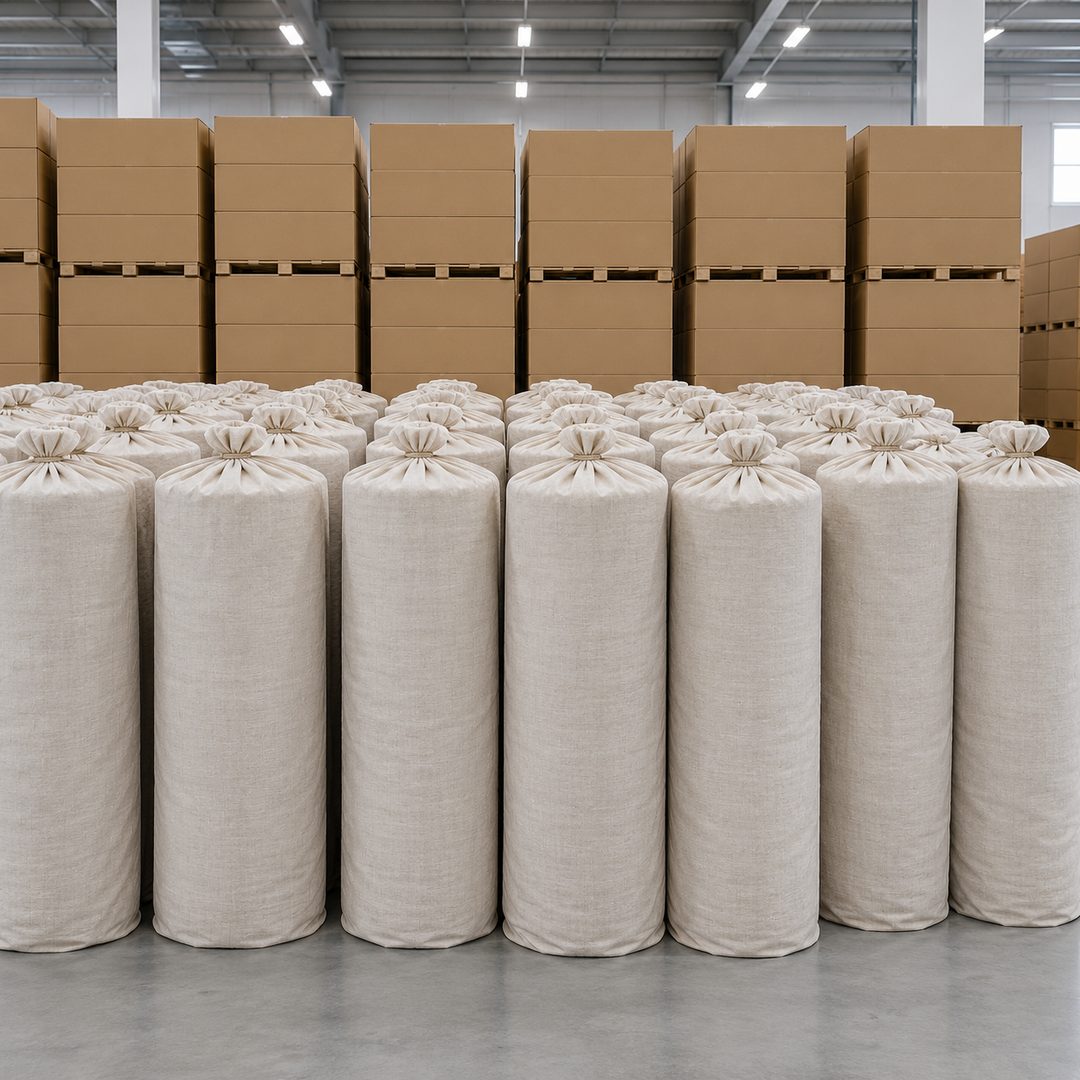
Moisture is the slower problem. Hall floors are often laid on a cold slab, and a warm, busy exhibition hall drives water vapour upward through the floor. Polyester takes up very little water, and this open construction with a textile backing lets the carpet breathe instead of sealing vapour under a plastic sheet. For storage we bag rolls in woven polypropylene rather than shrink-wrapping them.
A German machine-tool builder briefs us each year for the same stand at a Hanover trade fair: a 620 m² stand platform plus 280 m² of aisle, printed in the company design, with the aisle carrying the show's wayfinding marks. The floor has to be laid in a single night, survive five days of trolley traffic and be lifted within six hours of the close.
Four shows on, the rolls came back to Foshan for measurement: length change held at 0.22 % on the ISO 2551 wet-cleaning test, and print register was still within 2 mm across the width, so the aisle lines fell on the same module marks as the first build. Replacing 90 m² of the highest-traffic section from the original batch cost less than a tenth of a new set.


Orders for an exhibition get the full schedule, because a floor that fails at a show has no second chance. Our Foshan lab wet-cleans every exhibition roll for three cycles and measures length change to ISO 2551; the last eleven rolls came back inside 0.22 %. Abrasion is ISO 12947-2 at 5 kPa, and the last six batches averaged 32,600 rubs to defined change. Tuft bind to ISO 4919 is reported in Newtons, currently 34 N, with backing peel at 30 N/50 mm. Light fastness is ISO 105-B02 at Grade 5, rubbing is ISO 105-X12 at Grade 4 and fire is EN 13501-1 class Bfl-s1.
With tack strip or loose-lay tape, four to six shows is a realistic expectation for a stand floor that is handled properly, and some clients run longer. What ends a set's life is almost always the edge, not the print. Lifting by the carpet instead of the core, dragging a drop across a concrete floor, and storing rolls on their side all shorten it.
Not for a standard container journey. Polyester takes up very little water, and rolls bagged in woven polypropylene and closed with metal straps travel well in normal humidity. The wrap we add on request is a clear film for clients who will store the floor in an unconditioned warehouse for many months. Sealed film on a roll loaded warm can trap condensation inside.
Yes, and that is why colour is read on the line. The approved strike-off is measured on the spectrophotometer and archived with the artwork, and every roll is read against that reference at the head of the run. Register is held to plus or minus 2 mm across the 4 m usable width, so a logo printed over two drops still lines up.
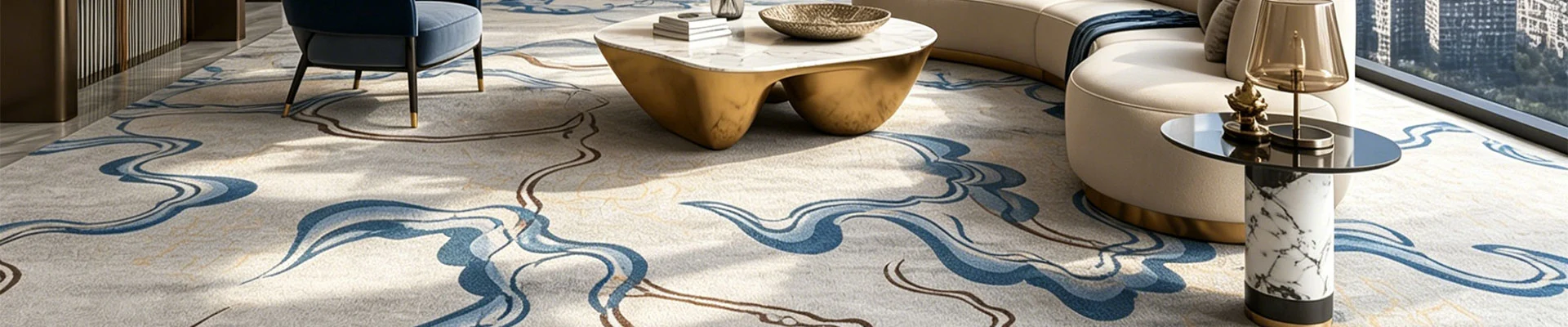
Printed across the full width rather than in a panel, the face is a cut pile with a matte finish, so a stand wall and the floor beneath it can carry one continuous graphic. At 6 mm it feels firm underfoot and reads flat on camera. Rolls are wound face inward on cores, trimmed straight at the selvedge, then bagged in woven polypropylene and closed with three metal straps.
Ordering starts with artwork or a Pantone reference; we return a digital proof, then a physical strike-off on the production yarn for approval, and bulk printing follows sign-off. There is no screen cost and no minimum pattern repeat, so a small directional print and a full-floor graphic are priced the same way. Face pile carries an 8-year warranty. Send LUCK Carpet your stand drawing and we will return a roll plan keyed to the modules.


Address
Shidaigongguan Building No.5 Office 1212, Haicheng east road, Duanzhou District, Zhaoqing City, Guangdong Province, China
Tel
Copyright © 2026 Zhaoqing Yunle International Trade Co., Ltd. All Rights Reserved.