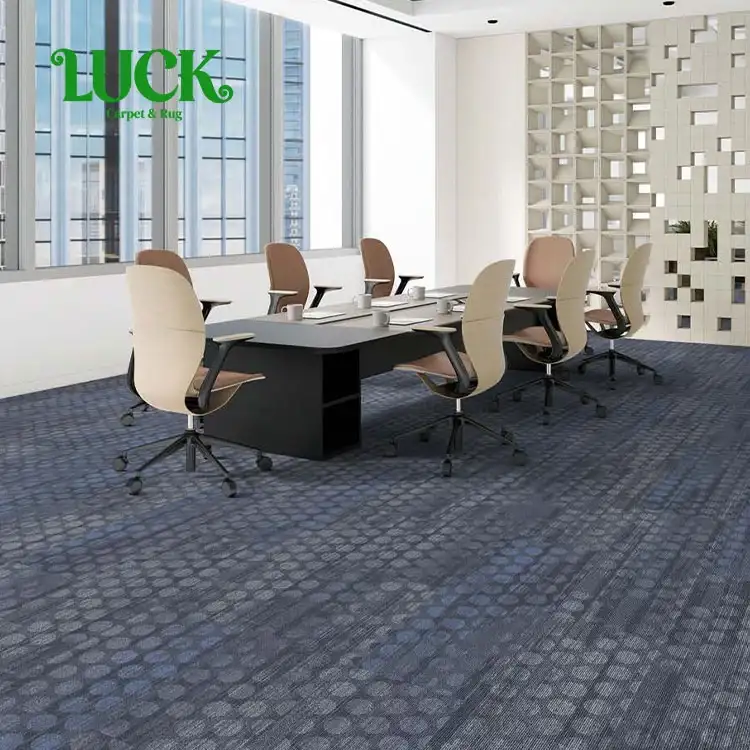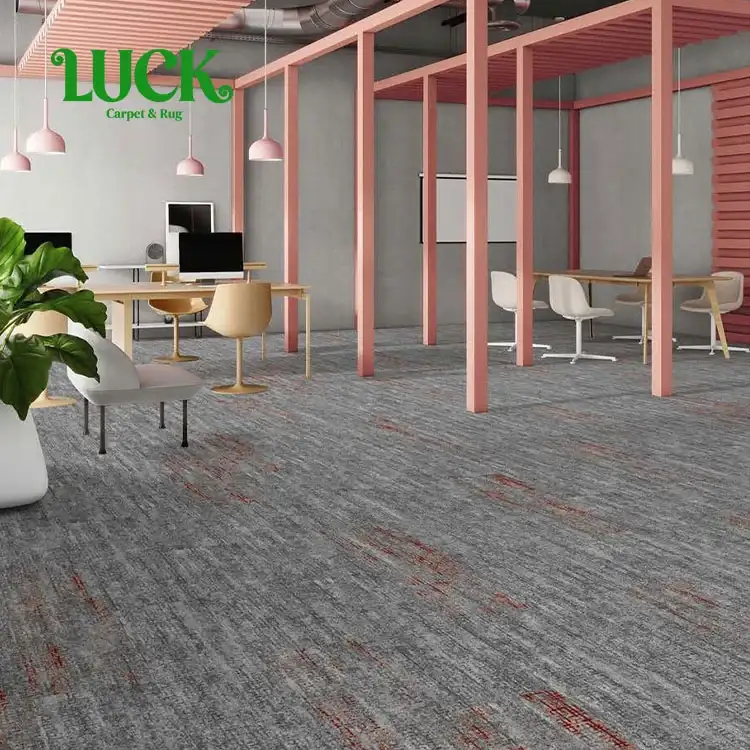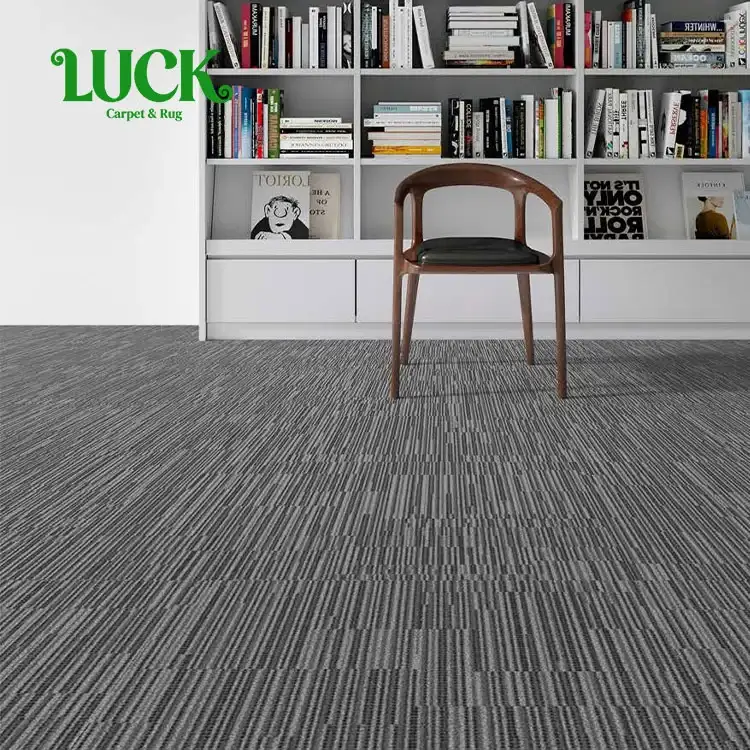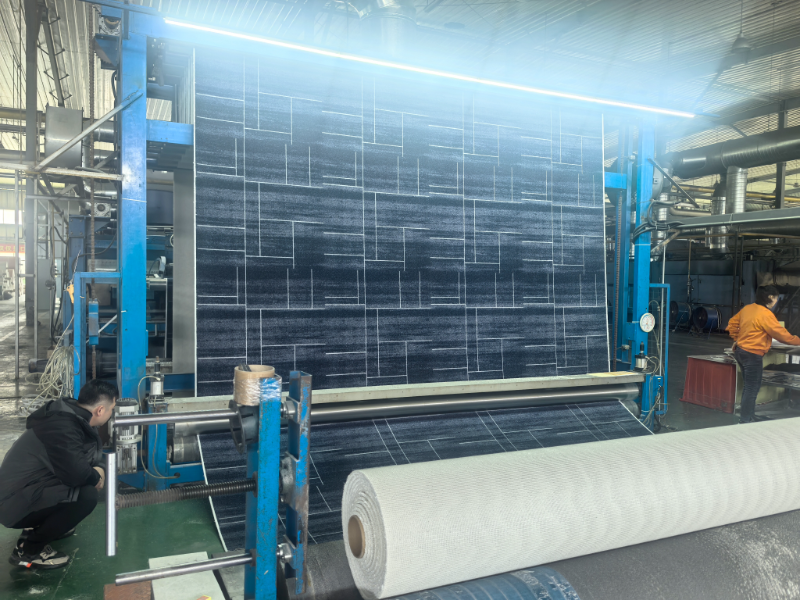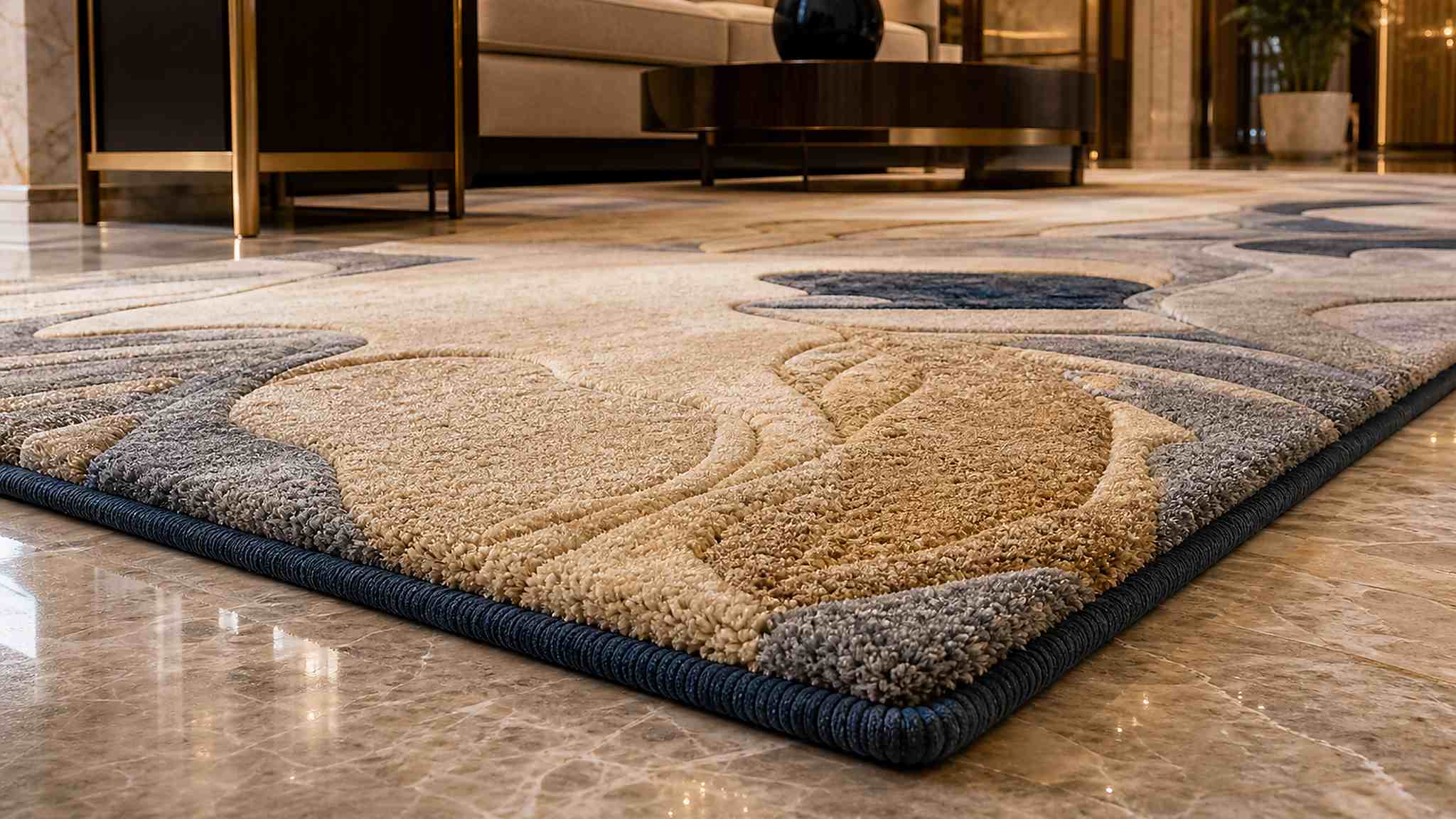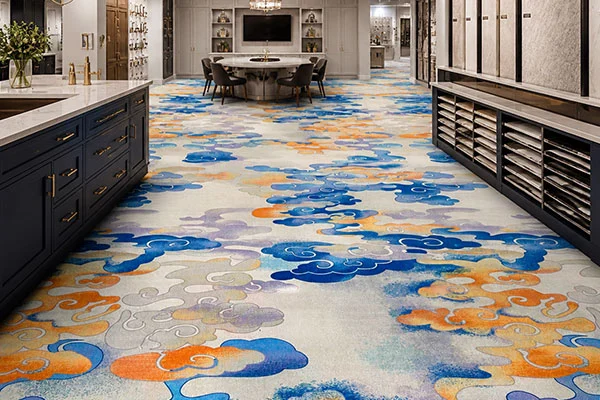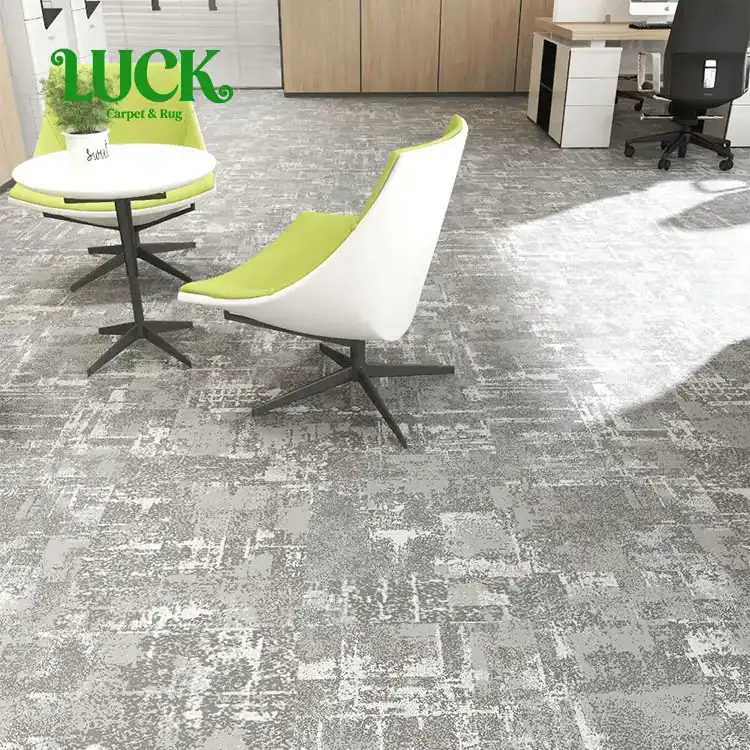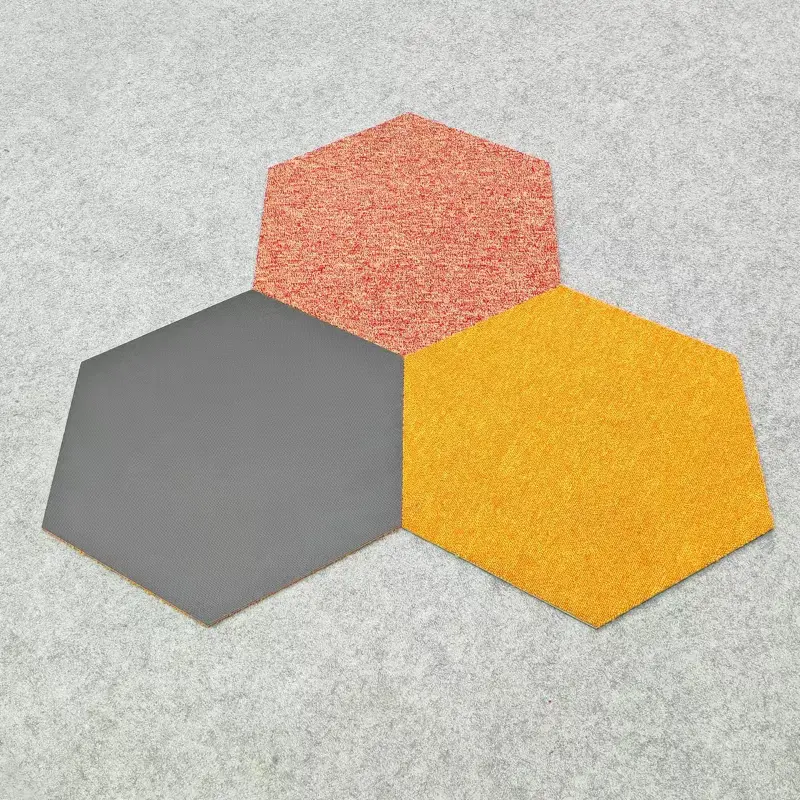
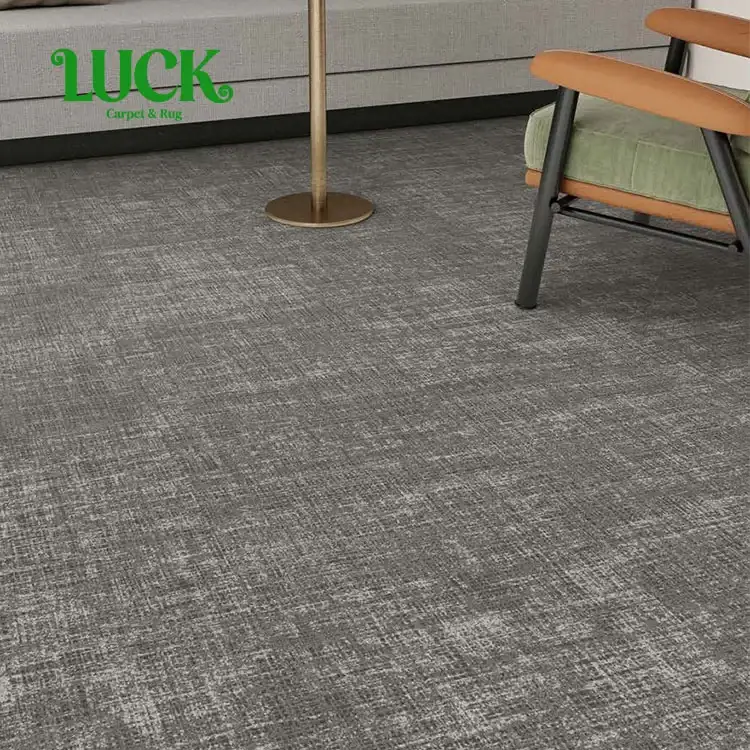
A printed carpet tile in polyester delivers what nylon finds hard to match: deep, saturated colour that reads evenly across a floor plate. LUCK Carpet tufts this 5 mm loop pile at 550 g/m2 from 100 % polyester yarn, prints it with the buyer's artwork, and laminates it to glass-fibre-reinforced PVC in Foshan, Guangdong. Offices and commercial interiors are the target. At Shanghai Hospitality Design Week, 24 of the 38 designers we asked named colour that shifts between cartons as their reason for rejecting a printed tile sample. Print clarity is why the product exists, so this page answers the question deciding whether a printed floor looks sharp or patched.
Low moisture regain and easy pigment take-up make polyester the easier fibre to print. Its moisture regain is low, so water-based pigment in the pile tips does not wick sideways and blur the edge of a shape, and it takes pigment deeply enough that a wood grain survives washing. The backing finishes the job, because print freedom is worthless if the base moves. Glass-fibre-reinforced PVC holds printed geometry through wet cleaning, with change to ISO 2551 under 0.25 %.
Sharp text below roughly 8 mm cap height is what the 5 mm pile will not hold, because the loop structure breaks the line at close viewing distance. We steer buyers away from very pale pastel fields in heavy soil areas, since polyester in a light tint shows tracked-in dirt sooner. Low moisture regain cuts both ways: fast drying after cleaning, and ready spotting if a spill is left to evaporate.
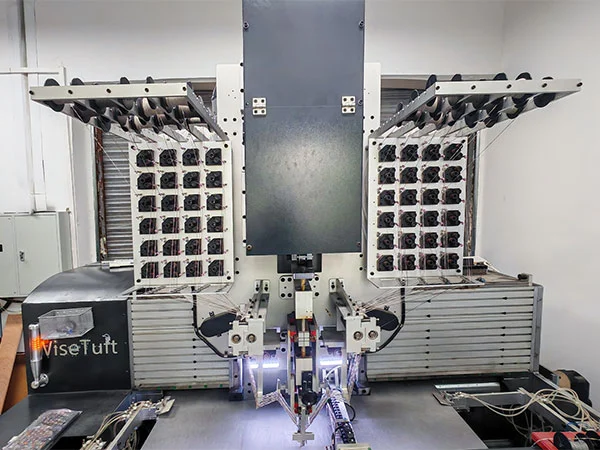
Three points on our line control register. Greige polyester is tufted at a fixed 1/10 gauge, because uneven stitch density changes how much ink each unit of surface accepts and the print drifts light or heavy along the web. The web then passes the digital printer, where optical sensors read fiducial marks and each pass tracks the previous one. Web tension stays constant.
The last control point is the cut, and it sets register on a finished floor. Tiles are punched on a hydraulic press against dies held to plus or minus 0.3 mm, and pallets are checked against a master gauge. Two tiles whose images are perfectly placed will still show a step if one is 0.3 mm wider than the other.
Pallets of this construction are sampled in our Foshan QC lab, and the figures below come from those production records rather than a hand sample. The size row gives modular tile and plank dimensions, not a broadloom width.
| Style | Polyester Printed Carpet Tile with PVC Backing |
| Yarn type | 100 % Polyester |
| Pile Height | 5 mm |
| Pile Weight | 550 g/m2 |
| Backing | PVC with glass-fibre reinforcement |
| Fire Resistance | Bfl-s1 (EN 13501-1) |
| Application | Office, Commercial |
| Width / Size | 50 cm x 50 cm standard tile, 25 cm x 100 cm plank and custom sizes |
| Pattern | Custom design available (artwork supplied by buyer, strike-off approved before production) |
| Surface / Technique | Loop pile |
This tile suits a commercial interior where the flooring carries a design idea as well as footfall: an office reception, a dealership showroom, a bank branch, a co-working floor, a hotel meeting level. There the floor is judged from standing height, which makes register across the joints the first thing a client notices and the last thing an installer can fix.
Position across a joint is a distance, and it can be quoted as one. On a monolithic lay, printed detail holds to about 0.4 mm on production pallets, below the threshold the eye picks up under office lighting. We measure that on assembled grids rather than single tiles, because a tile measured alone says nothing about its neighbour.
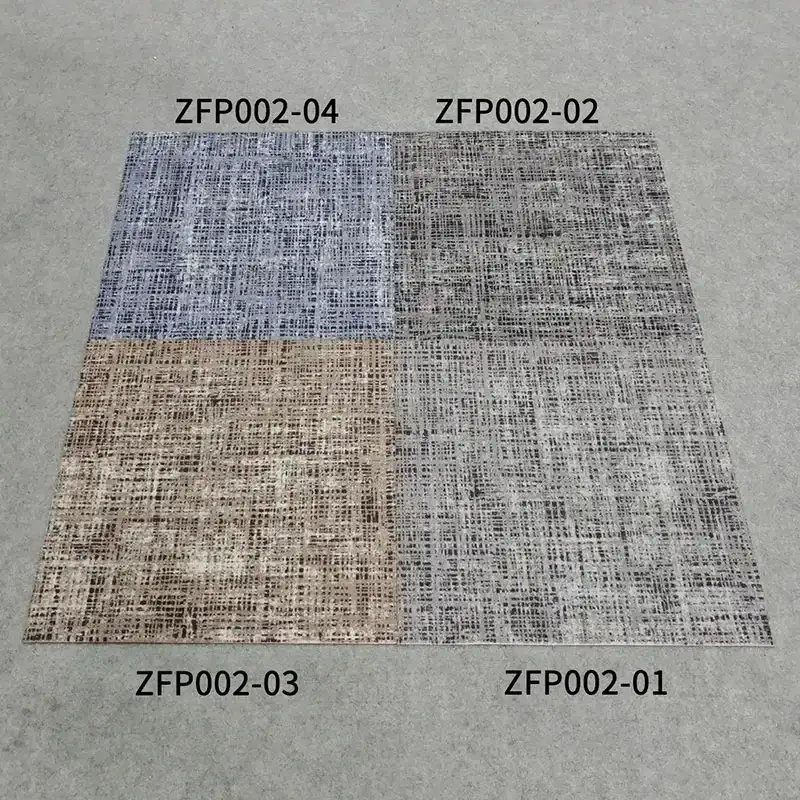
Two physical checks belong in the specification for any printed floor. The first is a laying pattern drawing showing which way each tile faces, because a monolithic and a quarter-turn lay produce different register behaviour from the same pallet. The second is a dry-laid panel: four tiles assembled on site under the real lighting and photographed before adhesive goes down. Skipping them means meeting a register problem once the floor is stuck.
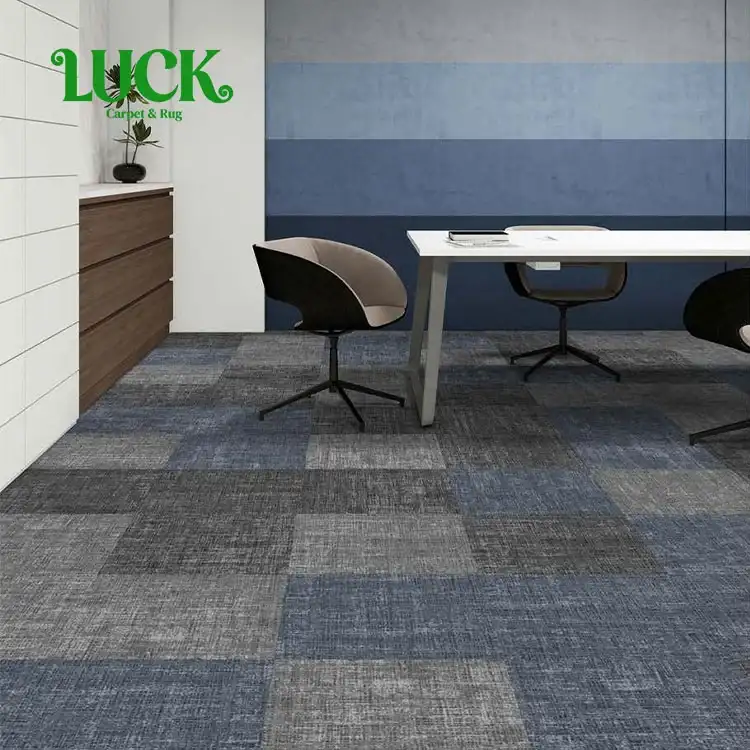
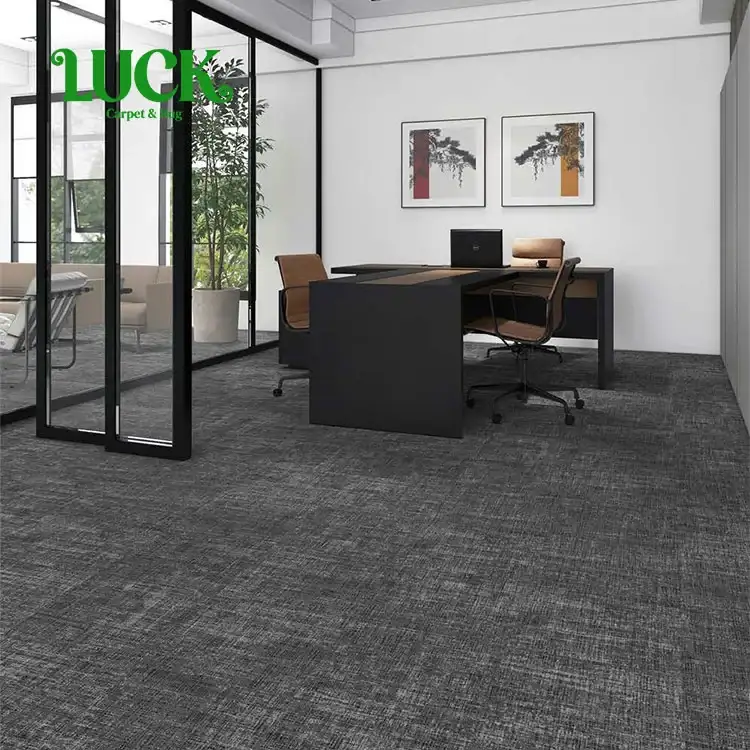
One floor is rarely what a commercial interior needs; it needs four that agree with each other, and printed modular tile handles that better than any other format. The office specification is the core case, with a graphic print through circulation and a plainer field under the desks. Showrooms take a bolder print, and branches want wayfinding colour that survives cleaning.
Take the 2,400 m2 interior we supplied in Ho Chi Minh City across two connected office towers for a single tenant. The brief asked for a printed oak plank effect through lift lobbies and open floors, laid ashlar so joints would not read as a grid. The risk there is entirely register, because ashlar steps the print by half a tile every row.
Drift is not a defect that appears on a pallet; it appears on a floor, with three sources. A drifting print head produces an image that wanders along one tile, visible at arm length. A drifting cut produces tiles all printed correctly but not all the same size, which shows when two of them meet.
What we cannot control is the geometry the designer chooses. Where a printed line runs straight across a quarter-turn or ashlar boundary, it breaks at every corner by definition, because the neighbouring tile is rotated or offset. On an ashlar lay, a plank print meant to read as continuous boards needs an offset matching the plank module. If continuity matters more than variation, specify monolithic.
One Vietnamese developer was fitting out two connected office towers in Ho Chi Minh City for a single banking tenant and wanted one continuous floor identity across both buildings. The area was 2,400 m2 of lift lobbies, reception and open work floors, printed as an oak plank effect and laid ashlar so the floor would read as timber rather than as a tile grid. Handover came in six stages.
We supplied 10,000 tiles across four production batches from one yarn lot, each packed with its own reference so the installer could work stage by stage. Cutting waste ran under 4 %, which we put down to the ashlar layout suiting the 25 cm x 100 cm plank format. Measured register across the installed joints came in at 0.4 mm, with no register or shade complaint in the eighteen months after handover.
Buyers comparing polyester quotations usually ask about wear, so here is what our lab books show. Abrasion runs to ISO 12947-2 at 5 kPa, with batches in the 34,000 to 46,000 rub band and recent runs averaging 41,600 rubs. Tuft bind to ISO 4919 measures between 36 N and 44 N, which stops fine printed detail pulling out at a cut edge. Colour fastness to light to ISO 105-B02 holds Grade 5 to 7 and rubbing fastness to ISO 105-X12 holds Grade 4 to 5.
Fire performance is certified to EN 13501-1 at Bfl-s1 through EN ISO 9239-1 and EN ISO 11925-2, peel strength measures 30 N/50 mm to 38 N/50 mm, and use classification is ISO 10874 class 33 heavy commercial under EN 1307. One limit deserves stating plainly: polyester lightfastness tops out a grade below nylon, so a glass-walled atrium with direct sun is the wrong room.
It depends on the laying pattern. Laid monolithic, the boards run true and the joints are almost invisible from standing height. Laid ashlar, the boards step by half a tile at every row, which reads as a deliberate stagger if the print module matches the step and as a mistake if it does not. Send us the layout drawing and we will confirm the pattern.
Polyester dries quickly after extraction, but liquid left to evaporate can leave a tide mark. Blot spills within a few minutes with a clean white cloth, then dab with a damp cloth and dry it. Vacuum daily with a brush head and extract every three to four months with a neutral pH detergent.
The fibre is an insulator, so a heated building at low winter humidity can produce a small shock at a door handle. Our backing carries a mild conductive path that bleeds a charge away when the floor is laid as part of a grounded system, and keeping indoor relative humidity between 45 % and 55 % removes the problem in practice.
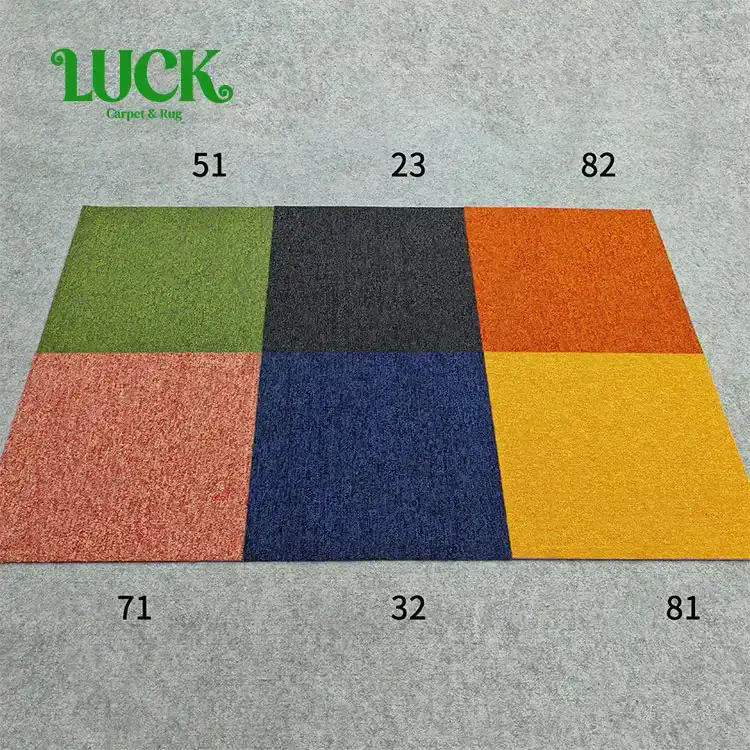
Custom printed tiles start at 500 m2, which is 2,000 tiles, so the press run and ink setup are worth doing properly. Below that we can usually match a design from our existing print library. Stock colourways in the 50 cm square ship from one carton, and a strike-off tile is approved before production begins.
Tiles arrive face to face in cartons of twenty, each labelled with print reference, colourway and production batch so a phased installation can be laid in sequence. The surface is a level loop pile 5 mm high at 550 g/m2, a firm face with a light directional sheen that shifts as you cross it.
Fixing is with a pressure-sensitive adhesive over a flat, dry substrate, or a tackifier for loose laying. LUCK Carpet has manufactured printed carpet in Foshan, Guangdong for 14 years from a 26,000 m2 plant with 180 staff, holds third-party inspection by SGS, Intertek or BV open at the plant, exhibits at DOMOTEX Hannover and The Canton Fair in Guangzhou, and warrants the face pile for 8 years. Send your artwork and floor plan.
Address
Shidaigongguan Building No.5 Office 1212, Haicheng east road, Duanzhou District, Zhaoqing City, Guangdong Province, China
Tel
Copyright © 2026 Zhaoqing Yunle International Trade Co., Ltd. All Rights Reserved.