Products


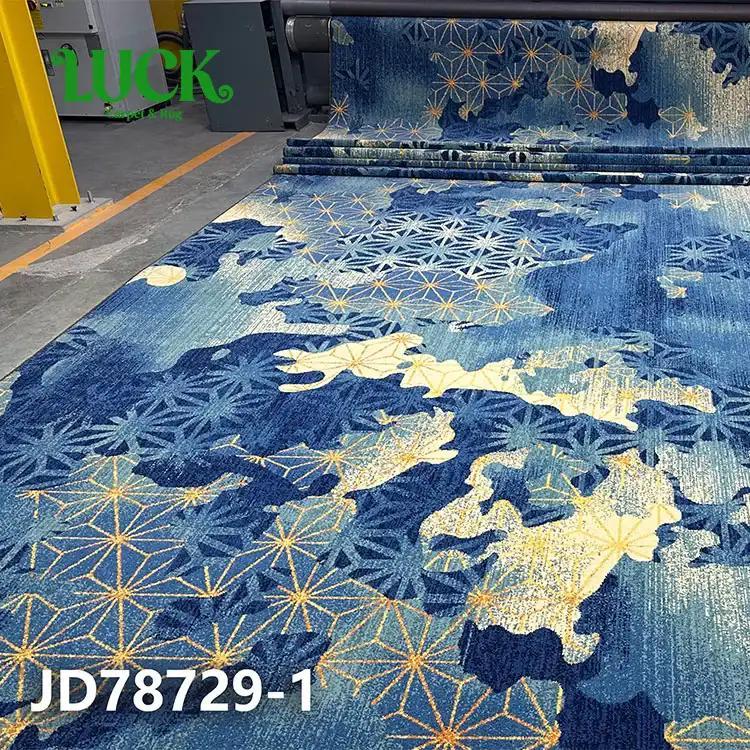
LUCK Carpet makes the Nylon Printed Carpet Tile with PVC Backing in Foshan, Guangdong, where one line tufts 100 % nylon into a 6 mm loop pile at 550 g/m2, prints it and laminates it to glass-fibre-reinforced PVC. Offices, retail floors, hotels and schools specify it where the slab is imperfect and the programme is short. Of 44 contract tilers we asked at The Canton Fair in Guangzhou what makes a printed tile floor fail inspection, 29 said the same thing: joints that do not line up.
Glass-fibre reinforcement is why a 50 cm printed tile behaves itself on site. Our Foshan lab records dimensional change after wet cleaning to ISO 2551 at under 0.25 % in the length direction, and the same tiles hold under 0.20 % through a dry thermal cycle. Over 50 cm that is a fraction of a millimetre, and a design crossing a floor plate must land in the same place on every tile.
Once a print crosses a joint the eye reads any mismatch, so the cut tolerance is tight. Tiles come off our hydraulic press against a master gauge, holding register to roughly 0.5 mm. That restraint lets the floor go down loose-laid with a perimeter tackifier or fully bonded, and it suits underfloor heating while the surface temperature stays at or below 27 C.
Cushion and bitumen backings give a maintenance team very little to work with when one tile must come out. PVC is different, because a dense sheet releases from pressure-sensitive adhesive under a broad scraper without crumbling or leaving fibres welded to the slab, and the removal takes minutes without disturbing the neighbouring tiles.
Service life is where this pays. A corridor or a shop entrance takes concentrated damage in a narrow band rather than evenly across the plate, so you renew that band instead of the room, and we hold the lot record so a re-order two years later still matches. What a printed floor cannot hide is a badly chosen pattern: busy graphics read worse than a quiet two-tone.
Values below come from finished-tile testing in our Foshan QC lab, on production batches rather than a single promotional sample. This is a modular tile, so the width and size row gives tile and plank dimensions rather than a roll width, and the fire class applies to the tile on a standard substrate.
| Style | Nylon Printed Carpet Tile with PVC Backing |
| Yarn type | 100 % Nylon |
| Pile Height | 6 mm |
| Pile Weight | 550 g/m2 |
| Backing | PVC with glass-fibre reinforcement |
| Fire Resistance | Bfl-s1 (EN 13501-1) |
| Application | Office, Retail, Hospitality, Education |
| Width / Size | 50 cm x 50 cm standard tile, 25 cm x 100 cm plank and custom sizes |
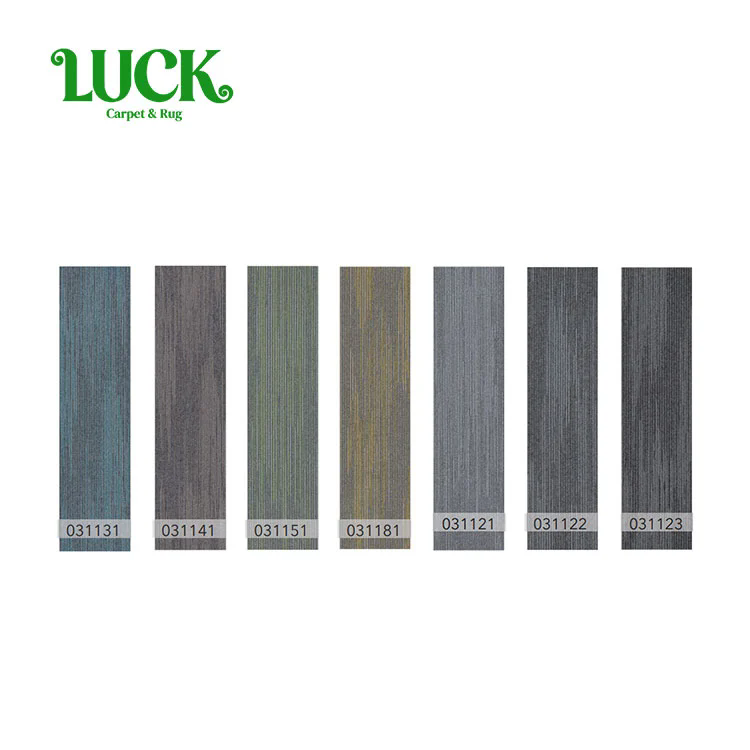
| Pattern | Custom design available (artwork supplied by buyer, strike-off approved before production) |
| Surface / Technique | Loop pile |
Specify this tile for ground-floor retail, hotel lobbies, corporate office plates, university teaching blocks and quick-service dining rooms. The case for it rests on three things: the tile holds its size, the print is manufactured rather than assembled on site, and any single square can be swapped years later from a carton in the store cupboard.
Dimensional stability is a laboratory result, and a supplier claiming a tile stays flat should name the method. Ours is ISO 2551, recorded under 0.25 % length change on production batches. The loop face is checked to ISO 12947-2 at 5 kPa, where recent batches averaged 39,200 rubs in our 34,000 to 46,000 rub band, and tuft bind to ISO 4919 sits between 36 N and 44 N.
Rolling load is a backing question rather than a face question. Under ISO 3416 static loading it shows a thickness loss of 8 to 14 % and recovers most of it once the load comes off. That is also the honest limit: a PVC tile closes the slab to vapour, so it belongs on a slab whose moisture has been measured and signed off.
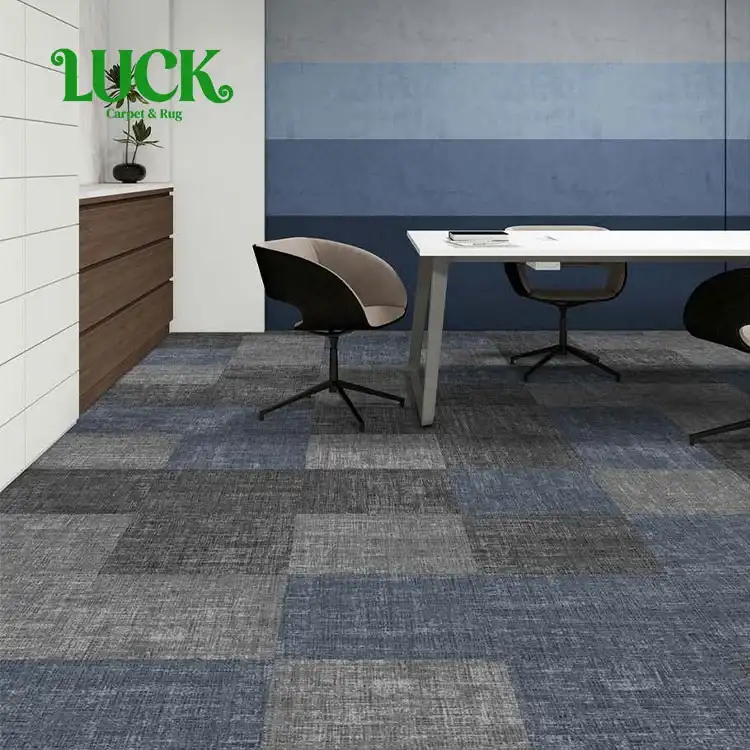
Printed tiles get specified because the design must do something a plain loop cannot: carry wayfinding colour, reproduce timber or stone for less, or put a brand pattern into a reception floor. Retail takes the abuse at the entrance while the shop floor stays presentable, and hospitality runs the same tile from lobby to corridor to lounge.
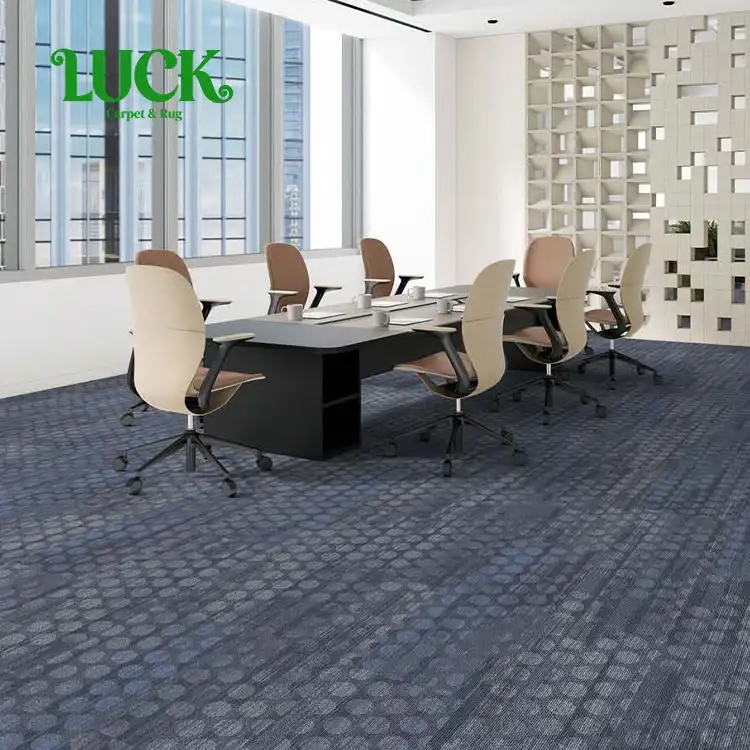
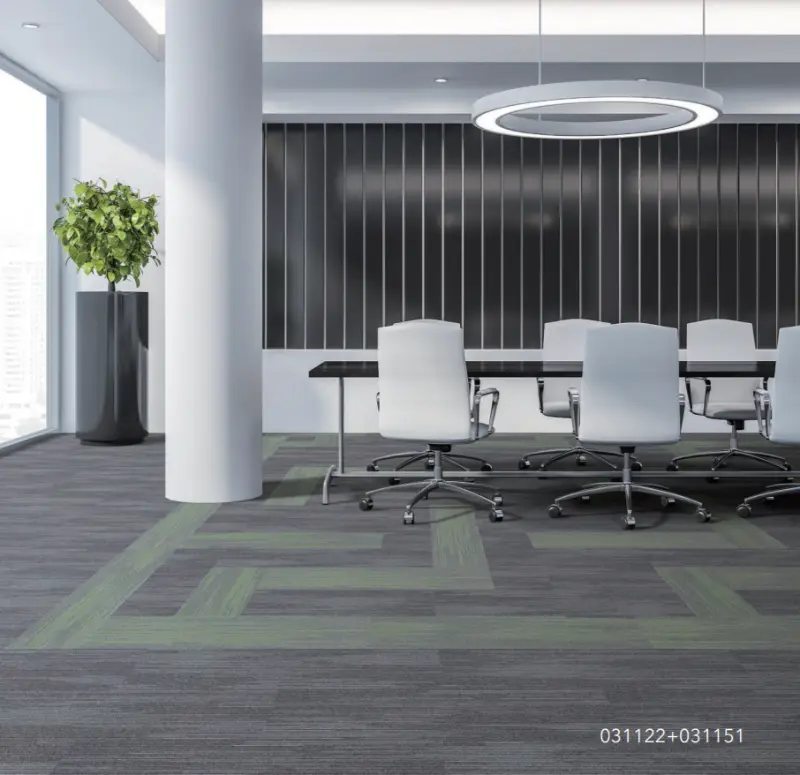
Office fit-outs are the largest single use we ship. In Kuala Lumpur we supplied 1,850 m2 for a technology tenant across an open floor plate, four meeting rooms and two corridor spines, as 8,200 tiles printed with a dark geometric design and a lighter border field. The floor had to survive rolling chairs and coffee spills while allowing tile rotation. Six months on: two swaps, no edge lift.
The complaint about printed modular floors is never that a tile failed; it is that the replacement stands out. Print register is the first cause, since a new tile running a fraction out of position shows the break where artwork crosses the joint. Shade is the second, because a re-order from another yarn lot can read warmer under the same lighting.
Our part is to make the swap mechanically easy, and the PVC backing does that. Lift the damaged tile with a broad scraper, scrape the adhesive bed flat, dry-fit the replacement, bond and roller it. We help on colour by supplying spares from the original run. Ask any supplier how many spare tiles they recommend, because a carton in Foshan is worth nothing when a coffee machine leaks elsewhere.
A tenancy fit-out in a Kuala Lumpur commercial tower needed 1,850 m2 across an open work plate, four meeting rooms and two corridor spines, with the tenant moving in on a fixed date and the raised access floor already commissioned. The design team wanted a printed geometric pattern in two tones, dark on the desk field and lighter through circulation. Panels moved whenever cabling changed.
We supplied 8,200 tiles in the 50 cm square format for a pressure-sensitive installation over prepared panels. Substrate relative humidity read 68 % before the floor went down, inside the limit we ask for, so no surface membrane was needed. Six months later the facilities team has swapped two tiles after a spill and a caster incident, with no visible patch, no edge lift and no gapping.
Every batch is tested in our own lab before packing, and buyers may send SGS, Intertek or BV into the plant to witness it. Abrasion runs to ISO 12947-2 at 5 kPa in the 34,000 to 46,000 rub band, colour fastness to light to ISO 105-B02 at Grade 5 to 7, colour fastness to rubbing to ISO 105-X12 at Grade 4 to 5, tuft bind to ISO 4919 between 36 N and 44 N, peel strength between 30 N/50 mm and 38 N/50 mm, and dimensional stability to ISO 2551 under 0.25 %. Reaction to fire is EN 13501-1 Bfl-s1 through EN ISO 9239-1 and EN ISO 11925-2, with use classification ISO 10874 class 33.
Two questions sort a manufacturer from a trader. Ask for the method number beside every claim, and ask which sample it came from: a hand sample or a tile off the production line. Then ask for peel strength in N/50 mm rather than a pass certificate, because that figure predicts whether the printed face separates from the backing after three years of cleaning.


Yes, with one condition. Keep the surface temperature at the tile at or below 27 C, which usually means capping flow temperature around 45 C on a hydronic system. The glass-fibre-reinforced backing takes the daily expansion cycle without measurable size change, so joints do not open as the floor warms. Warm the floor gradually over the first week.
It will on a monolithic lay, where every tile faces the same way and printed detail holds register to roughly 0.5 mm across the joint. A quarter-turn lay rotates each tile 90 degrees and an ashlar lay steps them by half a tile, so a design crossing the joint breaks at those corners by design. For continuous lines, specify monolithic.
Each 50 cm square covers 0.25 m2, so a 412 m2 floor takes 1,648 tiles before cutting waste. Allow 5 % on a simple rectangular plate and 10 % where there are many doorways, columns or diagonal cuts. Keep one spare carton per colour on site after handover, because it is the difference between a two-minute repair and a visible patch.
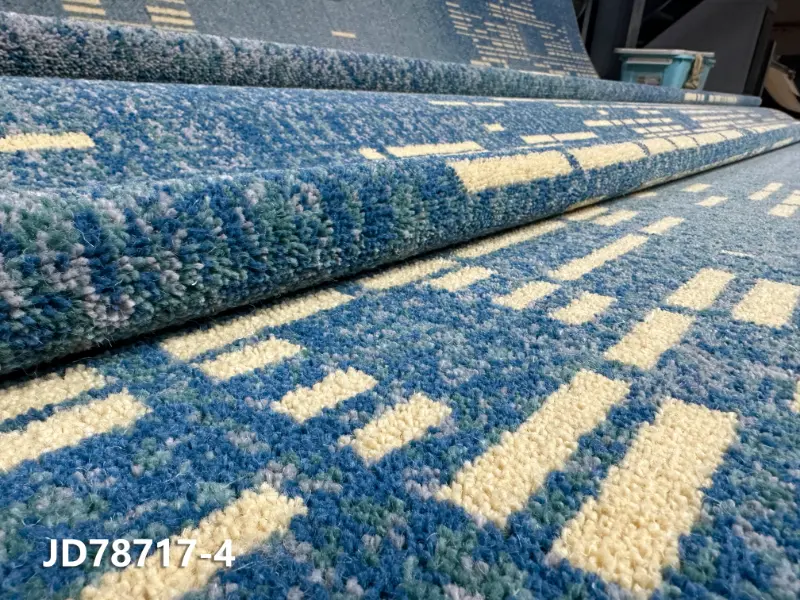
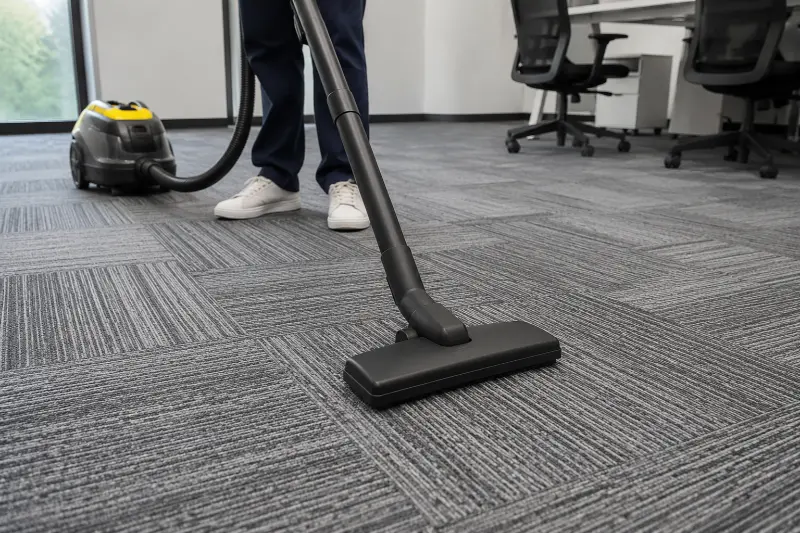
Its surface is a level loop pile, 6 mm high at 550 g/m2, a firm low-texture face that keeps printed detail legible and vacuums cleanly. Colour depth comes from print sitting down into the loop rather than on top of it, and darker colourways carry a slight sheen shift as you walk across the floor. The backing is a dense grey-black sheet with glass-fibre scrim on the reverse.
Ordering starts with artwork. Send vector or high-resolution files with a colour reference and we return a strike-off tile for approval, because approving a screen image is not the same as approving a printed tile. The 25 cm x 100 cm plank suits ashlar work, and fixing is with a pressure-sensitive adhesive over a flat, dry substrate. LUCK Carpet has exported carpet for 14 years from a 26,000 m2 plant staffed by 180 people, exhibits at DOMOTEX Hannover and The Canton Fair in Guangzhou, and warrants the face pile for 8 years.


Address
Shidaigongguan Building No.5 Office 1212, Haicheng east road, Duanzhou District, Zhaoqing City, Guangdong Province, China
Tel
Copyright © 2026 Zhaoqing Yunle International Trade Co., Ltd. All Rights Reserved.