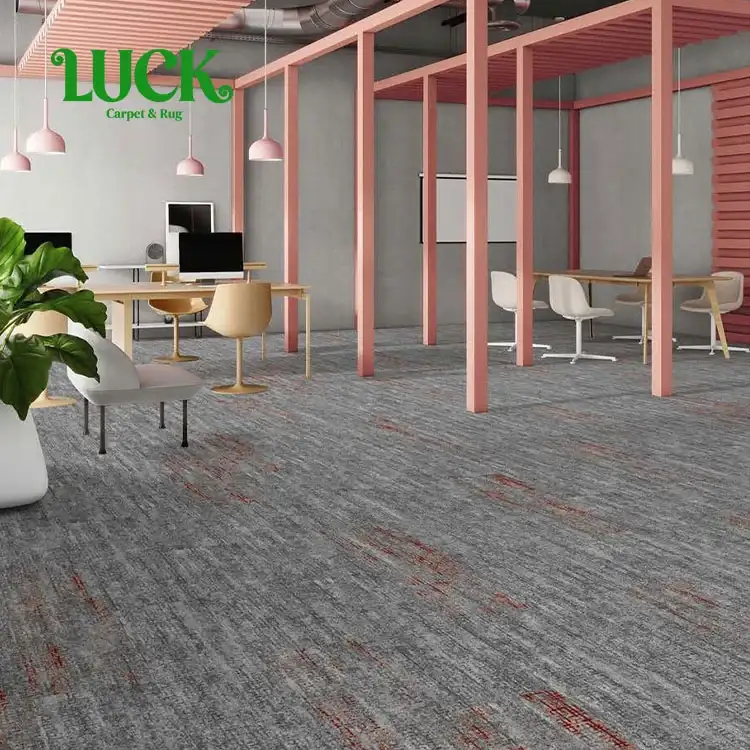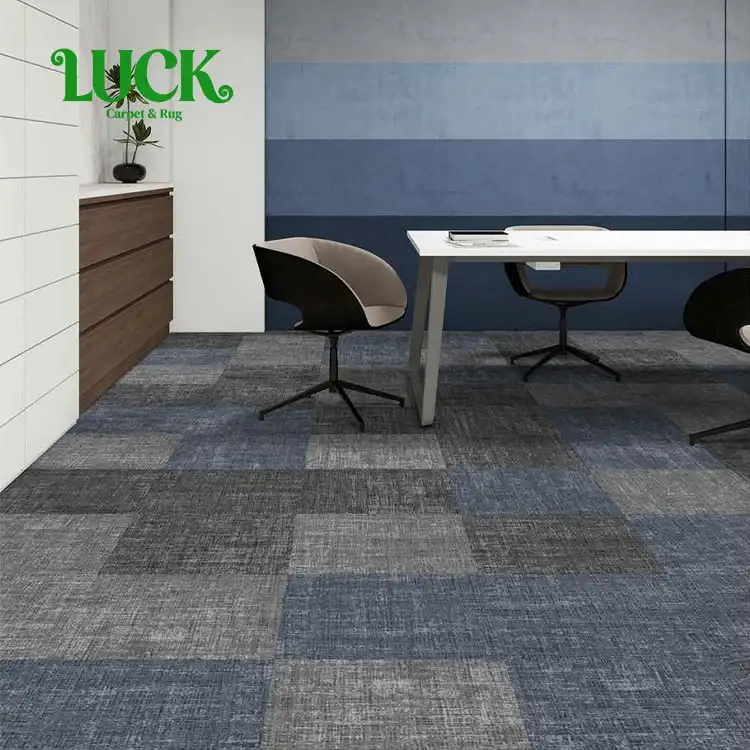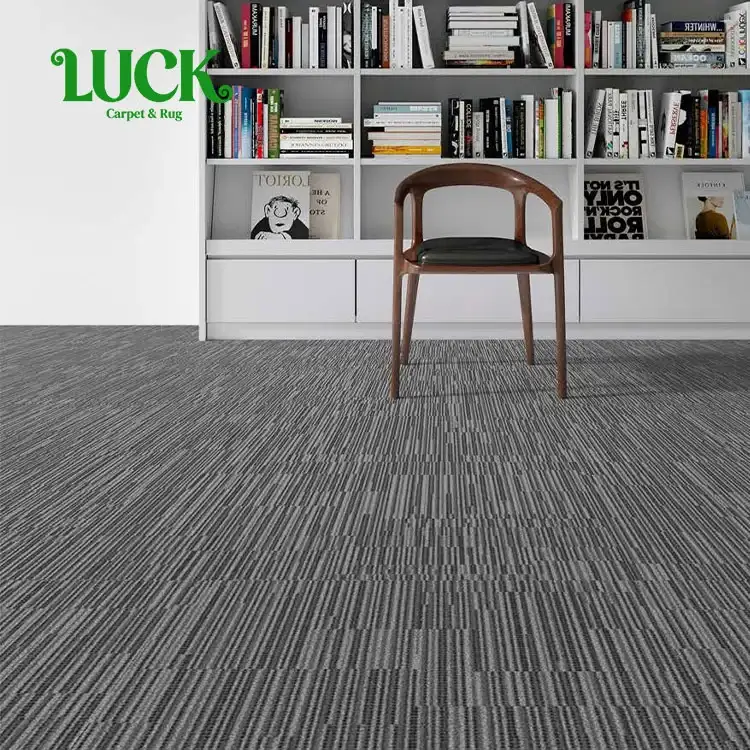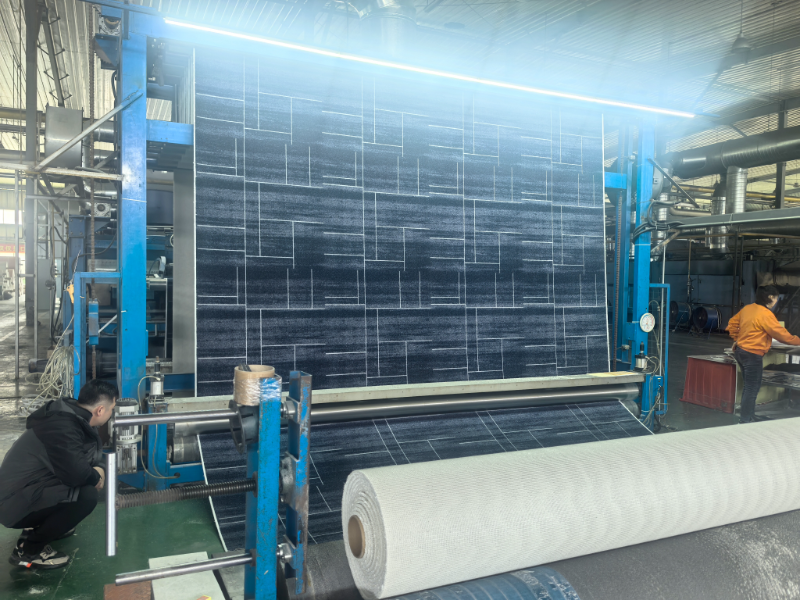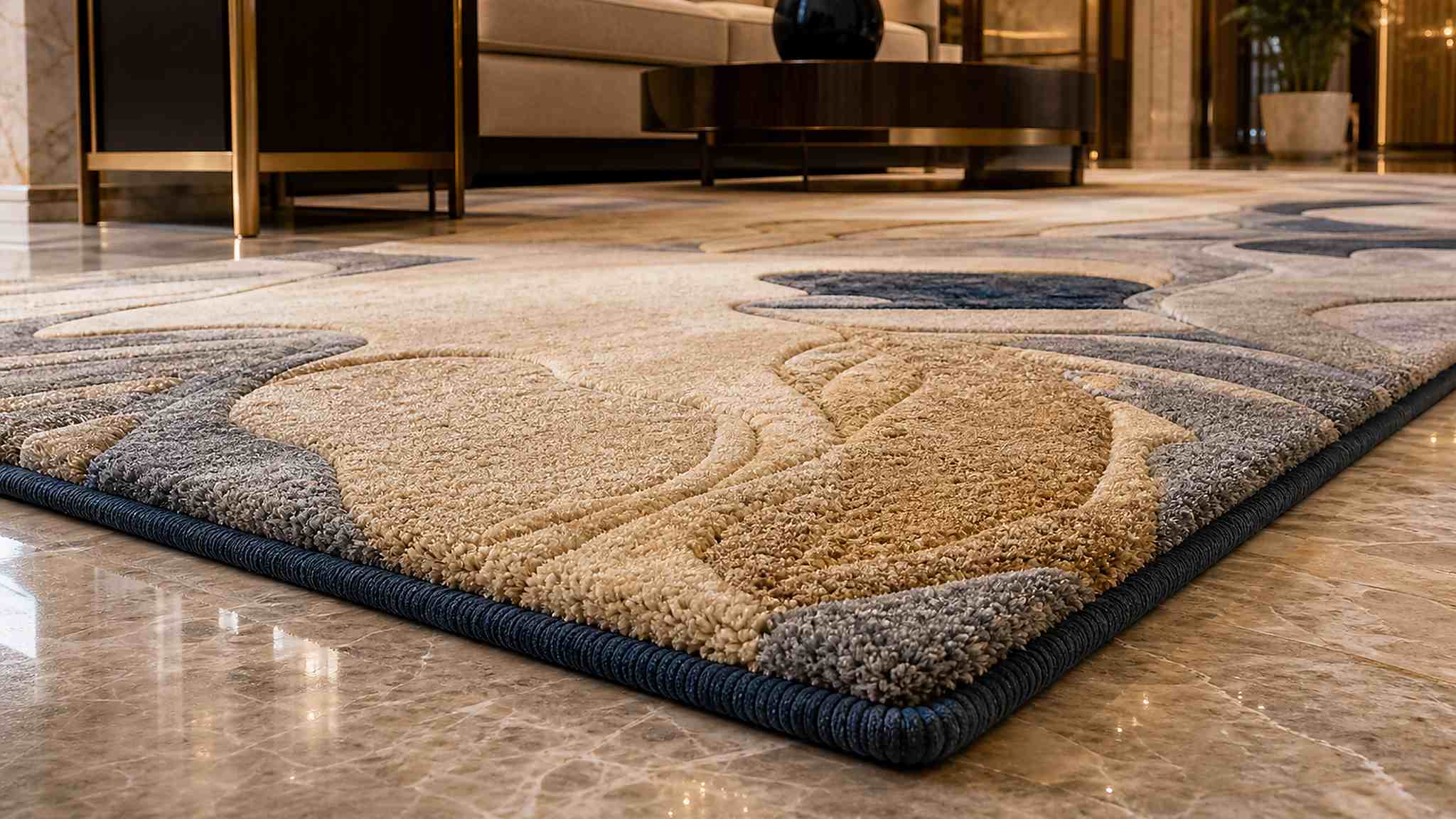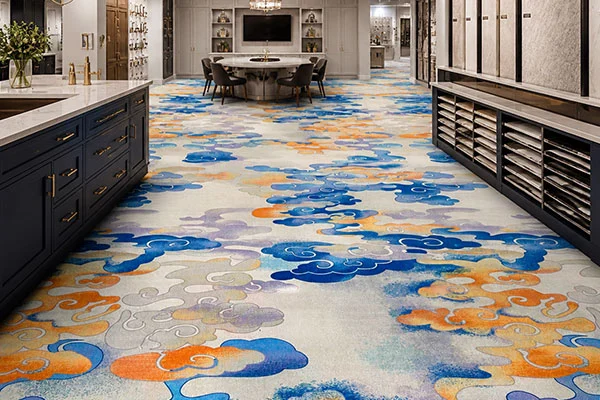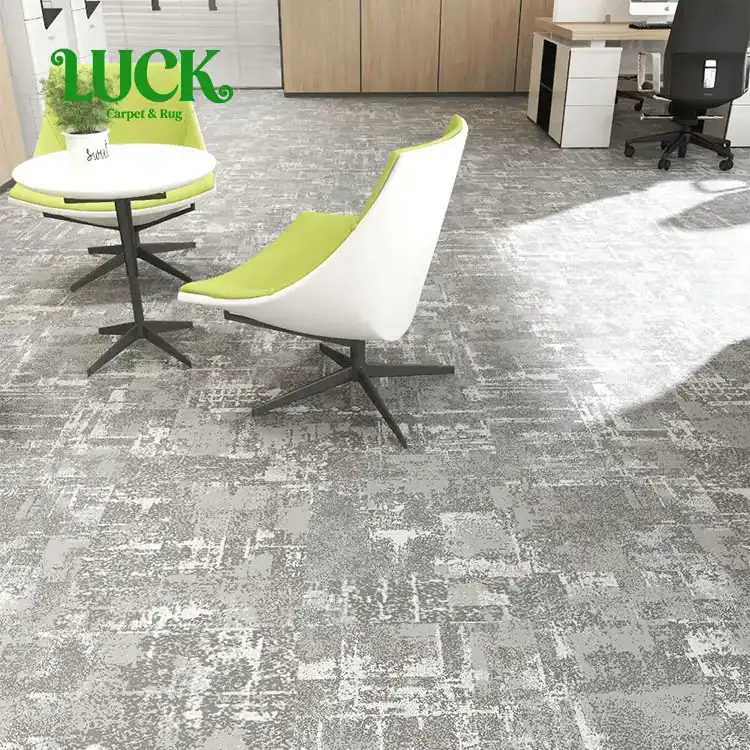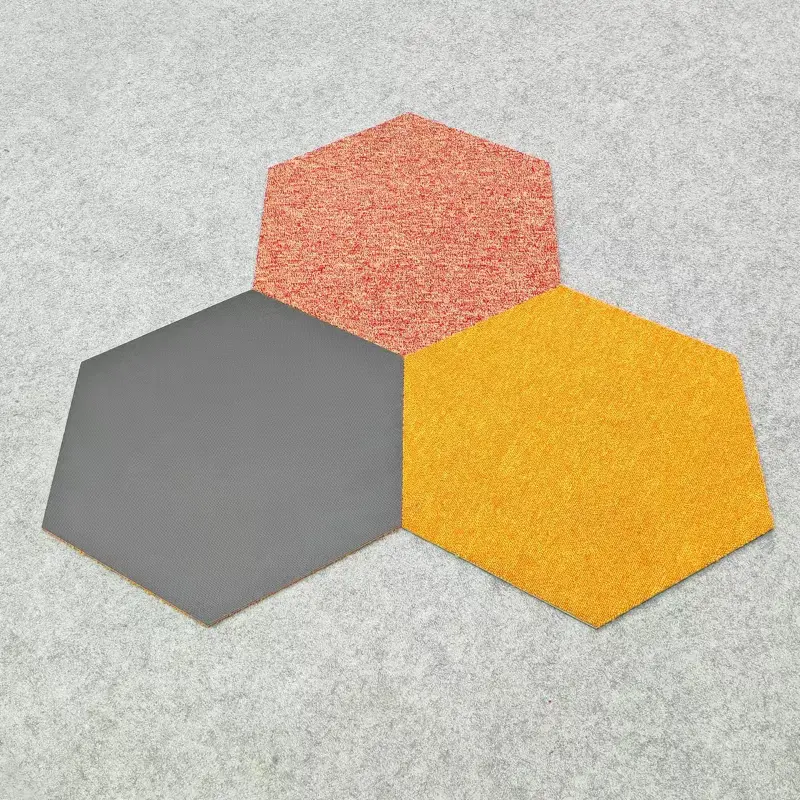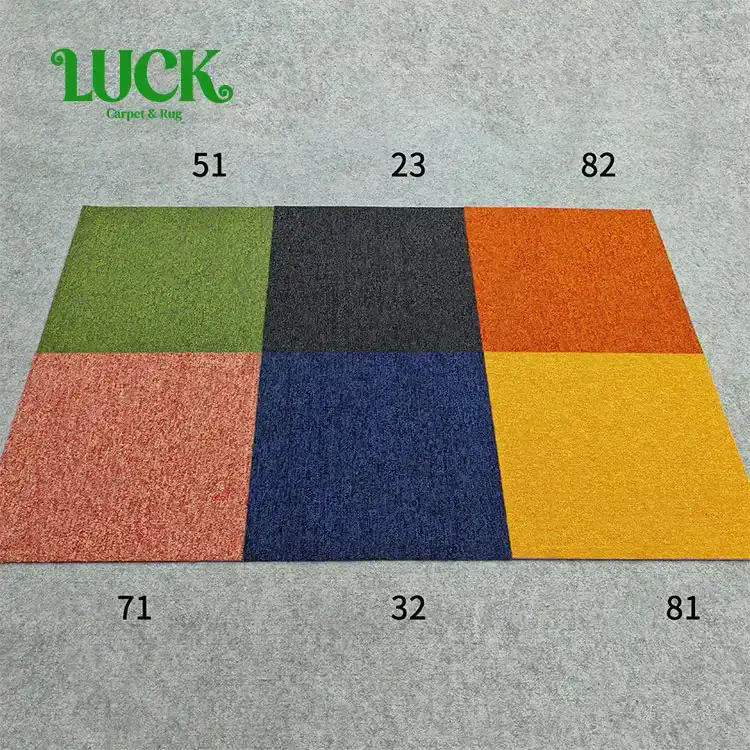
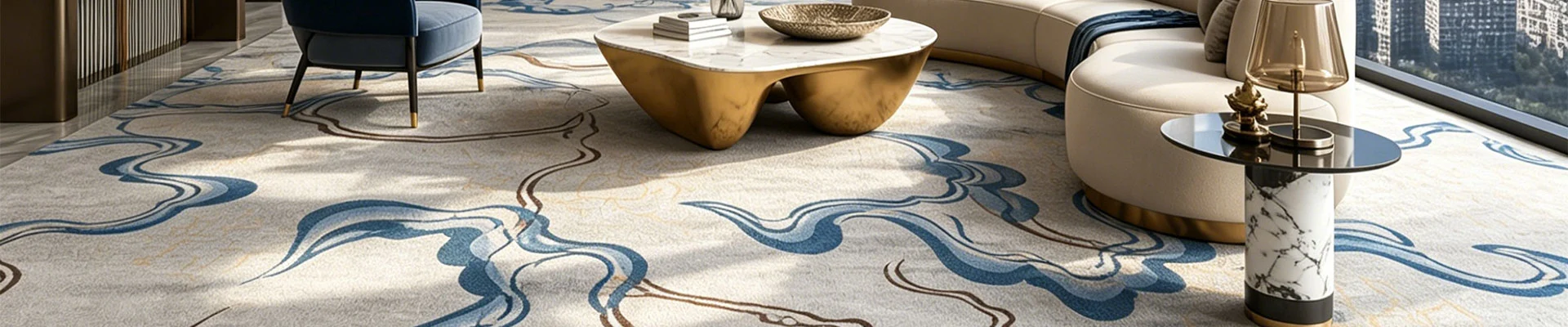
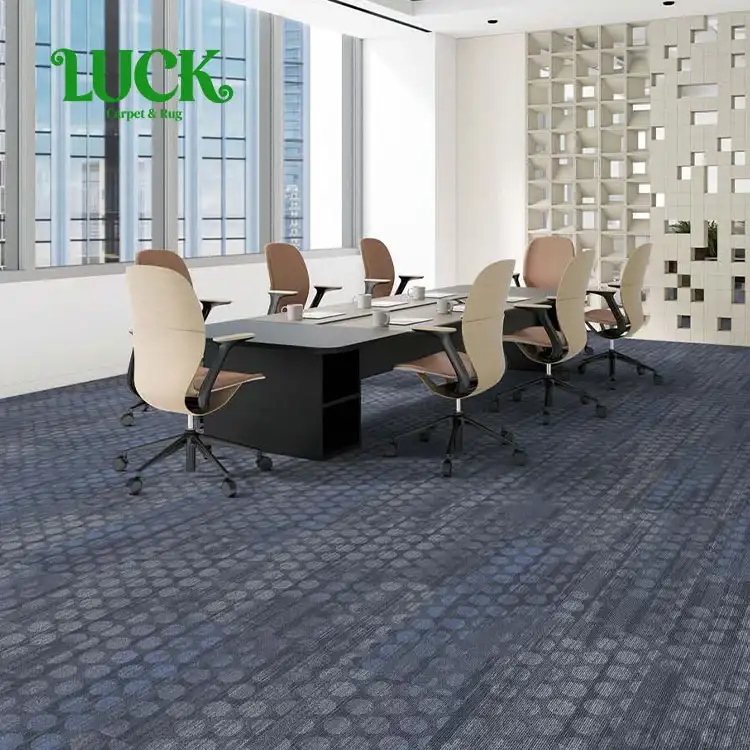
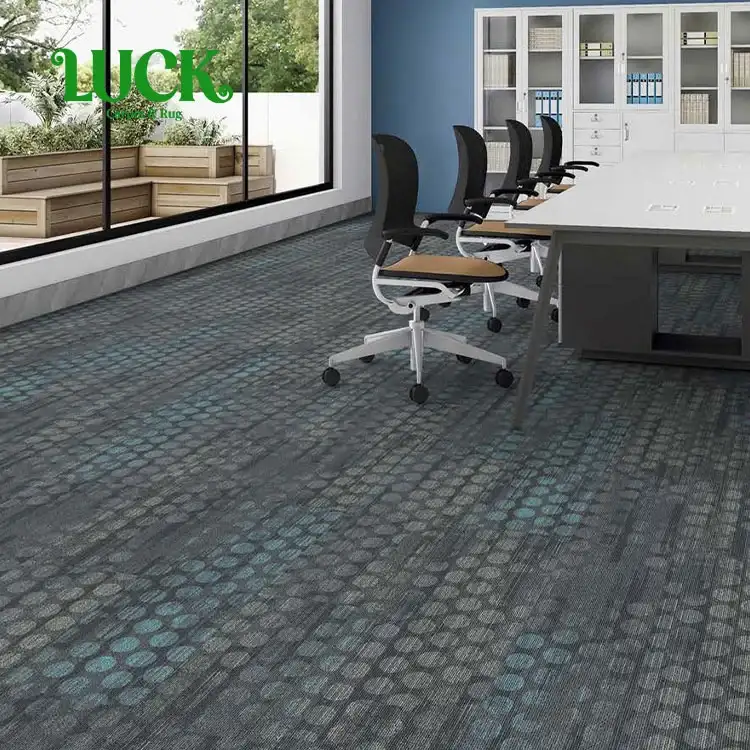
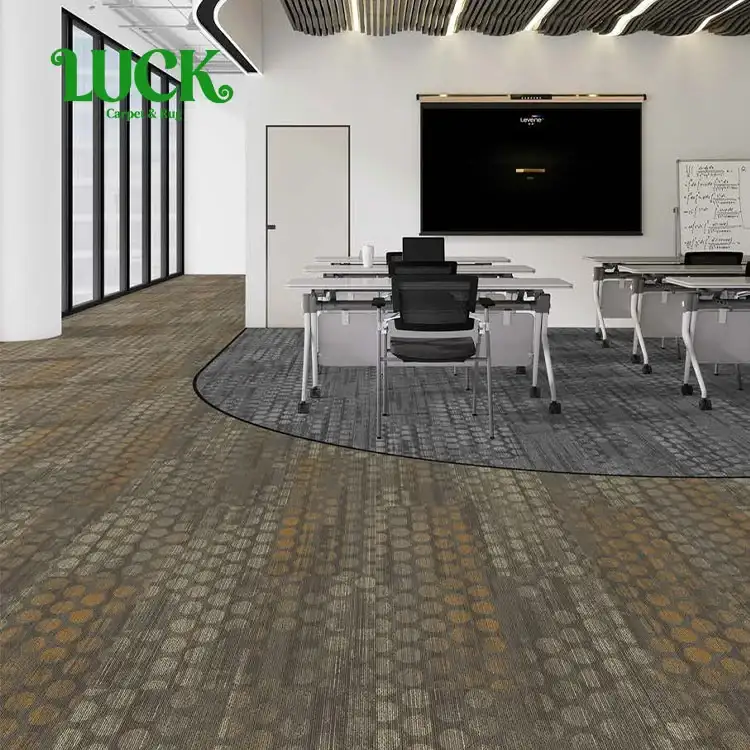
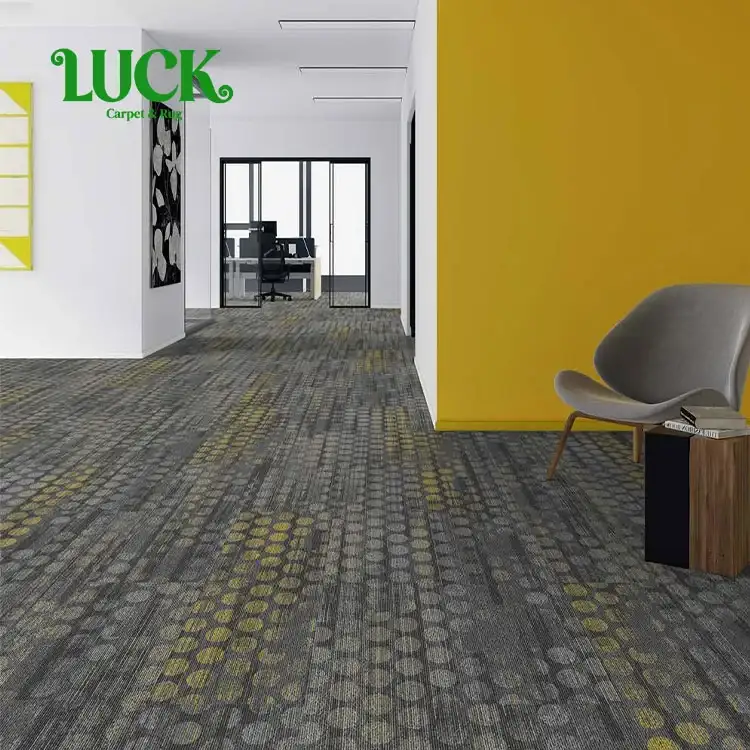
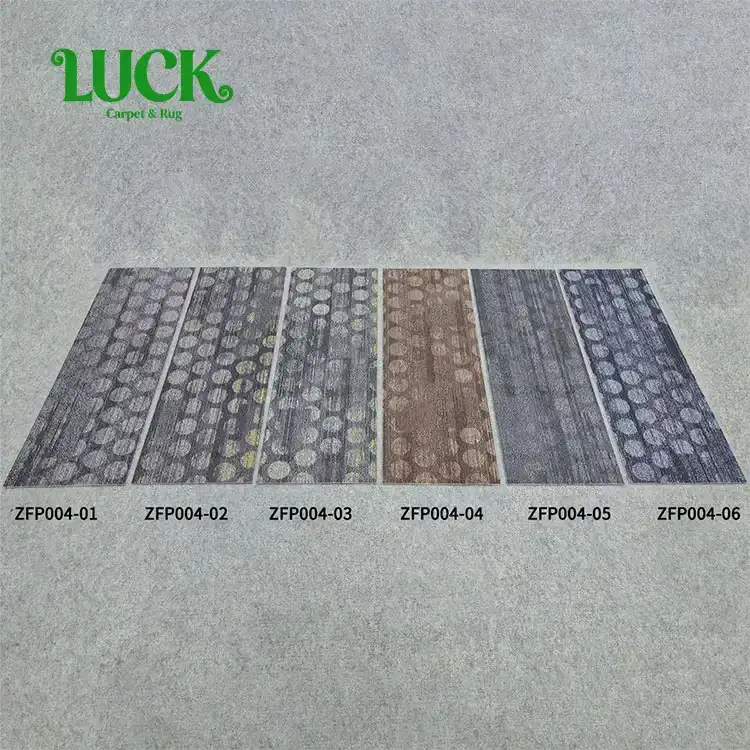
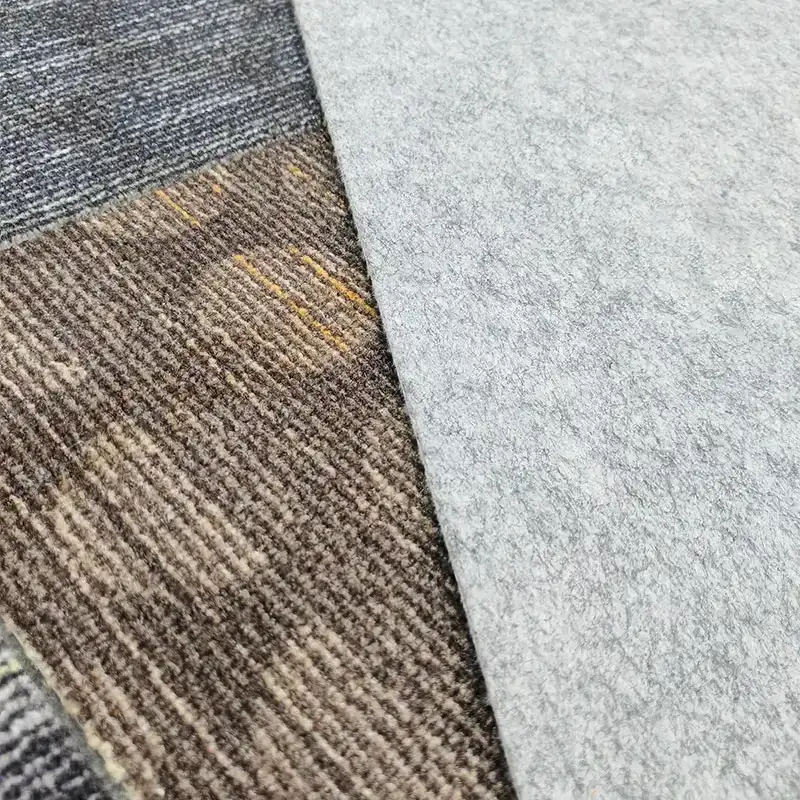
Air quality is now a line in the specification for schools, clinics and public buildings, and a floor covering has to answer for what it releases into the room. LUCK Carpet makes this tile in Foshan, Guangdong from 100 % polyester yarn tufted as a 6 mm loop pile at 550 g/m2, printed with the buyer's design and bonded to a bitumen-free backing made from recycled PET. Offices, retail stores and school classrooms are the declared applications.
Odour in a new carpet installation has two sources, and only one is the pile. The first is the backing compound, where bitumen and low-grade plasticisers release volatile organic compounds for weeks. Our backing is bitumen-free and built on recycled PET, so the first source is gone at the material level, and a water-based acrylic adhesive closes off the second. The finished tile is tested to GB 18587-2001 at Class A.
Polyester also takes colour without a wet dye bath. Our printed tiles carry the design as pigment deposited into the pile tips from water-based inks, fixed by steam and then washed, so there is no residual dye carrier in the finished face. For a project with an environmental submission, we supply the recycled content declaration for the backing and the emissions result with the quotation.
Every indoor air claim is only worth the method behind it, so a buyer should ask three questions about any tile quoted for a school or clinic. What was tested: the face yarn, the backing, or the finished tile? Which chamber method and class, because GB 18587-2001 Class A and a supplier's own odour note are not equivalent? And what is the total VOC result?
Acoustics arrive in the same conversation, since a quiet room and a clean-air room are often one room. This construction reduces impact sound to ISO 717-2 by 16 dB, which is the fibrous backing rather than the print, and the pile absorbs mid-frequency sound to ISO 354 at an alpha w of 0.20. Fire performance is EN 13501-1 class Bfl-s1 through EN ISO 9239-1 and EN ISO 11925-2.
Numbers below come from finished-tile testing in our Foshan QC lab, on production samples rather than a single approval tile. This is a modular product, so the size row gives tile and plank dimensions instead of a roll width, and the emission and acoustic results quoted in the prose come from the same batch records.
| Style | Polyester Printed Carpet Tile with Eco-Friendly Backing |
| Yarn type | 100 % Polyester |
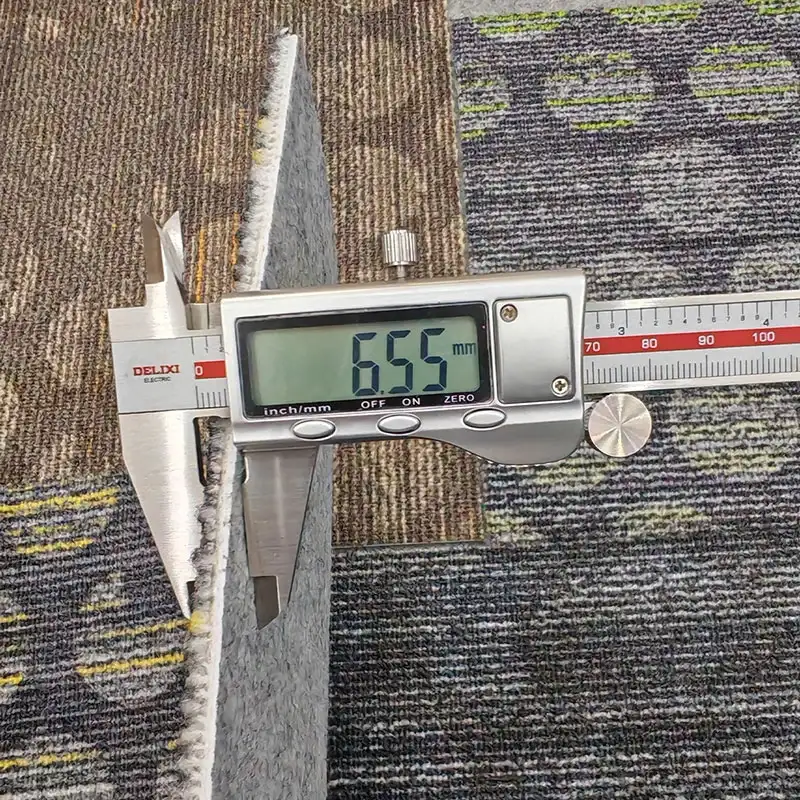
| Pile Height | 6 mm |
| Pile Weight | 550 g/m2 |
| Backing | Eco-friendly backing (recycled PET / bitumen-free) |
| Fire Resistance | Bfl-s1 (EN 13501-1) |
| Application | Office, Retail store, School Classroom |
| Width / Size | 50 cm x 50 cm standard tile, 25 cm x 100 cm plank and custom sizes |
| Pattern | Custom design available (artwork supplied by buyer, strike-off approved before production) |
| Surface / Technique | Loop pile |
Specify this tile where the building stays open while the floor goes down: a school working around term dates, a clinic that cannot stop seeing patients, a shop trading through a refit, an office floor with staff at their desks beyond a hoarding. Each case needs a floor that arrives without an odour problem, without a long adhesive cure, and without a solvent smell.
Occupied installation is a scheduling problem that material choice solves. A solvent-based adhesive needs a curing period during which the room stays empty. A water-based acrylic pressure-sensitive adhesive sets by water loss, so once the tiles are rolled the area returns to service the same day.
Cleaning catches people out, not installation. New floors are cleaned hard in the first month, and an aggressive alkaline or chlorine-based product used on polyester pile dulls printed colour and leaves surfactant residue. Use a neutral pH detergent, extract on a schedule, and keep free chlorine away from this face. Abrasion resistance to ISO 12947-2 at 5 kPa sits in the 34,000 to 46,000 rub band.
These three building types ask for the same thing in different words. A school wants the floor down in a holiday and no complaints from staff on the first morning back. A clinic wants treatment rooms returned to service one or two at a time without closing the department. An office wants a phased refit handed over floor by floor. Each needs a low-odour build, a fast adhesive and wayfinding colour.
Auckland provides a case we remember because the phasing was tight. A private clinic group refurbishing 900 m2 across two floors of a medical centre wanted one printed design in three colourways to distinguish waiting, treatment and staff areas, and the work had to run around clinic hours with patients on site. We supplied 3,600 tiles on the eco-friendly backing, with a water-based adhesive so each room was handed back the day it was laid.
Complaints reaching a head teacher are rarely about formaldehyde and usually about a smell. A floor laid over a weekend with a solvent-based adhesive can leave a corridor unusable on a Monday, and the school then chooses between ventilation and a complaint. Solvent and heavy plasticiser fractions keep evaporating for days, and a warm sealed building holds them. Removing bitumen removes one source, and a water-based adhesive the other.
Practical sequencing finishes the job. Lay the adhesive and let it flash to a clear tack before the tiles go down, rather than bonding into a wet bed, since trapped solvent has nowhere to go once a tile is pressed over it. Keep the room ventilated for 48 hours and schedule the work at the start of a holiday where possible.
One private clinic group in Auckland was refurbishing 900 m2 across two floors of a medical centre, covering a waiting area, twelve treatment rooms and two corridor runs. The centre stayed open, with patients on site every weekday and clinical waste routes crossing the works. The brief asked for one printed pattern in three colourways so patients could read waiting, treatment and staff zones without a sign.
We printed three colourways from one artwork on the polyester loop pile and bonded them to the recycled PET backing, supplying 3,600 tiles in the 50 cm square format with 10 % held as spares on site. Installation used a water-based acrylic adhesive in a sequence of six rooms per night, flushed and ventilated before the clinic opened each morning. Corridor impact sound reduction measured 16 dB to ISO 717-2.
Every production batch is sampled in our Foshan lab, which runs the finished laminate through a GB 18587-2001 chamber test and files the result against the batch number. Reports travel with the shipment. Emissions on the finished laminated tile are tested to GB 18587-2001 and meet Class A, the standard a school or healthcare tender will ask for. Abrasion to ISO 12947-2 at 5 kPa falls in the 34,000 to 46,000 rub band, colour fastness to light to ISO 105-B02 holds Grade 5 to 7, and tuft bind to ISO 4919 measures 36 N to 44 N.
Reaction to fire is EN 13501-1 class Bfl-s1, supported by EN ISO 9239-1 and EN ISO 11925-2. Dimensional stability is measured to ISO 2551 under 0.25 %, static loading thickness loss to ISO 3416 falls between 8 % and 14 %, and use classification is ISO 10874 class 33 heavy commercial under EN 1307.
Yes, with a water-based acrylic adhesive and a room-by-room sequence. The adhesive sets by water loss, so each room can be walked on as soon as the tiles are rolled and returned to service the same day. Ventilate mechanically for four hours and leave windows open overnight.
Avoid anything containing free chlorine, and avoid strong alkalis and cleaners with optical brighteners. Chlorine attacks polyester fibre and will dull printed colour permanently, while alkaline residue attracts soil. Use a neutral pH detergent at the label dilution, vacuum daily with a brush head, and extract every three to four months.
This backing contributes to healthcare acoustics rather than carrying the whole floor. The backing reduces impact sound by 16 dB to ISO 717-2 over a standard concrete slab, and the pile absorbs mid-frequency sound to ISO 354 at alpha w 0.20. For a ward adjacent to a plant room, add an acoustic underlay.
Yes, provided the surface temperature at the tile stays at or below 27 C. The vapour-permeable backing suits a heated screed because moisture can still move through the floor, and the polyester face above it will not shrink at that temperature. Bring the heating up gradually over the first week.
Its printed polyester loop pile, 6 mm high at 550 g/m2, gives a firm low-texture surface with a faint directional sheen that moves as you walk across the room. The design reads as matte depth rather than a glossy film, because pigment sits inside the pile rather than on top, which is also why the print survives extraction cleaning without clouding.
Cartons hold twenty tiles face to face, labelled with print reference, colourway and batch so a phased job can be laid in sequence. Ordering begins with artwork and a strike-off tile approved before the run, and custom prints start at 500 m2. LUCK Carpet is a direct manufacturer in Foshan, Guangdong with a 26,000 m2 plant, 180 staff and 14 years of export experience, opens the plant to third-party inspection by SGS, Intertek or BV, exhibits at DOMOTEX Hannover and The Canton Fair in Guangzhou, and warrants the face pile of this tile for 8 years.
Address
Shidaigongguan Building No.5 Office 1212, Haicheng east road, Duanzhou District, Zhaoqing City, Guangdong Province, China
Tel
Copyright © 2026 Zhaoqing Yunle International Trade Co., Ltd. All Rights Reserved.