Products

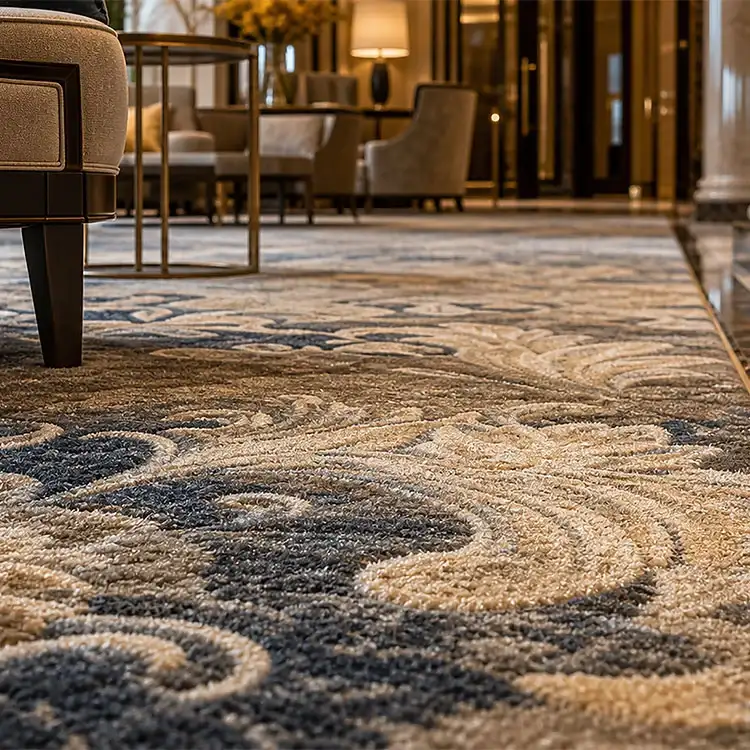
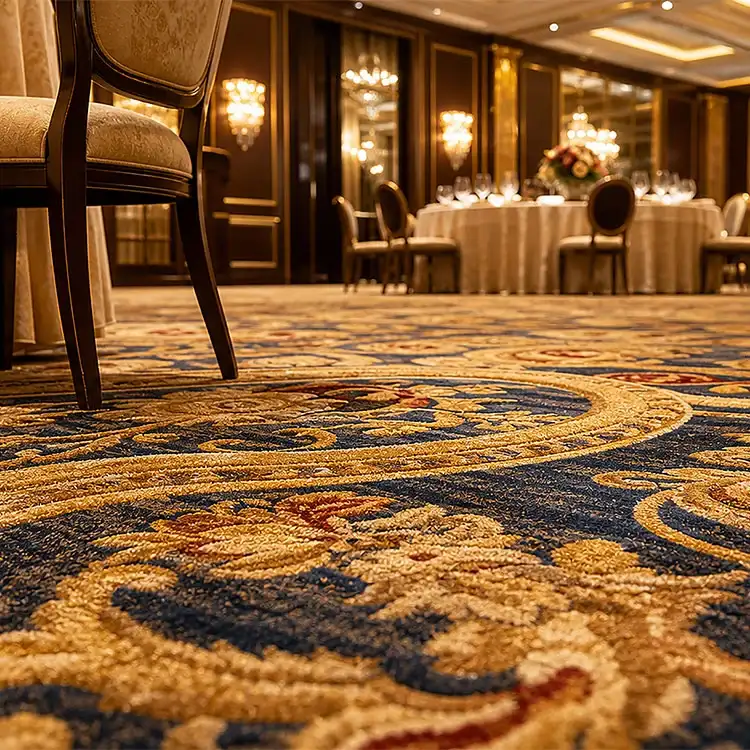
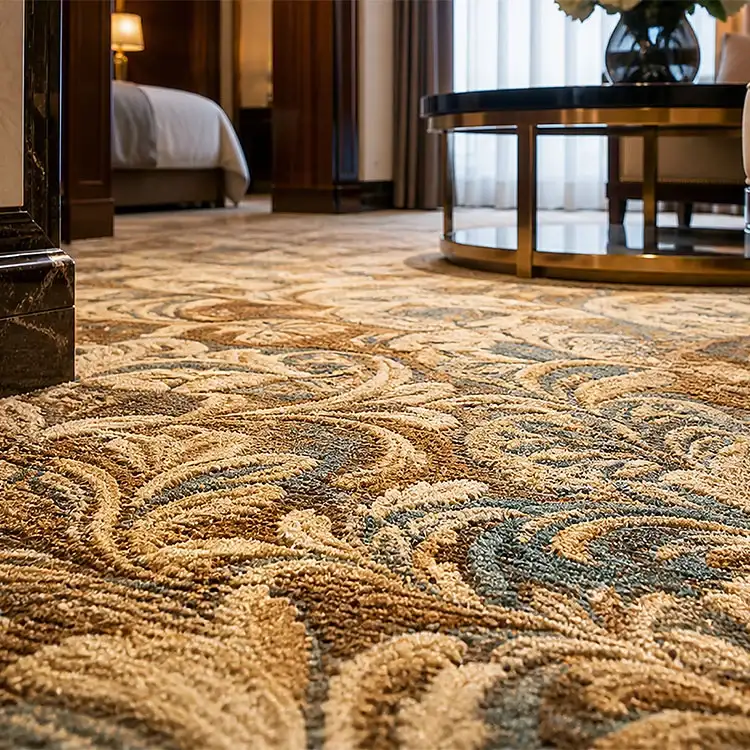
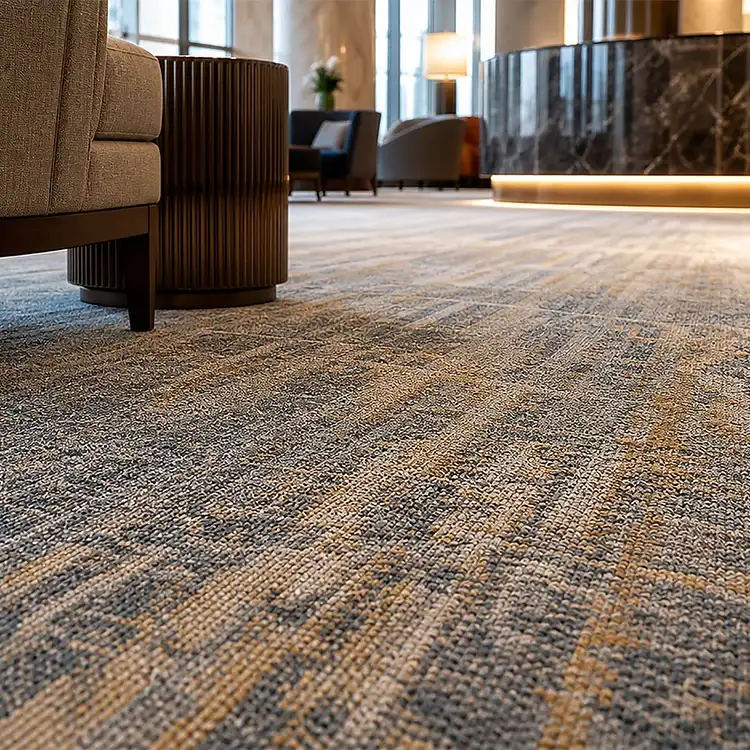
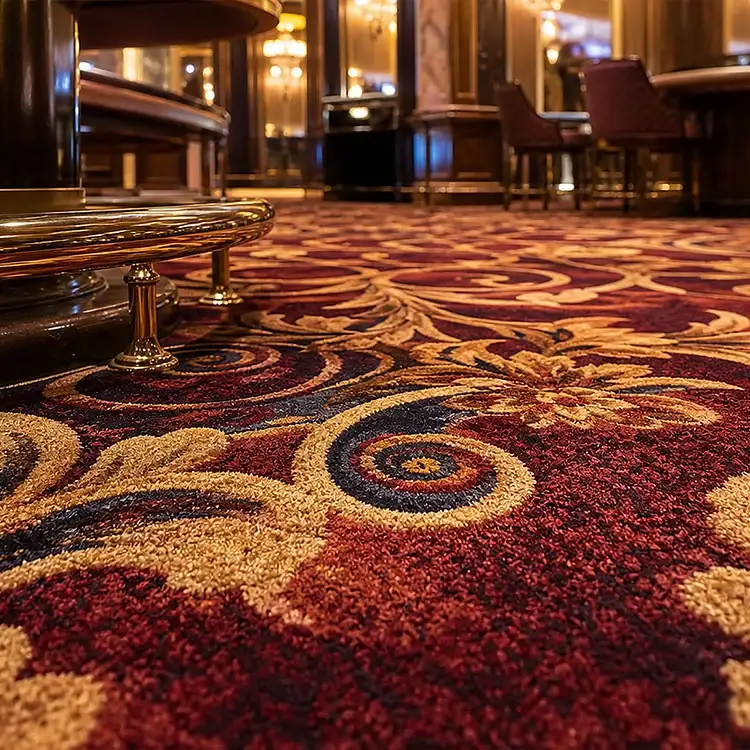
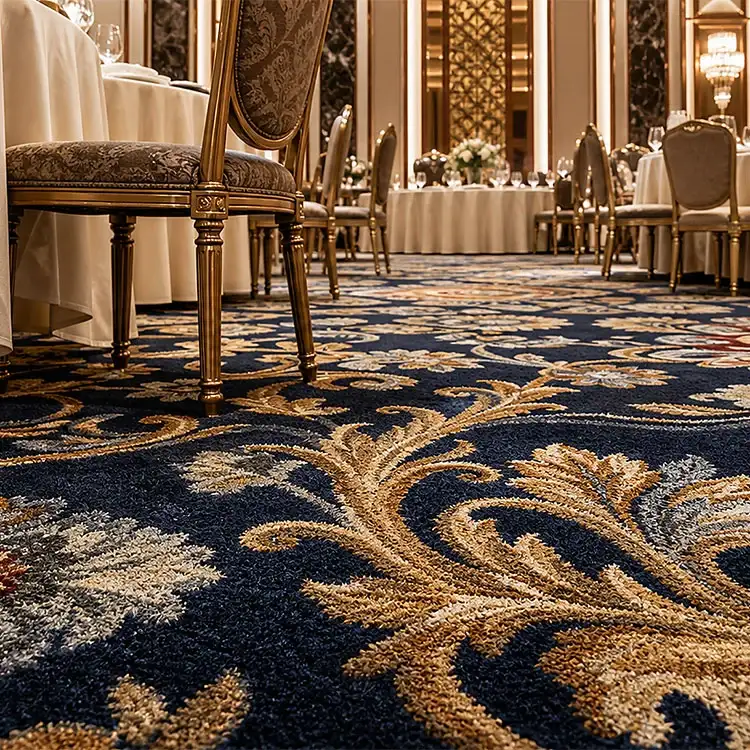
LUCK Carpet produces this lobby quality in Foshan, Guangdong, on the same digital print line that supplies our hotel and hospitality ranges, and we have been exporting printed carpet for 14 years. The build is a 100 % nylon face in cut pile, tufted as greige and printed in high definition with steam fixation and an in-line wash. An anti-slip textile backing keeps the roll flat on screed and on raised access floors. Lobbies are judged in the first few metres inside the door, where wet shoes, grit and trolley wheels arrive together, and where the same square metre has to look presentable at nine in the morning and at nine at night. This page deals with that entrance zone.
Soil does not spread evenly across a lobby. Roughly four fifths of the grit that enters a building is still in the first few metres of walking distance, so the entrance band ages two or three times faster than the seating area behind it. A 7 mm cut pile takes dry soil into the pile rather than holding it on the surface, and a daily pass with a beater bar machine lifts most of it out. Deeper pile in the same position simply buries the grit and abrades the yarn from underneath.
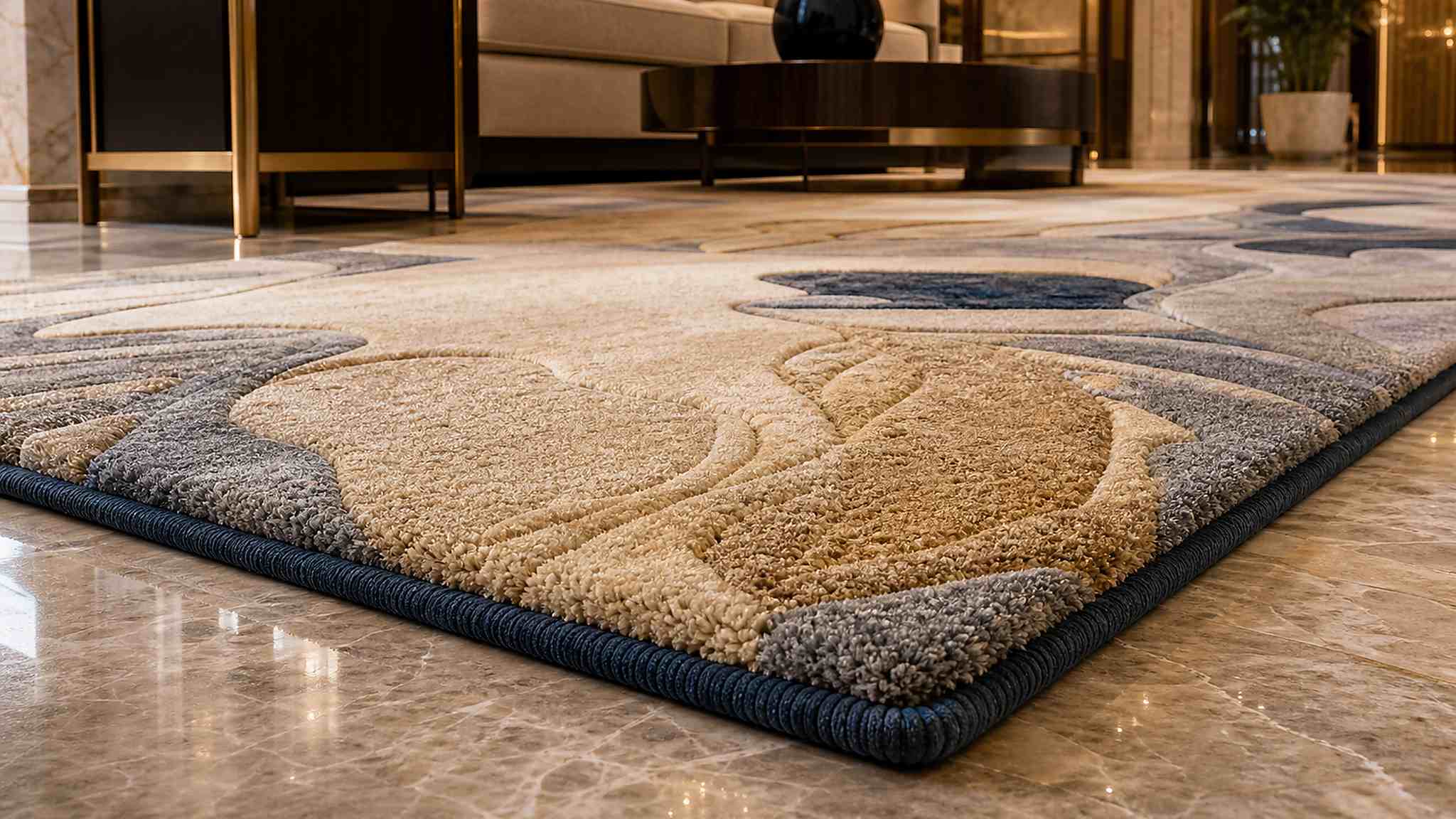
Seven millimetres is also the height at which printed detail stays crisp. Fine line work, small logos and subtle tonal patterns read cleanly on a short dense pile and blur on a tall one, because the print heads fire onto a flatter plane. The face weight is 800 g/m², which is the middle of our printed family. An entrance load is abrasive rather than compressive, and a moderate face weight cleans out faster than a heavy one. For a ballroom with moving furniture, we would quote the heavier quality instead.
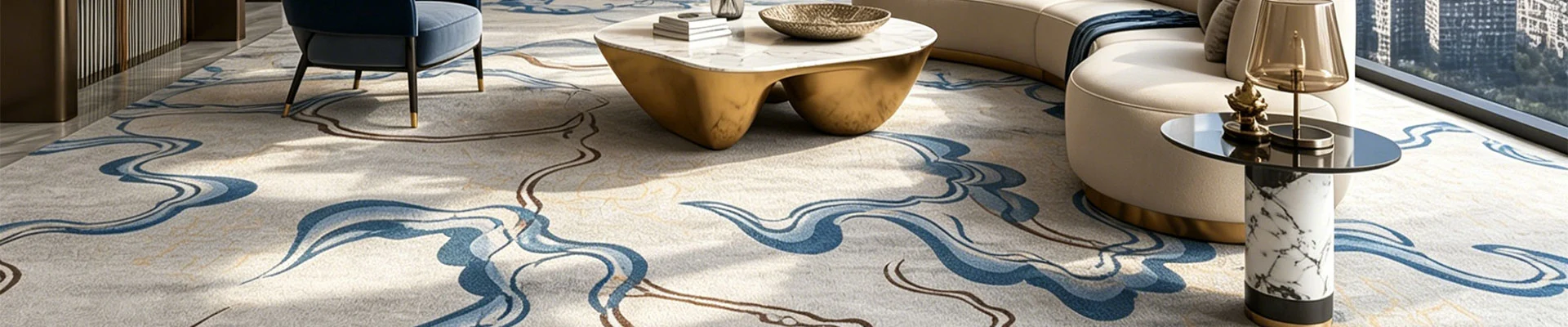
Printed construction gives a designer freedom that yarn dyeing cannot. A logo, a terrazzo derivation, an ombre fade or a map of the city can be reproduced without a dye lot minimum per colour. We print into tufted nylon greige, then steam the full width so the dye bonds inside the fibre. Because the colour sits within the yarn, a printed lobby floor does not develop the pale traffic lanes that surface printed or digitally coated flooring shows after a year of cleaning.
Colour control runs through the whole order. Operators read each run on a spectrophotometer against the approved strike-off, and registration is held to within 2 mm so a border stays parallel to the glass wall over a long run. Backing adhesion is tested as well: peel strength on this construction measures 31 N/50 mm, which keeps the laminate closed when a trolley crosses a wet floor.
Values below come from tests on finished rolls in our Foshan plant and from an accredited fire laboratory. One reading note for lobby work: pile weight is measured as face yarn mass per square metre, so compare that figure, not total roll weight, when you put two suppliers side by side.
| Style | Nylon Printed Wall to Wall Carpet for Lobby |
| Yarn type | 100 % Nylon |
| Pile Height | 7 mm |
| Pile Weight | 800 g/m2 |
| Backing | Anti-slip textile backing |
| Fire Resistance | Bfl-s1 (EN 13501-1) |
| Application | Lobby, Commercial Spaces |
| Width / Size | 4 m (13.1 ft) usable width |
| Pattern | Custom design available (artwork supplied by buyer, strike-off approved before production) |
| Surface / Technique | Cut pile |
A lobby is an entrance, a reception, a waiting room and a corridor at the same time, and it is on show from the moment the doors open until the last guest leaves. Traffic is heaviest in two peaks, morning and late afternoon, and cleaning happens between them. The specification that survives this is not the softest one or the heaviest one. It is the one matched to each zone inside the same room.
Reception chairs, luggage trolleys and cleaning machines all concentrate load in a lobby. The first failure we see is not pile flattening but edge soiling along the walking line: the carpet is sound, the traffic lane is grey. A printed pattern with tonal variation hides that lane far better than a plain colour, and a short pile keeps the surface from matting where a thousand shoes turn toward the desk each morning. Rain adds slip to the same square metres, which is why an entrance zone needs friction, not polish.
Abrasion results on this quality average 35,400 rubs to defined change under ISO 12947-2 at 5 kPa, and tuft bind sits at 33 N to ISO 4919. Colour fastness to rubbing measures between Grade 4 and Grade 5 under ISO 105-X12, which is the test that predicts how a floor copes with trolley wheels and repeated spray cleaning. Those four numbers, taken together, describe a lobby carpet honestly. A supplier who quotes only a rub count is giving you one third of the picture.
Four zones behave differently inside the same floor plate. The door band takes grit, rain and wind driven dust. The reception desk area takes standing load and chair castors. The lift lobby takes the highest number of turning feet and the most spill risk from cups and umbrellas. The seating area takes almost no abrasion but the most visible staining from coffee and food. We draw a layout that treats each zone with the same carpet and different pattern density, borders and cleaning frequency.
Doha, in the project described below, is a good illustration of why zone planning pays. The lobby there is glazed on two sides, so the carpet sits in strong daylight for eight hours a day. Light fastness on this construction reaches Grade 6 under ISO 105-B02, which keeps a printed pattern on tone in a glass walled entrance.
Grit does the damage that footfall gets blamed for. A grain of sand worked into a pile acts like a blade on the yarn, and once the yarn is cut, no cleaning brings the lustre back. At the April edition of The Canton Fair in Guangzhou we asked 74 facility managers which part of a lobby floor they replace first. Forty-seven named the entrance band rather than the desk or the seating. The fix is architectural rather than chemical: matting outside, matting inside, and enough of it. We ask for at least three metres of walk off matting between the external door and the first metre of carpet, because that is roughly the distance a shoe needs to shed most of what it carries.
Matting only works if it is cleaned. We write the maintenance schedule into the handover pack: vacuum mats daily with the beater bar set low, extract the mats monthly, and clean the carpet on a cycle tied to the weather rather than the calendar. The construction supports this routine because the anti-slip backing holds the roll flat and the pile takes repeated extraction without loss of height.
When a developer in West Bay, Doha, refitted the ground floor of an office tower, the brief was blunt: a floor that would still look new after a Gulf summer, with a pattern that disguised the pale dust carried in from the street. The lobby measures 1,150 m² including the lift lobby and a waiting area, and we supplied 11 full width rolls. The design team asked for a warm sand base with a fine linear motif rather than a bold graphic, on the reasoning that a busy pattern would show every scuff line.
We agreed, and added a darker border at the door band so the soil-heavy zone reads as a design decision. Threshold trims went in at the revolving door to protect the edge. Nineteen months after handover the facility team reported average thickness loss of 0.3 mm in the entrance band, no lifted seams at the door, and nightly cleaning time down by around 25 minutes across the lobby.


Our Foshan lab measures abrasion to ISO 12947-2, tuft bind to ISO 4919, and colour fastness to light and to rubbing to ISO 105-B02 and ISO 105-X12, and it holds three wet cleaning cycles to ISO 2551 before a batch is released, where our rolls finish at 0.15 % length change. Fire performance is verified to EN 13501-1 class Bfl-s1 with EN ISO 9239-1 and EN ISO 11925-2, which is the evidence a lobby inside an escape route needs. Ask for the sample identity and the laboratory name behind each figure. SGS, Intertek or BV can inspect at our plant on request.
Not in normal lobby use. Seven millimetres over a dense face recovers because the yarn mass supports the tufts rather than the backing alone. Where a lobby takes loaded trolleys along the same line all day, we recommend a 3 mm felt underlay and the heavier quality in our range, and we will say so before you order rather than after.
Vacuum daily, and vacuum twice on wet days. Sand must come out before it is walked deeper, so use a beater bar machine at a low setting and empty the bag often. Extract the carpet every three to four months with a hot water unit and a pH neutral agent, and keep a walk off matting zone of at least three metres at the door.
Send a Pantone reference or a physical sample and we will print a strike-off on the actual greige. Digital printing reaches colours that yarn dyeing cannot, and gradients are printed rather than tufted. We ask for written approval of the strike-off before the production run, because a screen and a carpet never render the same colour.
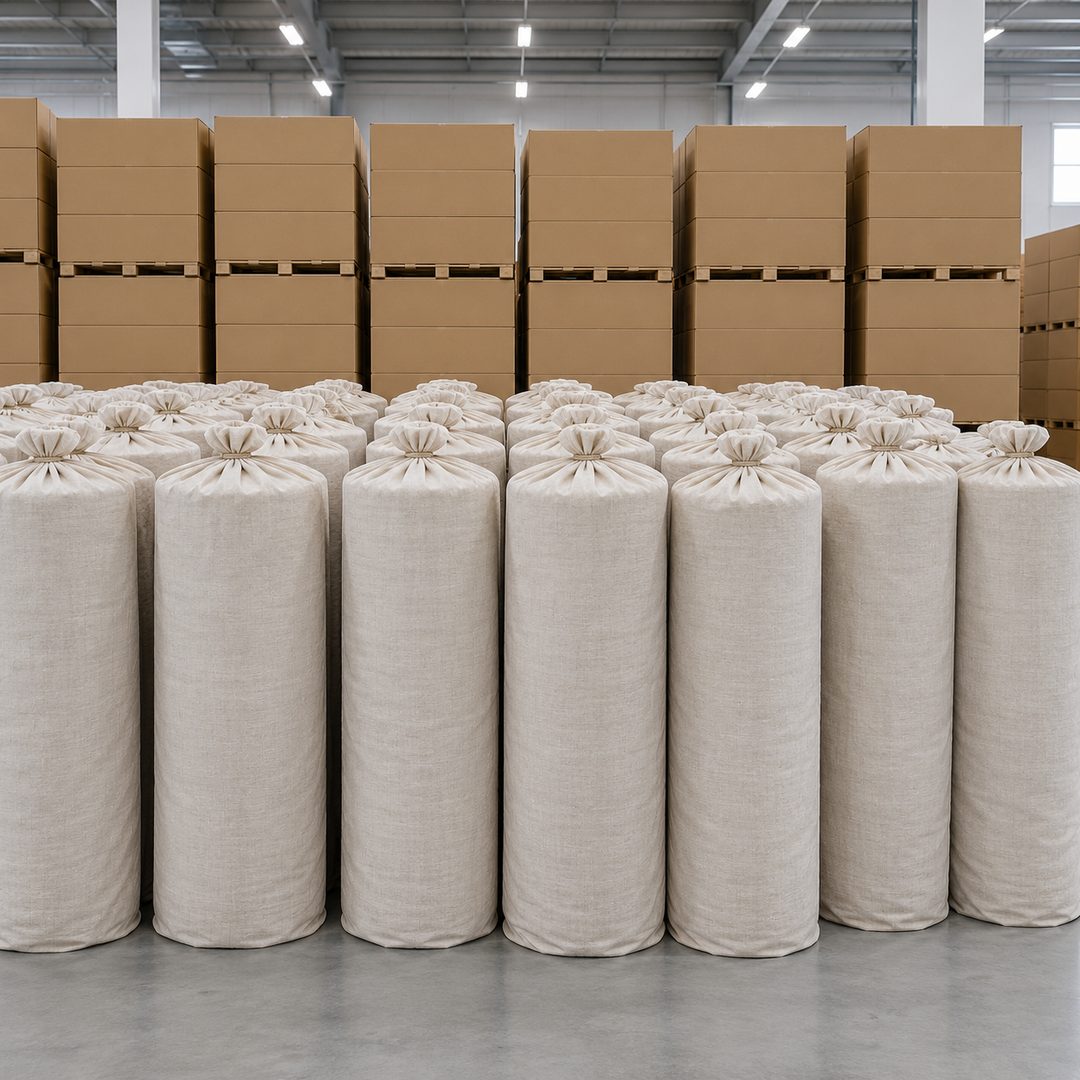
The pile is cut, dense and low, so the floor reads as a matte plane under downlights rather than a shiny surface, and the print carries the visual weight of the design. Colour is built in layers during printing, which gives gradients, fine line work and photographic references that tufted patterns cannot reproduce. Each roll comes film wrapped on a core at the full usable width, in 30 m lengths, with the repeat, batch and pile direction printed on the label and both selvedges trimmed straight for butt joins.
Order with a floor plan, the artwork, the entrance orientation and your programme date. We return a zone layout, a take-off, a quotation and a strike-off. Our plant in Foshan covers 26,000 m² and employs 180 people, we have exported printed carpet for 14 years, and the face pile on this construction is warranted for 8 years. Send your lobby drawing to our export team and we will mark up the entrance band with you.


Address
Shidaigongguan Building No.5 Office 1212, Haicheng east road, Duanzhou District, Zhaoqing City, Guangdong Province, China
Tel
Copyright © 2026 Zhaoqing Yunle International Trade Co., Ltd. All Rights Reserved.