Products

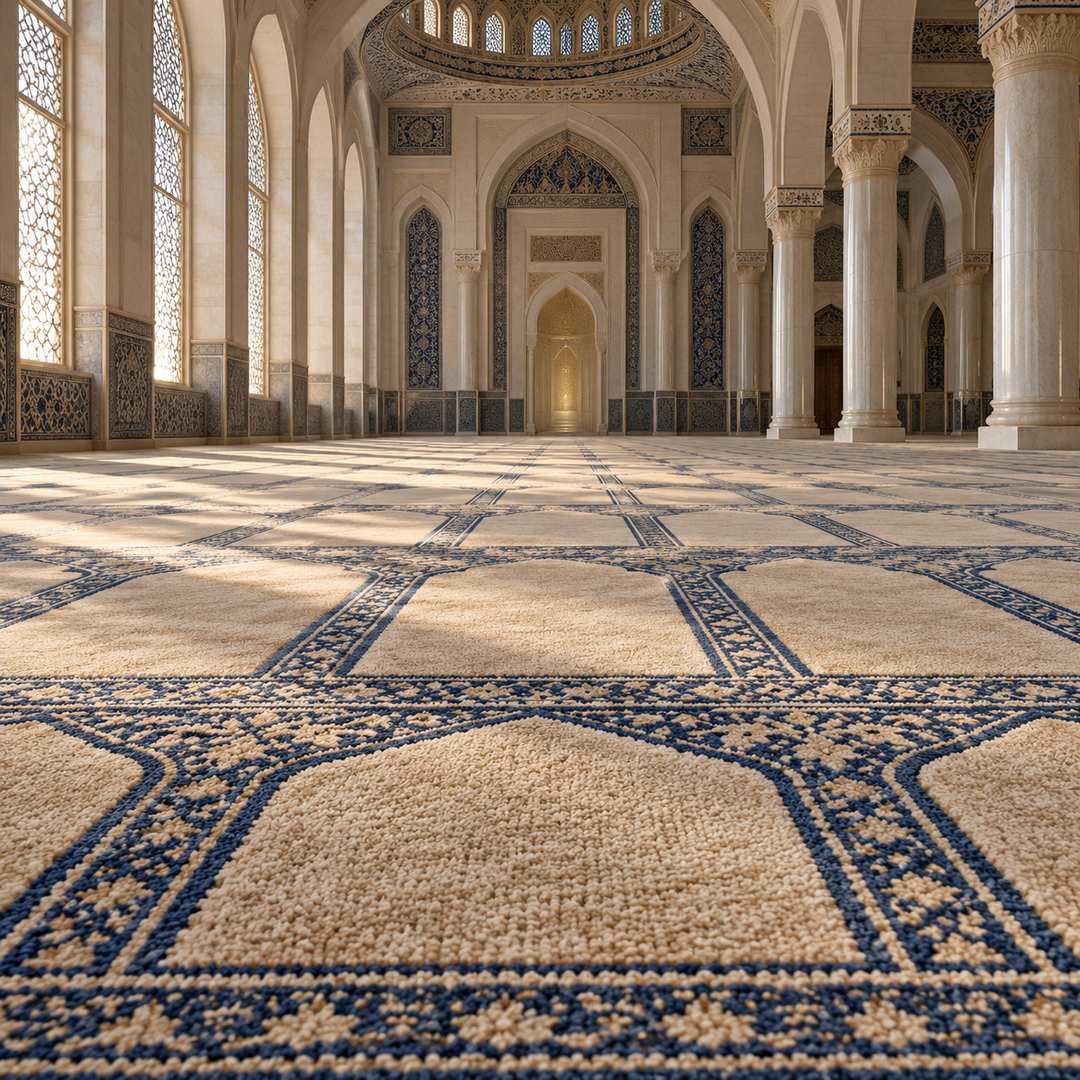
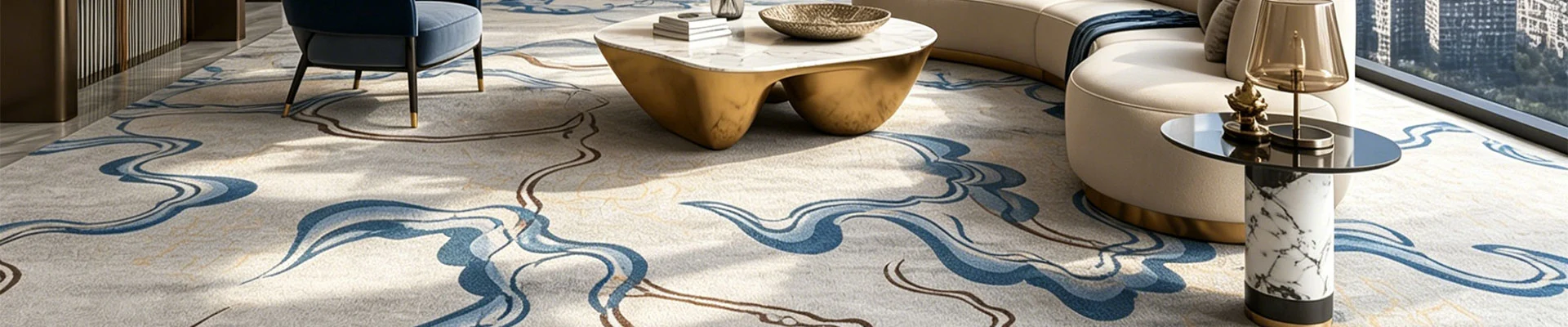
LUCK Carpet has manufactured printed hospitality carpet in Foshan, Guangdong for 14 years, and this quality is the one we ship most often to resorts and city hotels. The construction starts with a cut pile tufted from 100 % nylon greige, which we print in high definition and then steam and wash at full width. An anti-slip textile backing keeps long corridor runs flat, and the 4 m usable width reduces the number of seams a fitter has to close. Hospitality buildings mix traffic from the porte cochere to the top floor suite. This page is about holding one appearance standard across all of it.
Fatigue in a hospitality carpet shows up as two things: pile that has lost height and a surface that has lost contrast. The first is a resilience question and the second is a design question. This quality answers the first with 1,000 g/m² of nylon over an 8 mm cut pile, dense enough that furniture legs and luggage wheels compress the yarn without collapsing the tufts underneath. We check the second with static loading to ISO 3416 on each batch, because a corridor that sags at every door frame reads as an old carpet even when the pile is clean.
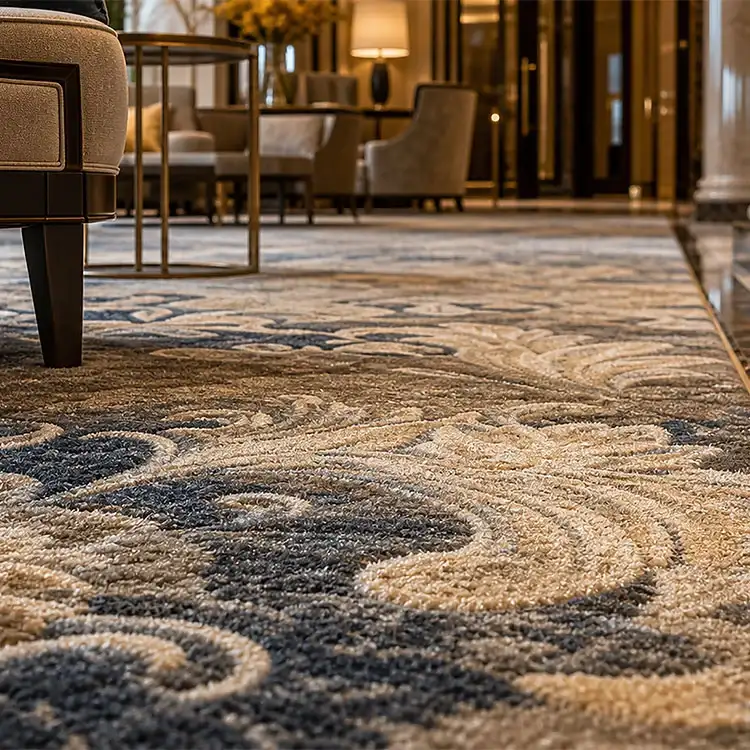
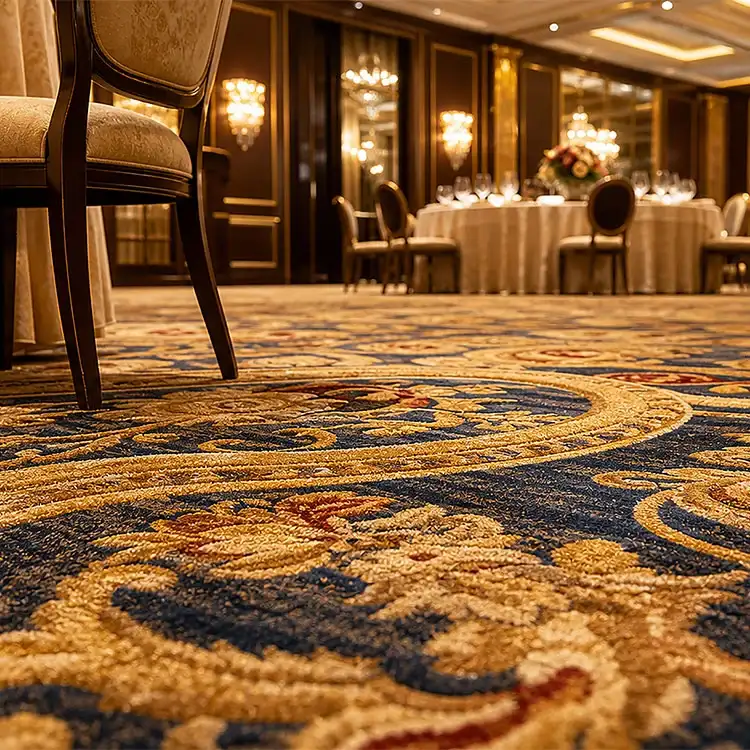
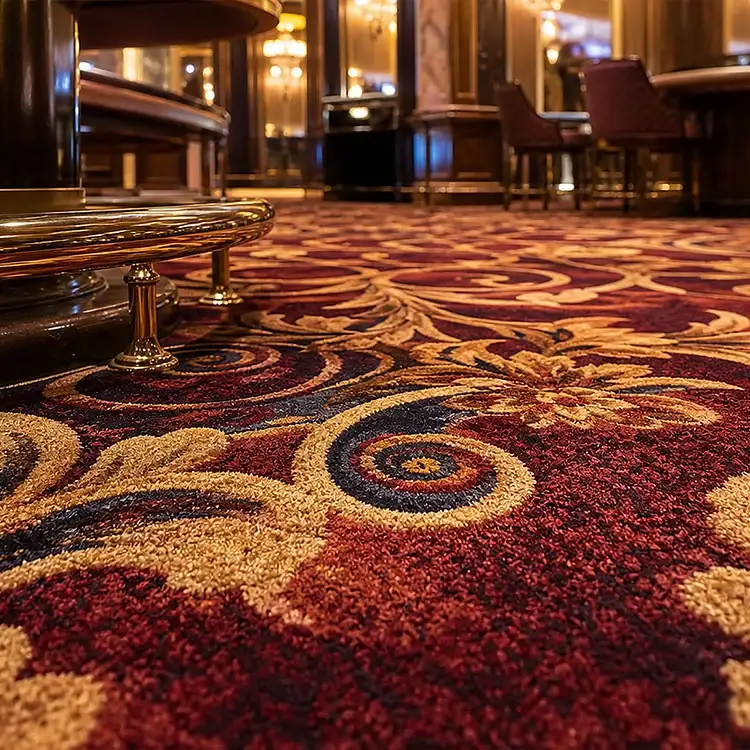
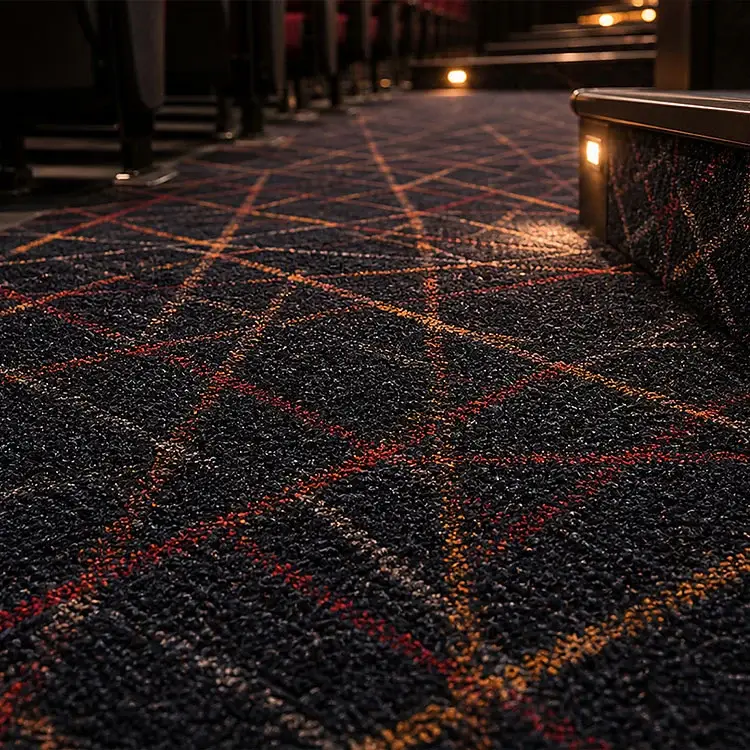
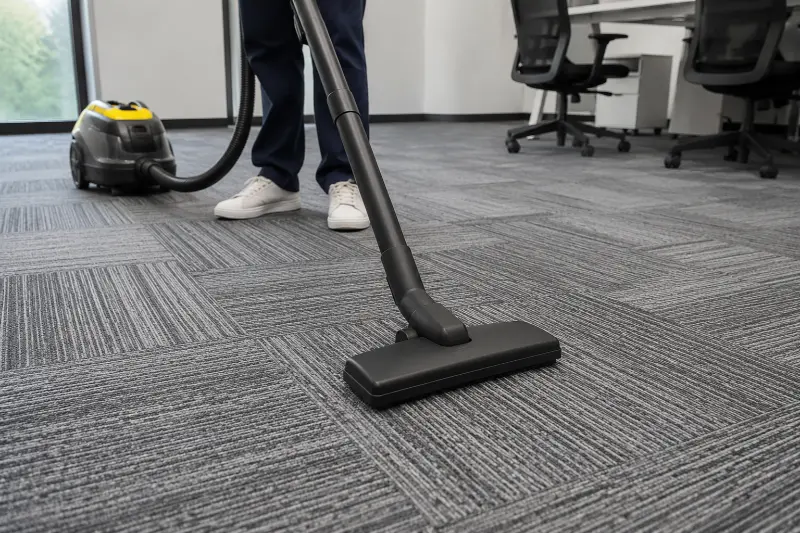
Appearance also depends on how much work the pattern does. A two tone design hides a traffic lane; a flat single colour publishes it. Public areas in a hospitality building take thousands of passes a day while a suite may take two, so we aim for a design with enough internal movement to disguise wear on the ground floor and enough calm to feel residential upstairs. The print makes that possible in one file. It also sets the limit: a printed cut pile shows vacuum marks, so housekeeping technique matters as much as the specification.
Hospitality projects rarely finish at once. A ballroom opens first, a tower follows a season later, and a spa refurbishment arrives two years after that. Colour continuity across those phases is the hardest promise in printed carpet, and it is a documentation problem before it is a printing problem. We archive the approved strike-off, the print file, the greige batch reference and the spectrophotometer readings from the original run, so a reorder can be measured against the same physical standard rather than against a photograph.
Keeping that standard alive on the line requires control at every step. Operators compare each run to the archived strike-off on a spectrophotometer, registration stays inside a 2 mm tolerance across the full width, and greige is drawn from controlled lots so pile height and density stay constant between campaigns. Light fastness on this construction measures between Grade 5 and Grade 6 to ISO 105-B02, and colour fastness to rubbing sits at Grade 4 to 5 under ISO 105-X12, which is what stops a sunlit atrium and a busy lift lobby from drifting apart in appearance over three years.
All values below were recorded on finished rolls in our Foshan plant, with fire performance verified at an accredited laboratory. A reading note for hospitality specifiers: pile weight is face yarn mass per square metre of finished carpet, so ask each supplier to confirm that basis before you compare two quotations.
| Style | Nylon Printed Wall to Wall Carpet for Hospitality |
| Yarn type | 100 % Nylon |
| Pile Height | 8 mm |
| Pile Weight | 1000 g/m2 |
| Backing | Anti-slip textile backing |
| Fire Resistance | Bfl-s1 (EN 13501-1) |
| Application | Hotel Lobby, Guest Room Corridors, Hotel Suites, Reception Areas, Hospitality Lounge Areas |
| Width / Size | 4 m (13.1 ft) usable width |
| Pattern | Custom design available (artwork supplied by buyer, strike-off approved before production) |
| Surface / Technique | Cut pile |
A guest walks across five floors and four finishes in twenty minutes: lobby, corridor, suite, lounge, then the restaurant. Any break in the visual language between those spaces is noticed, even when the guest could not say what changed. That continuity is the design problem this page addresses, along with the technical work of keeping it intact when a section of the building is refurbished years later.
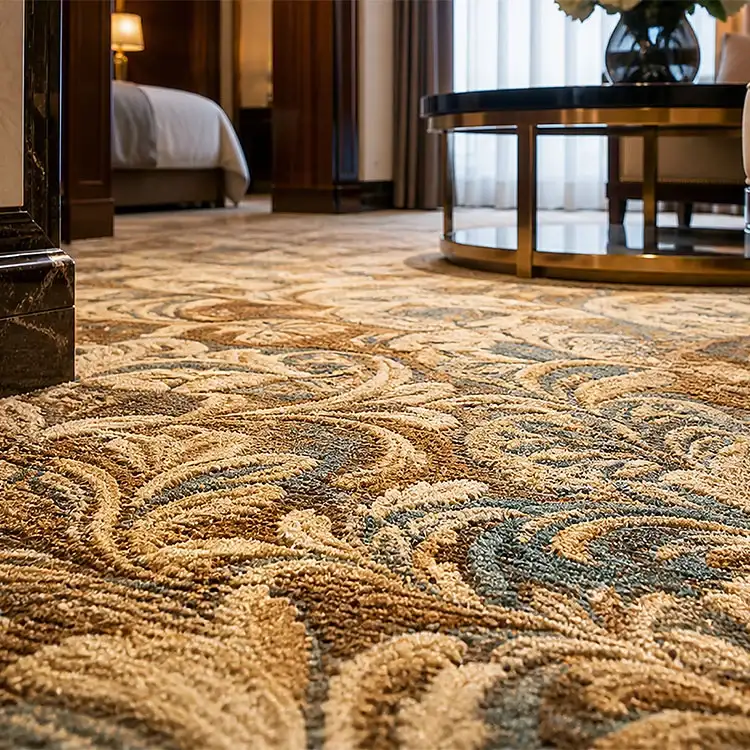
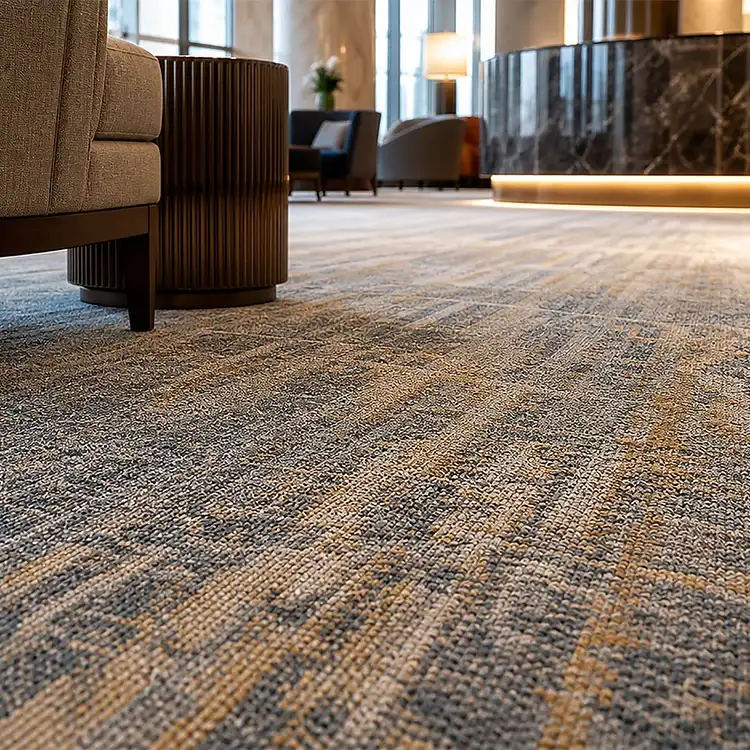
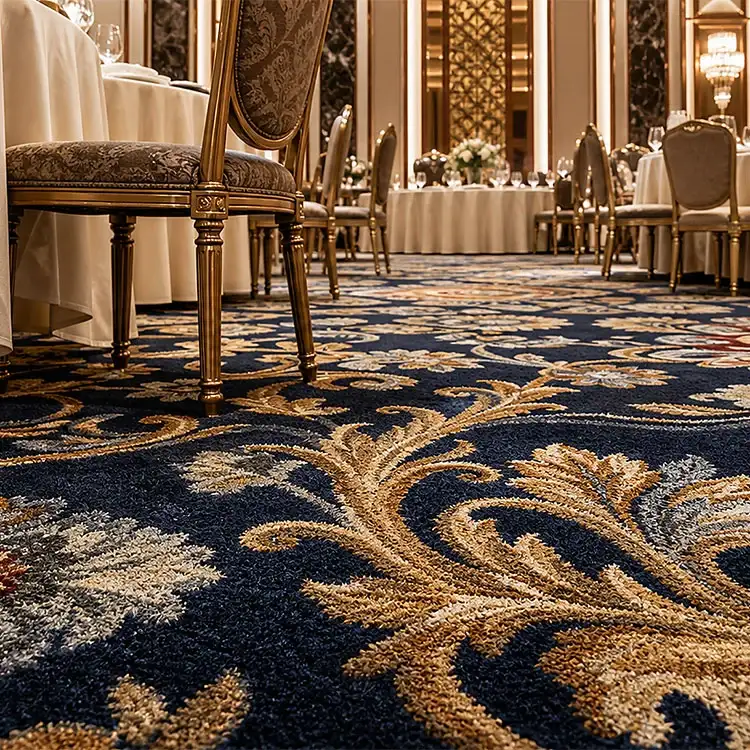
Five zones need five answers from one design file. A corridor wants a small repeat that survives being seen at a low angle while walking. A lounge can carry a larger motif that reads from a seat. Suites need a border and a calmer field so the room feels domestic. Reception wants the strongest graphic in the building, because that is where a guest forms an impression and where a logo may have to appear. The restaurant usually takes a darker ground to survive grease and wine.
What holds the scheme together is the palette and the drawing style rather than the motif size. We build the file as one artwork set, so the corridor repeat, the suite border and the reception graphic share line weights and tones, and the guest reads them as family. Practically, this means one print campaign with several panels rather than several orders, which also keeps the dyestuff and the greige batch identical across all five zones and makes the whole floor package easier to inspect at handover.
Suites, corridors, reception areas, lounges, ballroom pre-function space and dry restaurant floors all suit this construction. Abrasion results on the quality average 39,600 rubs to defined change under ISO 12947-2, and tuft bind measures 37 N to ISO 4919, which is the pair of numbers that matters for chair castors in a meeting room and trolley wheels on a service route. Backing peel holds at 28 N/50 mm, so a long run stays bonded when the floor is cleaned weekly.
Macau is the project described below, and it shows both sides of that judgement. The resort took printed nylon through 21,000 m² of lobby, corridors, suites, lounges and restaurants, and deliberately kept it out of the kitchen back-of-house, the pool surround and the wet spa rooms. Those areas were specified in tile. Guests never notice the change of material because the print stops at a door line, and the operator never has to replace a carpet that should not have been there.
Refurbishment creates the failure that hurts most, because a wing replaced out of sequence can look like a mistake even when the new carpet is perfect in isolation. The risk is real: dyestuff lots change, greige changes, and the pile of a two year old carpet has settled. Refurbishment that is planned beats refurbishment that is improvised, so we ask for the original project reference at quotation stage and pull the archived standard before we blend anything.
Attic stock is the cheapest insurance in a hospitality project. Five percent of the original order, stored flat and away from sunlight, covers the inevitable damage from a burst pipe, a red wine incident in a suite or a smoker on a landing. When a wing does need a full replacement, we quote from the archived file and send a strike-off for comparison against a lifted sample of the original. Our wet cleaning results support the same planning: under ISO 2551 this construction returns 0.25 % length change across three cycles, so an older roll and a newer one lay at the same dimensions.
An integrated resort in Macau SAR, China was renovating its public floors in phases, with a tower that would only be released for work two years after the first phase opened. The package reached 21,000 m² across lobby, corridors, suites, lounges and restaurants, supplied as 180 rolls. The brief called for a contemporary interpretation of a regional motif, warm enough for guest rooms and graphic enough for the arrival hall, delivered on a programme that could not be compressed.
We proposed a single artwork set with five scales, printed from one archived standard. Phase one covered the lobby, two restaurants and eight corridor runs. When the tower followed, our Foshan lab measured the new strike-off against the archived master and returned a difference of 0.6 on the spectrophotometer, inside the 1.0 tolerance we quote. The operator reordered 2,600 m² as 22 rolls, and no guest facing area shows a step in colour between the phases.
Our Foshan QC lab reads every print run on a spectrophotometer against the archived master, and on the Macau reorder that reading came back at a difference of 0.6 against a standard set two years earlier. Alongside colour, abrasion is measured to ISO 12947-2, tuft bind to ISO 4919, and colour fastness to light and rubbing to ISO 105-B02 and ISO 105-X12, with three wet cleaning cycles to ISO 2551 before release. Fire classification is Bfl-s1 under EN 13501-1, evidenced by EN ISO 9239-1 radiant panel and EN ISO 11925-2 small flame testing at an accredited laboratory. Ask any supplier to state the maximum colour difference they will accept on a reorder, and ask what they will measure it with.


It can, if the file is built as a family. We scale the motif for each space and keep the palette and line weights identical, so a corridor repeat and a lounge panel look related rather than duplicated. Guest room corridors usually take the smallest repeat and the calmest contrast, reception the boldest.
Request the archived standard reference with your handover documents and hold five percent attic stock from the original order, stored flat and out of sunlight. Send us the project reference at reorder and we will pull the print file, blend to the approved strike-off and send a comparison sample before production starts.
Printed nylon suits dry restaurant floors, lounges and treatment reception areas, where it handles chair drag, spilled wine and footfall. It is the wrong choice for wet spa rooms, pool surrounds, commercial kitchens or anywhere the floor is hosed down. Those areas belong in tile or sheet vinyl, and a mixed material scheme usually looks deliberate if the change happens on a door line.
Colour sits in the body of the yarn rather than on it, so a lounge under warm downlights shows a soft matte field instead of a reflective sheet. Rolls ship in 30 m lengths at the full usable width, on a cardboard core under film, and the label carries the repeat, batch number and pile direction. Selvedges are trimmed straight, and the anti-slip textile backing grips both screed and access panel floors without an additional underlay on most installations.
Send a zone schedule, floor plans, artwork or a reference image and your handover dates, and we will return a panel layout, a take-off and a strike-off for each zone. LUCK Carpet has built this range in its own Foshan plant, which extends over 26,000 m² and gives work to 180 people, and hospitality orders are covered by an 8-year pile warranty. Write to our export team with your phase plan and we will sequence the rolls to your opening dates.


Address
Shidaigongguan Building No.5 Office 1212, Haicheng east road, Duanzhou District, Zhaoqing City, Guangdong Province, China
Tel
Copyright © 2026 Zhaoqing Yunle International Trade Co., Ltd. All Rights Reserved.