Products

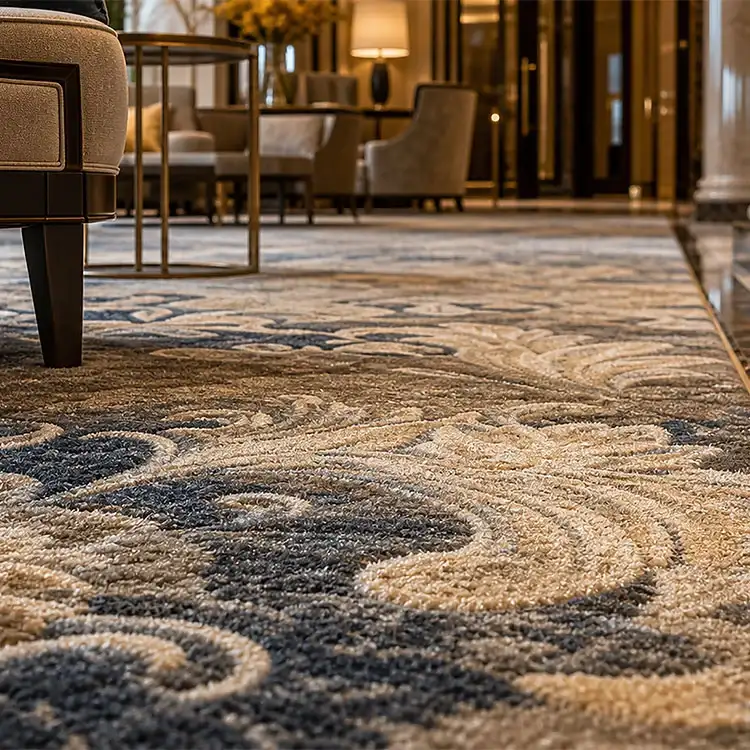
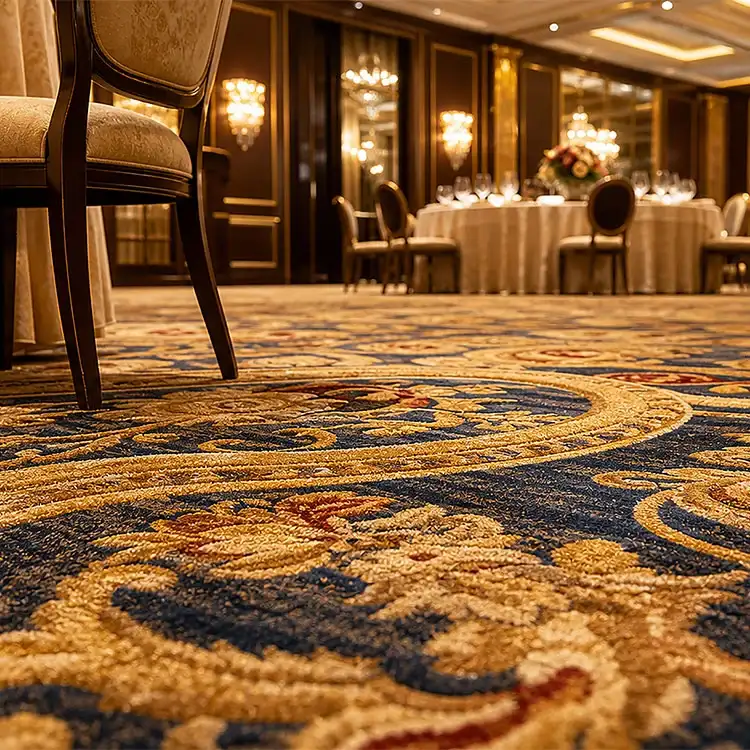
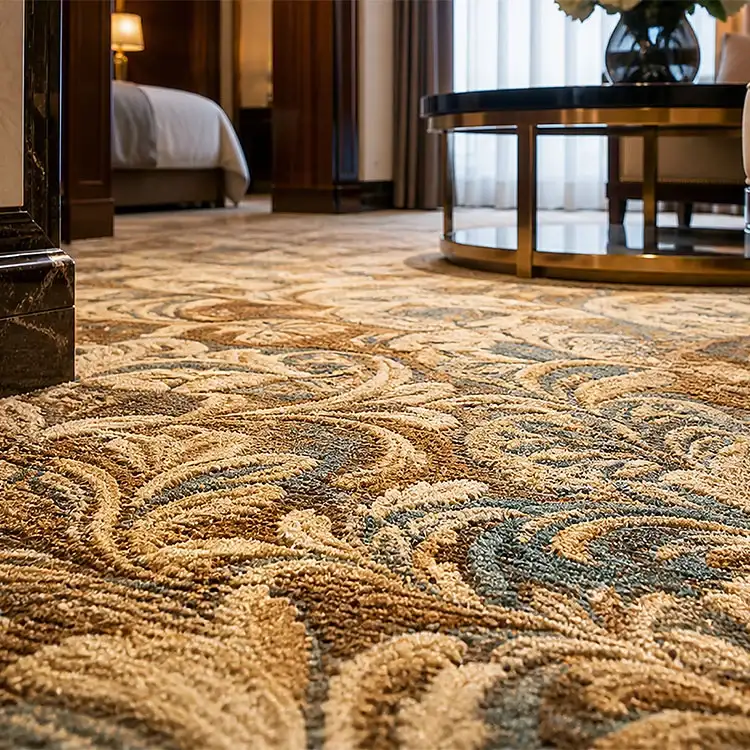
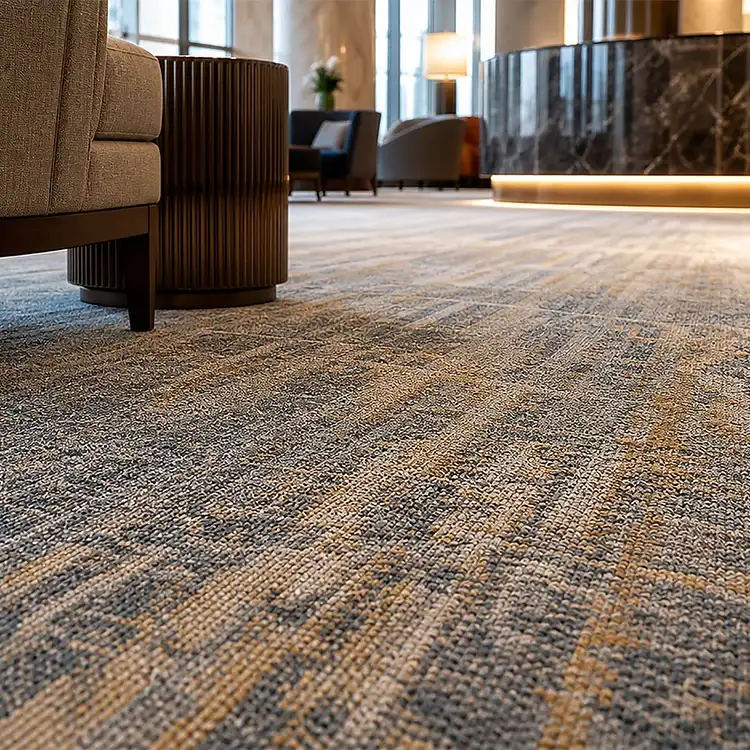
LUCK Carpet has manufactured printed commercial flooring in Foshan, Guangdong for 14 years and exports it directly, with no trading house in between. The face is 100 % nylon in a cut pile that we tuft as greige, then print in high definition, steam and wash in line so the colour bonds inside the fibre. A textile backing with an anti-slip finish holds the roll flat over screed and raised access panel floors, and the usable width cuts office bays and bank halls with few seams. Commercial work is not hospitality work: nobody is on holiday, budgets are audited, and cleaning is done by a contractor paid to be quick. This page is about durability and about keeping a printed pattern intact through aggressive cleaning.
Nylon is the reason this floor is still presentable after a commercial cleaning regime has been through it a hundred times. The fibre has a tighter molecular structure than polypropylene, which crushes and fuzzes under chair castors, and better elastic recovery than polyester, which takes a permanent dent under a desk leg. This construction carries 800 g/m² of that nylon over a 7 mm cut pile, dense enough for public circulation and low enough that soil is removed rather than buried. Static loading results to ISO 3416 are tracked batch by batch for that reason.
Buyers should read a printed carpet specification in a fixed order. Start with the basis of the pile weight: face yarn mass per square metre is the honest figure, and total roll weight flatters a product by including the backing. Then take tuft bind, because a tuft that pulls out of a bank queue becomes a bald patch within a month. Then ask how the pattern was applied, since a carpet printed into the greige and steamed behaves differently from one carrying a surface coating the first time a contractor extracts it with hot water.
Dye placement is the whole argument. We jet dye into the tufted greige, steam the full width until the fibre opens and traps the dye inside the polymer, then wash out the unfixed fraction in line. What remains is colour that belongs to the yarn rather than colour sitting on the tips. That is why a printed pattern holds its definition when a contractor scrubs a coffee stain in a reception area, and why the pile does not turn pale in the traffic lanes where the wet extraction machine passes every quarter.
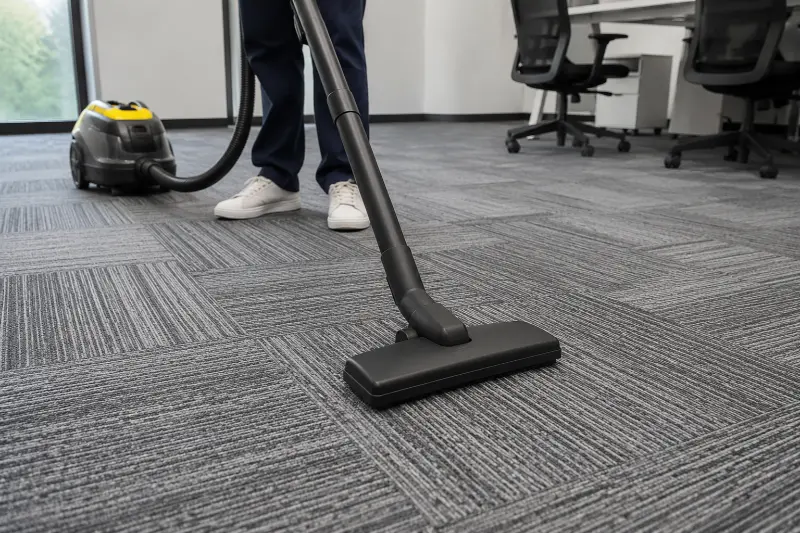
Cleaning is where commercial specifications are lost. Contractors work to a schedule, use hot water extraction at high pH, and reach for an oxidising spotter when a mark will not move. This construction tolerates that routine within limits. Backing peel measures 29 N/50 mm, so laminate stays closed through repeated wetting, and three wet cleaning cycles to ISO 2551 leave a length change of 0.18 %, which keeps a large open floor plane free of ripples. We supply a written cleaning protocol with every commercial order and ask that it travels to the contractor, not just to the buyer.
Every figure in the table below comes from rolls tested at our Foshan plant, with the fire classification confirmed by an accredited laboratory. A practical reading note for commercial buyers: compare pile weight on the same basis, then compare tuft bind, because those two numbers together explain most of the price difference between two apparently similar quotations.
| Style | Nylon Printed Wall to Wall Carpet for Commercial |
| Yarn type | 100 % Nylon |
| Pile Height | 7 mm |
| Pile Weight | 800 g/m2 |
| Backing | Anti-slip textile backing |
| Fire Resistance | Bfl-s1 (EN 13501-1) |
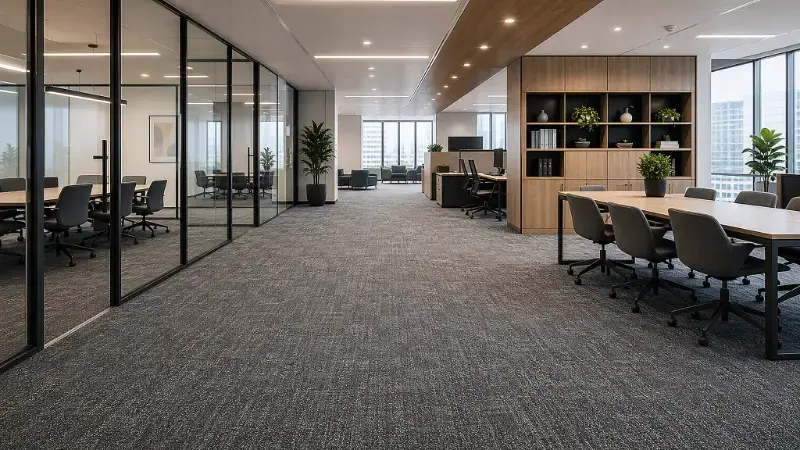
| Application | Commercial interiors: offices, clinics, banks, showrooms and public circulation |
| Width / Size | 4 m (13.1 ft) usable width |
| Pattern | Custom design available (artwork supplied by buyer, strike-off approved before production) |
| Surface / Technique | Cut pile |
Offices, clinics, bank branches and showrooms share one condition that hotels do not: the floor is an operating expense, reviewed every year against a cleaning contract and a maintenance budget. A commercial carpet has to look presentable on the day of an audit, five years after installation, with a contractor working to a schedule nobody on site controls.
Reading means asking four questions in the right order. What is the face weight measured as, face yarn or total roll? What is the tuft bind in Newtons to ISO 4919, and is it a batch average or a single best result? Was the design printed into the greige and fixed with steam, or applied as a coating? And what happens to the colour under a hot water extraction cycle? Abrasion figures help once those answers are on the table, but a rub count alone tells you very little about a printed commercial floor.
Bank and office halls also need the wear numbers put in context. This quality averages 41,200 rubs to defined change under ISO 12947-2, and tuft bind measures 35 N, which is the pair that determines how a queue line and a chair castor zone behave after two years. Light fastness reaches Grade 6 to ISO 105-B02, which matters in a glass fronted branch or a showroom with a west facing window. Rubbing fastness reaches Grade 4 to 5 on the ISO 105-X12 scale, the test that predicts how the print copes with trolley wheels and mop heads.
Clinics bring the strictest rules and the clearest limits. A consulting room, a treatment area or any space mopped with a chlorine based disinfectant should have a hard floor, and we say so before quoting. Dry clinic circulation, waiting areas, administrative wings and staff offices take printed nylon well, and the noise reduction helps in a waiting room. For those areas we point buyers at the indoor air results: this construction sits inside Class A of GB 18587-2001, which is the evidence a healthcare client usually asks for first.
Jakarta is the project described below, and it shows what a repeatable commercial pattern is worth. Six bank branches with different floor plates took the same printed design, so a customer walking into any branch recognizes the brand before reaching the counter. Showrooms ask for something different again: low traffic but maximum visibility, which makes light fastness and pattern sharpness the deciding numbers rather than abrasion.
Bleach is the fastest way to ruin a printed floor. A chlorine based cleaner left sitting on a stain strips the printed colour as well as the mark, and the result is a pale patch that no amount of cleaning will restore. Solvent spotters are gentler but can move dye sideways and leave a ring, and too much water in a hot extraction wand wicks soil back to the surface. None of this is a defect in the carpet. It is a chemistry problem, and it is solved with training rather than with a different product.
Two rules cover most incidents. Use a pH neutral spotter, apply it to a cloth rather than to the carpet, and blot from the outside of the stain inward. Then rinse with clean water and dry the area with a white towel under weight. Our Foshan lab tests the same principle in the wet cleaning sequence under ISO 2551 and reads the result against the retained strike-off, and the last audit showed a colour difference of 0.4 with no measurable transfer to the white cloth. We send that protocol with every order and will brief the cleaning contractor directly.
A regional bank in Jakarta was standardising its branch interiors and needed one floor that could be repeated across six locations with very different floor plates, from a 90 m² mall branch to a full service hall. The package came to 3,900 m², supplied as 34 rolls, with the balance held as attic stock for the branch network to draw on as leases changed. The brief specified the bank colours, a low contrast pattern that would not compete with signage, and a cleaning protocol the facilities contractor could follow.
We printed one artwork set and cut it to each floor plate, with the pattern break placed at the counter line in every branch. Two years later the bank opened a seventh site and reordered from the archived standard; our Foshan lab measured the new print against the original at a difference of 0.8 on the spectrophotometer. Eighteen months into service, thickness loss in the queue zones averaged 0.3 mm, and the facilities team has logged no colour related cleaning claims since the contractor switched to the neutral protocol.


Abrasion, tuft bind, colour fastness and fire performance are all measured on this construction in our Foshan lab: 41,200 rubs to defined change under ISO 12947-2, tuft bind to ISO 4919, light fastness to ISO 105-B02 and rubbing fastness to ISO 105-X12, with backing peel pulled on every batch and wet cleaning held to ISO 2551. The fire class is Bfl-s1 under EN 13501-1, supported by EN ISO 9239-1 and EN ISO 11925-2 evidence, and indoor air results sit in Class A of GB 18587-2001. Ask to see the method number, the sample reference and the name of the laboratory that issued each result. Third party inspection at our Foshan plant can be arranged through SGS, Intertek or BV.
It will survive normal commercial cleaning, but not chlorine bleach. Oxidising agents lift printed colour, and on any printed carpet the result is a permanent pale patch. Give the contractor the neutral protocol we supply, keep bleach off the floor, and specify a spotter with a pH between six and eight.
Ask every supplier to state face yarn mass per square metre and total roll weight separately, then compare tuft bind to ISO 4919 and the print method. A quotation that hides the weight basis is usually the cheapest on paper and the most expensive over a five year fit out cycle.
Both work, with one clear exception. Bank halls, back offices, waiting rooms and dry clinic circulation suit this construction, and the indoor air results in Class A of GB 18587-2001 help in healthcare approvals. Treatment rooms and any area disinfected with a chlorine based mop should stay in hard flooring, and we will tell you so at quotation stage.
Rolls come at full usable width in 30 m lengths, film wrapped on a cardboard core, and every label shows the pattern repeat, the batch and the pile direction. The cut pile is short and firm, so office chairs roll without dragging and the surface reads as a matte plane under LED lighting. Printed colour is built in layers, which handles gradients, fine line work and a corporate palette more precisely than tufted patterns, and the anti-slip backing usually removes the need for a separate underlay on commercial screeds.
Order with a floor plan, artwork or a brand reference, and your fit-out dates. We return a take-off, a cutting plan, a quotation and a strike-off for written approval. LUCK Carpet manufactures in Foshan on a 26,000 m² site with 180 staff and 14 years of export experience across printed, tufted and woven carpet, and the pile on this quality is warranted for 8 years. Send your branch or office drawings to our export team and we will cost the project with the cleaning protocol included.


Address
Shidaigongguan Building No.5 Office 1212, Haicheng east road, Duanzhou District, Zhaoqing City, Guangdong Province, China
Tel
Copyright © 2026 Zhaoqing Yunle International Trade Co., Ltd. All Rights Reserved.