Products


LUCK Carpet is a weaving mill in Foshan, Guangdong, and this product is the Wool Woven Wall to Wall Carpet for Lounges: a 100 % wool face, cut pile, 10 mm tall and 1200 g/m² heavy, from a 4 m (13.1 ft) usable woven width on an anti-slip textile backing. It goes into hotel lobby lounges, airport VIP lounges, corporate office lounges and residential sitting rooms, all of which share one characteristic that most carpet specifications ignore. People sit in them for hours, in the same seat, and the floor is expected to look untouched afterwards. This page deals with engineering a pattern repeat around a seating plan.
Long dwell time changes what a carpet has to do. Four hours of load sits on the same square metre, and the pile either springs back or it does not. Static loading is the honest test, which is why we run ISO 3416 on samples from every batch rather than once a year: a lounge compresses the same few square metres again and again. Wool crimp does the recovering, and 1200 g/m² means a chair leg presses on a deep spring rather than a thin one.
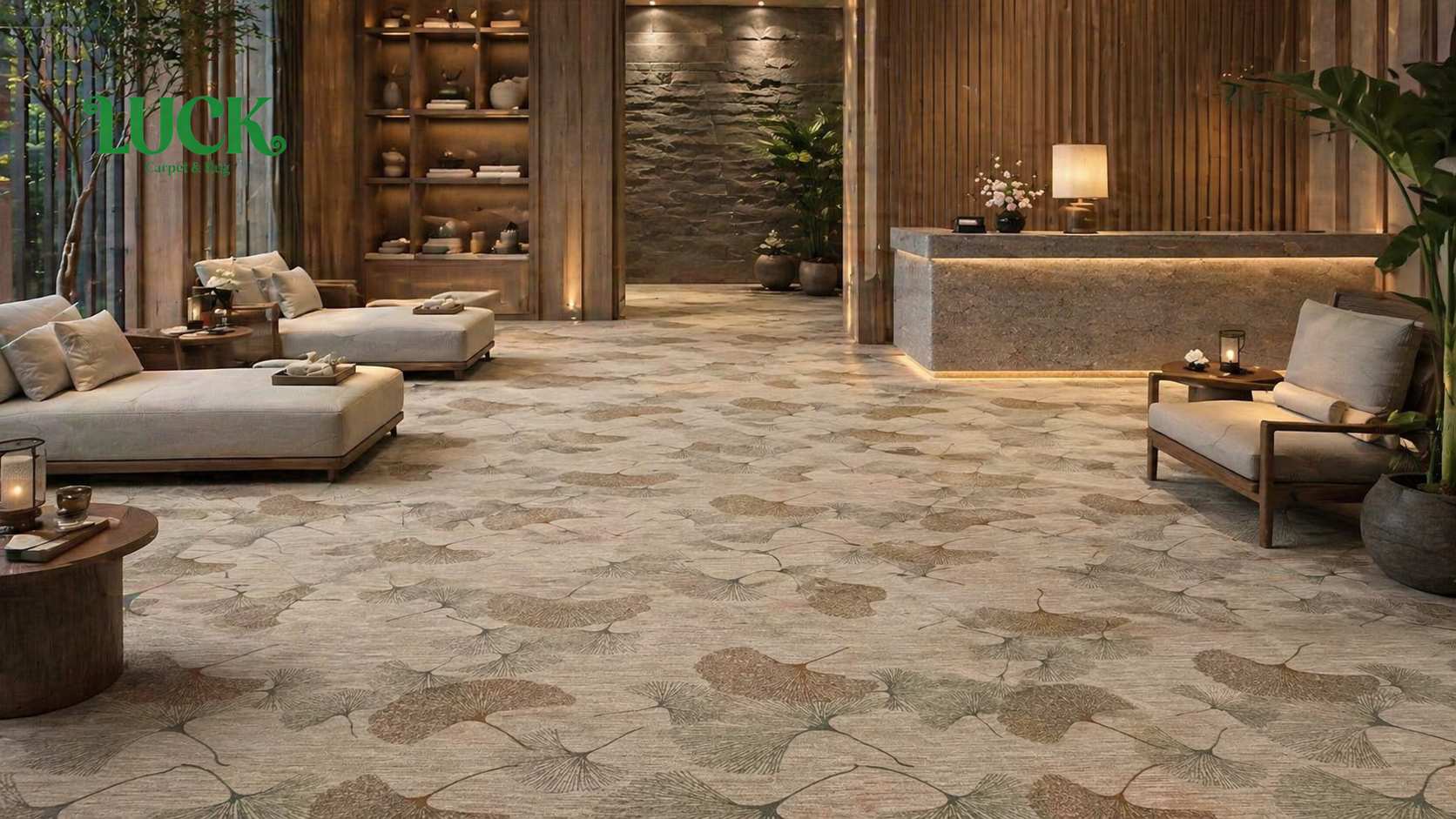
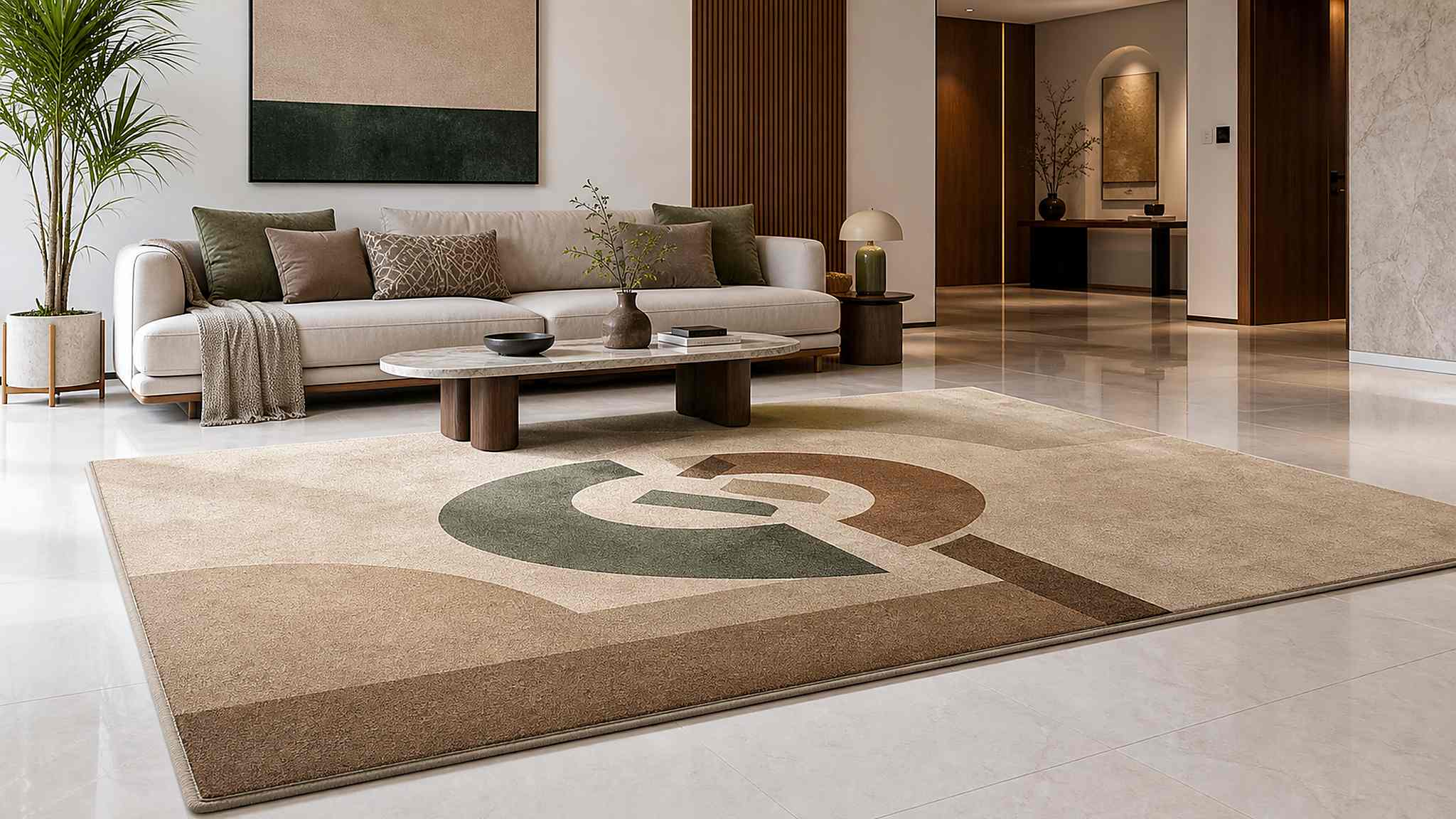
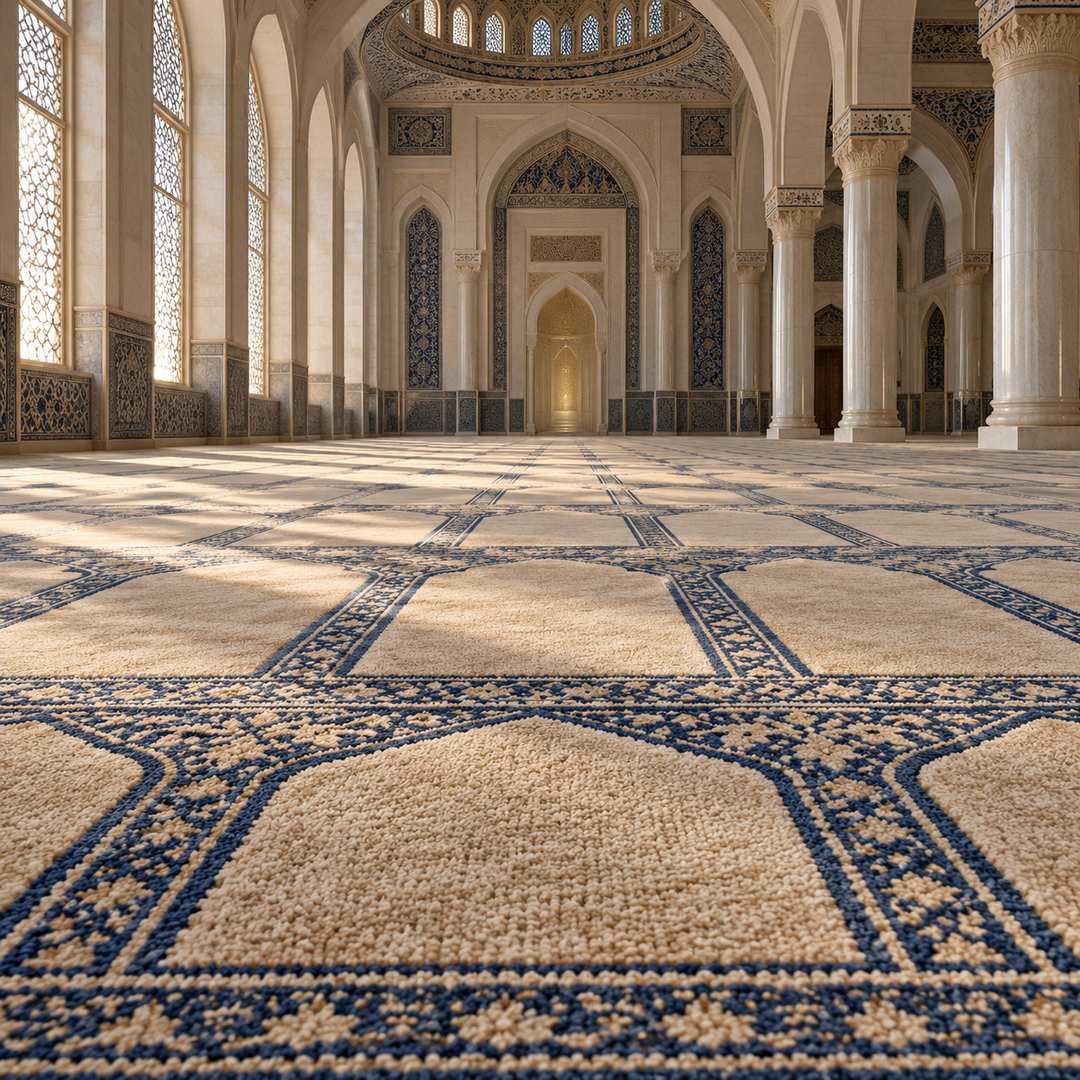
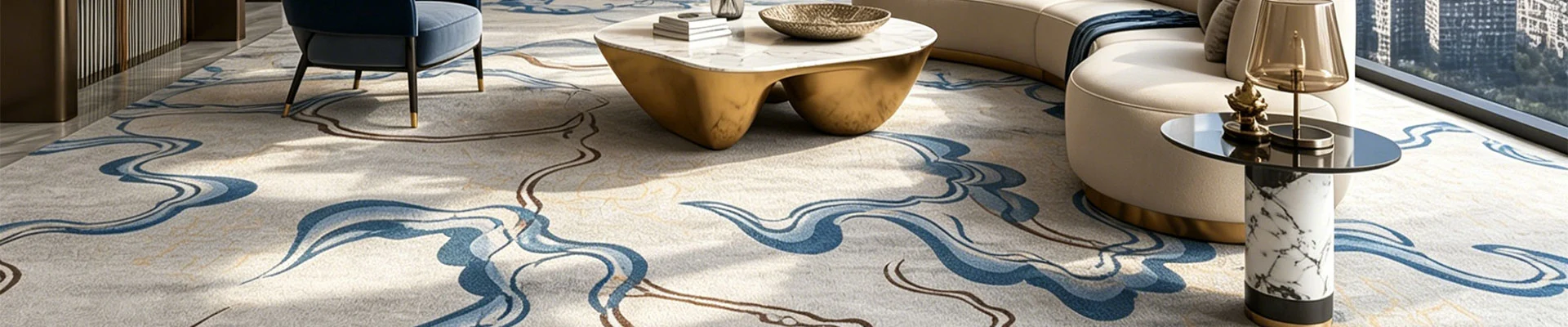
The repeat is the other half of the problem. A lounge is not one open floor; it is a plan of banquettes, armchairs, low tables and service routes, and a motif that ignores those lines gets cut through at every transition. We scale the design so a seating cluster sits inside one complete repeat, then place the join under a fixed element: the back of a banquette, the edge of a border, the centre line of a coffee table. Repeat position is held within 3 mm on a re-order, so the same lounge design can be laid in a second room years later.
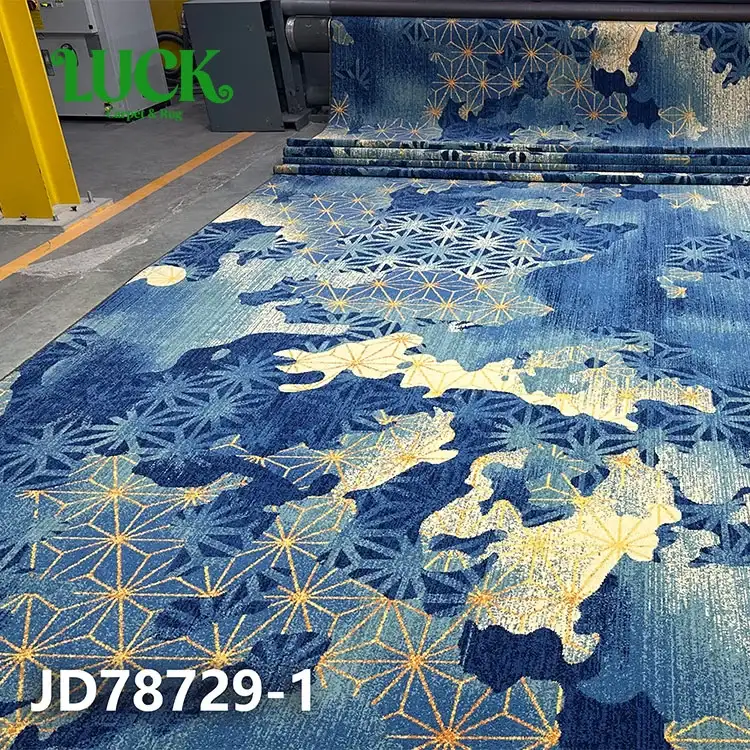
Every lounge order starts with a strike-off, but on this product we go one step further and weave a three-metre check strip of the actual repeat at the actual scale. That strip goes to the designer with the seating plan overlaid on it, so the motif can be judged against real furniture positions rather than on a flat swatch. If the client wants the pattern larger or the ground colour deeper, the change costs a sample at this stage and a loom set-up later.
Our testing on this construction is aimed at long, static, well-lit rooms. Abrasion to ISO 12947-2 at 5 kPa sits between 40,000 and 60,000 rubs, which covers a lounge used daily for a decade. Light fastness to ISO 105-B02 is Grade 6-7, which matters in an airport lounge where the glazing runs floor to ceiling and the sun never stops moving across it. Dimensional stability to ISO 2551 holds at under 0.2 %, so a 4 m panel laid over underlay does not creep out from beneath a banquette.
Values below come from the finished roll in our Foshan plant, not from a development sample. Two reading notes for a lounge specification. First, Width / Size of 4 m (13.1 ft) is usable woven width after trimming, so a 12 m lounge wall takes three panels and two joins, and we plan those joins against your furniture layout. Second, the fire class applies to the carpet as supplied on this backing.
Style Wool Woven Wall to Wall Carpet for Lounges
Yarn type 100 % Wool
Pile Height 10 mm
Pile Weight 1200 g/m2
Backing Anti-slip textile backing
Fire Resistance Bfl-s1 (EN 13501-1)
Application Hotel Lobby Lounge , Airport VIP Lounge , Corporate Office Lounge, Residential Sitting Lounge
Width / Size 4 m (13.1 ft) usable width
Pattern Custom design available (artwork supplied by buyer, strike-off approved before production)
Surface / Technique Cut pile
| Style | Wool Woven Wall to Wall Carpet for Lounges |
| Yarn type | 100 % Wool |
| Pile Height | 10 mm |
| Pile Weight | 1200 g/m2 |
| Backing | Anti-slip textile backing |
| Fire Resistance | Bfl-s1 (EN 13501-1) |
| Application | Hotel Lobby Lounge , Airport VIP Lounge , Corporate Office Lounge, Residential Sitting Lounge |
| Width / Size | 4 m (13.1 ft) usable width |
| Pattern | Custom design available (artwork supplied by buyer, strike-off approved before production) |
| Surface / Technique | Cut pile |
Nowhere else in a hotel is specified so casually and inspected so closely as a lounge. A hotel lobby lounge, an airport VIP room and a corporate floor buy the same qualities: a floor that still looks new at the end of a long dwell, a repeat that respects the seating plan, and a surface that hides what a hundred people a day leave behind. The three sections below take those in turn.
Repeat engineering is arithmetic before it is design. Take the seating plan, measure from the wall to the first banquette, then set the motif so that distance lands on a whole number of repeats. On a typical lounge we work to a motif between 1.2 m and 2 m, which gives two or three complete motifs across the woven width and keeps the pattern legible from a seated eye level. Joins are then marked on your plan, not on ours.
Joins placed under fixed elements disappear; joins placed in a walking route are looked at a thousand times a week. Repeat position is held within 3 mm on a re-order, and pile height tolerance is plus or minus 0.5 mm across the width, so two panels woven months apart still meet cleanly. Where a lounge has a curved bar or a round seating cluster, the motif is normally centred on the cluster and the ground colour carries the space between.
Consider the Oslo lounge in the case study below. It is a hotel lobby lounge with a 22 m glazed wall facing the fjord, six fixed banquette clusters along the glass, a central bar island and a corridor to the conference floor. The brief asked for a repeat that ran behind the banquettes without a join in front of a guest, plus a colour that would not grey out in a room with that much daylight. We wove seven rolls in a two-tone motif on a 1.6 m repeat.
Airport VIP lounges add a constraint the others do not have: rolling luggage. A trolley wheel is a point load of perhaps 40 kg on a 40 mm contact patch, and it crosses the same line all day. Corporate lounges are easier on the pile and harder on appearance, because a client notices a matted patch in a room that gets photographed. Residential sitting rooms are the most forgiving of traffic and the least forgiving of colour, since the same floor is seen in daylight and again under lamplight.
Look at any lounge carpet after a year and the soiling is not even. It is a halo around every seat, a dark line along the front edge of each banquette, and a track between the entrance and the bar. That distribution comes from shoes resting on the pile and from spills that land at table height. The fix starts at design stage with a mid-tone ground and a pattern that breaks up the outline of a stain, because plain pale wool shows every drip and a busy motif hides the first six months of them.
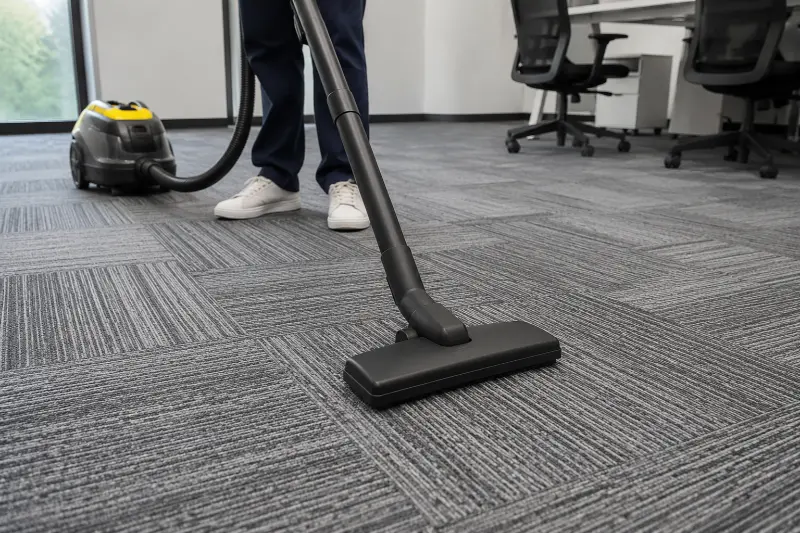
Cleaning is the other half of the answer. Wool holds dry soil near the surface and releases it to a vacuum, which is why a lounge vacuumed daily stays presentable with one hot water extraction a year. Colour fastness to rubbing at Grade 4-5 to ISO 105-X12 gives a cleaning contractor room to work on a spot without lifting the colour. What we cannot promise is a pale wool floor beside a coffee station. Put a dark tone or a hard surface there, or plan on a replacement patch in year three.
This waterfront hotel in Oslo rebuilt its lobby lounge and conference arrival corridor, 640 m² of carpet across two levels. Six fixed banquette clusters run along a 22 m glazed wall, so the repeat had to be positioned rather than repeated blindly, and the client wanted one unbroken field from the entrance to the bar island. We wove seven rolls of 25 linear metres in a wool two-tone motif on a 1.6 m repeat and issued a laying plan with every join marked under a fixed element.
Installation ran over a 7 mm felt underlay across two nights so the lounge could trade during the day. Measured 22 months after handover, the halo soiling around the banquettes was lifted by a standard extraction programme with no colour change recorded against the retained sample, pile height under the worst-used seat recovered to within 0.4 mm of the field, and the hotel has re-ordered the design for its conference corridor with the repeat matching the original within 3 mm.
Testing a lounge carpet for a decade of sitting
Five tests carry this product in a lounge. Static loading to ISO 3416 predicts appearance under fixed seating, and our Foshan lab loads a sample from the first and last metre of every lounge batch; the last nine averaged 8 % thickness loss, returning to within 2 % of original height after 22 hours. Abrasion to ISO 12947-2 at 5 kPa lands between 40,000 and 60,000 rubs. On colour, the face holds Grade 6-7 to ISO 105-B02 for light and Grade 4-5 to ISO 105-X12 for rubbing. Wet cleaning leaves the pile within 0.2 % of its original length under ISO 2551. Fire classification is Bfl-s1 to EN 13501-1, tested through EN ISO 9239-1 and EN ISO 11925-2. If a supplier cannot produce ISO 3416 data for a lounge, ask why, because that figure decides how the room looks in year four.


Yes, and we prefer to. Send the furniture layout with the floor plan and we will return a laying plan showing motif position, join lines and the number of rolls needed. That work costs nothing at quotation stage, and it is the cheapest moment in a project to move a join.
It compresses, and it recovers if the load moves. Wool at 1200 g/m² returns to within a few tenths of a millimetre after normal use, which is what ISO 3416 measures. A chair that never moves for years will leave a mark, so we specify castor cups or a glass mat under permanently parked furniture.
Halos around the seats should be extracted twice a year rather than the whole floor once, with daily vacuuming in between. A mid-tone ground colour and a pattern with movement give you margin. Pale plain wool in a lounge with a coffee service is a specification error, and we will say so before the loom starts.
For the seating areas, yes. It absorbs sound in a room that is otherwise glass and hard floor. For the trolley route between the entrance and the buffet, we recommend a hard strip or an entrance zone in a loop construction. About a fifth of the area usually carries most of the wear, and it is worth splitting the specification there.
Woven at 10 mm in cut pile, the surface has a slight directional sheen, so a two-tone design reads differently depending on the direction you approach it from, and the pile lay should run the same way across every panel in a lounge. Colour depth comes from dyed yarn rather than a surface finish, which is why a lounge carpet at year five still matches the retained sample in tone even where the pile has polished. Rolls are 4 m (13.1 ft) wide, selvedge-trimmed, sealed and wrapped, with the roll number and weave direction stencilled on the outside.
Quotations start from a furniture layout where one exists and include a laying plan, a seam schedule and a maintenance note your cleaning contractor can follow. Custom woven designs begin at 300 m² per design. We weave in Foshan and ship worldwide, with third-party inspection through SGS, Intertek or BV available at the plant, and we exhibit at DOMOTEX Hannover and The Canton Fair in Guangzhou.


Address
Shidaigongguan Building No.5 Office 1212, Haicheng east road, Duanzhou District, Zhaoqing City, Guangdong Province, China
Tel
Copyright © 2026 Zhaoqing Yunle International Trade Co., Ltd. All Rights Reserved.