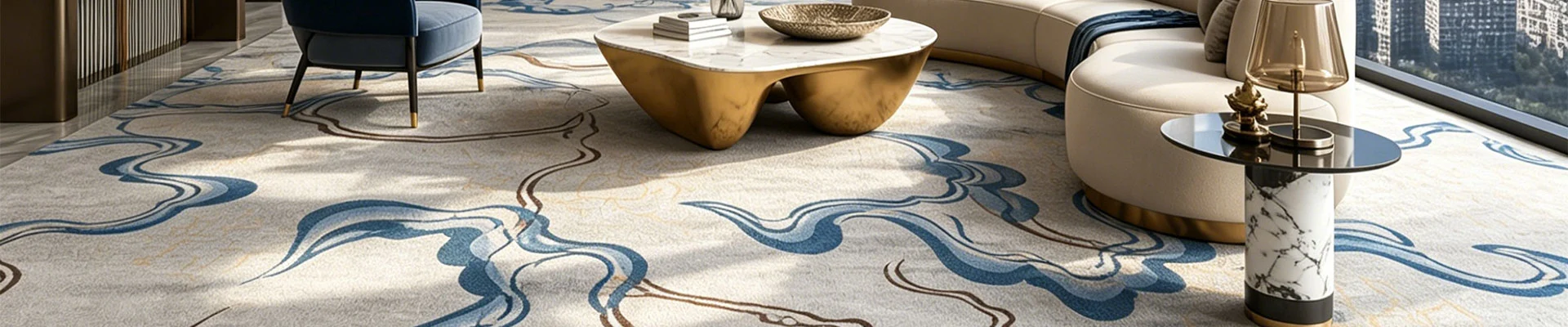
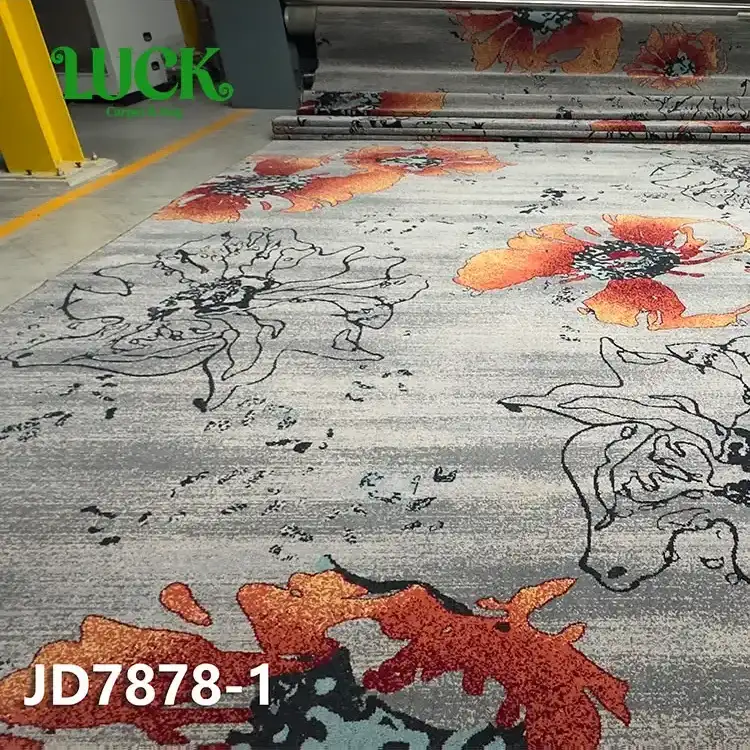
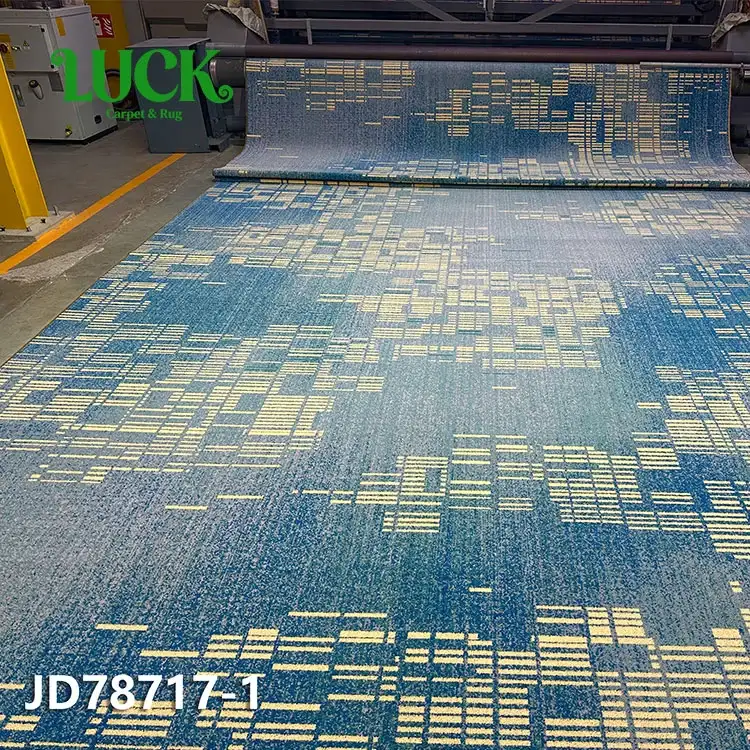
A designer sends artwork drawn for a screen, at a scale where the motif runs 3 m across. In a boutique 5 m wide that is one motif per wall. We rebuild the repeat at the loom instead: the drawing is redrawn on a finer pitch so the motif completes two or three times across the woven width, and only the details that survive at 10 mm pile height are kept. Bold shapes scale down well. Hairlines and thin script do not.
Scale is also a lighting question. Boutique floors are lit hard: track spots at 3,000 K to 4,000 K on the product walls, daylight through the shopfront, and dimmed circuits at night. A small motif in strong contrast flickers under a spot, so we normally set the pattern at low contrast against the ground and let the texture carry the design. Light fastness reported at Grade 6-7 to ISO 105-B02 is what stops that balance from shifting after two summers in a window.
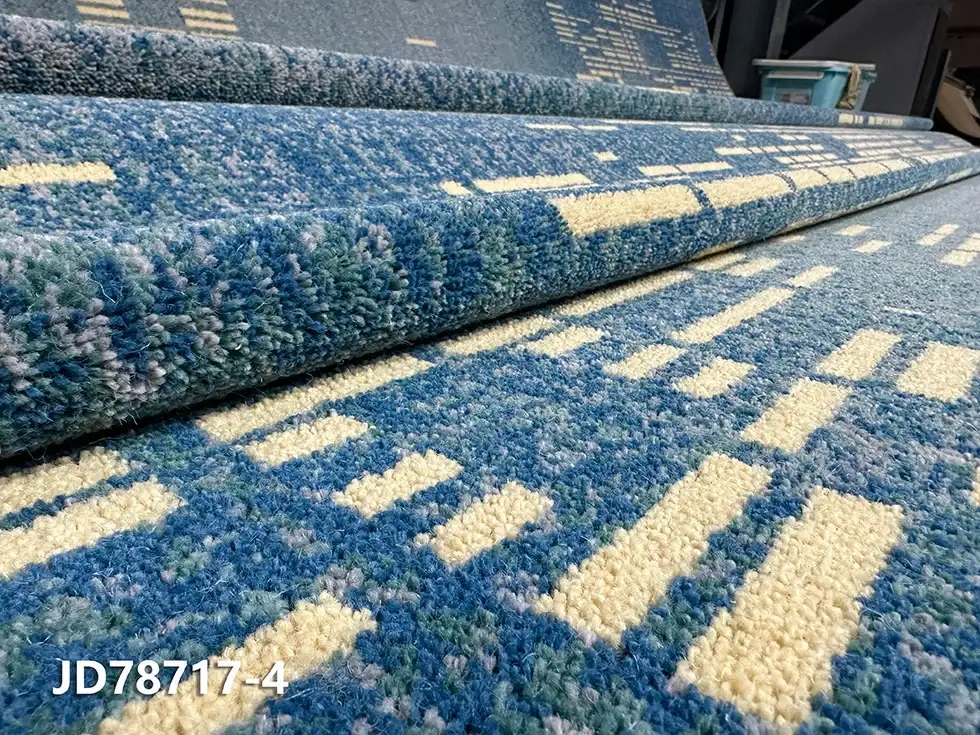
Small-format designs are usually printed onto synthetic yarn, because printing is cheap at short runs. We weave them instead. On the loom the pattern is a set of dyed yarn positions, so colour sits in the pile from the backing upwards and cannot crack, flake or wear off a pile tip. The trade-off is honest: weaving costs more per square metre at low volume, and a repeat change is a loom set-up rather than a new file. On a 60 m² selling floor that gap is small money spread over a decade.
Weaving earns its place at a fitting-room door as well. A printed face depends on the pile holding its coating through every shoe scuff and every clothes hanger dragged across it, while a woven face has no coating to lose. Pile height tolerance on our looms is plus or minus 0.5 mm and the repeat is repeatable within 3 mm on a re-order, which is what lets a brand specify one carpet across four shops and open the fifth with a matching floor.
Data below comes off the finished roll at our Foshan plant before wrapping, and any value can be re-verified by SGS, Intertek or BV at the plant. One note for retail: this carpet is quoted by the linear metre from a 4 m (13.1 ft) usable width, so a small room rarely uses the full width, and we draw the cutting plan around your fixtures to keep the offcut usable as attic stock.
| Style | Wool Woven Wall to Wall Carpet for Boutiques |
| Yarn type | 100 % Wool |
| Pile Height | 10 mm |
| Pile Weight | 1200 g/m2 |
| Backing | Anti-slip textile backing |
| Fire Resistance | Bfl-s1 (EN 13501-1) |
| Application | lounge areas |
| Width / Size | 4 m (13.1 ft) usable width |
| Pattern | Custom design available (artwork supplied by buyer, strike-off approved before production) |
| Surface / Technique | Cut pile |
Nowhere carries more design risk per square metre than a 60 m² boutique. Everything in it sits close to the eye, the layout changes with every collection, and the traffic concentrates in three places. The sections below cover repeat scale in a small footprint, the zones that matter in a shop, and the two wear points retail clients ask about most, which are the fitting-room threshold and the strip in front of the mirror.
Do the arithmetic before the mood board. A 60 m² boutique measuring 6 m by 10 m takes roughly 17 linear metres of 4 m carpet once the cutting plan is drawn, which is one roll, and that single roll has to carry the whole design idea. We set the repeat between 800 mm and 1,400 mm for a shop of that size: small enough that a customer in the doorway reads a pattern rather than a fragment, large enough that the floor does not look like a hotel corridor.
Position matters as much as size. The first full motif should land between the shopfront and the first display bay, so a customer walks onto a complete design step. A join, if there has to be one, belongs under a fixed fixture rather than in open floor. On a small plan we also hold one spare square metre per fitting room from the same roll, because a patch cut from the original dye lot is invisible and a patch from a later batch is not.
Our Tokyo case study below is typical of the format. It sits on one level, 5.4 m wide at the frontage and 12.6 m deep, with a 1.8 m display bay either side of the entrance, three fitting rooms along the back wall and a cash desk on the right-hand wall. The brand mark is a 420 mm monogram, and the brief was to repeat it on a grid without the floor looking like packaging. We set the repeat at 1,680 mm, so four monograms complete across the woven width.
Each zone asks something different of the same carpet. The display bay is where plinths and mannequins stand, so the pile compresses in small patches and the pattern has to read around them. Fitting rooms take bare feet, shoe scuffs and dropped pins, and they want a dense face rather than a soft one. The cash desk carries the most abrasion per square metre in the shop.
At The Canton Fair in Guangzhou we asked 58 retail fit-out managers how they specify a shop floor. Thirty-six gave the same answer about the first thing to fail: the fitting-room threshold, usually inside the first year. A 900 mm opening takes a shoe scuff every time someone steps in, on a strip of carpet that is often only 300 mm deep, and it fails as a frayed edge rather than as worn pile. A flat trim set into the screed, plus as much walk-off as the plan allows, prevents most of it.
There is one version of this product that is wrong for a boutique, and we say so at quotation stage. If a shop moves rolling racks of stock, a 1200 g/m² cut pile compresses along the wheel line and stays compressed, so a loop construction or a hard floor belongs in the stockroom with the wool kept for the selling floor. The same applies to a shop that hot-washes its floor weekly: cut wool wants dry extraction and spot treatment, not a rotary shampoo.
Tokyo is the example: a fashion brand opened a 68 m² flagship in Aoyama on a single level with a 5.4 m frontage. The brief asked for a floor that carried the 420 mm monogram without looking like a printed logo, matched the brand's warm grey, and could be patched as fixtures moved. We wove a single 25 m roll in a low-contrast wool ground with the monogram on a 1,680 mm grid, retained 4 m of the same roll as attic stock, and issued a cutting plan that kept the monogram whole at the entrance.
Laying took one morning over a 5 mm felt underlay, with the grid set so the first complete monogram fell inside the doorway. Measured 30 months later, the field showed no colour shift against the retained sample, the two fitting-room areas were replaced from attic stock in a single evening after a fixture change and matched the field, and the brand has opened three further stores on this specification, each within 3 mm of the Aoyama repeat.
Retail buyers get five numbers from us before the loom starts. Abrasion to ISO 12947-2 at 5 kPa reads between 40,000 and 60,000 rubs on this construction, well beyond what a 68 m² selling floor can generate in a decade. Colour fastness to light is Grade 6-7 to ISO 105-B02, the grade that decides whether a shop-window floor survives two summers, and rubbing fastness is Grade 4-5 to ISO 105-X12. Dimensional stability to ISO 2551 remains under 0.2 % after wet cleaning. Fire performance is Bfl-s1 to EN 13501-1, tested to EN ISO 9239-1 and EN ISO 11925-2, and indoor air is Class A to GB 18587-2001. Ask for the reports, not the summary line.
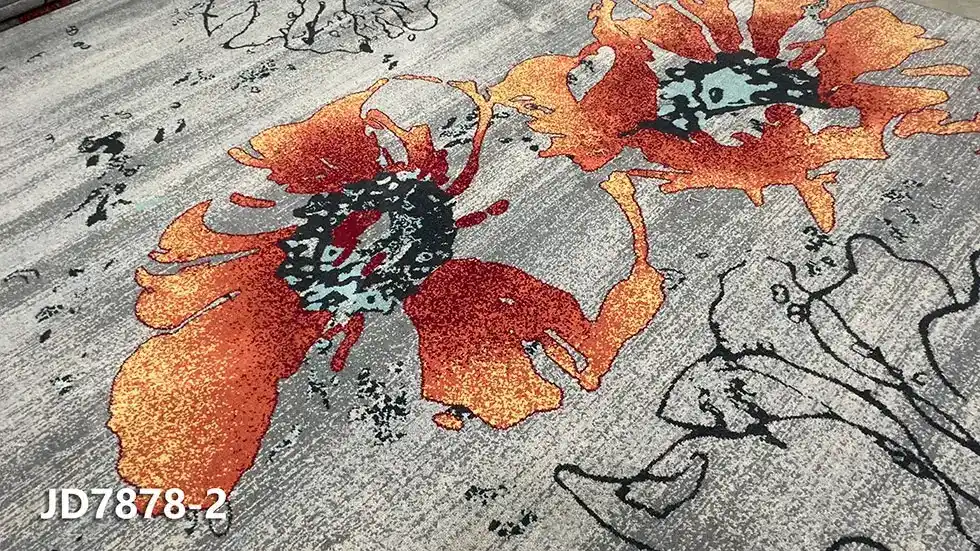
One 60 m² boutique cannot fill a loom run on its own, so custom designs are quoted from 300 m² per design. Most retail clients reach that by rolling the same design out across several stores or by sharing a run with a second colourway. We will tell you plainly which of those routes costs less for your programme.
Yes. We keep the artwork, the loom programme and the dye recipe on file, and we hold the repeat to within 3 mm of the original. Colour sits inside a small tolerance on a new dye lot, so we send a strike-off for approval before the second run and recommend keeping a part roll from each delivery.
Colour for retail is dyed to Grade 6-7 for light fastness to ISO 105-B02, which is high for a contract carpet. Strong ultraviolet through glass still shifts saturated reds and blues over several years, so we suggest UV film on west or south-facing shopfronts and moving display plinths off the same spot each season.
Fitting rooms work with the same carpet, and it usually looks better than a change of product at the door. What fitting rooms need is a dense face that resists scuffing, plus a plan that allows the floor to be replaced from the same roll later. If pins and heels are a genuine problem, a loop construction in the same colour is the harder-wearing alternative.
In a small room everything shows, so the ground colour matters more than the motif. We dye wool to a matte finish for retail, because a lustrous yarn throws light back at a customer standing under a track spot. The surface is a 10 mm cut pile with a firm hand, closer to a good wool coat than to a deep pile rug, and the colour runs through the full pile, so a scuff in the fitting-room doorway does not open a pale line. Rolls arrive 4 m (13.1 ft) wide, trimmed, sealed and marked with roll number and weave direction.
Send the layout at concept stage and we will return a cutting plan, a repeat drawing and an attic stock recommendation before the design is signed off. LUCK Carpet has exported woven carpet from Foshan for 14 years, exhibits at DOMOTEX Hannover, The Canton Fair and Shanghai Hospitality Design Week, and offers SGS, Intertek or BV inspection at the plant.
Address
Shidaigongguan Building No.5 Office 1212, Haicheng east road, Duanzhou District, Zhaoqing City, Guangdong Province, China
Tel
Copyright © 2026 Zhaoqing Yunle International Trade Co., Ltd. All Rights Reserved.