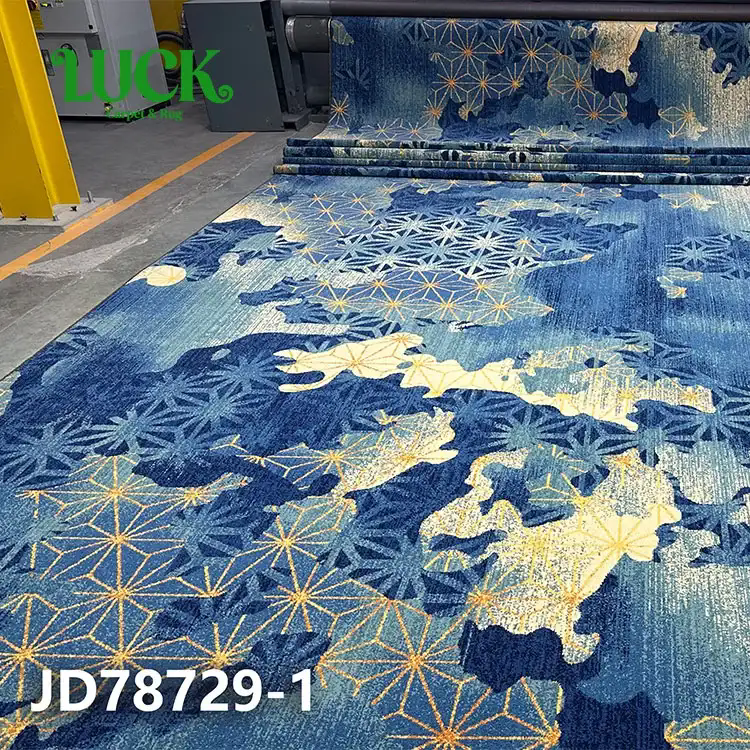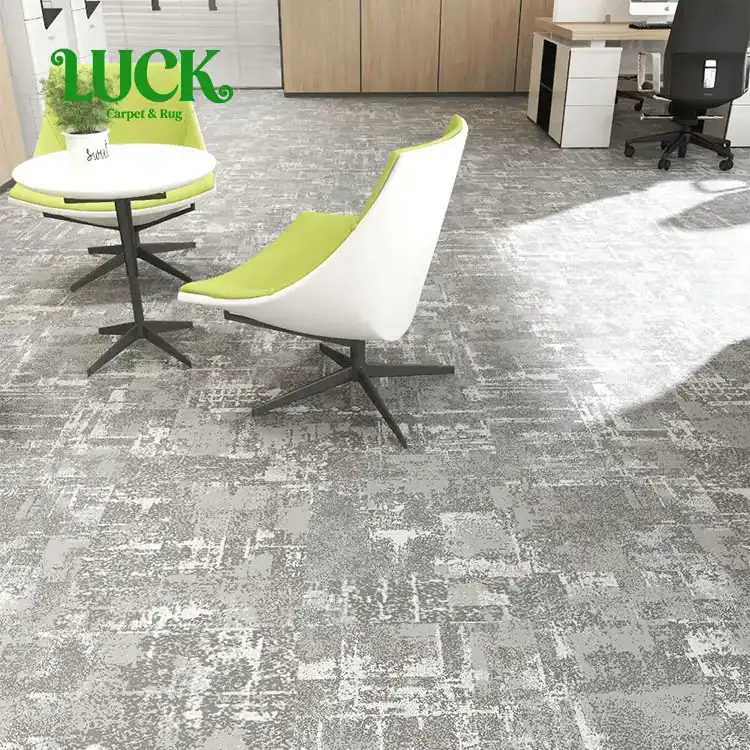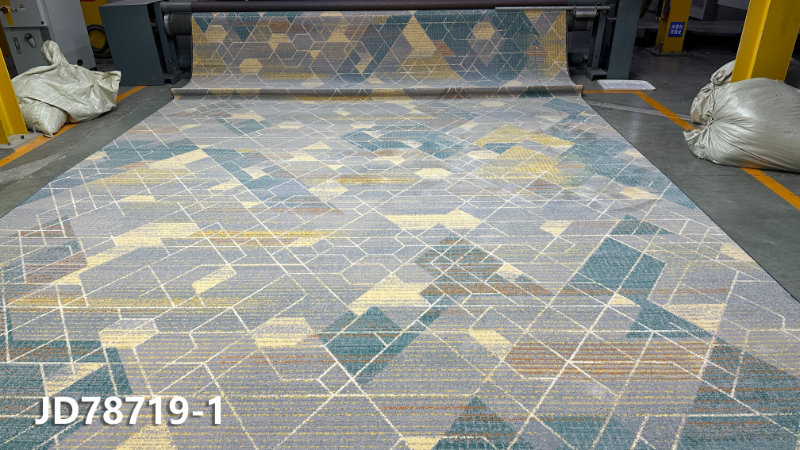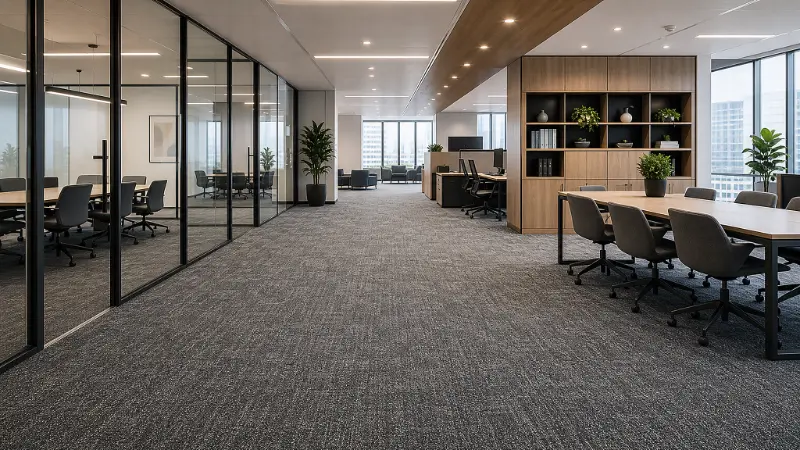
LUCK Carpet makes the Acrylic Hand made Area Rug(1) on hand-tufting frames in our 26,000 m² plant in Foshan, Guangdong, with no trading company in between. The face is 100 % acrylic at a 12 mm pile and 1800 g/m2 over a cotton canvas back, squared by hand. Hotel clubs, VIP rooms and custom commercial interiors order it for saturated colour without a wool budget. This page covers colour hold, recovery, and where acrylic stops working.
Acrylic carries pigment inside the filament rather than on the surface. Under ISO 105-B02 our rugs read Grade 6 on the blue wool scale, and beside floor-to-ceiling glass that colour survives daylight which would visibly yellow a wool pile. Bright brand shades such as teal or coral also hold evenly across a wide panel.
Liquid behaviour is the second reason buyers pick acrylic: the fibre is hydrophobic, so a spilled drink sits on the pile long enough for staff to blot instead of wicking into the cotton canvas. Acrylic has less spring than wool, so a fixed leg load from a heavy chair compresses the pile without pushing back. This build has body for foot traffic, not memory for a load that never moves.
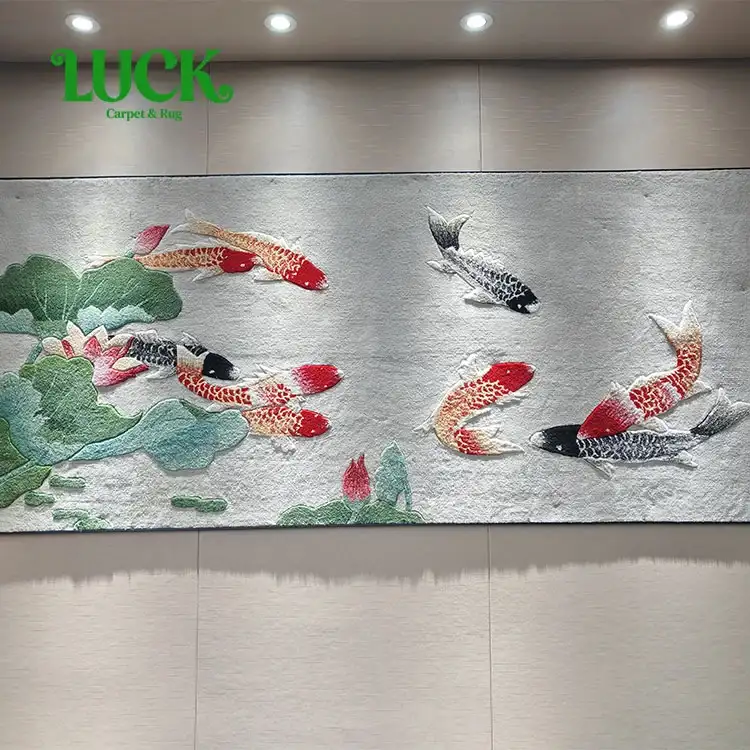
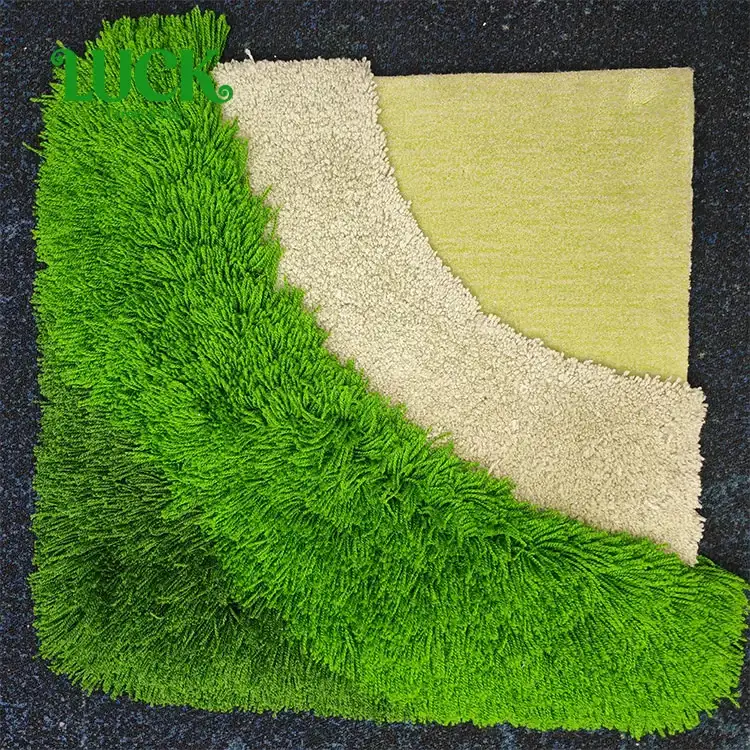
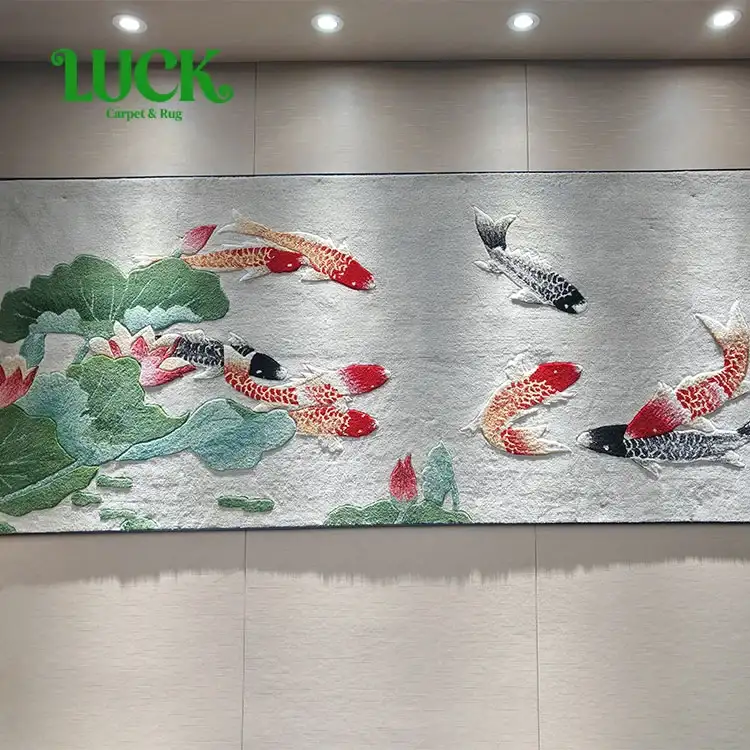
Every rug in this range is made to order. Artwork goes onto a 1:1 drawing, the canvas is stretched on a frame, and a tufting operator follows it by hand. One frame can carry a standard rectangle or an irregular shape. After tufting we laminate a latex compound to the back, bond cotton canvas over it, then shear and carve the face.
Adhesion is measured, not assumed. Peel strength on our cotton-laminate build sits between 24 and 32 N/50 mm depending on pile and coating weight, 27 N/50 mm typical here. Tuft bind averages 32 N under ISO 4919, inside the 28 to 36 N band we publish for hand-made rugs. Pile height is held to plus or minus 1 mm, and every rug is squared and hand-finished, under a 10-year construction warranty.
Figures below are the released specification for the Acrylic Hand made Area Rug(1), checked on finished pieces in our QC room rather than a yarn datasheet. Size is made to order, so treat the two standard rectangles as starting points and check them against your plan.
| Style | Acrylic Hand made Area Rug |
| Yarn type | 100 % Acrylic |
| Pile Height | 12 mm |
| Pile Weight | 1800 g/m2 |
| Backing | Cotton canvas |
| Fire Resistance | Bfl-s1 (EN 13501-1) |
| Application | Hotel/Club / VIP Room/Custom Commercial Interior |
| Width / Size | Made to order; standard 1.6 m x 2.3 m, 2.0 m x 3.0 m and custom sizes |
| Pattern | Custom design available (artwork supplied by buyer, strike-off approved before production) |
| Surface / Technique | Hand-tufted |
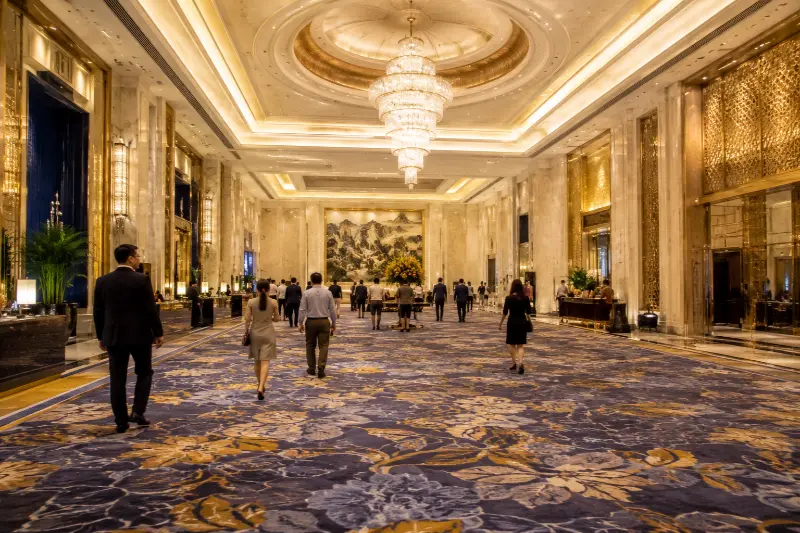
Picture a club lounge at nine in the evening, or a VIP room where the rug carries the brand colour after two hundred guests. Acrylic hand-tufted rugs earn their place in those rooms. They are the wrong purchase in a few others.
Cost is the first answer. A 100 % acrylic hand-tufted rug at 1800 g/m2 lands well below a wool rug of the same size and pile, because the fibre is cheaper and dyes brighter with less pigment. That matters across a whole club floor. In light contract use, ISO 10874 class 23 and 31, this construction returns 26,500 rubs to defined change on ISO 12947-2 at 5 kPa.
Recovery is where wool wins. Wool fibre has a natural crimp that pushes back after compression; acrylic bends and stays bent. A club with fixed banquette seating or a queue that always forms in the same metre should use wool in those zones. Cleaning splits the same way: acrylic releases oily stains readily, but high-temperature extraction can flatten the pile, because the fibre is thermoplastic.
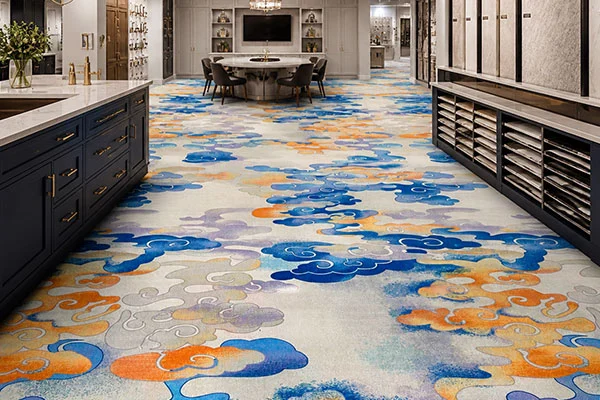
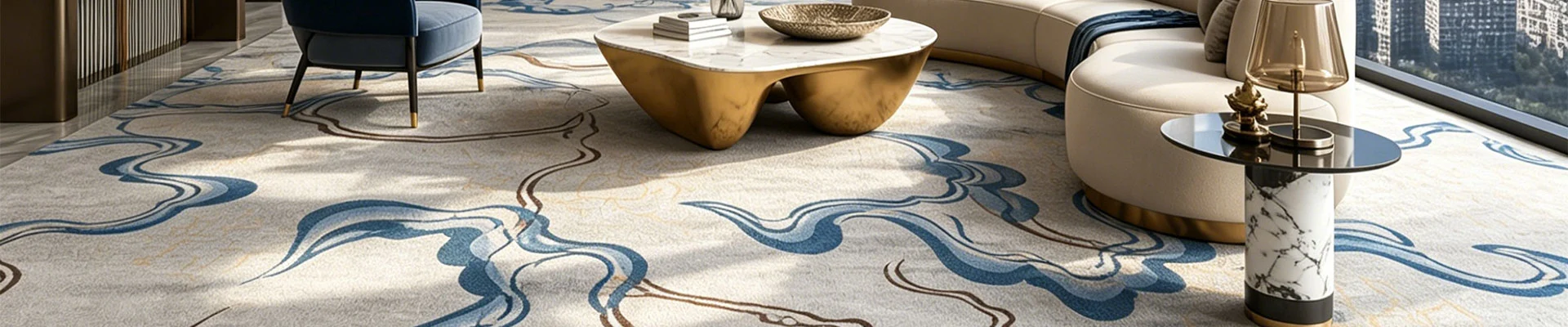
This rug suits interiors where the floor has to match a brand standard: a hotel club lounge, a members bar, a casino VIP room, a showroom reception. Because the face is tufted to a full-size drawing, a pattern can be scaled to the room or a logo repeated in the centre of a 2.0 m x 3.0 m piece without distortion.
Practical details decide whether a specification survives. A lounge with a glazed wall and polished stone underfoot needs a rug that will not shift, so use a dense felt underlay or a light tackifier. Circulation between bar and seating should stay on hard floor, with the rug sized to the furniture group. That is the arrangement we sampled for the Miami club below.
Two failures turn up when a rug sits beside glazing. The first is fade. Wool and viscose blends go patchy along the window line inside two summers, and nobody notices until a chair moves. Acrylic resists it, which is why a saturated rug can sit in a west-facing lounge, sunlit half included, and hold its colour across the whole piece.
Flattening is the second failure, and acrylic is the most exposed to it. Sun through glass warms the pile, and a chair leg that never moves collapses the fibres until the sheen changes along the crushed path. Three countermeasures work: felt pads under fixed legs, a seasonal 180 degree rotation where the layout allows, and enough pile depth for the yarn to stand in. Where a permanent load sits in direct sun, specify wool for that piece instead.
A members club on the Miami Beach waterfront rebuilt its lounge and two VIP rooms in 2023. The scope was 340 m² across 16 pieces, from 1.6 m x 2.3 m room rugs to a 4.2 m x 6.0 m lounge panel in deep teal, sand and coral. The west wall is glass, the afternoon light is brutal, and the previous wool rugs faded into three visible bands within two years.
We proposed acrylic on cotton canvas and ran a coral strike-off so the club could approve it against the glazing. The pieces shipped in three batches. After 18 months, a reference sample kept in a dark store and a disc cut from the sunlit lounge both re-tested at Grade 5 under ISO 105-B02, with no banding at the window line. The only service note came from two heavy chairs, where felt pads solved compression marks.
Our Foshan QC room runs the same battery on every acrylic order. Abrasion goes through ISO 12947-2 at 5 kPa, where four recent runs averaged 26,500 rubs. Light fastness is measured to ISO 105-B02 at Grade 6, rubbing fastness to ISO 105-X12 at Grade 4. Tuft bind reads 32 N on ISO 4919 and laminate peel 27 N/50 mm. Dimensional change after wet cleaning reads 0.3 %, inside the 0.4 % ceiling of ISO 2551. Fire performance is Bfl-s1 under EN 13501-1, supported by EN ISO 9239-1 and EN ISO 11925-2, and emissions pass GB 18587-2001 Class A. Third-party inspection by SGS, Intertek or BV is available at the plant, and we show at DOMOTEX Hannover and The Canton Fair.
Does acrylic feel like wool underfoot?
Close enough that few guests would name the difference, and not identical. Acrylic has a softer, drier hand and a brighter surface; wool feels denser and springs back when pressed. Designers choose acrylic for colour and price, then specify wool for the piece where people sit on the floor.
Can acrylic rugs be cleaned like wool rugs?
Blot spills within minutes, vacuum weekly with a suction head rather than a beater bar, and keep high-temperature extraction away from acrylic, which is thermoplastic. Every made-to-order rug ships with a care sheet naming the face yarn, so the cleaning contractor works to the fibre.
What is the lead time and minimum order?
Sampling runs about ten days from approved artwork, and the strike-off is the gate: nothing reaches the frame until you sign the drawing and colour. A 16-piece order like the Miami club takes four to five weeks in production. We build from one piece upward, so a single VIP room rug is a normal order.
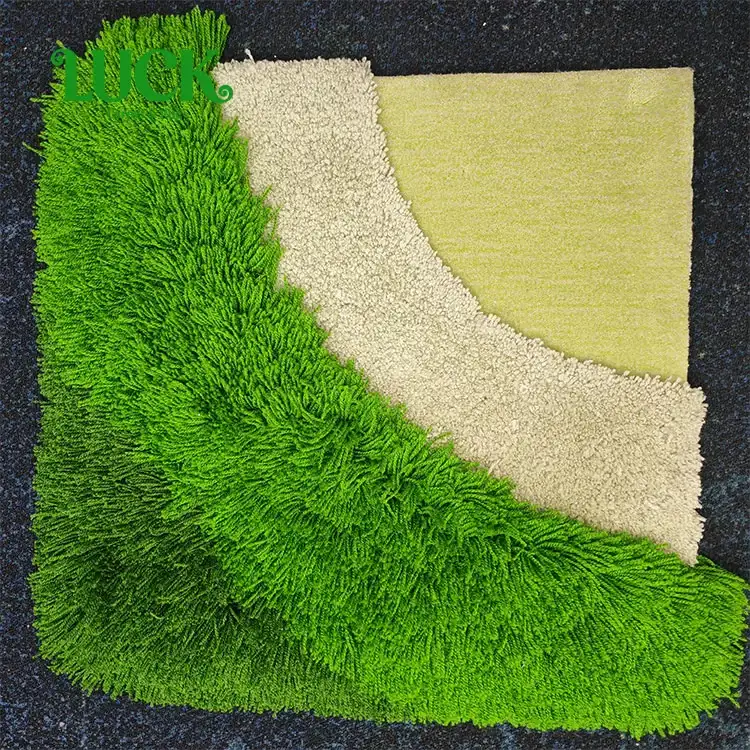
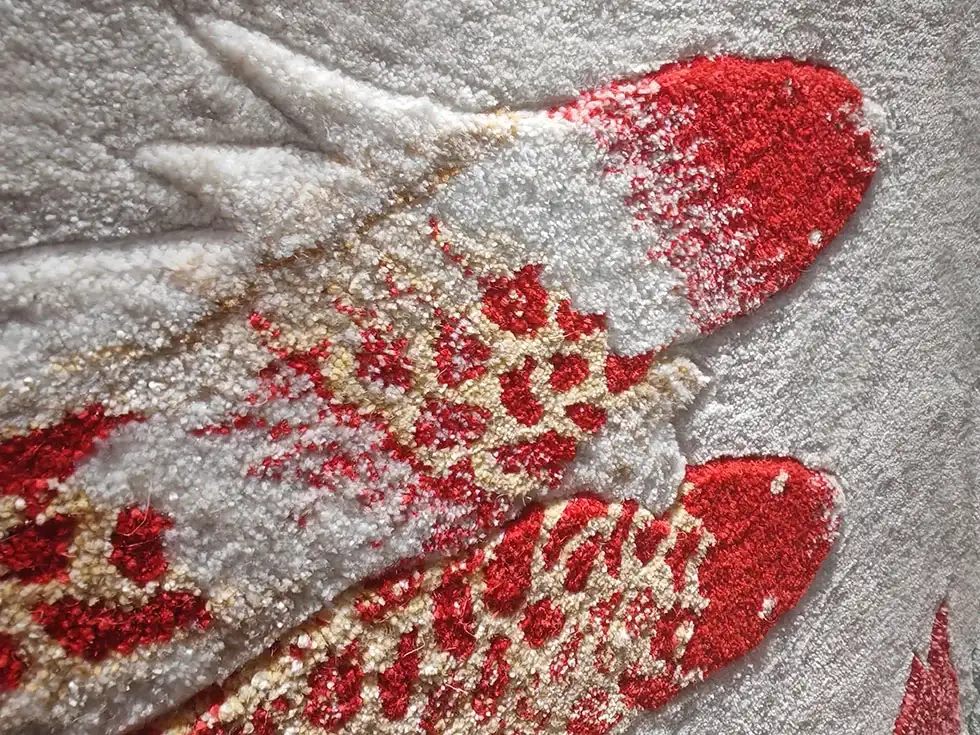
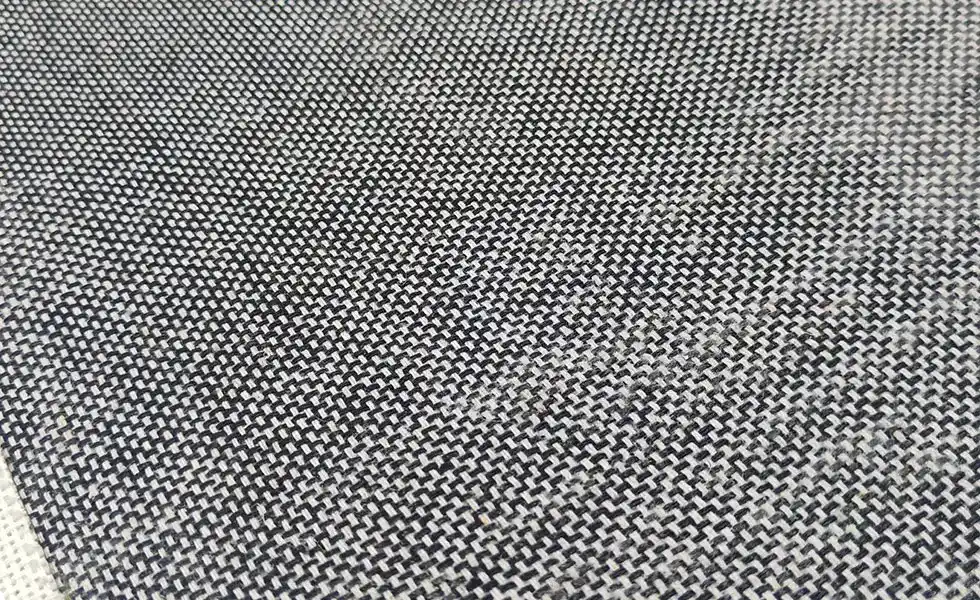
The face is a cut pile at 12 mm, dense enough to read as a solid field of colour rather than a fluffy surface. Shearing leaves an even hand with a slight sheen, and carving sits a couple of millimetres below the field so the pattern reads in a photograph as well as in the room. Cotton canvas closes the back and the edges are hand-finished and squared.
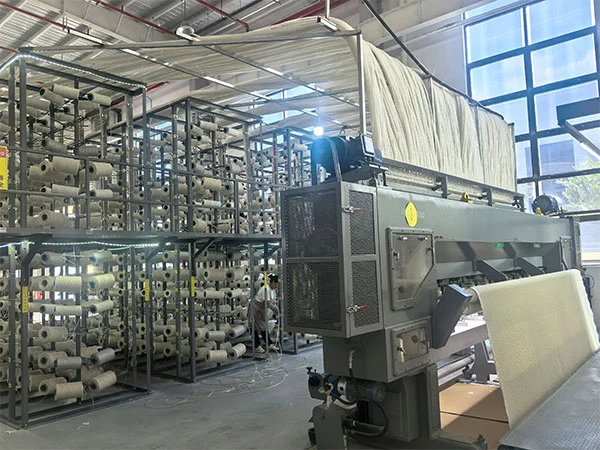
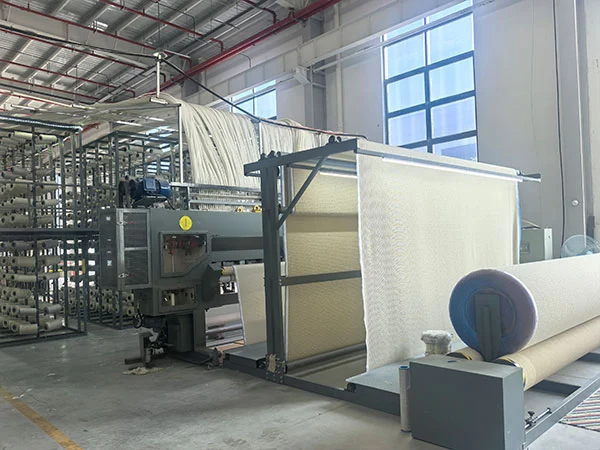
Rugs travel rolled on a core, wrapped in film and packed in a woven export bag, labelled with size, colour code and room reference. Use a felt underlay on hard flooring; on carpet tile, a light tackifier is enough. Send a floor plan and artwork for a size quotation. LUCK Carpet in Foshan, Guangdong, runs 26,000 m² of plant with 180 staff and 14 years of export production behind it.
Address
Shidaigongguan Building No.5 Office 1212, Haicheng east road, Duanzhou District, Zhaoqing City, Guangdong Province, China
Tel
Copyright © 2026 Zhaoqing Yunle International Trade Co., Ltd. All Rights Reserved.