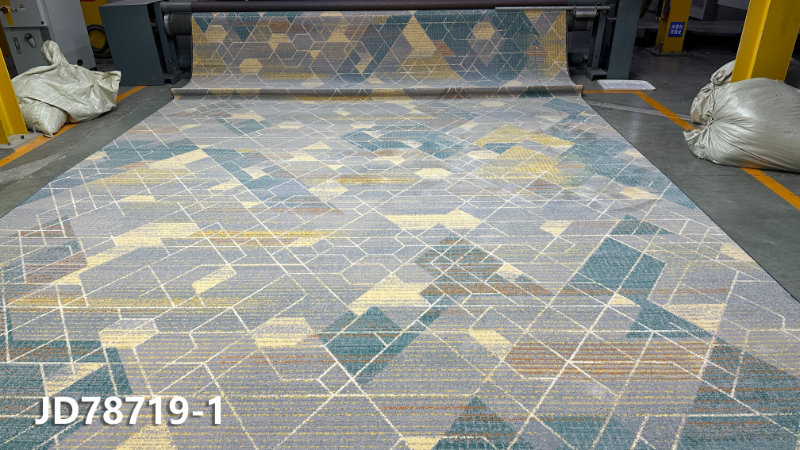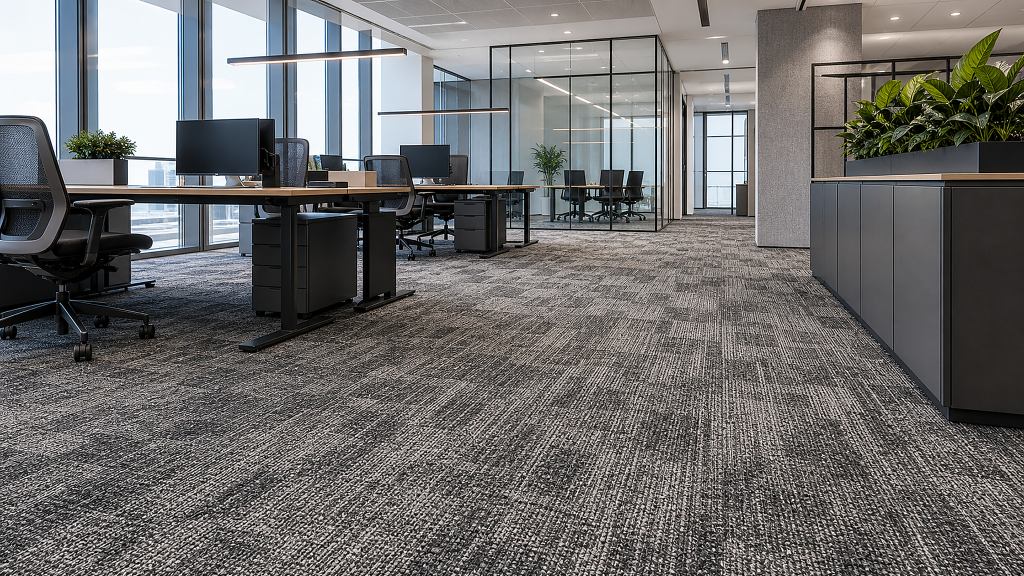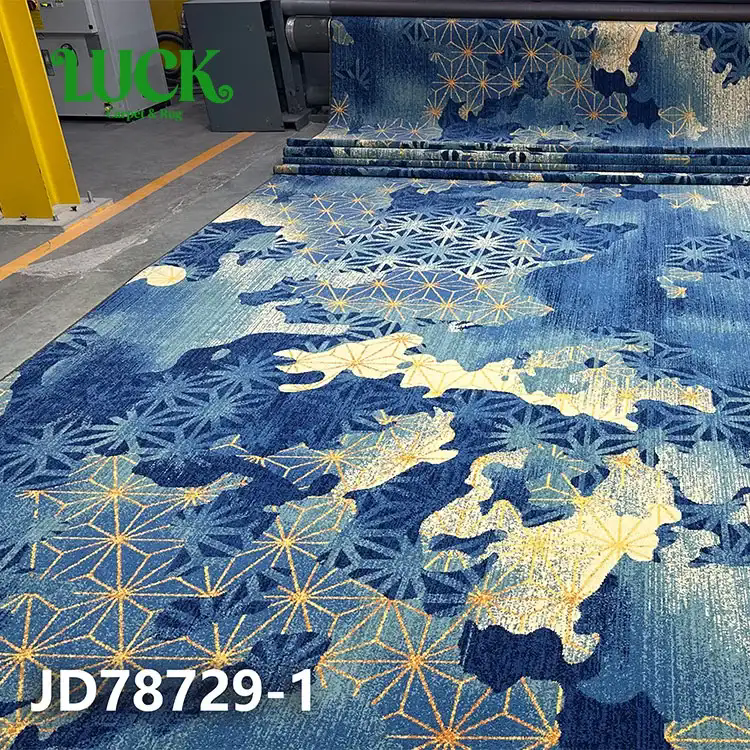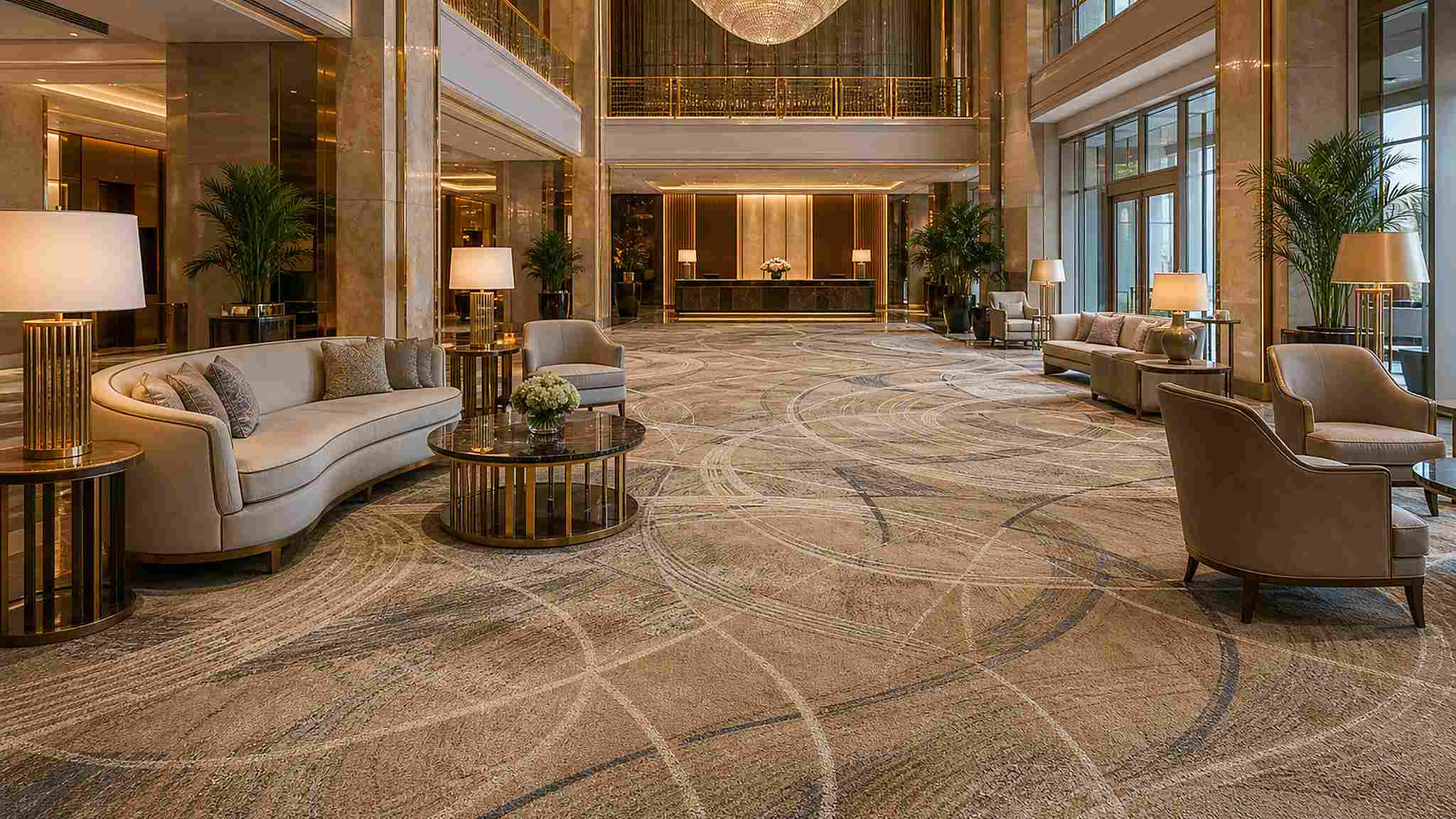
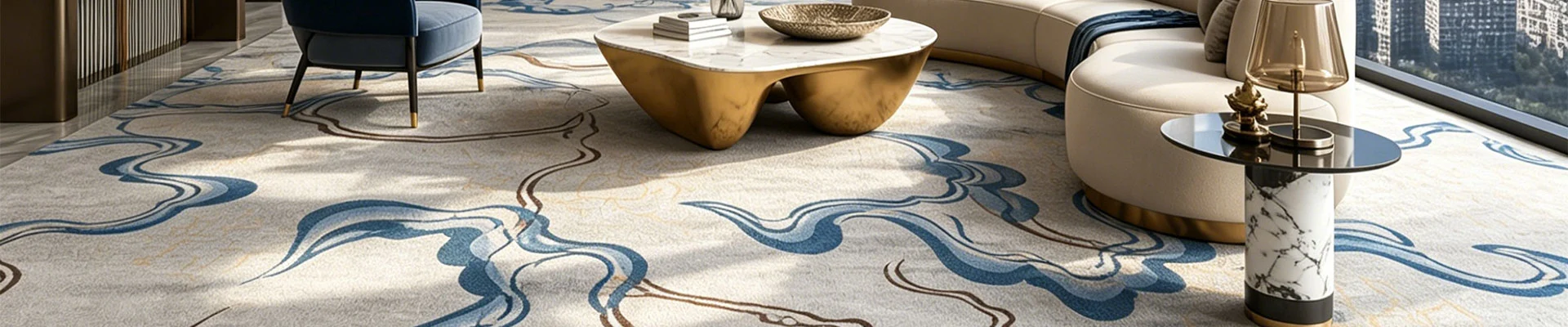
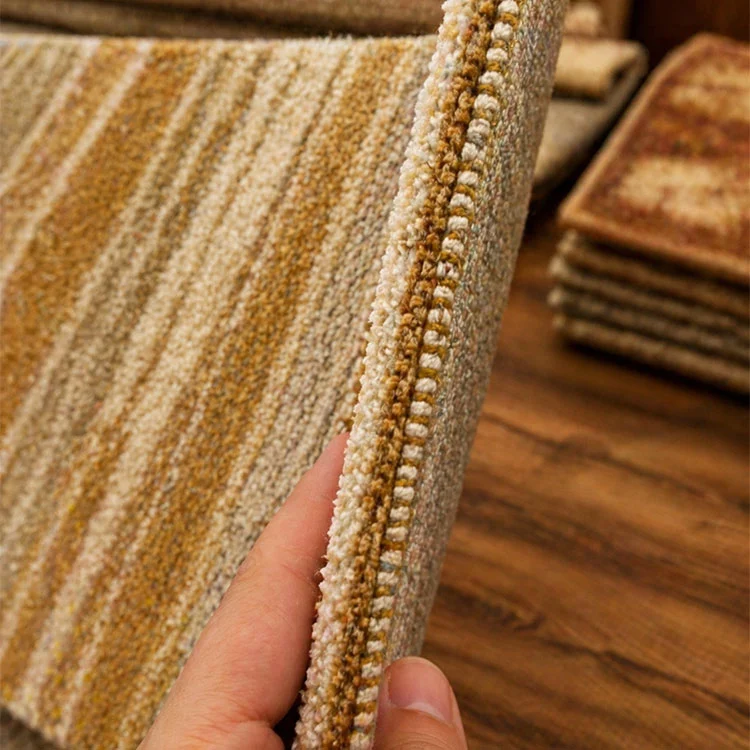
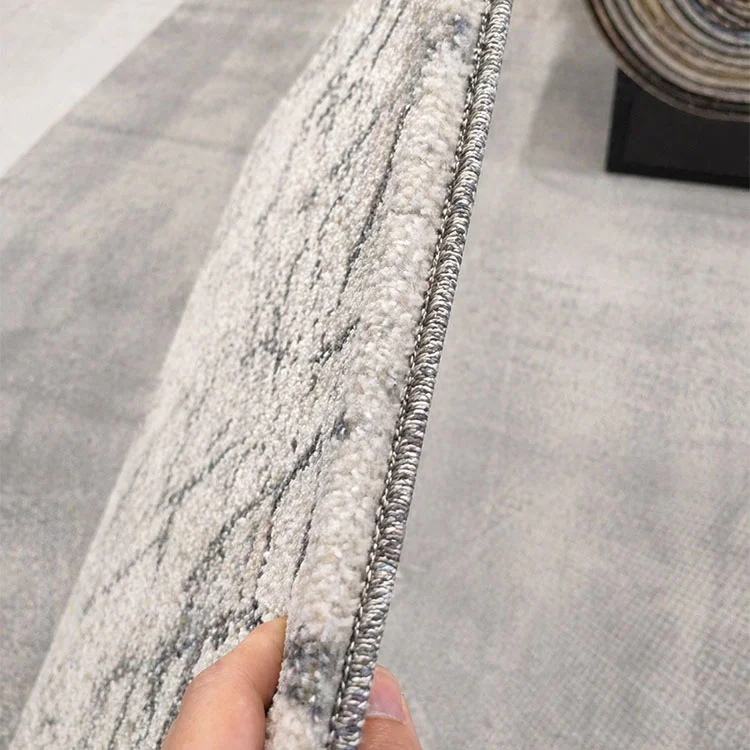
LUCK Carpet weaves this rug on Wilton looms in Foshan, Guangdong, from 100 % wool at 8 mm pile height and 1550 g/m² over a natural jute backing. Designers specify it for decoration rather than for traffic: a reception rug, a feature rug under a dining table, a piece that holds a colour scheme together. Because the pattern is placed by the loom's Jacquard mechanism and never printed, colour goes all the way through the pile.
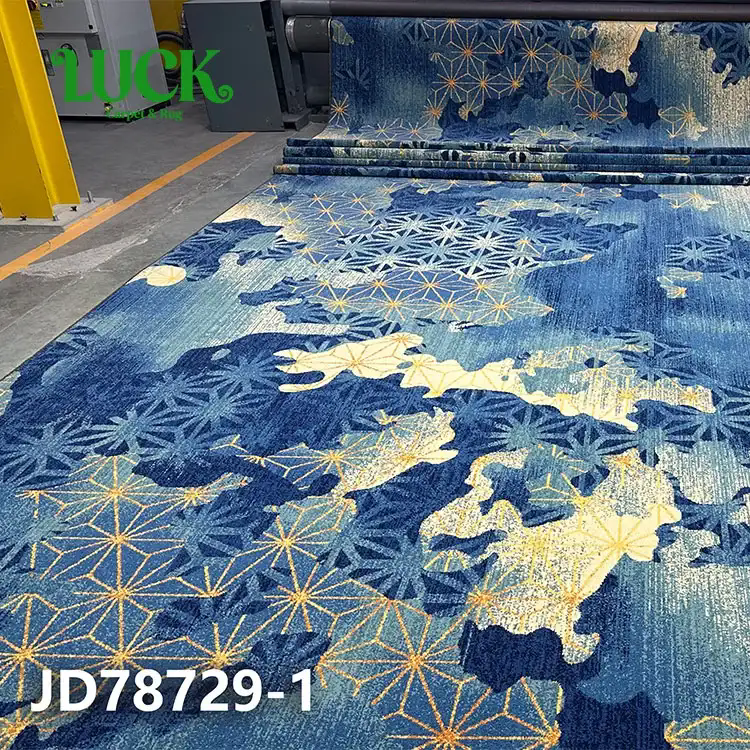
On a Jacquard Wilton loom the design is held as a set of yarn positions. Where the drawing calls for blue, a blue yarn is lifted into the face; where it calls for cream, the loom selects cream. Nothing is laid on top of the surface afterwards, so there is no ink film to crack, no registration to drift along a four metre length, and no pale base waiting to appear when the surface wears.
An 8 mm pile sets a limit that designers need to know before they draw. A woven face at this height cannot hold a hairline: features narrower than about 5 mm lose their crispness, and we advise keeping meaningful line work at 10 mm or more so it reads from the doorway as well as from above. Broad bands, geometric fields and large florals weave beautifully. Fine hatching and tiny lettering do not.
Colour depth is a property of dyed yarn rather than of ink. Wool takes dye deeply and holds it, so the surface carries a slight lustre that shifts with the angle of light instead of reading flat. That is why a woven rug can hold six or eight colours in one pattern without looking busy: every colour has the same light response, because every colour is the same material.
Our Foshan lab keeps the numbers attached to that appearance. Light fastness to ISO 105-B02 records Grade 6 on this construction, which counts under skylights and full-height glazing. Rub fastness to ISO 105-X12 sits at Grade 4, abrasion to ISO 12947-2 at 5 kPa averaged 29,200 rubs to defined change, and dimensional change after wet cleaning to ISO 2551 stays at or below 0.3 %.
Values below come from Foshan QC records on finished rugs. Width / Size is a made-to-order row, and in decoration work that row decides the composition: the rug is woven to the zone, so the border lands where the layout drawing puts it rather than where a standard size allows.
| Style | Wilton Area Rug for Interior Decoration |
| Yarn type | 100 % Wool |
| Pile Height | 8 mm |
| Pile Weight | 1550 g/m2 |
| Backing | Natural jute |
| Fire Resistance | Bfl-s1 (EN 13501-1) |
| Application | Interior Decoration |
| Width / Size | Made to order; standard 1.6 m x 2.3 m, 2.0 m x 3.0 m and custom sizes |
| Pattern | Custom design available (artwork supplied by buyer, strike-off approved before production) |
| Surface / Technique | Woven (Wilton) |
Decoration rugs have to do two jobs at once. They work as objects in a room that already contains a colour scheme, joinery and artwork, and they have to survive being walked on. The three sections below cover pattern, placement, and the errors we are most often asked to correct on site.
Pattern definition starts with the drawing, not with the loom. Send artwork at final rug scale with the border position marked, and we will tell you which details survive a woven pile of this height. As a working rule, a motif needs 10 mm of face width to read cleanly, and a gap between two colours needs the same to stay separate.
Registration matters on large pieces. A four metre rug gives a pattern a long distance to wander, so we check repeat alignment along both axes before the piece leaves the loom and square the edges to the drawing. Two numbers support that discipline: dimensional change after cleaning to ISO 2551 at or below 0.3 %, and a pile height tolerance of +/- 1 mm.
Placement in decoration work is about proportion. A seating group reads as one zone when the front legs of the sofa and chairs sit on the rug by 15 to 30 cm. A dining rug needs 60 to 75 cm beyond the table edge so chairs stay on textile when they are pulled out. In an open plan interior, keep 80 to 100 cm of clear floor along the main walking route.
Feature areas carry the strongest patterns. A reception rug, a rug under a grand piano, a stair hall rug and a formal dining rug can all take a bold geometric or a large scale floral, because the eye expects to stop there. Corridors and secondary spaces want restraint, and a rug that repeats the joinery timber exactly looks accidental rather than chosen.
Clashing colour is the error we are asked to fix most often, and it usually begins with a screen. A pattern approved from a digital file can arrive in the room warmer or cooler than the scheme, because wool reflects light differently from a monitor. The remedy is physical: request yarn wraps, ask for a woven strike-off, and look at it in the room under the actual light sources and beside the actual joinery sample.
Scale errors are the second problem. A small repeating motif that looks elegant on paper can look busy across a large area rug, and a large motif that works in a hall can overwhelm a compact sitting room. Two habits prevent it: lay the pattern out at full size in paper on the floor before the loom is programmed, and keep one pattern as the feature while everything else stays quiet. At DOMOTEX Hannover we asked 40 interior designers what ruins a feature rug, and 32 put pattern scale ahead of colour.
A designer-led refurbishment of a hillside villa in Marrakech needed three feature rugs for an open plan living space, a formal dining area and a stair hall, 84 m² in total. The scheme was warm walnut joinery, brass detailing and deep green upholstery, and the clients wanted a geometric pattern with enough presence to hold the centre of the living room without competing with the view through the glazing.
We wove the three rugs in one dye lot with four loom colours, squared the borders to the room axis, and supplied a full size strike-off that the designer checked on site under the installed lighting. The scheme was approved in one sample round instead of the three the designer had budgeted for. Twenty-two months later the window-side rug still matched the retained strike-off.
Test reports travel with every decoration rug from our Foshan lab: abrasion to ISO 12947-2 at 5 kPa abrasion to ISO 12947-2 at 5 kPa, light fastness to ISO 105-B02, wet and dry rub to ISO 105-X12, and dimensional change after wet cleaning to ISO 2551. Fire performance sits at Bfl-s1 under EN 13501-1, a classification supported by radiant panel testing to EN ISO 9239-1 and small flame testing to EN ISO 11925-2. For contract interiors we also quote the duty classification to ISO 10874. Our Foshan plant has exported woven and printed carpet for 14 years with 180 staff, and third-party inspection by SGS, Intertek or BV can be arranged before loading. Construction carries a 10-year warranty.
Can you match a rug colour to a fabric or paint reference?
Yes, and we prefer a physical target. Send a cutting of the upholstery or a painted panel rather than a screenshot, because screen colour and wool reflectance do not correspond. We dye to the physical reference, then send yarn wraps and a woven strike-off for approval in the room under its own lighting.
What is the smallest detail you can weave at this pile height?
Plan for 10 mm of face width on any line or motif that must read cleanly, and treat 5 mm as the practical floor below which adjacent colours soften into each other. Broad geometric fields, large florals and tapestry motifs are ideal. Very fine hatching, small lettering and single-pixel gradients should be simplified before the loom is programmed.
Do you supply a layout drawing before weaving?
Every custom order starts with one. We mark the rug outline on your floor plan, show the border position and the pattern direction, and issue a full size paper layout with the strike-off. Furniture positions, door swings and the walking route are checked at that stage, because a size change after the loom is set costs far more than a drawing revision.
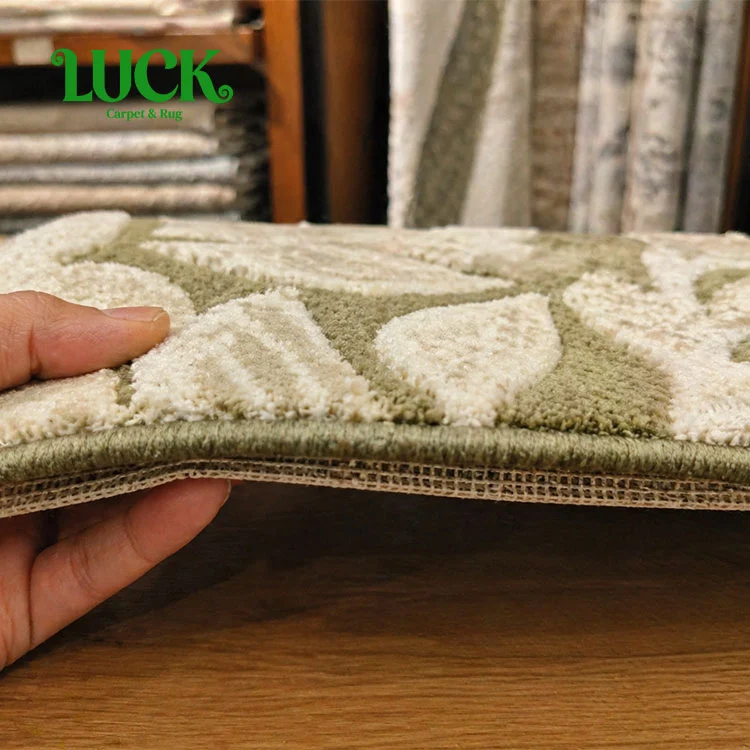
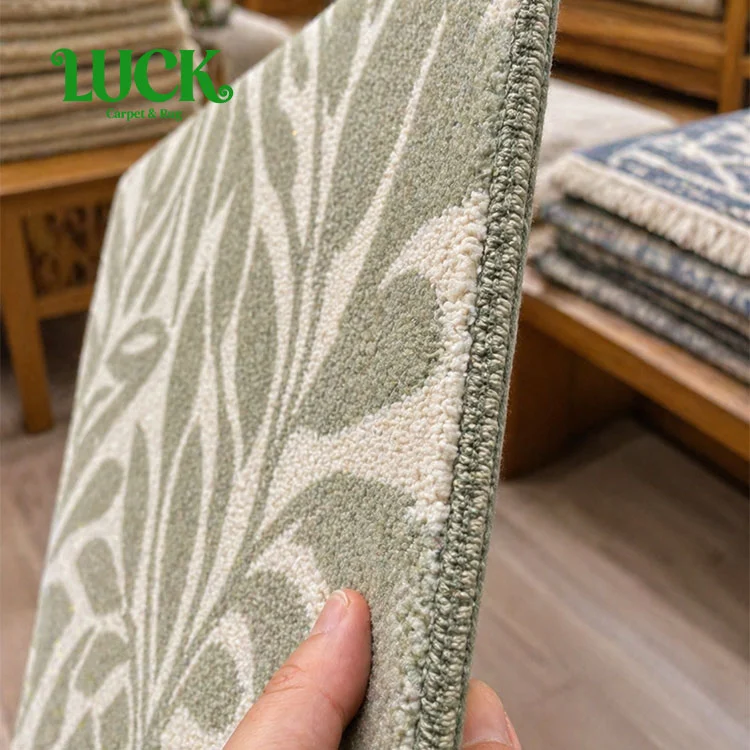
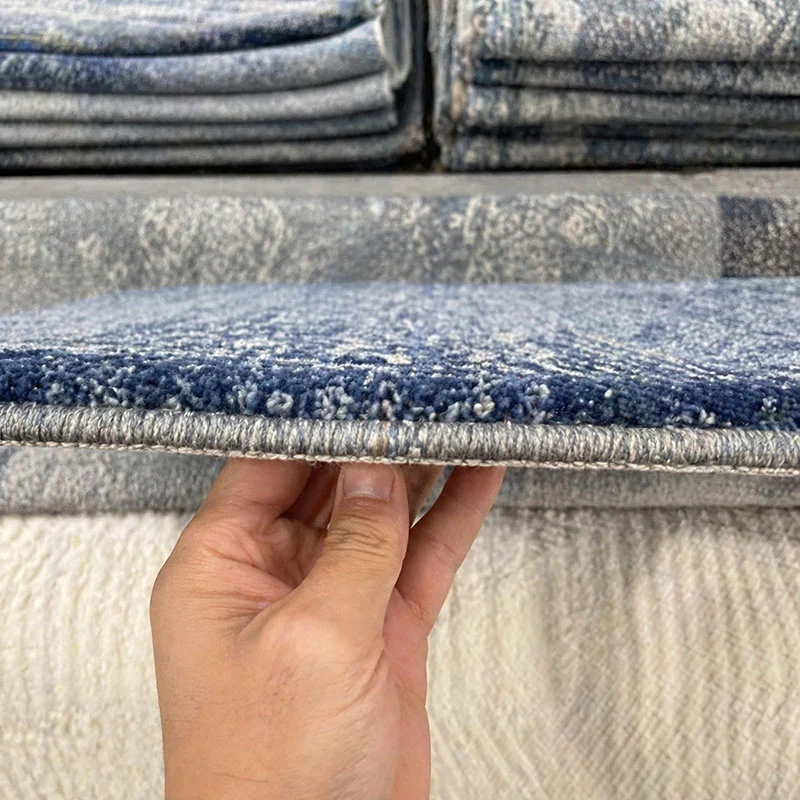
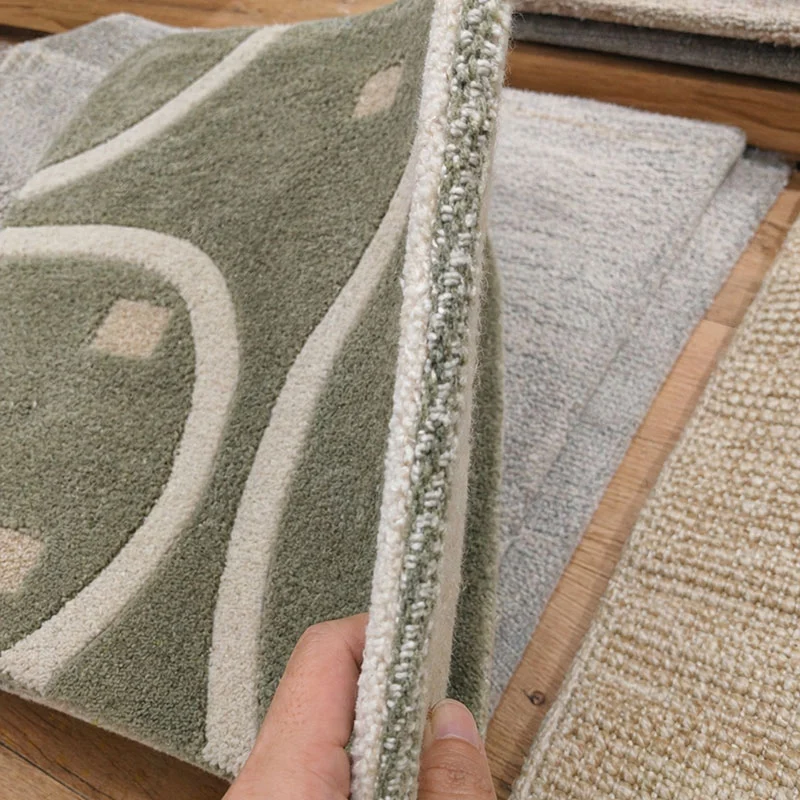
Subtle lustre is what separates a woven wool surface from a printed one: colour deepens and lightens as you move through a room instead of reading as a flat field. Pattern edges are woven rather than printed, borders are squared to the drawing, and the jute back shows the woven structure when the rug is lifted.
Shipments leave Foshan rolled on a core in a protective wrap, with size, design code, pattern direction and care note marked on the label. A felt underlay is recommended on hard floors and a rug grip pad on polished stone. Minimum order is four pieces per design for feature rugs, with 40 to 45 days of production after strike-off approval. Send LUCK Carpet your layout drawing, colour references and lighting notes, and we will return a woven sample against them.
Address
Shidaigongguan Building No.5 Office 1212, Haicheng east road, Duanzhou District, Zhaoqing City, Guangdong Province, China
Tel
Copyright © 2026 Zhaoqing Yunle International Trade Co., Ltd. All Rights Reserved.