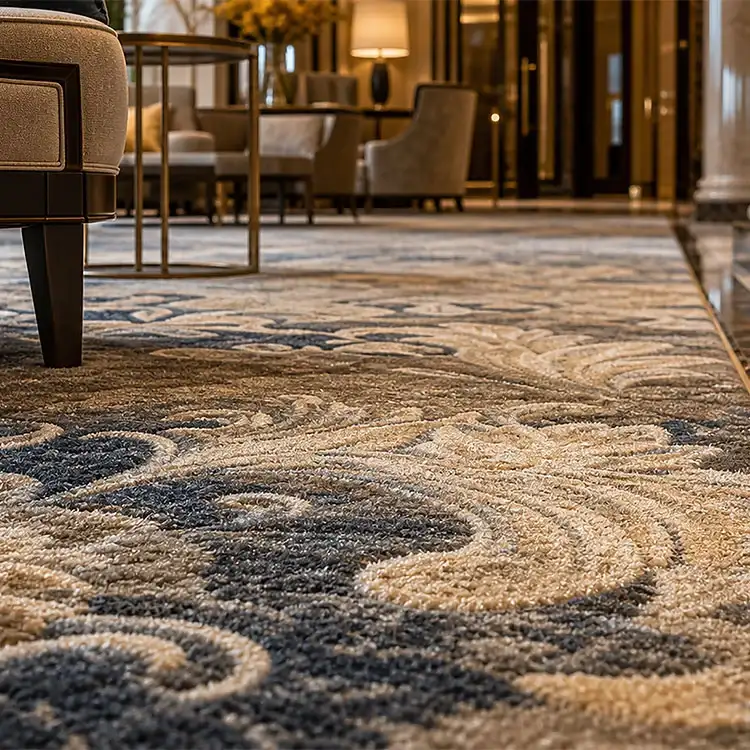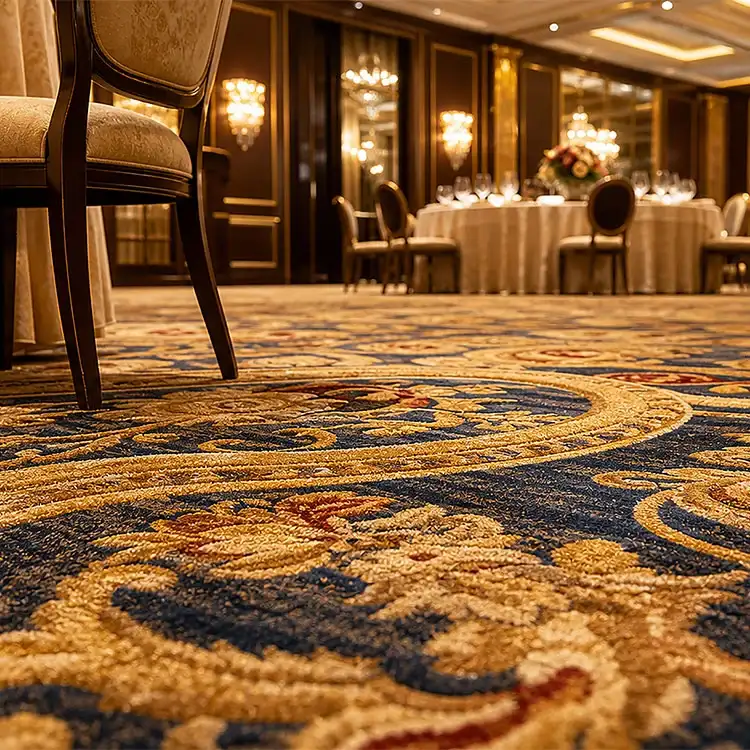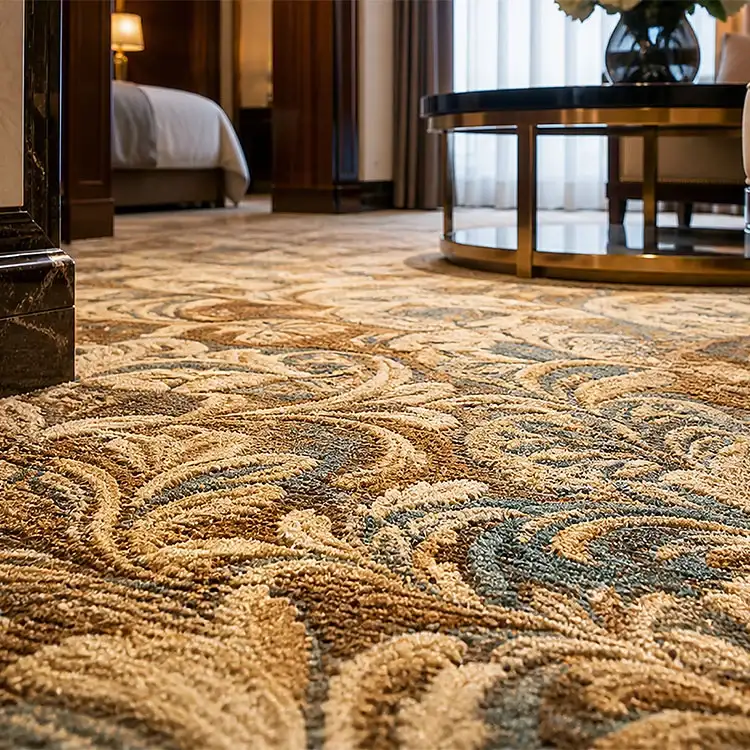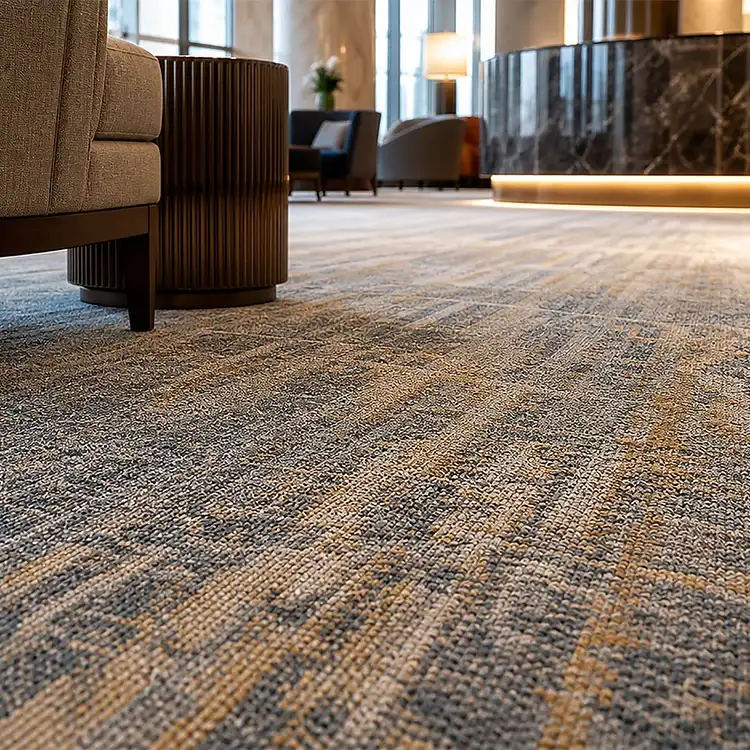


LUCK Carpet is a printed broadloom manufacturer in Foshan, Guangdong, with a 26,000 m² plant and 180 staff. This page covers our Polyester Printed Wall to Wall Carpet for Restaurants: 100 % polyester, a cut pile at 10 mm and 1,200 g/m², printed on a high-definition digital line, steamed to fix the disperse dye, washed in line and laminated to an anti-slip textile backing. The subject here is grease, slip risk and hygiene in a working dining room.
Restaurant carpet has one job that office carpet does not: it has to take food. A 10 mm cut pile at 1,200 g/m² puts a lot of surface area under a table, and surface area is where grease sits. The fibre finish repels oil and water long enough for staff to blot a spill, and the colour lives inside the filament, where a spot cleaner cannot lift it.
Density is the other half of the answer. At 1,200 g/m² the tufts stand close enough together that a dropped fork or a chair leg does not push through to the backing, and the pile springs back after a banquette is dragged sideways. That density costs more per square metre than a thin commercial pile, and it buys a floor that still reads as a dining room after two years.
Our Foshan lab treats restaurant carpet as a chemistry problem as much as a wear problem. Colour fastness to rubbing is measured wet and dry to ISO 105-X12, and this construction records Grade 4-5, the figure that predicts whether repeated spot cleaning will lift the pattern at the busiest table. Dimensional stability is measured to ISO 2551 after three wet-cleaning cycles.
Hygiene testing matters as much as wear testing. Face and backing pass GB 18587-2001 at Class A for volatile organic compounds, the standard a health inspector is most likely to ask about on a textile floor. Print consistency is controlled at the line: we measure the approved strike-off on a spectrophotometer, archive it, and read every print run against it.
These are finished-roll figures from our Foshan plant, taken after printing, steaming and washing. A 10 mm pile at 1,200 g/m² is a deep, dense construction that hides chair drag and takes a spill without the backing showing through. The backing line confirms the anti-slip textile layer, which lets an installer lay the floor on tack strip with no adhesive and no curing smell.
| Style | Polyester Printed Wall to Wall Carpet for Restaurants |
| Yarn type | 100 % Polyester |
| Pile Height | 10 mm |
| Pile Weight | 1200 g/m2 |
| Backing | Anti-slip textile backing |
| Fire Resistance | Bfl-s1 (EN 13501-1) |
| Application | Restaurants |
| Width / Size | 4 m (13.1 ft) usable width |
| Pattern | Custom design available (artwork supplied by buyer, strike-off approved before production) |
| Surface / Technique | Cut pile |
A dining room asks a floor to do contradictory things. It should feel soft enough for a two-hour sitting, hard enough to take a chair pushed back a thousand times a week, and cleanable between services without a drying window. Everything below holds those three requirements together in one construction.
Grease is not a stain in the usual sense. It migrates along the fibre, so a small splash becomes a large shadow over a week, and a water-based cleaner can push it further in. The fibre finish slows absorption enough for a dry cloth to blot the oil, and the dense face limits how far liquid travels between tufts. Blot within a minute and use a mild detergent, never a solvent.
Where this product is the wrong choice: the dishwash area, the bin store, walk-in cold rooms and any floor the kitchen team hoses down. Those rooms need welded vinyl or ceramic tile, and we say so rather than sell carpet into them. In the dining room, the bar surround and the private rooms, one punished section can be lifted and replaced without touching the rest.
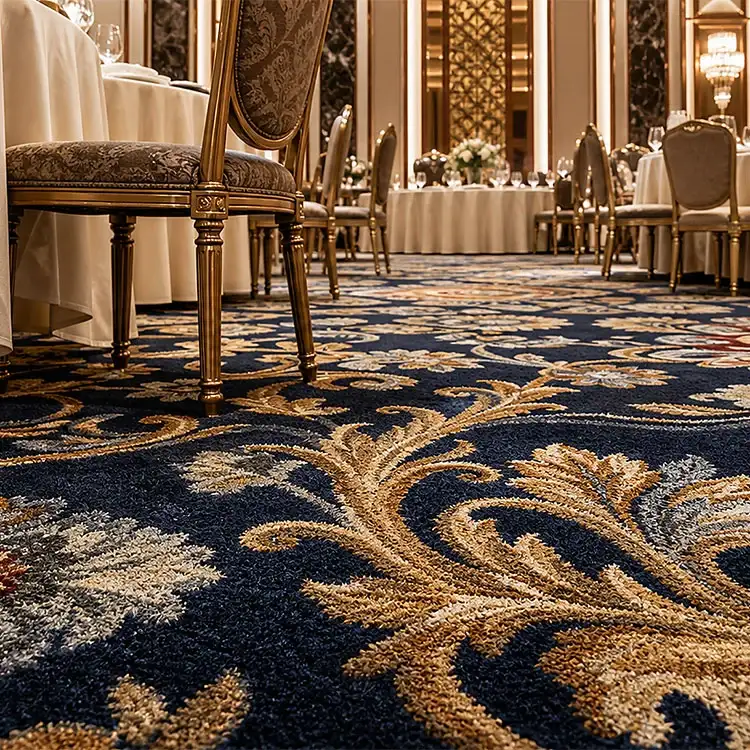
Zones in a restaurant wear at very different rates, and a printed floor can be planned around that. Dining rooms take chair drag from four directions and need a pattern that hides crumbs and shading between services. Banquettes concentrate load along the line where guests slide in, so a seam should never run along that edge. Bar surrounds take standing traffic and dropped ice.
The Bangkok project behind this page was a 780 m² all-day dining room and private dining suite on the eleventh floor of a hotel. The brief was a floor that could take three services a day, including a buffet, and still look right in photographs. We printed one warm patterned field in a single run, delivered nine rolls at the 4 m usable width, and set the seams under the buffet counter.
Two incidents cause most restaurant flooring claims. The first is a slip at the pass, where a server turns with a tray on a floor that has just been wiped. We do not publish a single slip number for a carpet, because the result depends on the backing, the underlay and the screed beneath it. What we supply is the anti-slip textile backing, plus the DIN 51130 R-group and the EN 13893 friction figure for the exact build you specify.
Mildew is the second problem. Spilt drinks, mopping and humid air all push moisture downward, and a non-breathable backing traps it against the screed. The textile backing and the open construction here let the floor dry from below, and routine vacuuming keeps the pile open. A floor that dries within a shift does not develop the smell that tells guests something is wrong.
For a hotel group in Bangkok the brief covered an eleventh-floor all-day dining room, a bar surround and two private rooms on one floor plate. Three services a day, a buffet line, and a floor that had to photograph well. The design had to survive trolley traffic from the kitchen pass, wine spills at the bar and a nightly mop. We printed it in one run and supplied nine rolls at the 4 m usable width.
Twelve months in, the hotel reported what had changed. Spot cleaning had settled into a blot-and-leave routine with a mild detergent, and the two worst table positions were replaced with 40 m² cut from the original roll batch, matching the surrounding floor under the room lighting. Colour there held at Grade 4-5 on the ISO 105-X12 wet rub test after a year of nightly cleaning.


Orders for a restaurant are tested on the same schedule as every other printed batch. Our Foshan lab re-tests the face after each of the three ISO 2551 wet-cleaning cycles, running a wet rub to ISO 105-X12 each time, and the grade has not dropped below 4-5 in the last eight restaurant batches. Abrasion is ISO 12947-2 at 5 kPa, and the last six batches averaged 41,000 rubs to defined change. Tuft bind to ISO 4919 sits at 36 N and backing peel at 32 N/50 mm. Light fastness is ISO 105-B02 at Grade 5, dimensional stability is ISO 2551 at 0.28 %, and VOC performance is GB 18587-2001, Class A.
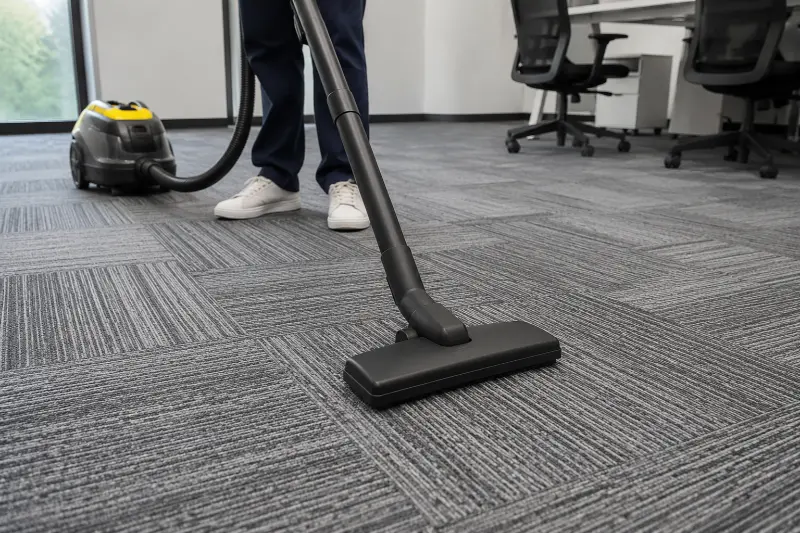
Yes. Routine care is vacuuming plus immediate blotting, and the face is finished so a mild detergent and a damp cloth lift most food spills. What you should not do is flood the pile or reach for a strong solvent, because both push a stain deeper and slow the next service. A hot-water extraction pass once a quarter is enough.
It is, if you accept two things. Light fields show shading where chairs and tables sit, and they show a wine spill immediately, which is either a problem or an advantage depending on your service style. Printed mid-tones and warm patterns hide far more than a plain pale carpet. Keep the palest tones away from the pass and the bar.
Use a dense fibre pad rather than a thick sponge. The pad adds cushion for guests and takes some of the noise out of a full room, but it has to be firm enough that a chair leg does not sink and tear the backing. Under the bar and the pass we often specify a thinner pad or a direct tack strip installation.
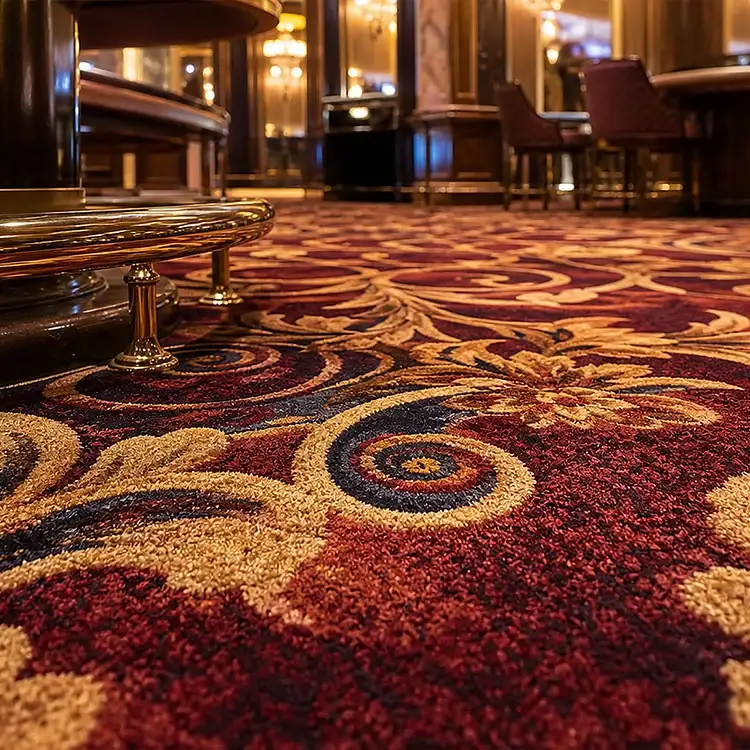
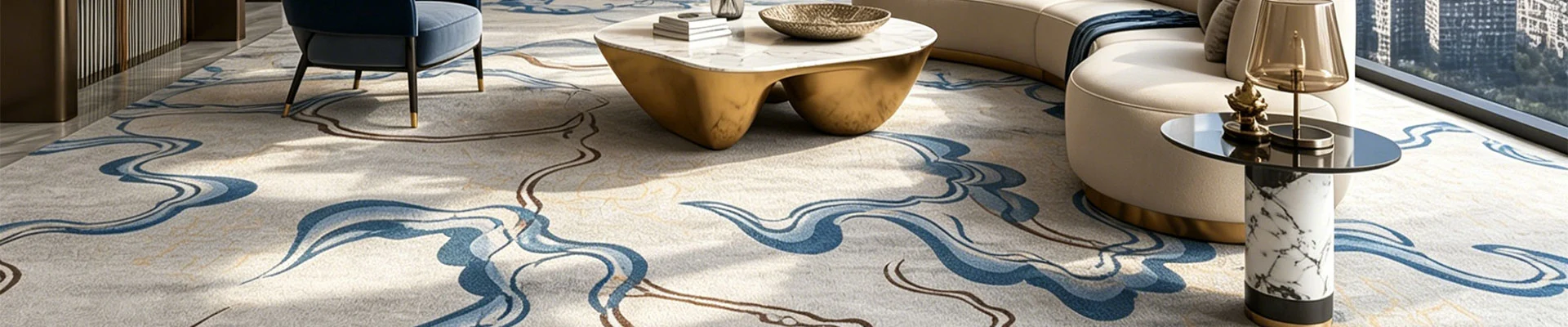
Face depth is where this construction earns its money: a deep cut pile with a matte surface and a soft hand, printed so the colour sits in the pile rather than on top of it. Rich reds, deep greens and warm neutrals all print cleanly, and the pattern can be scaled to the room. Rolls are wound face inward on cores and trimmed straight at the selvedge.
Ordering runs from artwork or a Pantone reference to a digital proof, then to a physical strike-off for approval; bulk printing starts after sign-off. Minimum order is four rolls for a custom print, and we hold the print file so a damaged section can be replaced later with a matching piece. Face pile carries an 8-year warranty. Send LUCK Carpet your seating plan as well as the floor plan, and we will set the seams where the room hides them.


Address
Shidaigongguan Building No.5 Office 1212, Haicheng east road, Duanzhou District, Zhaoqing City, Guangdong Province, China
Tel
Copyright © 2026 Zhaoqing Yunle International Trade Co., Ltd. All Rights Reserved.