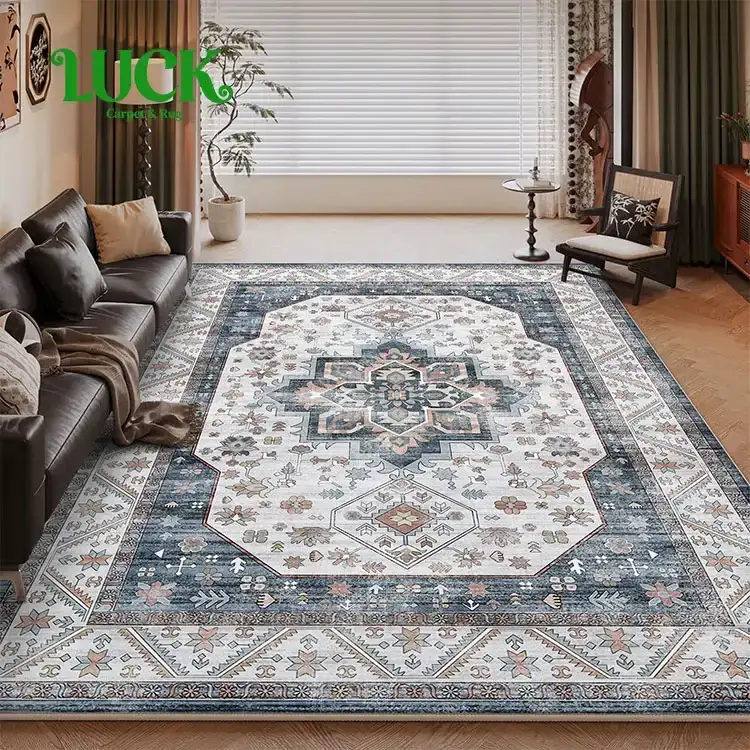
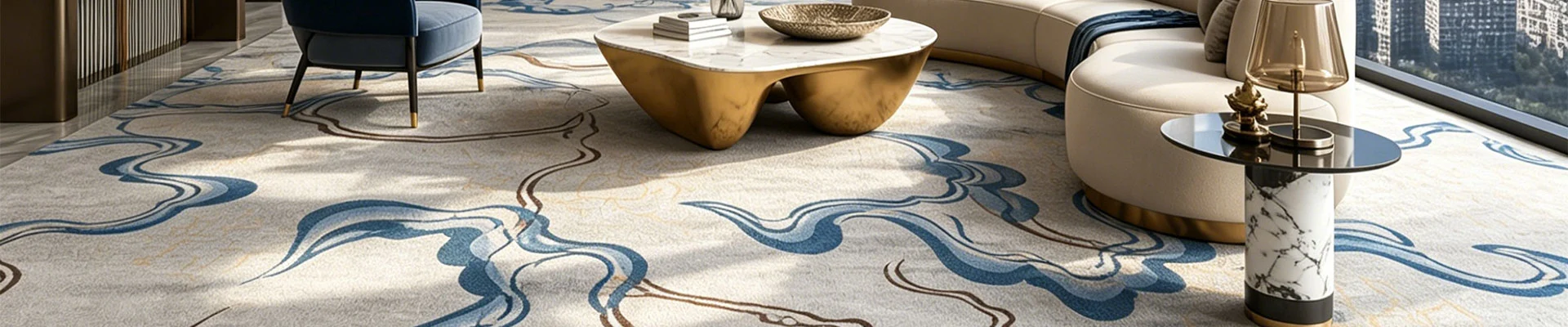
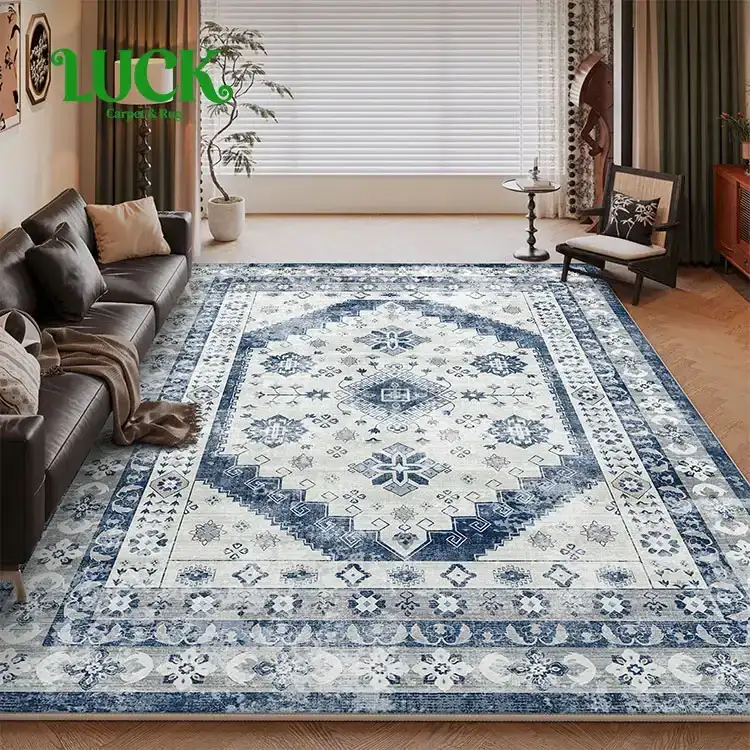
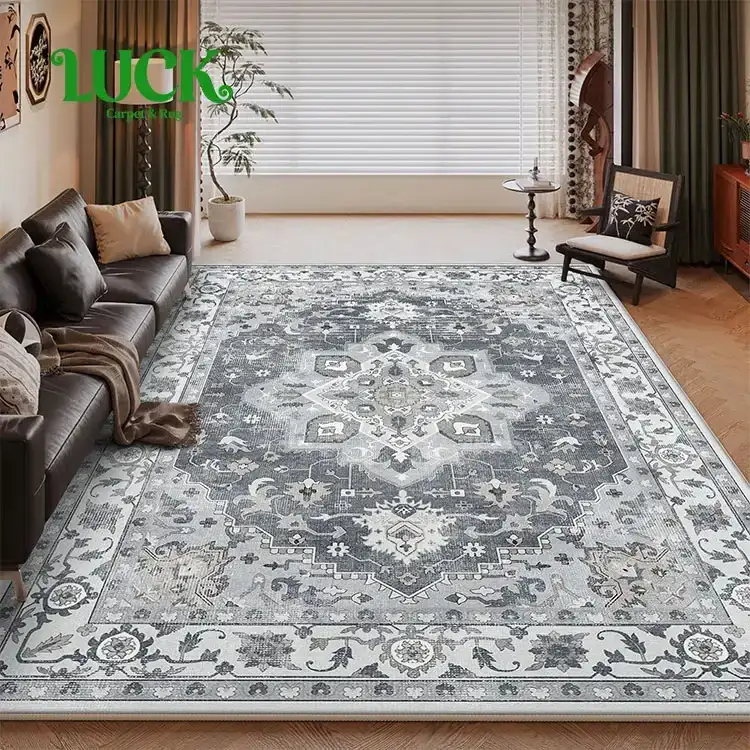
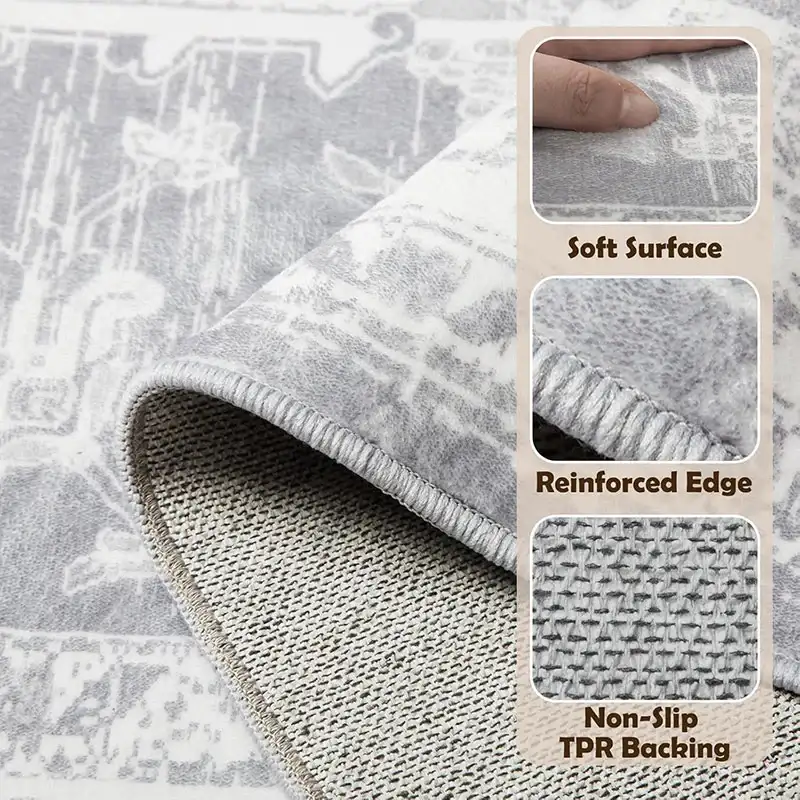
LUCK Carpet makes this printed polyester area rug at our 26,000 m² plant in Foshan, Guangdong, on the same digital print line as our cotton-backed rug but with a different bottom layer: an anti-slip nitrile rubber backing applied under heat and pressure. The face is 100 % polyester at 6 mm and 450 g/m². Entrances, kitchens, bedrooms and living rooms are the rooms it is quoted for, and most of what we ship goes onto hard flooring. Grip is why this page exists, and moisture is why it needs rules.
Nitrile is chosen over cheaper SBR and over PVC for two reasons that matter in a home. It resists oil, grease and the plasticisers used in vinyl flooring, so a mat left in place for a season does not leave a brown outline on luxury vinyl tile or welded sheet. It also holds its shape better under a repeated point load, which is what a kitchen mat takes at the sink. Laminate peel strength measures 30 N/50 mm.
Grip is a property of the assembly, not of the rug alone. Rubber works by conforming to the micro-texture of a floor and pushing air out of the contact patch, so the same mat holds firmly on porcelain tile and slides on a dusty screed. Three substrates are wrong for it: a wet floor, a waxed floor, and a floor carrying loose grit. On those surfaces the backing is not a safety device. Keep this rug out of bathrooms and wet rooms.
Print sealing is where a rubber-backed rug is won or lost. Ink is printed onto the polyester face and cured before the backing is applied, because the heat and pressure of lamination come after the colour is set. Wet rub fastness to ISO 105-X12 sits at Grade 4, so a cloth wrung out over a kitchen mat does not lift colour, and light fastness to ISO 105-B02 records Grade 5. Abrasion to ISO 12947-2 at 5 kPa averaged 23,800 rubs on the last six kitchen-mat batches.
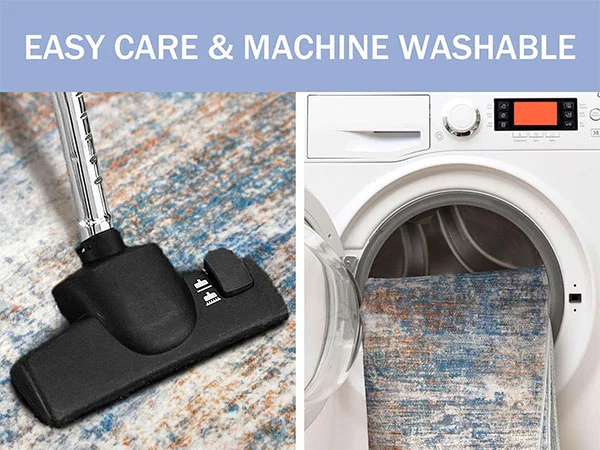
Moisture is the honest limitation. A rubber back seals the floor, so water that reaches the substrate stays there, and a sealed wet layer is where odour and mould begin. We therefore specify this construction for dry, smooth, clean floors and ask buyers to lift and dry the mats weekly in kitchens and entrances. Dimensional change after cleaning to ISO 2551 measured 0.35 % on the worst recent batch, and indoor air emissions report Class A to GB 18587-2001.
The values below are recorded on finished rugs in our Foshan QC lab. One reading note matters more than the rest: Width / Size is a made-to-order row, and grip depends on the mat covering the full width of a doorway, so measure the opening first.
| Style | Polyester Printed Area Rug with Rubber backing |
| Yarn type | 100 % Polyester |
| Pile Height | 6 mm |
| Pile Weight | 450 g/m2 |
| Backing | Anti-slip rubber (nitrile) |
| Fire Resistance | Bfl-s1 (EN 13501-1) |
| Application | Entrance, Kitchen, Bedroom, Living Room, Kids Room, Apartment, Online Retail, Home Decor Store |
| Width / Size | Made to order; standard 1.6 m x 2.3 m, 2.0 m x 3.0 m and custom sizes |
| Pattern | Custom design available (artwork supplied by buyer, strike-off approved before production) |
| Surface / Technique | Printed |
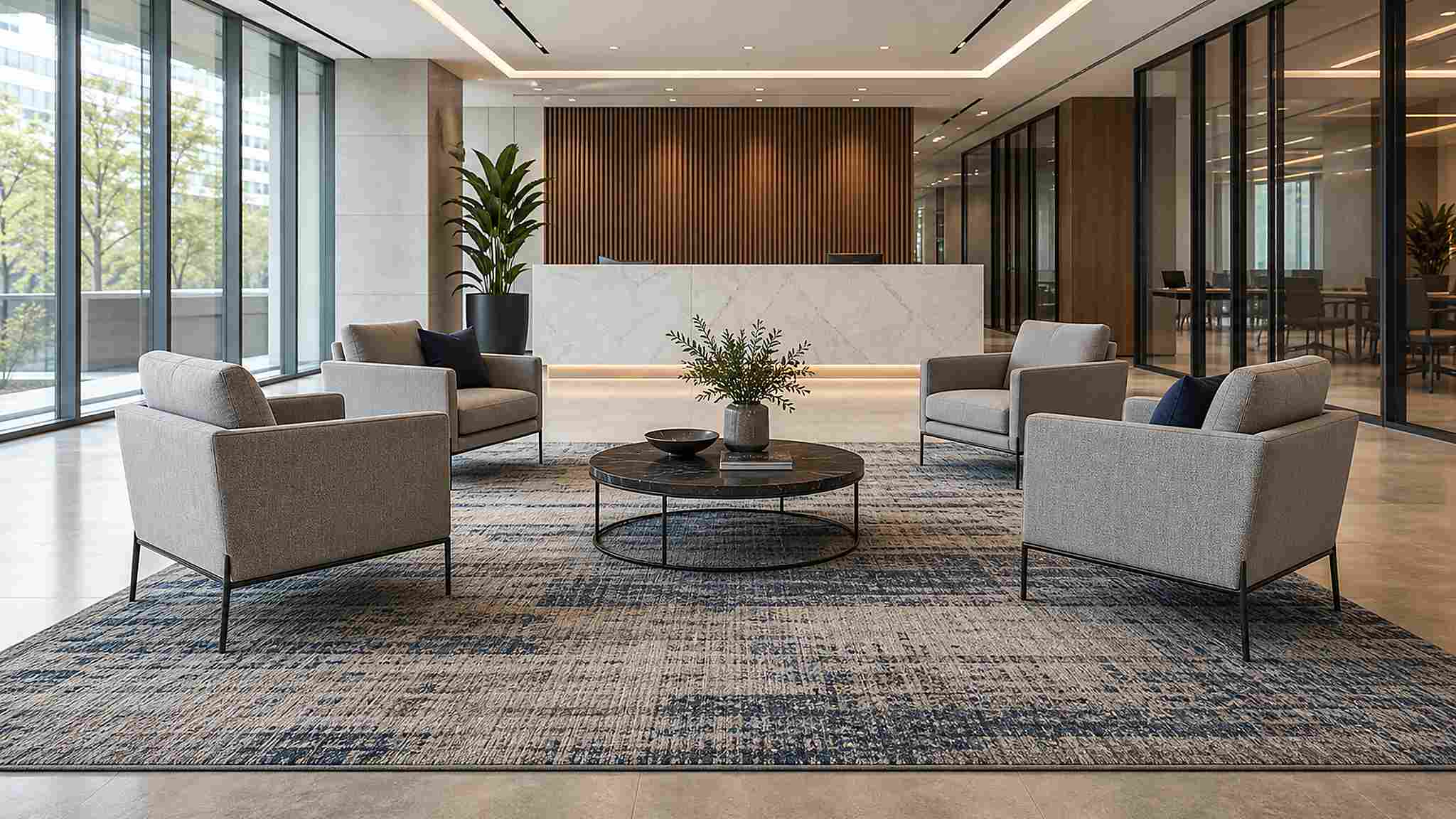
Four rooms justify a rubber-backed printed rug, and each one asks something different of the backing: an entrance that takes rain, a kitchen that takes spills, a bedside where a mat must not slide under a foot, and a family living area where children cross the floor at speed.
Measured grip comes from the assembly, so we test the assembly. Dry dynamic friction on the rug and tile combination is measured to EN 13893, and for the bare tile we ask the supplier for its DIN 51130 R group rather than guessing. What we control is the backing compound, its embossed profile and its weight. A heavier backing increases contact area and resists the sideways kick of a foot pivoting at a door.
Mass helps too. A 1.6 m x 2.3 m rug in this construction leaves our line at about 2.6 kg, most of it in the backing, so a wet shoe landing at an angle moves it far less than a light cotton-backed mat of the same size. Cleanliness still decides the outcome. A film of cooking oil defeats any backing, and a mat mopped over week after week will glaze and lose grip.
Entrances want a mat wider than the door and long enough for two steps, so grit is caught before it reaches the hallway. Kitchens want the mat in front of the sink and the hob, clear of the dishwasher door swing. Bedrooms take a smaller format beside the bed, and family living areas take a full-size rug where the backing stops the rug travelling when children run across it.
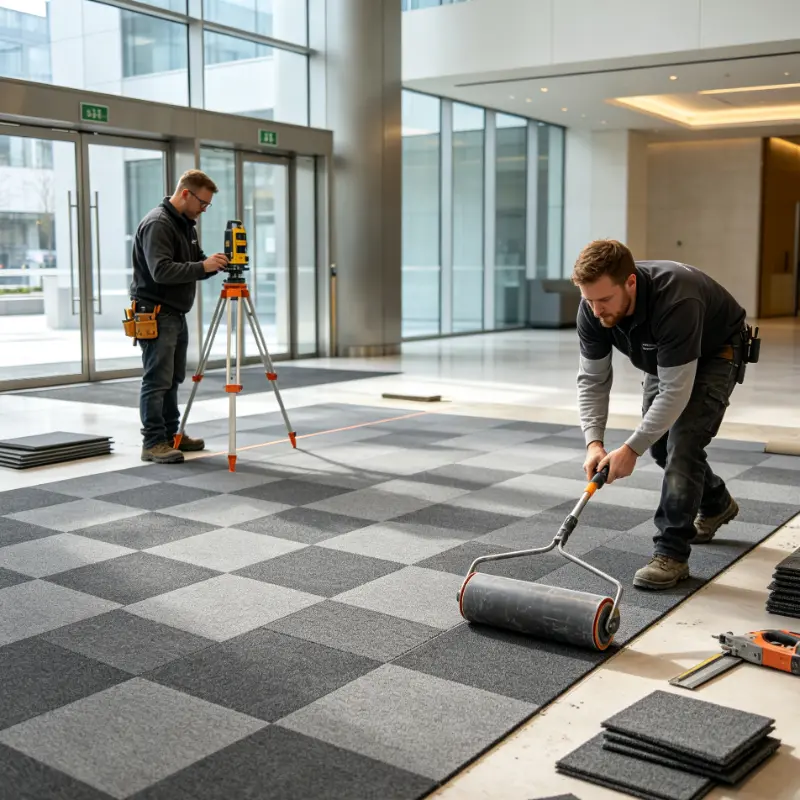
Sizing is the part buyers get wrong most often. A doorway mat 20 cm narrower than the opening leaves two strips of bare floor exactly where wet feet land, and a mat placed where a dishwasher door drops will be pushed and folded every time it opens. Our standard formats cover most living areas, and the custom route handles runners for galley kitchens and long halls.
Slip at a doorway is the complaint that reaches us most often, and the cause is rarely the backing. It is usually a mat that is too small, a floor that has just been mopped, or a curled corner left over from storage. A curled corner is a trip edge, so unpack, lay the rug flat for a day and reverse roll it if the memory is stubborn. Replace any mat whose backing has gone shiny.
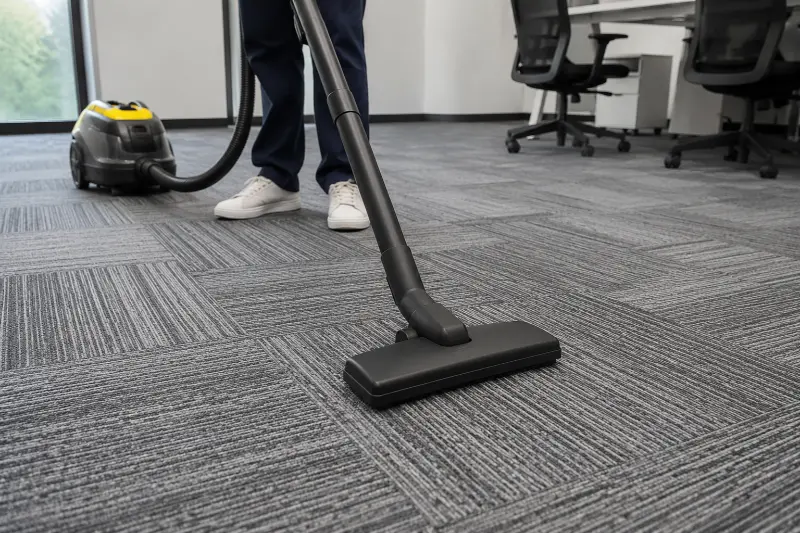
Trapped moisture is the second complaint. When a rubber-backed mat sits on a floor that stays damp, the substrate cannot dry, and after a few weeks the smell tells you before any stain does. The routine that prevents it costs seconds: lift the mat, let the floor dry, and stand the mat on edge overnight once a week. Never lay this rug over a screed that has not finished curing.
A Tel Aviv cafe group with fourteen sites along the seafront replaced its entrance and kitchen mats after two winters of complaints. The old mats were cotton-backed and drifted on wet porcelain whenever the doors were busy. We supplied 260 printed mats, 186 m² in total, in nitrile-backed polyester, sized so every threshold mat spanned the full door opening plus 15 cm on each side.
Kitchen mats went in front of the pass and the sinks, and each site was asked to lift and dry every mat at closing. Over the following winter the group recorded two slip incidents on matted thresholds against eleven the winter before, and the operations manager estimated 25 minutes of floor drying saved per site per week.
Every batch leaves our Foshan lab with four numbers attached: abrasion to ISO 12947-2 at 5 kPa, light fastness to ISO 105-B02, wet and dry rub to ISO 105-X12, and dimensional change after cleaning to ISO 2551. Fire performance is classified Bfl-s1 to EN 13501-1, supported by EN ISO 9239-1 radiant panel and EN ISO 11925-2 small flame testing. Our lab runs both wet and dry rub on every batch, and the last five kitchen-mat runs finished at the Grade 4 family target in both wet and dry rub. LUCK Carpet has exported printed carpet for 14 years from this plant, where 180 staff run printing and lamination, and SGS, Intertek or BV can inspect a rubber-back order before it ships. The printed face pile is warranted for 8 years.
Can this rug be used in a bathroom or wet room?
No. A nitrile backing seals the floor, and a bathroom floor is wet by design, so water held under the mat has nowhere to go. Use this construction where spillage is wiped up within minutes: entrances, kitchens, utility rooms, beside a bed or a sofa. For a bathroom we would quote a different product.
Will a rubber backing mark a vinyl floor?
This backing is specified partly because it resists plasticiser migration, which is what turns a vinyl floor yellow under some rubber mats. Test it anyway. Put a sample face down on an offcut of your floor under a weight for 72 hours in a warm room, then lift it and look for a ring.
How do we keep a doorway mat from moving?
Span the full door opening with a margin on each side, lay the mat on a dry, clean, unwaxed floor, and run the long edges parallel to the direction people walk. Lift and dry it weekly. If the backing has gone shiny or picked up oil, the mat should be replaced.
Low polyester pile with a matte finish keeps logos legible at standing height and hides the grey of daily grit better than a pale solid colour. Edges are hand-finished and squared before packing, and the rubber backing is trimmed flush so nothing catches under a door.
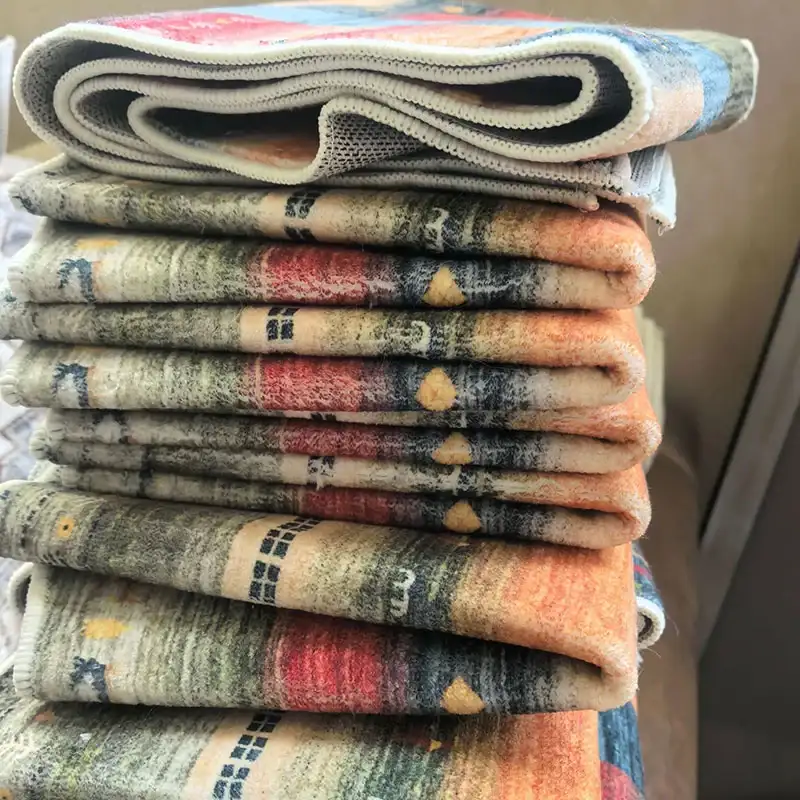
Mats and rugs ship rolled or folded in a polybag with a size sticker, barcode and care note, which suits retail picking and online fulfilment. No underlay is needed, and adding one under a rubber back is a mistake, because two soft layers reduce contact with the floor. Minimum order is 60 pieces per design for a new print, with 25 days of production after strike-off approval. Send LUCK Carpet your floor plan and artwork.
Address
Shidaigongguan Building No.5 Office 1212, Haicheng east road, Duanzhou District, Zhaoqing City, Guangdong Province, China
Tel
Copyright © 2026 Zhaoqing Yunle International Trade Co., Ltd. All Rights Reserved.