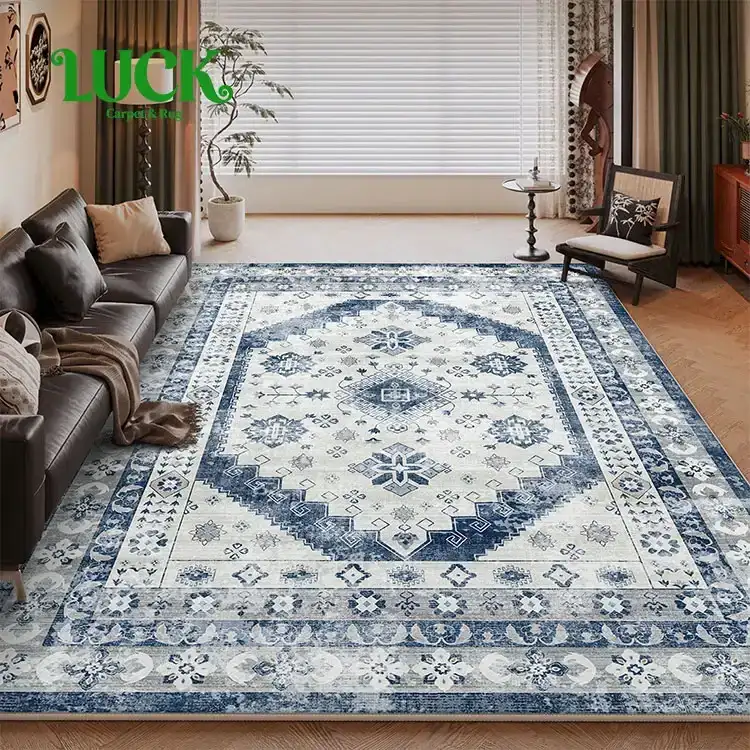
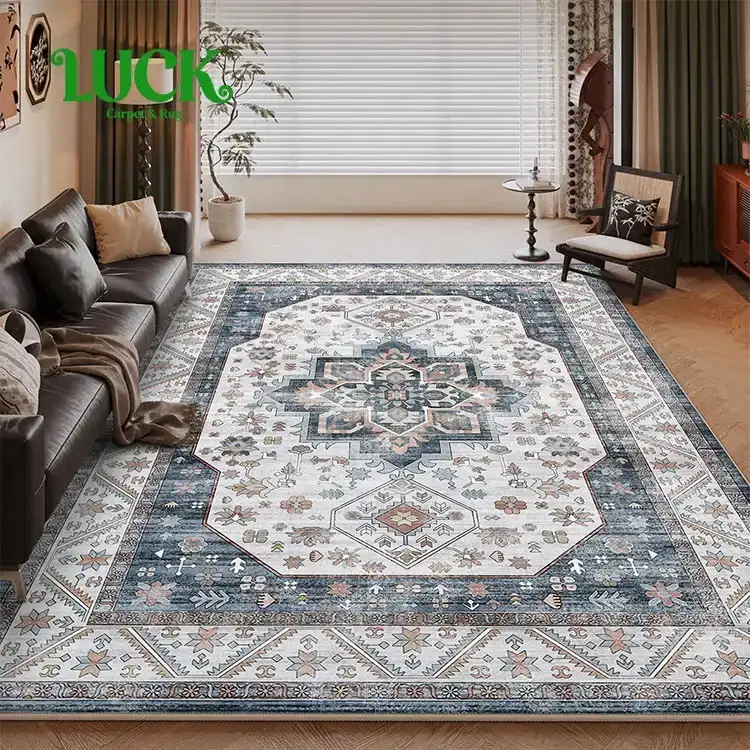
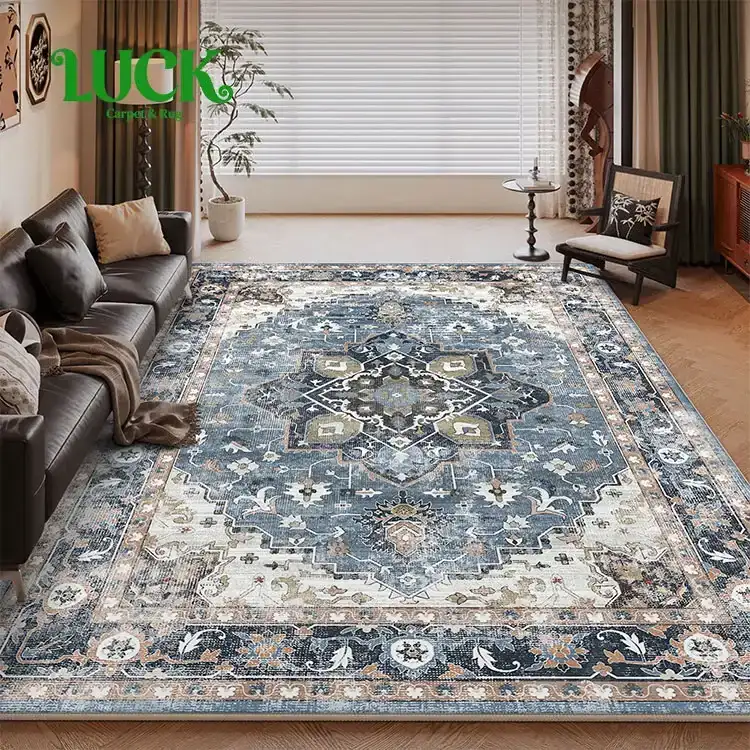
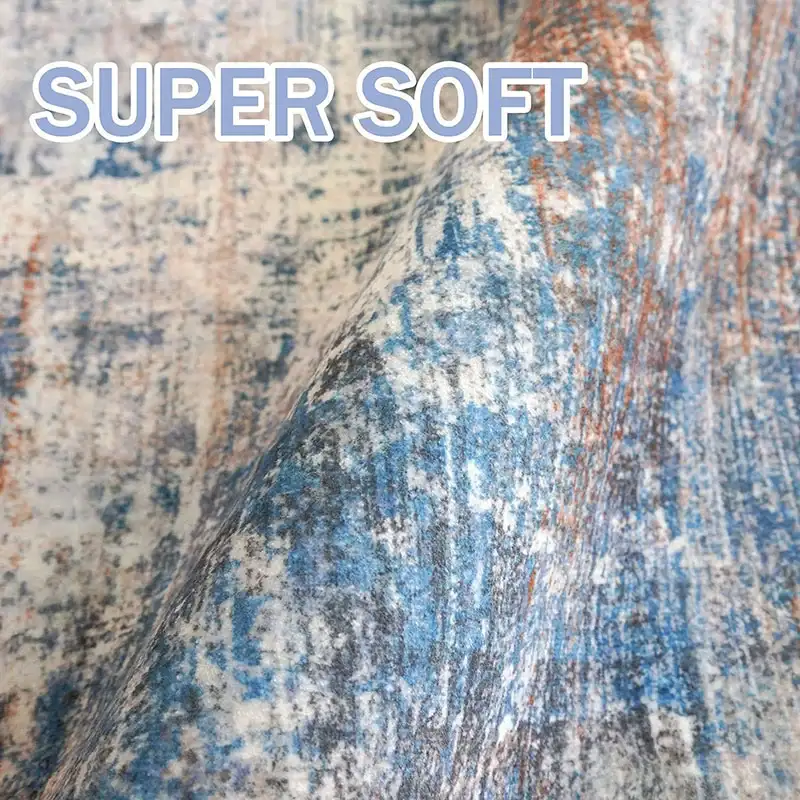
In our factory experience with Polyester Printed Area Rug with Cotton Backing, the difference between velvet polyester and faux-cashmere polyester should be explained through product data that directly affects touch, photo presentation, and printed pattern clarity. For this cotton-backed printed rug, velvet polyester is usually selected when the buyer needs a smoother surface and sharper image reading. We often discuss velvet-style surface fabric in a lighter-to-medium range of about 180–280gsm, because this weight gives the surface enough textile body while keeping the pile direction flatter. A flatter surface helps geometric lines, vintage borders, and small floral details remain clearer after printing. When the design includes thin strokes, we usually recommend keeping the key line width above about 2mm, because lines thinner than this may look acceptable on screen but can visually weaken after the ink meets a textile surface. Faux-cashmere polyester is different. It is usually chosen when the product needs a warmer hand feel and a softer home atmosphere. In our sampling discussions, faux-cashmere surfaces are often planned in a fuller range of about 320–450gsm, because the extra fabric body can make the rug feel more cushioned and more suitable for bedrooms, kids rooms, and cozy living spaces. The trade-off is that a fuller nap can soften very sharp pattern edges, so I usually guide suppliers to use larger motifs, softer gradients, or home-style prints rather than extremely tiny linework. Color planning also changes with texture. A simple velvet rug with 2–4 main color areas can look crisp and commercial, while a faux-cashmere design using 6–10 soft tones can feel richer and more decorative. This is why we do not simply tell buyers which surface is better. We compare fabric weight, surface direction, minimum line width, main color count, and final selling scene, then recommend the texture that matches the product’s real use and photo display.
Our support for suppliers is built around online teaching and fast sample confirmation, so the buyer can move from design idea to physical product with fewer unclear decisions. In a typical new rug development case, I prefer to organize the online guidance into four steps: artwork check, material confirmation, sample requirement, and packing/care review. During the artwork check, we ask the supplier to confirm the final size ratio, image sharpness, and minimum printed detail before sampling; if the file is enlarged for a 160cm × 230cm rug, we check whether the visible pattern still keeps enough clarity instead of only asking for a "high-resolution image." During material confirmation, we usually ask the supplier to choose between 2 surface directions, such as smoother velvet or softer faux-cashmere, and 2 backing directions, such as lighter cotton backing for folding or heavier cotton backing for better body. Before making a physical sample, we normally use a 5-point confirmation list: surface texture, artwork file, color reference, backing choice, and edge finish. After the sample is ready, we review it through 6 inspection points: printed color, image sharpness, hand feel, backing flexibility, edge neatness, and folding recovery. For online sellers, this process is useful because the sample must perform in both product photos and shipping conditions. If a supplier needs fast confirmation, a small sample section or strike-off can first be used to check color and surface direction before discussing full-size production. We do not promise every sample can pass in one round, because artwork complexity, color expectation, material availability, and revision frequency can change the result. What we can do is make the process clearer: one online checklist before sampling, one focused sample review after production, and one adjustment record before moving toward bulk discussion. This is how we support suppliers with practical data rather than vague advice.
| Style | Polyester Printed Area Rug with Cotton Backing |
| Yarn type: | Polyester |
| Pile Height: | 6mm |
| Pile Weight: | 450g/ ㎡ |
| Backing: | Cotton |
| Fire Resistance: | Bfl-S1 |
| Application | Living Room, Bedroom, Kids Room, Apartment, Online Retail, Home Decor Store |
| SIze | Custom |
| Pattern | Custom Design Available |
| Technique | Printed |
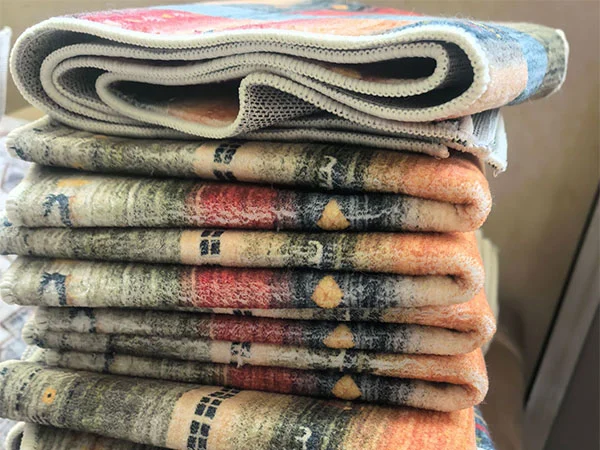
Crease marks on a Polyester Printed Area Rug with Cotton Backing should be handled with a controlled recovery method, because most creases come from folding pressure, carton compression, and warehouse storage rather than from a permanent surface defect. In our packing and sample review work, I usually separate crease treatment into three stages. The first stage is flat relaxation: after opening the package, the rug should be laid flat on a clean floor for about 24–48 hours, allowing the polyester surface and cotton backing to release folding tension naturally. This step works well for light fold marks because the rug body is no longer under carton pressure. The second stage is reverse rolling: if the fold line is still visible, the rug can be reverse rolled for about 6–12 hours, but the printed surface should be protected and the roll should not be too tight. This method is useful because it applies a slow counter-force instead of a sharp pull. The third stage is local pressure adjustment: for raised corners or stronger fold memory, clean flat weight can be placed on the crease area for about 12–24 hours. I usually avoid direct high-temperature ironing, because strong heat can affect printed color, surface texture, and edge stitching. If a buyer wants to test warm air or low steam, I suggest testing a hidden area first and keeping the heat source at least 15–20cm away from the surface. Crease recovery also relates to product structure. A lighter surface and softer backing may relax faster, while a fuller faux-cashmere surface or heavier backing may need a longer flat-rest time. For e-commerce products, this is why we discuss folded packing, roll packing, carton pressure, and unboxing recovery before production, instead of treating crease handling as an after-sales problem only.
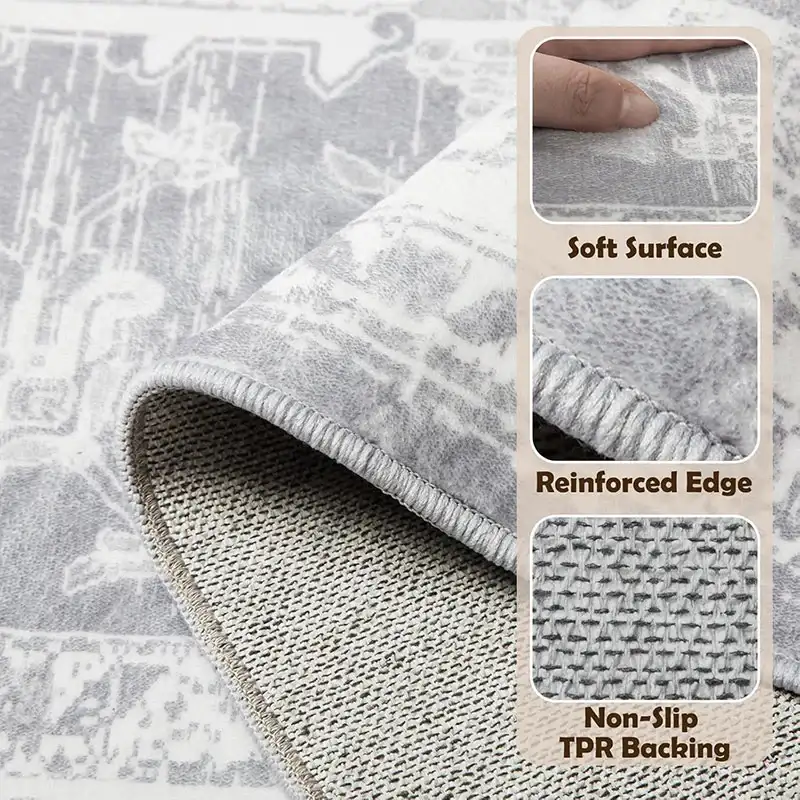
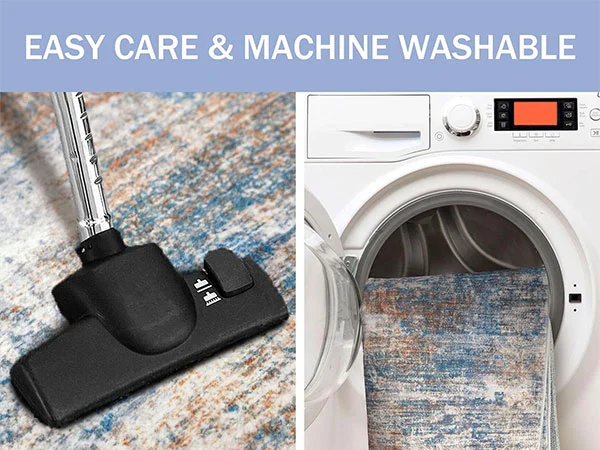
This cotton-backed printed rug can be planned for machine cleaning because the material structure is lighter and more flexible than many heavy traditional rugs, but we judge machine washability through structure data, not through the word "washable" alone. The first reason is the polyester surface. Polyester generally holds less water than wool or cotton yarn surfaces, so after washing it can dry more easily when air movement is good. The second reason is the cotton backing. A cotton backing in a moderate range, such as about 120–300gsm, can bend and fold more easily than a thick rigid backing, making the rug more suitable for a home washer when the size and weight are reasonable. The third reason is edge control. If the edge uses stable overlock or binding with about 3–5mm per stitch, the rug is better prepared for gentle washing than a loose or unfinished edge. I usually remind buyers that a rug can become about 1.5–3 times heavier after soaking, so washer capacity must be considered before cleaning. For small and medium home rugs, an 8kg–12kg washer may be discussed according to the rug’s dry weight, folding volume, and wet load. For washing settings, we usually suggest around 30°C low-temperature water, gentle or delicate cycle, mild detergent, and a lower spin speed around 400–800rpm when suitable. High-speed spinning can stress the edge and backing, while high-temperature drying can affect shape stability. After washing, flat air drying for about 12–24 hours is usually safer than tumble drying, depending on room humidity and airflow. Therefore, the reason this product can be discussed as machine washable is not one single material point; it is the combination of polyester surface, flexible cotton backing, reinforced edge, controlled water temperature, suitable washer capacity, and safe drying method.
Address
Shidaigongguan Building No.5 Office 1212, Haicheng east road, Duanzhou District, Zhaoqing City, Guangdong Province, China
Tel
Copyright © 2026 Zhaoqing Yunle International Trade Co., Ltd. All Rights Reserved.