Products

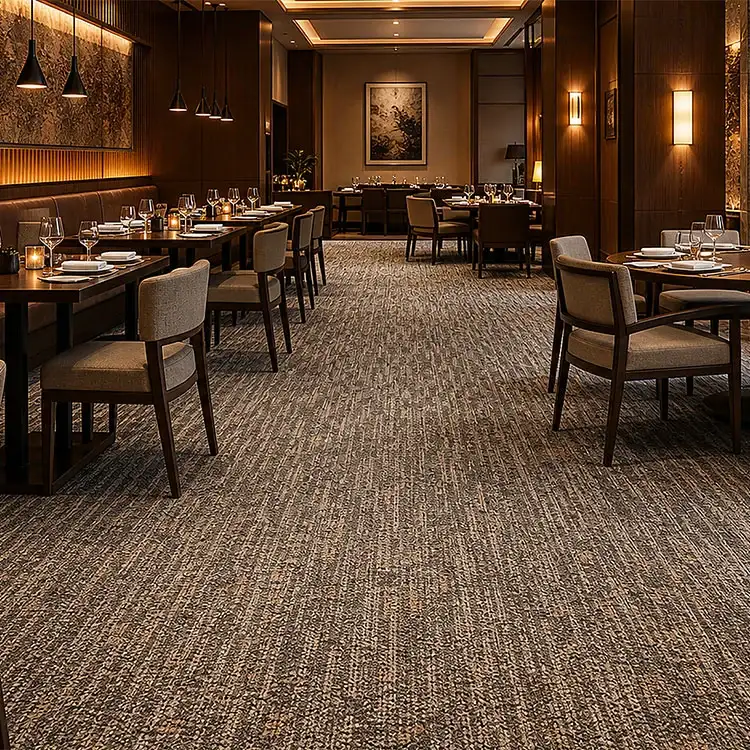
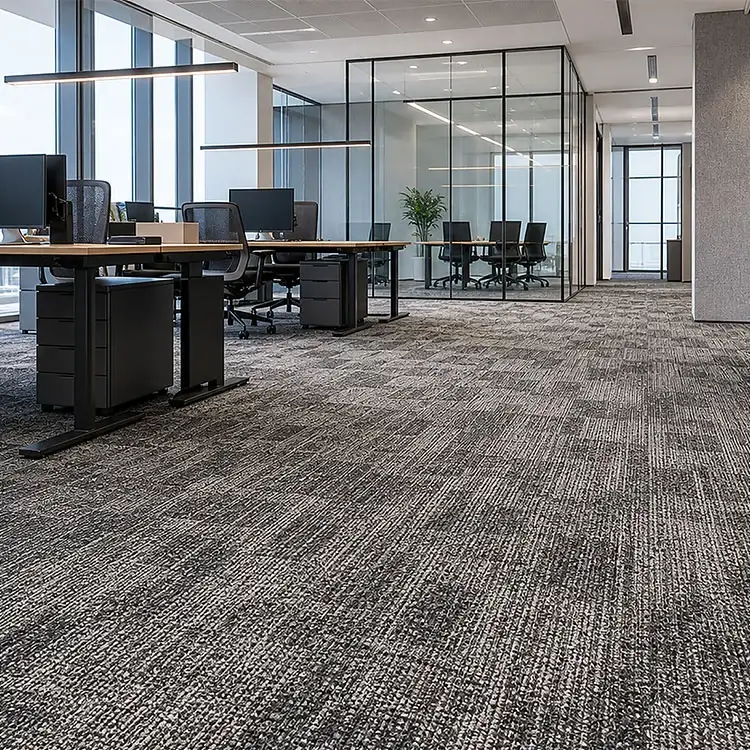
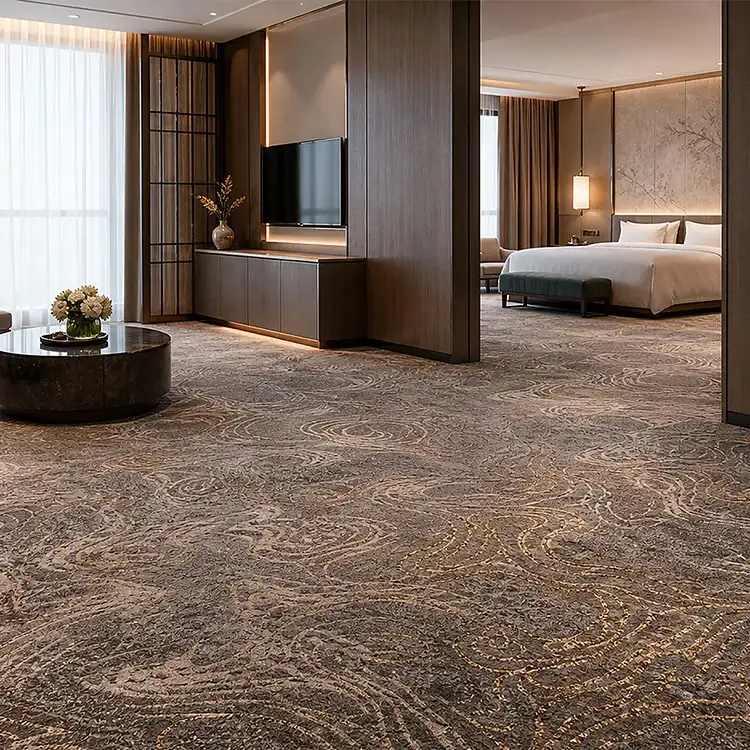
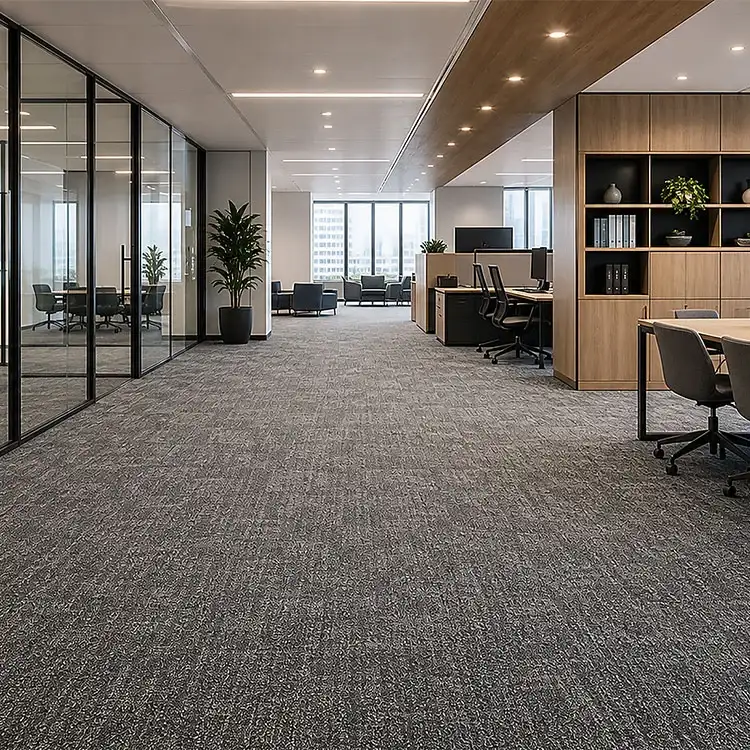
LUCK Carpet is a Foshan manufacturer of nylon tufted wall to wall carpet, and this construction is the one we sell most often to hospitality groups. The face is 100 % nylon cut pile, 6 mm at 800 g/m2, on an anti-slip textile backing in a 4 m usable width. It goes into hotels, serviced apartments, restaurants and members clubs, where guests see the front of the house and staff see the back. Wear levelling is the subject of this page.
Shade continuity is the quiet test of a hospitality carpet. Guest areas are re-done in phases, ten rooms here, one wing there, and drift between phases shows instantly at the doorway where old meets new. We hold the yarn lot record and a retained sample for 24 months after delivery, and we tuft re-orders from a single dye lot wherever the quantity allows. If the original lot has run out, a strike-off goes to you for approval first.
Colour stability under artificial light is the other half. Hotel corridors and restaurants run on warm LED for 18 hours a day, and cheap yarns shift under it within a year. Light fastness on this face measures Grade 5 to 7 to ISO 105-B02, and rubbing fastness Grade 4 to 5 to ISO 105-X12. Our Foshan lab files a spectrophotometer reading for every hospitality lot we tuft; across the last 40 orders the average colour difference between approved strike-off and production roll is Delta E 0.9 under D65.
Front of house takes 400 passes on a busy weekend; a service corridor behind the same wall takes 40, all of them by staff pushing a cart. Both surfaces are 800 g/m2 nylon and both should still look like the same carpet in year five. Wear levelling is a specification decision rather than a maintenance one: the face must be durable enough for the public side without looking industrial on the guest side.
Our use classification for this construction lands in class 33 heavy commercial under ISO 10874, with EN 1307 covering the classification method. Abrasion to ISO 12947-2 at 5 kPa runs 34,000 to 46,000 rubs across production. Thickness loss under static load to ISO 3416 records an 8 to 14 % recovery deficit, which is why a hospitality carpet should never be judged by its appearance in the first month.
All figures come from finished rolls tested in our Foshan lab, not from a sample prepared for a catalogue. Read the table as one specification serving two audiences: the performance rows carry the back of house, and the pattern and surface rows carry the front.
| Style | Nylon Tufted Wall to Wall Carpet for Hospitality |
| Yarn type | 100 % Nylon |
| Pile Height | 6 mm |
| Pile Weight | 800 g/m2 |
| Backing | Anti-slip textile backing |
| Fire Resistance | Bfl-s1 (EN 13501-1) |
| Application | Hotel |
| Width / Size | 4 m (13.1 ft) usable width |
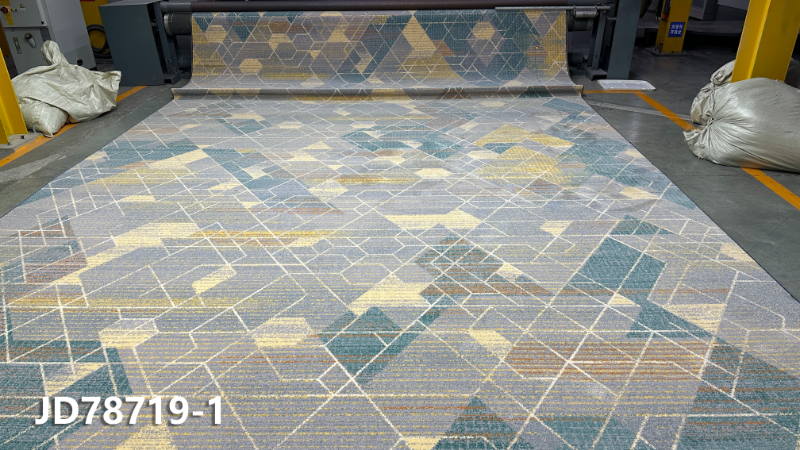
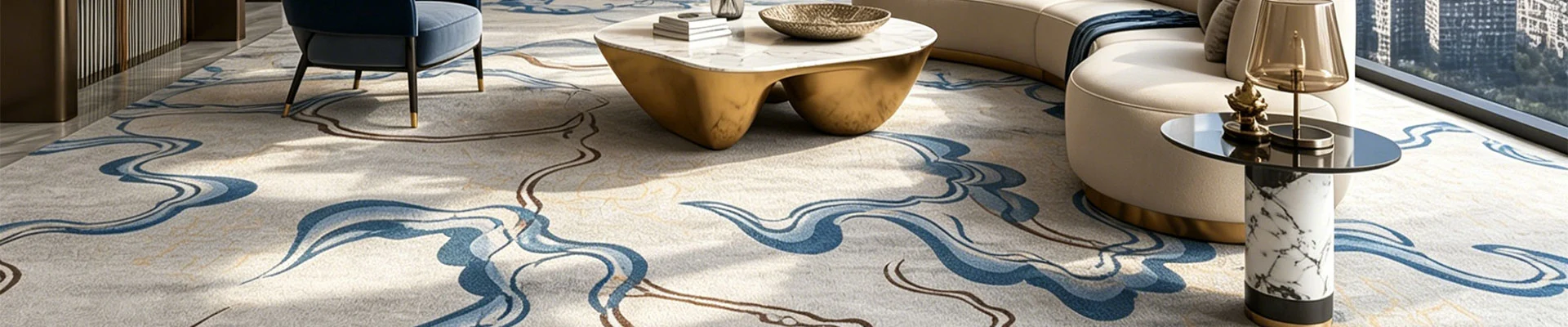
| Pattern | Custom design available (artwork supplied by buyer, strike-off approved before production) |
| Surface / Technique | Cut pile |
Hospitality space is graded by who is allowed in. Guests see the lobby, the restaurant, the corridor and the room. Staff see the service lift, the linen route and the bin store. Clients pay for one carpet across all of it, and these floors are not equal in load, cleaning regime or tolerance for visible wear.
A guest never compares your carpet to a colour card. They compare the strip they walked on at reception with the strip outside their room. Running one dye lot through a whole property removes that comparison. We schedule large hospitality orders as one continuous tufting campaign where volume allows, keeping the same yarn lot, backing lot and finishing settings, so the difference between first roll and last is a lab measurement.
Where a property is too large for one lot, we split by zone rather than by floor, and place the break at a doorway or a turn, never mid-corridor. Retained samples from each lot travel with the delivery note so the installer knows which roll goes where. Third-party inspection at our plant is available through SGS, Intertek or BV, and colour verification falls inside that scope.
Public areas are lobbies, restaurants, bars and meeting foyers. Semi-public areas are guest corridors, lift lobbies and club rooms: seen by guests, cleaned to a guest timetable, carrying lower traffic. Service areas are the back corridor, housekeeping, linen and staff routes. The same 6 mm, 800 g/m2 cut pile suits all three, but underlay and cleaning regime should differ, with daily machine cleaning in public areas and a weekly regime on service routes.
We supplied 2,600 m2 across all three zones of a 148-key boutique hotel in Barcelona, Spain, from 26 rolls, holding one shade from the reception desk to the staff corridor. The brief required a single neutral that would work under warm decorative lobby lighting and cool fluorescent tubes at the back. The measured result, zone by zone, appears in the case study below.
The sharpest edge in any hospitality floor is the threshold between two rooms with different traffic. Pile on the busy side flattens and darkens, pile on the quiet side stays upright, and the change happens across a 40 mm strip. It looks like a manufacturing fault and is almost always a wear levelling fault, fixed by planning rather than by replacement.
Tracked soil is the second common cause. Grit carried from a hard surface into a carpeted room cuts the pile at the point of entry, so the doorway greys before the rest of the floor. Matting or a hard transition zone at each high-traffic threshold extends the life of the carpet behind it. Where a line has already appeared, we re-tuft the affected band from retained stock. For a commercial kitchen, textile flooring is the wrong specification.
Every carpeted surface in a 148-key boutique hotel in the Eixample district was replaced in one programme: lobby and bar, guest corridors on six floors, meeting foyers, and the staff route to the linen room. The package came to 2,600 m2 from 26 rolls at 4 m usable width. The property stayed open, and works ran between 10:00 and 17:00.
Its brief asked for one neutral that would survive a lobby lit with warm decorative fixtures and a back corridor lit with cool fluorescent tubes. We tufted the whole order in a single campaign from one yarn lot and split it by zone, placing the roll break at the service door. Sixteen months on, the hotel reports thickness loss of 10 % in public areas and 4 % on the service route, with no visible shade difference front to back.
Buyers in this sector usually ask about colour before abrasion, so we test both. Light fastness to ISO 105-B02 comes back at Grade 6 on production rolls, and rub fastness to ISO 105-X12 holds Grade 4 to 5 wet and dry. Abrasion to ISO 12947-2 at 5 kPa averaged 37,400 rubs to defined change across our last seven hospitality orders. Tuft bind to ISO 4919 measures 39 N and backing laminate peel 32 N/50 mm. Reaction to fire is Bfl-s1 to EN 13501-1, supported by EN ISO 9239-1 and EN ISO 11925-2, and indoor air quality is Class A to GB 18587-2001. Ask any supplier for the light fastness grade on the dye lot you are buying.


Yes, and we prefer to. A single yarn lot across a property removes the doorway contrast guests notice first. For very large orders we split into lots by zone and put the change at a door, and retained samples travel with the delivery note so your installer knows which roll goes where.
In a mid-market property with daily vacuuming and one deep clean a year, expect 8 to 10 years in public areas and longer on service routes. The 8-year face pile warranty covers pile integrity rather than appearance. Real service life depends far more on entrance matting and on how quickly spills are blotted.
Vacuum daily with a cylinder machine rather than a beater bar, and blot food and wine spills at once with a clean cloth before using a mild water-based cleaner. Deep clean dining areas twice a year. We supply a written maintenance schedule with every hospitality order.
Custom colours and designs start at 500 m2 with 25 to 30 days production after strike-off approval. Stock shades ship in 10 to 15 days above 1,000 m2, and single rolls are available from stock for repairs. Add customs clearance and sea freight time for your destination port.
Dense and matte, the 6 mm cut pile feels firm underfoot and is tight enough that a light neutral does not turn grey in its first season. The 800 g/m2 construction gives the surface body to hold a pattern edge sharply when a design is tufted into it. Rolls are 4 m (13.1 ft) usable width by about 25 linear metres, wrapped in PE film on cardboard cores.
Full-spread adhesive over a dry substrate suits public and semi-public areas; service corridors can use the same system with a shorter open time. Custom design is available: your artwork, our strike-off, no production until you sign it off. LUCK Carpet has exported tufted and printed carpet from Foshan for 14 years with 180 staff on a 26,000 m2 site.


Address
Shidaigongguan Building No.5 Office 1212, Haicheng east road, Duanzhou District, Zhaoqing City, Guangdong Province, China
Tel
Copyright © 2026 Zhaoqing Yunle International Trade Co., Ltd. All Rights Reserved.