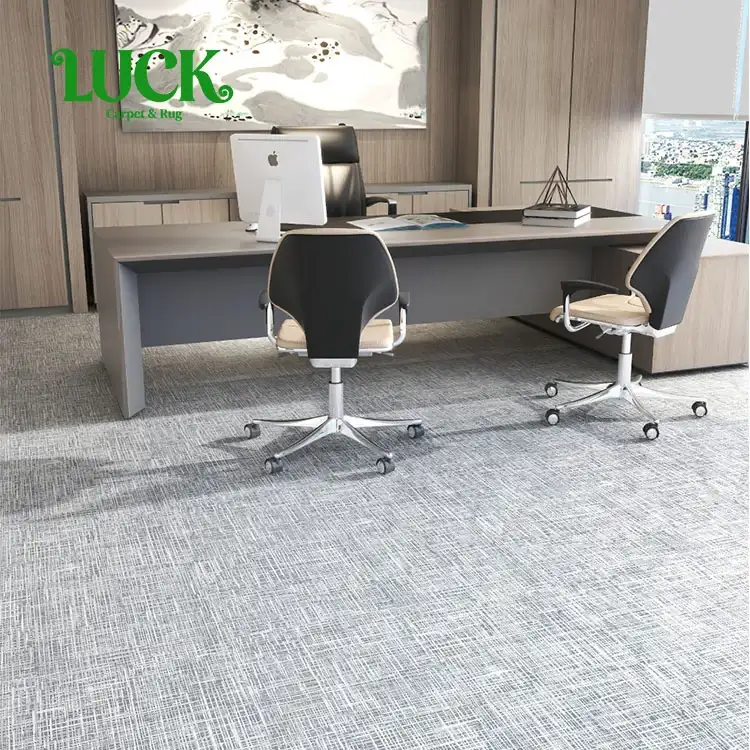
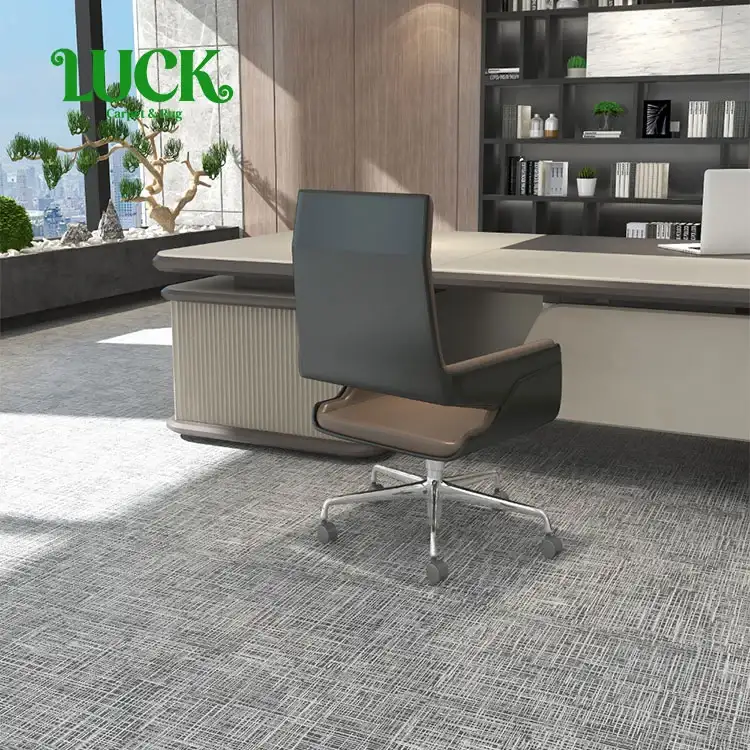
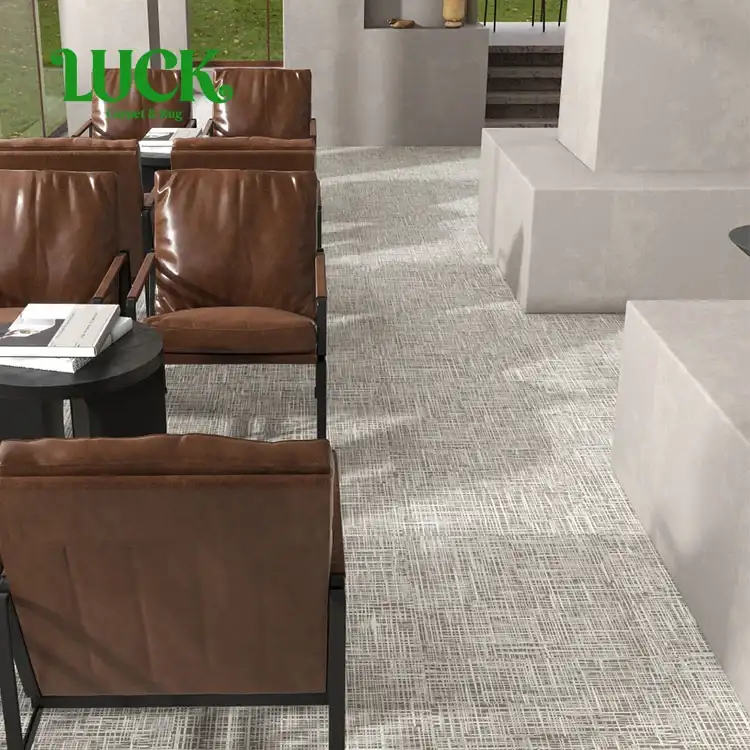
When we talk about printed cut pile carpet tiles with our clients, one of the first things we like to do is flip a tile over and walk through its construction. Understanding what goes into each layer, and why it matters, transforms the way people think about carpet. Too often, the focus stays on the face fiber alone, while the engineering underneath gets overlooked. In our experience, the longevity and day-to-day performance of a carpet tile depend just as much on what you cannot see as on what you can.
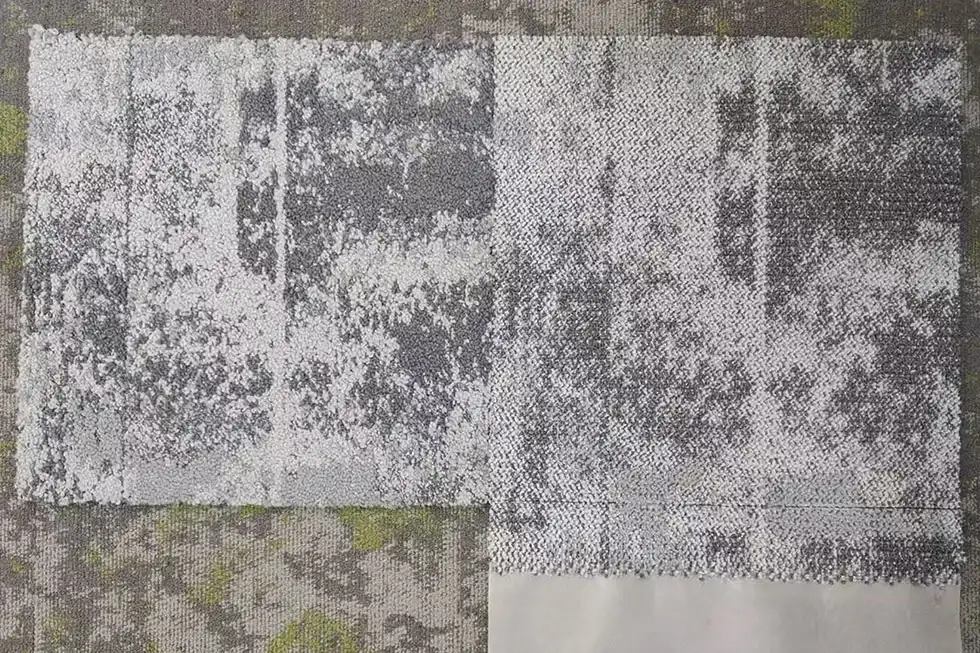
The face fiber layer is the surface you see and touch. For printed cut pile tiles, this is most commonly nylon 6 or nylon 6, 6 yarn tufted into a primary backing fabric. Nylon dominates commercial carpet because it offers an exceptional combination of resilience, abrasion resistance, and dye receptivity. When the yarn is cut at the top of each tuft loop, the result is a dense, upright pile surface that feels plush yet maintains its posture under repeated compression from foot traffic and rolling chairs. The cut pile construction also provides an excellent canvas for digital printing. Modern inkjet printing systems can deposit dye precisely onto the yarn tips with resolutions exceeding 400 dpi, producing photographic-quality imagery and intricate geometric patterns that remain sharp even as the carpet ages. The pile height typically ranges from 3 to 6 millimeters, with a face weight between 400 and 700 grams per square meter depending on the intended traffic level. A higher face weight generally translates to a denser, more durable wearing surface, though it also affects the overall cost and the tile‘s handling weight.
Directly beneath the face yarn sits the primary backing, a woven or nonwoven fabric into which the tufting needles insert the pile yarn. Polypropylene and polyester are the most common materials used here. The primary backing acts as the foundation that holds the tufts in place during manufacturing and provides a stable substrate for subsequent coating operations. Without a robust primary backing, the tufts would lack anchorage, and the dimensional integrity of the tile would be compromised before any other layer is even added. In our production line, the primary backing typically has a unit weight of 50 to 120 grams per square meter, selected to balance strength with flexibility during the tufting process.
After tufting, a precoat layer is applied to the backside of the primary backing. This precoat is essential because it locks the tufted yarns permanently into place. If you have ever seen a carpet where individual fibers pull out easily from the back, chances are the precoat was insufficient or poorly formulated. Most manufacturers, ourselves included, use a synthetic latex compound for this step, often a carboxylated styrene-butadiene or acrylic-based formulation. The precoat penetrates the fiber bundles at the base of each tuft, encapsulating them and bonding them to the primary backing. Application weight generally falls between 200 and 500 grams per square meter. Beyond fiber lock, the precoat also contributes to the tile‘s overall tuft bind strength, a critical metric that determines how well the carpet resists fiber pull-out during vacuuming and daily use.
Next comes the reinforcement layer, and in our view, this is where the engineering becomes genuinely interesting. The reinforcement layer almost always contains a fiberglass scrim or a nonwoven glass mat. Fiberglass has a unique property that makes it invaluable in carpet tile construction: it has an extremely low coefficient of thermal expansion. To put that in practical terms, a nylon carpet tile without fiberglass reinforcement can expand and contract noticeably with temperature and humidity changes, leading to gaps between tiles, edge curling, or doming in the center. The fiberglass layer suppresses this movement. It acts like a rigid skeleton inside the tile, holding the dimensions constant whether the installation environment is a climate-controlled office or a sun-exposed lobby. The typical fiberglass mat weight ranges from 30 to 80 grams per square meter. Some constructions embed the fiberglass within a polymer layer rather than using it as a standalone sheet, which can further enhance the bond between adjacent layers and improve overall tile flatness.
The backing layer is the thickest and heaviest component of the carpet tile, and it largely dictates the tile‘s handling characteristics, its acoustic properties, and its interaction with the subfloor. Three main types of backing materials dominate the industry: PVC, bitumen, and polyurethane. Each brings its own set of trade-offs, and we’ll explore those in detail later. The backing layer serves multiple functions simultaneously. It adds mass, which helps the tile stay in place on the floor without adhesive in many installations. It provides compliance, meaning the tile can conform slightly to minor subfloor irregularities. It absorbs impact sound, reducing the hollow echo that hard flooring surfaces can produce. And it protects the reinforcement layer and the tufted structure from moisture and mechanical wear coming from the subfloor side. A typical backing layer for a commercial carpet tile weighs between 800 and 2, 000 grams per square meter, and the thickness can range from 2 to 5 millimeters.
Some carpet tiles include a secondary backing fabric, often a nonwoven polyester or polypropylene layer, on the very bottom surface. This secondary backing serves as a finishing layer that improves the tile‘s appearance from the underside, provides additional dimensional reinforcement, and in some systems acts as the loop or hook receptor for raised-access flooring installations. Its presence or absence depends on the specific backing system and the intended installation method.
Understanding this layered architecture helps explain why two carpet tiles that look similar on the surface can perform very differently over a five-year or ten-year service life. The face fiber might be identical, but if the precoat is too thin, tuft loss accelerates. If the fiberglass layer is omitted or underweight, the tiles will gap and curl. If the backing is formulated with excessive filler to cut costs, it can crack or crumble when flexed during installation. These are the kinds of trade-offs we think about every day in our production planning, because our reputation depends on getting the balance right layer by layer.
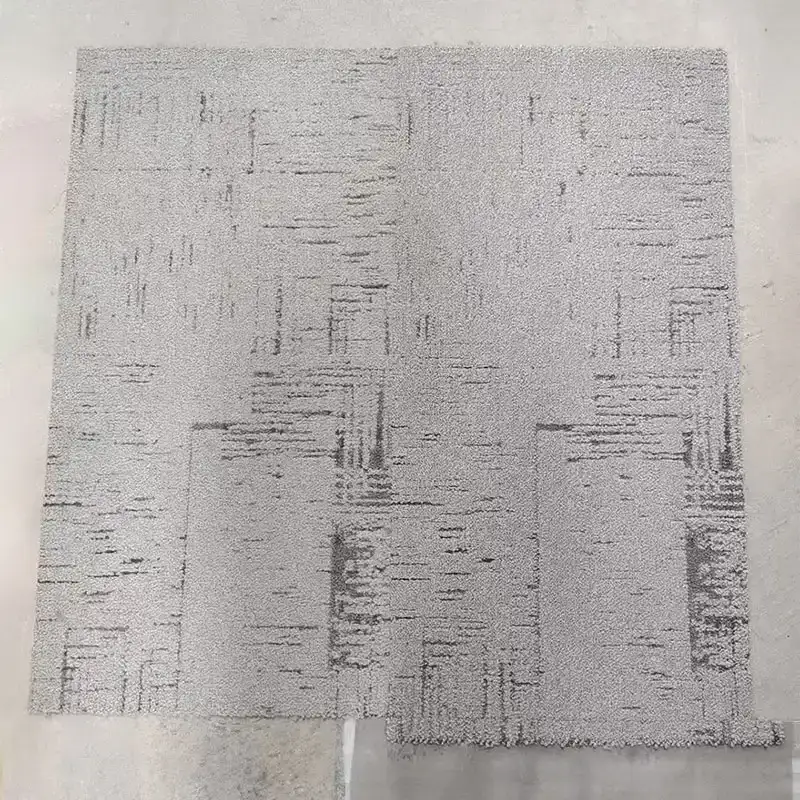
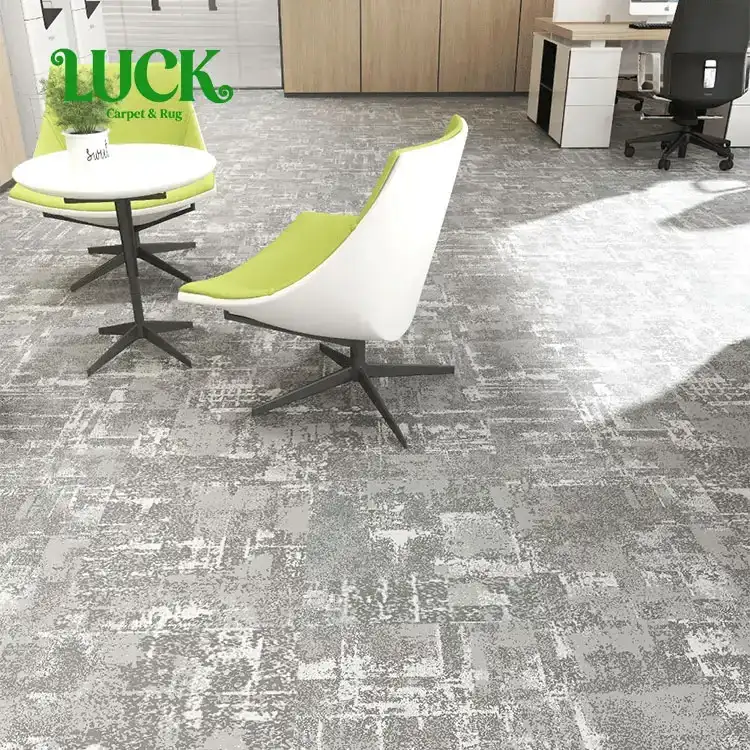
| Style | Printed Cut Pile Carpet Tile |
| Yarn type: | Nylon/Polyester |
| Pile Height: | 5mm |
| Pile Weight: | 600g/㎡ |
| Backing: | PVC/PE/Eco-friendly Backing |
| Fire Resistance: | Bfl-S1 |
| Application | Office / Corporate / Retail / Showroom |/School |
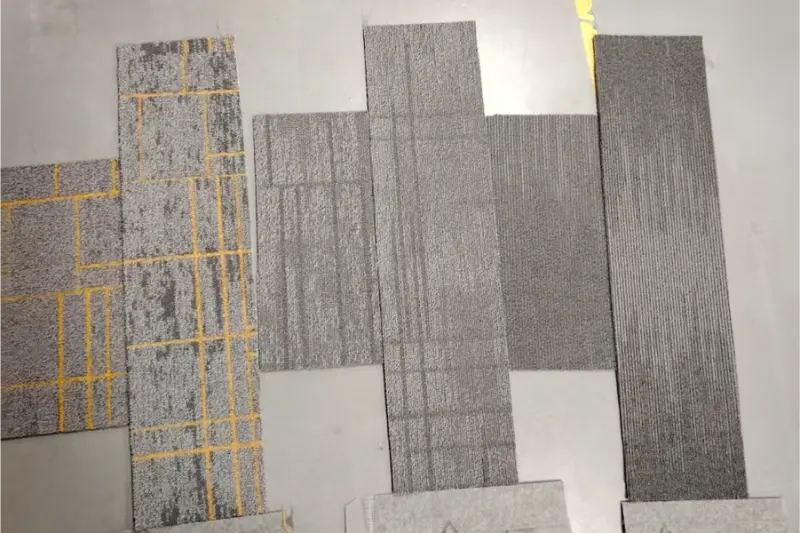
| SIze | 50cm50cm/25cm100cm/Custom |
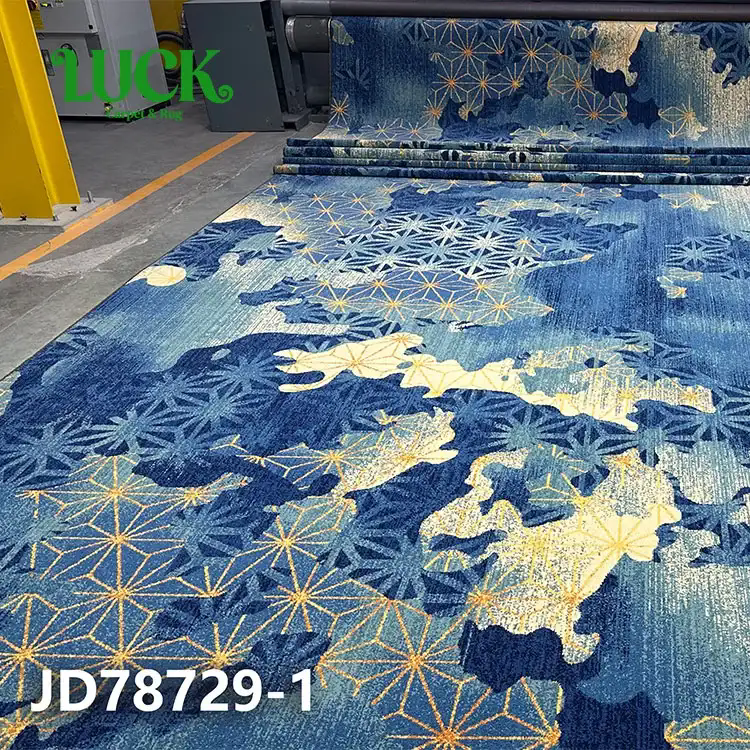
| Pattern | Custom Design Available |
| Surface Pile | Cut pile |
One question we hear regularly from our clients is some version of this: Why does one carpet tile cost significantly more than another when they look nearly identical in the catalog or on a sample board? The answer almost always lies in the materials, particularly the backing system and the quality of the intermediate layers. In this section, we want to share what we’ve observed over years of producing carpet tiles across different price points, and how those differences translate into real-world performance.
Let’s begin with the face fiber, because that is where people naturally look first. In premium printed cut pile carpet tiles, the face yarn is typically nylon 6, 6, a material recognized across the flooring industry for its superior resilience and crush recovery. Nylon 6, 6 has a higher melting point and greater tensile strength than nylon 6, which means it retains its appearance longer in high-traffic corridors and under heavy furniture. It also accepts printed dyes with excellent color saturation and wash fastness, so the design stays vivid through years of cleaning. Value-oriented tiles, on the other hand, frequently use nylon 6 or, in some cases, polypropylene fiber. Nylon 6 performs quite well in moderate-traffic settings and offers a meaningful cost saving over nylon 6, 6. Polypropylene is the most affordable face fiber option, and while it provides good stain resistance due to its inherent hydrophobic nature, it lacks the resilience and abrasion resistance of nylon. Over time, polypropylene pile tends to mat down more readily, and its lower melting point limits the thermal setting processes that give nylon cut pile its springy recovery.
Moving below the surface, the precoat layer represents another area where cost reduction can quietly affect durability. Higher-grade carpet tiles use a generous application of high-solids latex precoat, thoroughly saturating the tuft bases and creating a tenacious bond between the yarn and the primary backing. In budget constructions, the precoat may be applied at a lower weight or formulated with a higher proportion of fillers such as calcium carbonate. The immediate visual difference is imperceptible, but after months of vacuuming and foot traffic, the lower precoat weight can lead to progressive fiber shedding and tuft pull-out, particularly along cut edges and in pivot areas around desk chairs.
The fiberglass reinforcement layer is perhaps the most critical component for long-term dimensional stability, and it is also one of the easiest layers to skimp on. A proper fiberglass mat, evenly distributed at an adequate weight and well-bonded within the polymer matrix, keeps the tile flat and dimensionally stable across a wide range of temperature and humidity conditions. We have seen carpet tiles that omit the fiberglass layer entirely or replace it with a lightweight spunbond fabric. Such tiles may look acceptable immediately after installation, but within a few seasonal cycles, they can develop curling edges, doming, or gaps between adjacent tiles. For a facility manager responsible for a commercial building, those small gaps become a maintenance headache and a potential trip hazard. It’s a classic case of short-term savings leading to long-term costs.
Now let’s turn to the backing layer, where the material differences are most pronounced and where budget decisions have the biggest impact. PVC backing, based on polyvinyl chloride compounded with plasticizers and fillers, remains the dominant choice in many markets. It offers good flexibility, strong adhesion to subfloors, and resistance to moisture and microbial growth. A properly formulated PVC backing can deliver a service life of 10 to 15 years in a typical commercial environment. However, not all PVC backings are equal. Some manufacturers reduce costs by loading the PVC compound with high levels of calcium carbonate filler. When flexed during installation or rolled for shipping, overly filled PVC can crack or develop stress fractures that propagate over time. PVC also carries environmental considerations regarding its end-of-life disposal, though recycling infrastructure for PVC carpet backing is steadily improving in several regions.
Bitumen backing, composed of modified bitumen blended with polymers and mineral fillers, has been a staple in the European carpet tile market for decades. Bitumen-backed tiles tend to be heavier and denser, which provides excellent acoustic damping and a substantial feel underfoot. They also offer a cost advantage because bitumen is generally less expensive than PVC or polyurethane on a per-kilogram basis. The environmental case for bitumen is worth noting as well: bitumen can be recycled and, in some European countries, over 90 percent of carpet tiles use bitumen backing for this reason. The trade-off is that bitumen is less flexible than PVC at room temperature. When bitumen-backed tiles are bent sharply during installation, the backing can exhibit micro-cracking, and they are more demanding in terms of subfloor flatness. If the substrate is uneven, bitumen tiles are more prone to edge lift and corner curl than their PVC counterparts.
Polyurethane backing sits at the higher end of the market. PU-backed carpet tiles use a chemically cross-linked polyurethane foam or elastomer that provides outstanding resilience, a softer and more comfortable feel underfoot, and superior acoustic insulation. PU backings are inherently flexible and remain so across a broad temperature range, which makes them forgiving during installation and resistant to cracking over the tile‘s lifetime. From an environmental standpoint, polyurethane has an advantage in that it can be recycled through chemical or mechanical processes, and it does not contain the chlorinated compounds associated with PVC. The disadvantage is cost: polyurethane backings are the most expensive of the three common systems, and that premium is reflected in the final tile price. For projects where budget is the primary constraint, PU-backed tiles may be difficult to justify, but for high-end corporate interiors, hospitality settings, or healthcare facilities where acoustic comfort and long-term durability are top priorities, the investment often pays off.
Beyond the backing chemistry, other material decisions affect the price-performance equation. The secondary backing fabric, if present, can be a simple spunbond polyester or a heavier needle-punched nonwoven. The density and weight of this layer influence the tile‘s overall stability and its compatibility with raised-access flooring systems. The printing technology itself also varies: high-end production lines use multi-pass digital printers with precise color calibration, while budget lines may use lower-resolution systems or rotary screen printing that cannot reproduce the same level of detail.
What we encourage our clients to do is look at a carpet tile not as a commodity defined by face weight and pattern, but as an engineered system of interdependent layers. The face fiber gets the attention, but the backing, the reinforcement, and the precoat determine whether the tile will still look good and perform reliably after years of use. A carpet tile that saves a few dollars per square meter at the point of purchase but requires replacement three or five years sooner is rarely a bargain. In our production, we focus on getting the balance right for each market segment: offering value-conscious options that do not compromise on the essentials, and premium configurations where every layer is optimized for maximum longevity and comfort. We are always happy to discuss these material choices with anyone who is specifying a project, because we believe that informed decisions lead to better outcomes, and better outcomes are what keep our clients coming back.
Address
Shidaigongguan Building No.5 Office 1212, Haicheng east road, Duanzhou District, Zhaoqing City, Guangdong Province, China
Tel
Copyright © 2026 Zhaoqing Yunle International Trade Co., Ltd. All Rights Reserved.